Showing posts with label animal escapes. Show all posts

Friday, 14 June 2019

14 lions on the loose in South Africa, with nowhere to go


JUNE 7, 2019
A pride of 14 lions is on the loose near a mining community bordering South Africa's Kruger National Park, officials said Friday, and warned members of the public to be alert.
The lions have been spotted roaming around the Foskor phosphate mine outside the town of Phalaborwa on the western boundary of the famed wildlife park, which is fenced in.
But a disagreement broke out what to do with the big cats, which are being monitored by a team of rangers until a new home is found where they cannot run into humans.
Officials from the Limpopo provincial government said the lions had escaped from the Kruger park and should be taken back.
But a Kruger spokesman said the big cats were not from the park and could not be moved there as well-established prides would drive them out.
"The widely reported pride of lions seen recently in the mining area outside Phalaborwa is not a known pride from the Kruger National Park," spokesman Ike Phaahla said in a statement, adding this meant they were the responsibility of provincial authorities.

Monday, 29 April 2019

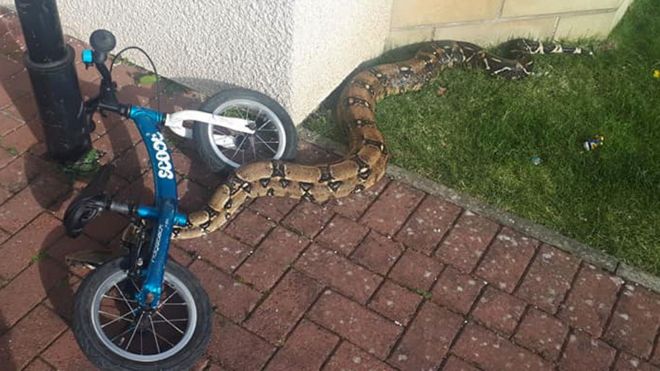
Dad's shock after children find boa constrictor in garden - via Richard Muirhead


23 April 2019


Image copyrightBRUCE BAKER

A father has spoken of his shock after his children found a seven-foot boa constrictor in their garden.

Bruce Baker thought the youngsters were playing a prank when they told him to come and see the 2.1m-long snake.

He and a neighbour had to coax the boa constrictor into a plastic box until the Scottish SPCA arrived at his home in the Scottish Borders.

Efforts are continuing to try and trace the owner of the stray snake, which was captured in Innerleithen on Sunday.

The boa constrictor, which is thought to be an escaped pet, has been taken to the Scottish SPCA rehoming centre in Edinburgh.

Monday, 11 February 2019

Red panda that escaped from Belfast zoo is found


Zoo says animal has been returned to its home after going missing on Sunday
Press Association
Mon 28 Jan 2019 12.22 GMTFirst published on Mon 28 Jan 2019 08.14 GMT
A red panda that went missing from Belfast zoo has been found. 
Police in the Northern Ireland capital said the animal went missing on Sunday and was “believed to be currently taking in the sights of beautiful Glengormley”, referring to an area near Belfast.
Police had asked the public not to approach or attempt to capture the animal.
Officers said: “Our curious friend has not yet learned the green cross code, so if motorists could also be vigilant.”
On Monday the zoo tweeted: “We are happy to report that the missing red panda has been located and is being returned to its home at Belfast zoo. Thanks to everyone for their help with the search!”
Two panda cubs were born at the zoo last June, but only started to venture outside towards the end of the year.
According to the International Union for Conservation of Nature, the red panda is facing a very high risk of extinction.


Thursday, 17 January 2019

Runaway leopard returns to Indian park after escape


January 5, 2019
 Official estimates suggest there are between 12,000 and 14,000 leopards in India
A runaway leopard which escaped from an safari park in eastern India on New Year's Day has been recaptured after a massive search operation, an official said Saturday.
Wildlife authorities had deployed drones, trained elephants and set up traps with live bait to find the big cat after it escaped the park located in the foothills of the Himalayas, 557 kilometres (346 miles) north of Kolkata, capital of West Bengal.
The four-year-old beast nicknamed Sachin finally returned to its enclosure in the park late Friday, after a days' long hunt.
Nearly 100 foresters were pursuing the cat after its escape sparked panic in local villages.
"Sachin had been raised in captivity and could not hunt to feed itself," Vinod Kumar Yarad of the West Bengal Zoo Authority told AFP. "We kept a large chunk of meat inside the leopard's enclosure with its gate left open. On Friday night, it returned to its enclosure, injured and hungry," he said
Yarad said the cat was raised in captivity and lacked the ability to hunt in a wild, and had probably suffered injuries in an attempt to kill a wild boar or some other animal.
The animal is being treated for its injuries.


Sunday, 30 December 2018

Think Keeping Up With Your Dog Is Tough? Try a Pet Tortoise - via Herp Digest


The hardy reptiles are escape artists, capable of evading enclosures and law enforcement; ‘I put on my lights. He kept going’ 
By Kathleen Hughes, Wall Street Journal, 12/11/18 
Biz Stone, the co-founder of Twitter, discovered last March that the family’s pet Russian tortoise, Roshi, had escaped from their yard in Marin County, Calif. 
Mr. Stone’s wife, Livia, had put Roshi on the grass under a mesh tent to protect him from their new Black Labrador puppy while she moved their chickens out of the coop. 
“In those five minutes,” says Mr. Stone, “Roshi managed to dig out, boogie to the edge of the property, and get under the fence. 
The couple needed to break the news to their 6-year-old son, Jake. “Let’s not freak out,” suggested Ms. Stone, as they searched in vain for the rescue tortoise they had kept for 15 years. “Let’s say Roshi went on a grand adventure.”
Eight months later, Jake, now 7, was in a gardening class in school, not far from the house, when someone said, “Oh look, a tortoise!” 
It was Roshi, eating the clover. “That’s my tortoise!” said Jake, who spotted the familiar three white splotches on his shell. “Incredible!” tweeted Mr. Stone in October. “Roshi is back after a grand adventure.”
 Aesop’s fable, it seems, may have sold the tortoise short. Tortoises and turtles of all types have soared in popularity as pets. It turns out they are resilient escape artists with long lives—and surprisingly adept at outmaneuvering their owners.
“Tortoises can walk really fast and get really far away,” says Susan Tellem, executive director at American Tortoise Rescue in Malibu, Calif. “They have nothing to do all day but figure out how to escape.”

Tortoises have been breaking out of fenced yards, heading down sidewalks and crossing busy streets at a good clip—leaving heartbroken owners and bewildered bystanders to post lost and found photos on social media.
Speeds vary by tortoise, experts say, but one British tortoise, Bertie, was clocked at a pace of .92 feet per second, which made him the Guinness World Record holder as fastest tortoise. 
Many owners never research the challenge of building a truly secure outdoor habitat. “Tortoises can scale a 6-foot fence and dig a 20-foot burrow,” warns James Liu, managing director of the Turtle Conservancy in New York. A tortoise on the run could be seeking a mate, heading out to lay eggs or foraging for food, he adds. 
There could be as many as a million pet tortoises in California, according to the Tortoise Group, a Las Vegas nonprofit focused on the welfare of the desert tortoise. The group estimates there are more than 188,000 tortoises in captivity in the greater Las Vegas area alone. That rivals the number of wild tortoises roaming free in the Mojave Desert, says Kobbe Shaw, the executive director of the Tortoise Group, which sponsored a study on captive tortoises. 
Those who start with a cute little baby tortoise from a pet store, particularly if it is an expensive Sulcata, are often shocked as it grows to more than 100 pounds. And many tortoises have lifespans of well over 60 years. While some may break free, others are eventually dumped. Some are stolen. 
“We get 1,500 calls a year about abandoned tortoises,” says Mr. Shaw who drives around Las Vegas picking up lost and found tortoises in his gray Honda Accord, with an odometer that has passed 250,000 miles. 
The escapees are considered a threat since pet tortoises can carry diseases that can wipe out vulnerable wild tortoises.
Consider Tortle, a 50-pound pet Sulcata tortoise the size of two basketballs. 
Three years ago, Ronna Rodarte, who works with special-needs children in Lancaster, Calif., came home to find traffic stopped in both directions. Tortle had exited her front yard, probably through an open gate, making it to the center yellow line of the boulevar
“The traffic travels at 70 miles per hour,” she says. “It was wonderful to see how many people stopped.” Ms. Rodarte put a padlock on the gate. This year, the day after Thanksgiving, Tortle went missing again. He failed to show up for meals, and Ms. Rodarte searched his burrow, which curves out of sight.
“I’m 200 pounds and I almost made it into the burrow,” says Ms. Rodarte. But since she didn’t fit, she rigged a mirror to a curtain rod and dropped a flashlight down using a dog leash. The burrow was empty. 
After days of searching, the family finally spotted Tortle. He had scaled a tall display case in the yard, becoming wedged between a chain-link fence and a heap of furniture and appliances covered with a tarp. 
Ms. Rodarte is considering finding Tortle a safer home, fearing that her family members don’t take his security seriously. “No one loves that tortoise like I love him. 
Last month, Alicia Chavez, a medical assistant in Peoria, Arizona, went to work, leaving Bubba, her 40-pound Sulcata tortoise in the front yard. Her brother-in-law called at 5 p.m. to say the gate was open. Bubba was gone. 
“When we called his name and he didn’t show up, we knew something was wrong,” says Ms. Chavez. “We were panicked.” The family put up fliers and searched the neighborhood. 
Ms. Chavez posted Bubba’s photo on the Tortoise & Turtle Lost & Found page of Facebook . Ten minutes later, Peoria Police Animal Control officer Megan Smith called to say she caught Bubba after he was spotted crossing the street near City Hall. 
“I could see his little bottom tail walking,” the officer says. “I put on my lights. He kept going. He was heading to the alley.”
Ms. Smith stopped her truck and got out. ”I ran and grabbed him,” she says. “He was unusually fast for a tortoise.” 
The family retrieved Bubba at the police station.
“I don’t think he would have come back on his own,” says Ms. Chavez. “Bubba just likes to be on the go.” 
Last week, Ms. Chavez tried to create a more secure area for Bubba by placing cinder blocks around a doghouse.

Thursday, 13 December 2018

Boa constrictor on the loose in Lincolnshire


Police have warned people not to approach the snake, which escaped from its owner’s home in Boston
Press Association
Thu 29 Nov 2018 06.27 GMTLast modified on Fri 30 Nov 2018 00.35 GMT
A boa constrictor has been reported missing from a house in Lincolnshire.
Police have warned the public not to approach the snake, which has a white tail and grey, black and brown spots.
It was reported missing from its owner’s house in Union Street in Boston at about 7pm on Wednesday.
The snake is not venomous but boa constrictors attack prey with their teeth and then constrict it until they die.
Lincolnshire police have warned that it is likely to find somewhere warm, so could be in an area such as a garden shed. They have instructed anyone who sees the snake to call 999 quoting incident 361.

Sunday, 9 September 2018

An 18-Foot Fugitive Python Is on the Loose in Poland


By Mindy Weisberger, Senior Writer | August 29, 2018 03:17pm ET
For nearly two months, a slippery fugitive has evaded capture in the Polish countryside. Nicknamed Bertha, she followed a serpentine path to escape her seekers' best efforts.
You might say that she slithered right through her would-be captors' hands.
Bertha is a rogue Indian python (Python molurus molurus), though few of those looking for her have actually seen her. Animal Rescue Poland (ARP) received reports on July 7 of shed snakeskin found near the Vistula River south of Warsaw that measured nearly 7 feet (2 meters). When ARP investigated the high grass closer to the river, they found a second piece of molted skin measuring about 16 feet (5 m), suggesting that the snake could be as long as 20 feet (6 m) from nose to tail tip, according to an ARP blog post. [Photos: Giant Pythons Invade Everglades]


Monday, 6 August 2018

Why an Escaped Jaguar Went on a Killing Spree at New Orleans Zoo


By Laura Geggel, Senior Writer | July 16, 2018 03:37pm ET

Nine animals have died since an escaped jaguar attacked them at the Audubon Zoo in New Orleans on Saturday (July 14). But the jaguar didn't actually eat the animals — including red foxes, alpacas and an emu — so why did it attack so many?

The answer? The 3-year-old male jaguar likely went into a mode known as "surplus killing," in which a predator kills more prey than it can possibly eat at one time, said Howard Quigley, executive director of the jaguar program at Panthera, a global wildcat-conservation organization, who isn't involved with the jaguar at the Audubon Zoo.

"It just means that they go into a kind of excess killing mode," Quigley told Live Science. "There's evidence of mountain lions getting into sheep pens and killing 20 or 30 sheep. When they get the fight reaction, they go and make the kill, and if there's another accessible prey, they go and make the kill again." [On the Lam: 10 of the Greatest Animal Escape Artists]


Monday, 6 November 2017

The lynx effect: search for one-year-old Lillith continues in west Wales


Borth Wild Animal Kingdom attracts large crowd of visitors as mother prowls cage while offspring eludes staff and police

Monday 30 October 2017 18.10 GMTFirst published on Monday 30 October 2017 16.53 GMT

Zoo keepers kitted out with thermal imaging equipment, nets and cages baited with rabbit have been scouring a craggy hillside and the gardens of a seaside town in search of a wild cat that made a daring leap for freedom.

Lillith the Eurasian lynx is thought to have climbed a spindly sapling growing in the pen she shared with her mother and two siblings and dived over a 4-metre fence and two electrified wires, possibly as she chased a bird.

The year-old lynx – around twice the size of a domestic cat – has eluded the efforts of staff at the Borth Wild Animal Kingdom in west Wales and those of Dyfed-Powys police, who provided a helicopter to recapture her.

“We’re pretty sure we know roughly where she is,” said Dean Tweedy, who runs the small coastal zoo with wife, Tracy. “It’s a matter of tempting her back. It’s a waiting game. She’s never hunted for herself or ate live food so she’ll soon get hungry if she can’t catch rabbits or rodents.”


Thursday, 12 October 2017

Lovelorn koala nabbed after zoo escape in hunt for mate


October 5, 2017

A handout photo shows Irene the koala, who escaped from her enclosure at the Australian Reptile Park at the start of her first mating season, impatient to find a partner

Australian wildlife staff needed a crane to rescue a lovelorn female koala who escaped from her enclosure at the start of her first mating season, impatient to find a partner.

Irene the koala was discovered missing from her holding yard at the Australian Reptile Park outside Sydney early Thursday, park officials said.

The two-year-old was eventually found stuck in a nearby tree after a "Houdini-style" escape through an opening in her pen, they said.

General manager Tim Faulkner said Irene had only recently reached sexual maturity and this week marked the start of the annual koala mating season.

"It's not the first time we've had a young female koala keen on finding a mate, and it's no coincidence she made her way out of her yard to find a mate's yard," he said.

Park officials insisted Irene's desires would be satisfied, but more prosaically.

She "will be introduced to the correct male after 'selective pairings are made' managed by a stud book," the park said.


Thursday, 19 January 2017

Quokka escapes Rottnest Island on garbage barge, sparking fears for survival


Search under way after marsupial startles recycling centre worker who thought it was a large rat

Thursday 12 January 2017 03.11 GMT Last modified on Thursday 12 January 2017 22.41 GMT

Authorities in Western Australia are searching for a quokka that apparently escaped Rottnest Island in a rubbish bin and reemerged on the mainland, startling a recycling centre worker who thought it was a “large rat”.

Native to WA and famous for smiling happily in selfies, quokkas were largely eradicated on the mainland and survived thanks to a large, isolated population on Rottnest Island, a prison camp turned popular holiday destination off the coast of Perth.

They roam free around the island, which is devoid of both cars and large predators, and authorities fear the escaped quokka will not survive an encounter with these new threats.
Reports of the escapee emerged on 10 January, when a WA man working at the recycling centre in Cannington, in Perth’s southern suburbs, realised the blurry photos of a “large rat” presented by his South African colleague were in fact a quokka.

It is a common mistake: Rottnest got its name from Dutch explorer Willem de Vlamingh who named it Rotte nest, or rat’s nest, in 1696.

Penni Fletcher-Hughes, from Rottnest Island Authority, said it appeared the quokka had climbed into a garbage bin in search of food and was accidentally transferred on to the garbage barge, which took it to Cannington.

“Being as it has got itself in a very good place for food, the chances are it will be fine,” Fletcher-Hughes said. “It just depends where it goes from there.”

Quokka escape was “very unusual,” Fletcher-Hughes said, but finding quokkas in bins is not.
Basically, this quokka is now at large.

“I have seen them climb the walls; they are quite resourceful when it comes to searching for food,” she said. “We are not concerned in terms of him finding food … it’s other threats and just general stress. It’s a bit stressful to suddenly wake up in a recycling centre.”

Wednesday, 19 October 2016

Gorilla recaptured after escape at London zoo


Animal reportedly shot with tranquiliser dart after zoo said it was ‘managing an incident’
Kevin Rawlinson and agencies

Thursday 13 October 2016 18.52 BST Last modified on Friday 14 October 2016 12.01 BST 

London zoo was placed under lockdown on Thursday after a gorilla escaped from its enclosure.
Armed police were called to the central London attraction and visitors were evacuated as keepers tried to recapture the animal.

But Malcolm Fitzpatrick, curator of mammals at the zoo, described the escape of Kumbuka as a “minor incident” in which the male gorilla got into a secure keeper area that was not open to the public. 

Fitzpatrick said the western lowland had been tranquilised before being returned to the Gorilla Kingdom, where he was “up and grumbling and interacting with the rest of his gorilla family”.

He added: “It was a safe, secure keeper area, so at no time did he actually get out into the zoo.

“At no time were any of our visitors in any danger. The gorilla did not get out of the safe space, there were only about 100 visitors, it was the end of the day and I would like to thank all of those visitors for co-operating and moving in to buildings.”

Fitzpatrick said keepers would be staying on into the evening to check up on Kumbuka and giving him his “favourite treats”. 

Related Posts with Thumbnails

ShareThis