Showing posts with label chinook salmon. Show all posts

Sunday, 17 November 2019

Bigger doesn't mean better for hatchery-released salmon

NOVEMBER 15, 2019

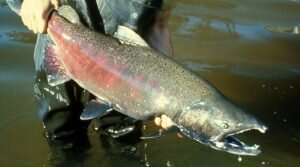
Chinook salmon are also known as king salmon. They depend on healthy estuaries to spawn, which also provide habitat for invertebrates and smaller fish. Credit: U.S. Fish and Wildlife Service.

Fish permeate the culture of the Pacific Northwest (PNW). In particular, the iconic salmon has been an important part of the region for thousands of years, from ancient Native American trade routes and legends to modern fishing and sporting. In the area of the Salish Sea—inland waterways including Puget Sound, the Strait of Georgia, and the Strait of Juan de Fuca—the cultures, economies, and technologies there are all impacted and influenced by salmon. It is no wonder, then, that salmon are of high conservation interest and constitute a large proportion of hatchery-raised fish in the region.

A recent study in the Ecological Society of America's journal Ecosphere examines hatchery practices in regard to how the Chinook salmon that are released back into the natural waterways in the PNW are affecting wild populations.

In the face of changing climate, ocean conditions, freshwater habitat loss, and increased human consumption, many salmon populations in the PNW are depleted relative to historical abundance. A large salmon, for instance, is a prized and sought-after catch for a sport fisher. There is a growing demand for salmon hatcheries to provide food security and to bolster fish populations; many hatcheries release fish after they reach a certain age or size, with a goal of increasing opportunities for commercial, recreational, and indigenous fishers.

Wednesday, 5 December 2018

'We're sounding the alarm': half of Canada's chinook salmon endangered

Prospects for species look dire as federal science body finds that only one of the country’s 16 populations is believed to be stable


Leyland Cecco in Toronto

Wed 5 Dec 2018 09.00 GMTLast modified on Wed 5 Dec 2018 09.02 GMT

Half of Canada’s chinook salmon are endangered, with nearly all other populations in precarious decline, according to a new report, confirming fears that prospects for the species remain dire.

The report by the Committee on the Status of Endangered Wildlife in Canada concluded that eight of the country’s 16 populations are considered endangered, four are threatened, one is of special concern and the health of two remain unknown.

Only one population, which spawns on the Thompson river in British Columbia, is believed to be stable.

“For those of us who have been working on recovering chinook salmon runs in British Columbia, we knew they were in terrible, terrible shape for quite a while now,” said Aaron Hill of Watershed Watch, an organisation that monitors ecosystem health. “It was actually good to see it finally recognised by this federally mandated science body, because this hopefully initiates more serious protection efforts from the government.”

Monday, 12 March 2018

Largest Chinook salmon disappearing from West Coast


Date:  February 27, 2018
Source:  University of Washington

Summary:
The largest and oldest Chinook salmon -- fish also known as 'kings' and prized for their exceptional size -- have mostly disappeared along the West Coast, according to a new study.


Wednesday, 22 November 2017

Recovery of West Coast marine mammals boosts consumption of chinook salmon


November 20, 2017

Recovering populations of killer whales, sea lions and harbor seals on the West Coast have dramatically increased their consumption of chinook salmon in the last 40 years, which may now exceed the combined harvest by commercial and recreational fisheries, a new study finds.
While the recovery of marine mammals represents a conservation success, it creates complex tradeoffs for managers also charged with protecting the salmon they prey on, the study concludes. The U.S. Marine Mammal Protection Act of 1972 protects all marine mammals, including whales and pinnipeds (seals and sea lions) within the waters of the United States. and the Endangered Species Act protects nine West Coast populations of chinook salmon.

The study was published today in the journal Scientific Reports. The findings resulted from a collaboration of federal, state and tribal scientists in the Pacific Northwest, including Oregon State University and NOAA Fisheries. The research was designed in part to understand the pressures on chinook salmon consumed by southern resident killer whales, which in contrast to other killer whale populations are endangered and show few signs of recovery.

Southern residents spend much of the year in the inland waters of Washington and consume about the same volume of salmon today as they did 40 years ago, the study found. The study suggests that, at least in recent years, competition with other marine mammals may be more of a problem for southern residents than competition with human fisheries.

Saturday, 9 June 2012

Too Few Salmon Is Far Worse Than Too Many Boats for Killer Whales

ScienceDaily (June 6, 2012) — Not having enough Chinook salmon to eat stresses out southern resident killer whales in the Pacific Northwest more than having boatloads of whale watchers nearby, according to hormone levels of whales summering in the Salish Sea.

In lean times, however, the stress level normally associated with boats becomes more pronounced, further underscoring the importance of having enough prey, according to Katherine Ayres, an environmental and pet-behavior consultant who led the research while a University of Washington doctoral student in biology. Ayres is lead author of a paper appearing online June 6, in the journal PLoS ONE.
In a surprise finding, hormone levels show that southern resident killer whales are best fed when they come into the Salish Sea in the late spring, Ayres said. The Salish Sea includes Puget Sound and the straits of Georgia, Haro and Juan de Fuca. Once there they get a necessary boost later in the summer while eating Chinook salmon at the height of the Fraser River run.

Related Posts with Thumbnails

ShareThis