Showing posts with label malnutrition. Show all posts

Friday, 3 April 2015

Being born in lean times is bad news for baboons


Date:
April 2, 2015

Source:
Duke University

Summary:
The saying 'what doesn't kill you makes you stronger' may not hold up to scientific scrutiny. Baboons born in times of famine are more vulnerable to food shortages later in life, finds a new study. The findings are important because they help explain why people who are malnourished in early childhood often experience poor health as adults.


Monday, 2 June 2014

Humpback whale strandings in WA: malnutrition a major factor, vets say

An unprecedented number of mostly young whales have become stranded on the West Australian coast since 2008

Australian Associated Press

theguardian.com, Wednesday 28 May 2014 08.40 BST

Poor nutrition has led to a rise in the number of stranded humpback whales on the West Australian coast, veterinary researchers have said.
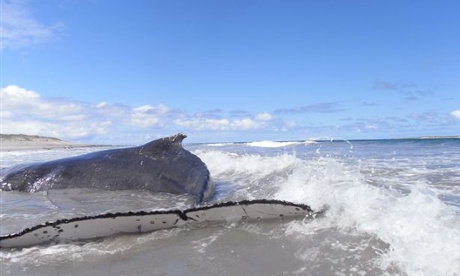
A juvenile humpback whale stranded on a beach
 at Windy Harbour, near Pemberton in WA's
 south-west. Photograph: WA Department of
 Environment and Conservation/AAP

Carly Holyoake, from Murdoch University, at the Australian Veterinary Association's annual conference in Perth on Wednesday, said an unprecedented number of mostly young whales had become stranded on the coast since 2008.

Between 1989 and 2007, the average number of humpback whales coming ashore was two or three, she said.

But in 2008, there were 13 strandings, followed by 46 in 2009 and 16 in 2010.

In 2011, there were 17 strandings involving 14 calves and three juveniles, representing a rise in the number of young whales dying compared with previous years.

Saturday, 14 December 2013

NOAA: 11 Dead Whales Suffered From Malnutrition

SNIPE POINT (CBSMiami/AP) — Eleven of the pilot whales found dead in the Florida Keys were found to be emaciated and suffering from malnutrition, according to federal officials Monday. 

National Oceanic and Atmospheric Administration stranding coordinator Blair Mase said the whales’ empty bellies could be a result of disease or of being out of the deep, cooler waters that form their natural habitat.

“Really we don’t know how long they’ve been in the area and we don’t have any clues of why they got here in the first place,” she said in a conference call with the media. It could be weeks to months before the results of the necropsies come in, she said, and “there is a possibility there could be more whales in the area.” 

Related Posts with Thumbnails

ShareThis
