Showing posts with label Western Australia. Show all posts

Friday, 27 September 2019

Eat your heart out: Native water rats have worked out how to safely eat cane toads


SEPTEMBER 23, 2019

by Marissa Parrott and Simon Clulow, The Conversation
Water rats in Western Australia are safely hunting cane toads. Author provided
Australia's water rats, or Rakali, are one of Australia's beautiful but lesser-known native rodents. And these intelligent, semi-aquatic rats have revealed another talent: they are one of the only Australian mammals to safely eat toxic cane toads.
Our research, published today in Australian Mammalogy, found water rats in Western Australia adapted to hunt the highly poisonous toads less than two years after the toads moved into the rats' territory.
The rats, which can grow to over 1kg, are the only mammal found to specifically target large toads, neatly dissecting the toads to eat their hearts and livers while avoiding the poisonous skin and glands.
Water rats
Water rats are nocturnal and specially adapted to live in waterways, with webbed feet and soft water-resistant fur. Their fur is so impressive there was once a thriving water rat fur industry in Australia.
They can be found in lakes, rivers and estuaries, often living alongside people, in New South Wales, Queensland, Tasmania, South Australia, far north and southwest Western Australia, the Northern Territory, and Victoria, where they can even be seen along St Kilda Pier.

Thursday, 7 February 2019

Cane toads: What they do in the shadows


January 21, 2019, Macquarie University
Cane toads are picking up some shady habits, according to a new study co-authored by a Macquarie University researcher.
Toads in Western Australia have been spotted awake and active during the day in deeply shaded habitats, despite the species usually being nocturnal in Australia and other parts of the world.
However nearby cane toad populations at more exposed sites remained only active at night.
"We didn't expect them to change such a fundamental behaviour," says Dr. Simon Clulow from Macquarie's Department of Biological Sciences. "Particularly given their nocturnal neighbours were only four to seven kilometres away."
"This suggests that cane toads are particularly good at changing their behaviour in response to their environment, something known as behavioural plasticity, which might assist their invasive spread into new environments."
The research, which was published in Scientific Reports overnight, looked at cane toad populations near the invasion front in El Questro Wilderness Park in WA's Kimberley region from 2013 to 2015. It's research that has consequences for managing Australia's cane toad plague.
The toads first arrived at the sites studied in 2012 or 2013.

Monday, 13 August 2018

Two new peacock spiders identified in Western Australia


Biologist Jürgen Otto and colleagues have named two species of the extraordinarily colourful dancing spiders

Sat 21 Jul 2018 23.14 BSTLast modified on Sun 22 Jul 2018 03.25 BST

It is only a few millimetres in size, performs a dance as part of a courtship ritual and has striking coloured markings on its back that “look like a pharaoh’s headdress”.

But when biologist Jürgen Otto first spotted the peacock spider species he has named Maratus unicup, he didn’t immediately recognise how special it was.

“I didn’t think much of it because I’m partially colour blind,” he says. “But there was quite a reaction to photographs of it on the internet, with people saying it’s beautiful.”

Otto discovered the spider near Lake Unicup in Western Australia last year. He said the new species was notable for its courtship display in which the male dances – swinging its abdomen from side to side – while the female watches from a close distance.


Sunday, 28 May 2017

Giant octopus suffocates foolhardy dolphin that tried to eat it

25 May 2017

by Alice Klein

A dolphin in Western Australia has bitten off more than it can chew. An attempt to eat a large octopus turned fatal when its airway was obstructed by a mass of tentacles.

The Indo-Pacific bottlenose dolphin – known as “Gilligan” to researchers in the area – was found dead on Stratham Beach near the port city of Bunbury in August 2015. Octopus arms were seen hanging out of the side of its mouth.

A post-mortem examination revealed one octopus tentacle extending down the dolphin’s oesophagus, and the other seven stuck in the back of its throat. The tentacle suckers were gripping the throat walls and had blocked off the airway, causing the dolphin to suffocate.

The tentacles belonged to a Maori octopus (Macroctopus maorum), the largest species of octopus found in Australian waters and the third largest in the world.

It is not unusual for bottlenose dolphins to feed on octopuses, but they normally break the body and tentacles into smaller pieces first using a “shake-and-toss” method. Shaking the octopus helps to kill it and tear it apart, while tossing prevents it from latching on and also weakens the suckers.

Down in one
Gilligan’s downfall was trying to swallow the 2.1-kilogram octopus whole without proper preparation, says Nahiid Stephens at Murdoch University in Perth, Western Australia, who performed the post-mortem. “We assume it simply wasn’t broken up adequately,” she says.

Continued

Friday, 16 September 2016

First live quoll found in WA's largest national park in 50 years - via CFZ Australia

BY Shannon Verhagen |
September 15, 2016
It’s the first sighting from traditional owners since the 1960s and the first European record of the species in the area.

FOR THE FIRST time in over 50 years, a northern quoll has been captured in Karlamilyi – Western Australia’s largest and most remote national park.

The historic find comes after a joint survey effort between Kanyirninpa Jukurrpa (KJ) Punmu and Parnngurr ranger teams and Department of Parks and Wildlife (DPAW) scientists earlier this month.

Located in the Pilbara, in the heart of Martu country, the park was once home to quolls – called wiminyji by the traditional owners – however they had not been seen since traditional life was disrupted around 50 years ago.

“They recall seeing wiminyji throughout the Karlamilyi region when they were living a traditional life in the area, which was as recent as the early 1960s,” said Gareth Catt, fire management officer for KJ.
 

Sunday, 28 August 2016

Sluggy McSlugface no more: sea slug named for fly-in, fly-out mining workers


Multicoloured slug, a species of nudibranch, was discovered in 2000 off the Western Australian coast and will be officially named Moridilla fifo


Monday 22 August 201605.51 BSTLast modified on Monday 22 August 201606.15 BST

A multicoloured sea slug discovered off the coast of Western Australia has been named for the state’s fly-in, fly-out mining workforce after a judging panel ruled that Sluggy McSlugface breached the International Code of Zoological Nomenclature.

The slug, which is a species of nudibranch, was discovered in 2000 off the coast of Dampier, about 1,500km north of Perth, by the WA scientist Dr Nerida Wilson.

Wilson will apply for it to be officially named Moridilla fifo after a public competition to name the nudibranch received more than 4,500 entries.

A significant number of those entries suggested either Sluggy McSlugface or Nudie McNudeface, but Dr Amber Beavis, who was on the judging panel, said that breached international rules against “frivolous” scientific names, as well as a few other regulations.

 “Sluggy McSlugface – there’s no way to Latinise that,” Beavis said. “You can do the ‘sluggy’ bit but to get the spirit of that would be impossible.”

Beavis said Moridilla fifo was the clear winner after Patrick Dwyer made a compelling argument likening the nudibranch’s toxic secretions to the transient workforce.

The logic, as explained by Dwyer, is that nudibranches eat jellyfish and other animals with stingers and then secrete those same toxins out of its cerata, the blue and orange sausage-shaped appendages that line its back, as a form of self-defence. Fly-in fly-out (fifo) workers, Dwyer told Radio National, were similarly “an important resource also brought in from elsewhere”.

Tuesday, 22 December 2015

Scientists discover rare sea snakes, previously thought extinct, off Western Australia

Date: December 21, 2015
Source: ARC Centre of Excellence in Coral Reef Studies

Scientists from James Cook University have discovered two critically endangered species of sea snakes, previously thought to be extinct, off the coast of Western Australia.

It's the first time the snakes have been spotted alive and healthy since disappearing from their only known habitat on Ashmore Reef in the Timor Sea more than fifteen years ago.

"This discovery is really exciting, we get another chance to protect these two endemic Western Australian sea snake species," says study lead author Blanche D'Anastasi from the ARC Centre of Excellence for Coral Reef Studies at JCU.

"But in order to succeed in protecting them, we will need to monitor populations as well as undertake research into understanding their biology and the threats they face."

The discovery of the critically endangered short nose sea snake was confirmed after a Western Australia Parks and Wildlife Officer, Grant Griffin, sent a photo of a pair of snakes taken on Ningaloo Reef to Ms D'Anastasi for identification.

"We were blown away, these potentially extinct snakes were there in plain sight, living on one of Australia's natural icons, Ningaloo Reef," says Ms D'Anastasi.

"What is even more exciting is that they were courting, suggesting that they are members of a breeding population."

The researchers also made another unexpected discovery, uncovering a significant population of the rare leaf scaled sea snake in the lush seagrass beds of Shark Bay.

Monday, 13 April 2015

Quokka survives alleged attempt by French tourists to light it on fire

Two men, aged 18 and 24, will face court on animal cruelty charges after police seized a video of the alleged attack on the marsupial on Rottenest Island near Perth


Sunday 12 April 2015 03.38 BST
Last modified on Sunday 12 April 201503.57 BST

Two French tourists have been evicted from Rottnest Island, a popular holiday spot 20km off the coast of Perth, Western Australia, for allegedly attempting to light a quokka on fire.
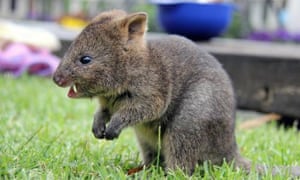
A quokka joey. WA police say two men
 aimed lit a stream of aerosol aimed 
at a quokka on Rottnest Island, 
which was singed during the alleged 
attack. Photograph: Taronga Zoo/PR

WA Police spokeswoman Ros Weatherall said the men, aged 18 and 24, allegedly lit a stream of aerosol on fire and aimed the jet of flame at a quokka on April 3.

Weatherall said the animal was allegedly singed during the incident.

It’s understood the quokka was not badly injured and managed to run off. It has not received veterinary treatment.

The men have been charged with animal cruelty and bailed to appear in Fremantle magistrates court on Friday.

Tuesday, 31 March 2015

WA shark policy allowing killing of great whites will not be reviewed

Environmental Protection Authority says exemption allowing use of drumlines in case of a ‘serious threat’ is unlikely to significantly affect the environment


Monday 30 March 2015 20.23 BST

The Environmental Protection Authority will not review Western Australia’s policy of using drumlines to catch sharks that pose a “serious threat” because it is unlikely to have a significant effect on the environment, the authority’s chairman has said.

WA Greens MP Lynn MacLaren referred the policy to the EPA in January.

It grants fisheries officers an exemption to kill great white sharks, which are protected under federal laws, in the event of a shark attack or when a “high hazard” shark is reported to have a continuous presence near a popular beach.

The definition of a high hazard shark incident was broadened last year when the “imminent threat” policy, introduced in 2012, was rebadged as a “serious threat”.

Conservationists said the new policy could potentially kill more great white sharks than the now-defunct shark cull, which caught 172 sharks before the EPA declared it environmentally unacceptable and it was dumped.

Wednesday, 18 February 2015

Traffickers caught with Australian reptiles hidden in luggage

Two separate operations by State and Commonwealth authorities have thwarted the attempted trafficking of hundreds of Western Australian native animals.

Four men have been arrested and charged with animal trafficking in a joint investigation by the Australian Customs and Border Protection Service (ACBPS) and the Western Australia (WA) Department of Parks and Wildlife.

Two men from Russia and two from the Czech Republic were arrested by ACBPS officers at Perth International Airport after the discovery of more than 150 reptiles and amphibians allegedly hidden in hollowed out books and cigarette packets contained in packages posted from Australian addresses to European destinations.

Two of the men also allegedly had reptiles hidden in their luggage at the airport.

Parks and Wildlife officers identified 157 skinks, geckos, frogs, pygmy pythons, a dead death adder, a number of invertebrates and 33 dead reptiles which appear to have been tagged for use as specimens.

Friday, 23 January 2015

Just one surf club supported Australia's shark cull

No Great Whites have been caught in the cull

Just one local surf club supported Western Australia’s controversial shark cull The Australian Guardian has reported.

The newspaper was shown documents relating to the 23 stakeholders, including government departments and Surf Life Saving WA, consulted about the ban, which showed just one, The Margaret River boardriders club, supported all aspects of the proposed cull.

The Government records show 41 groups were consulted about the proposal in December 2013 and after a four-month freedom of information application process lawyers for Sea Shepherd were given documents relating to 23 organisations the charity believed would support the policy. 

Thursday, 8 January 2015

Two children, six and 10, survive stings by Irukandji jellyfish on WA beach

Health officials say the intense pain generated by the Irukandji’s sting raises the victim’s blood pressure which can lead to death


theguardian.com, Wednesday 7 January 2015 06.23 GMT

Two children have been treated for the sting of a tiny jellyfish known for producing “a sense of impending doom” in its victims.

The children, a six-year-old girl and a 10-year-old boy, were stung by Irukandji jellyfish at Honeymoon Cove beach in far-north Western Australia on New Year’s Day and 4 January respectively.

A spokesman for the WA Country Health Service said both were taken to the emergency department of the Nickol Bay hospital and “responded well” to treatment.

Jamie Seymour, an associate professor from James Cook University and recognised expert in venomous Australian animals, said symptoms from the sting of the thumbnail-sized jellyfish take 20 minutes to develop and “range from a mild headache to death”. Usually, though, they present as “intense, overall pain”.

“[People get] stomach cramps, nausea, vomiting and pain coming in waves,” Seymour said. “But it’s not a wave that comes and goes, it’s a wave that builds up. It’s progressive. It peaks, and peaks again, and peaks again.”

Wednesday, 31 December 2014

WA shark cull: Colin Barnett defends catch-and-kill policy for 'serious threat'

Anti-cull campaigners describe order to kill shark believed responsible for a fatal attack on a teenager near Albany as a ‘revenge killing’


Tuesday 30 December 2014 04.45 GMT

The West Australian premier, Colin Barnett, has defended his government’s catch-and-kill policy for sharks deemed to pose a “serious threat”.

The No WA Shark Cull group has described the order to kill a great white believed to be responsible for an attack that killed a teenage boy near Albany on Monday as a “revenge killing”.

Addressing the media in Perth on Tuesday, Barnett said the policy was justified by the large number of shark attacks in West Australian waters in recent years, saying “eight fatalities in four years is proof enough”.

On Monday 17-year-old Jay Muscat from Albany died near Cheynes beach, which is about 65km east of the south coast town, after he was bitten on the leg by a large shark.

He had been spearfishing with fellow local teenager Matt Pullella, who told authorities he shot his speargun in the mouth of a great white shark after it bit his friend.

Sunday, 23 November 2014

‘Extinct’ spectacled hare-wallaby spotted in Western Australia

Conservationists thrilled after threatened marsupial seen in Kimberley region for the first time in a decade

Australian Associated Press

Sunday 23 November 2014 07.09 GMT

A marsupial feared locally extinct has been again spotted in Western Australia’s Kimberley region, thrilling scientists and conservationists.

The threatened spectacled hare-wallaby was recently rediscovered near Broome after nearly a decade without any recorded sightings.

Using camera traps, Yawuru country managers and WWF-Australia captured images of the marsupial during its nightly forage.

The sensor cameras were set up as part of a survey on Yawuru-owned Roebuck Plains Station where the species was last sighted in 2004.

The wallaby, named from the distinctive orange fur that surrounds each eye, is considered very rare in the Kimberley region.

Sunday, 26 October 2014

WA abandons shark culling program, but reserves right to kill again

Western Australia’s premier, Colin Barnett, announces application for baited drum line approval has been withdrawn


theguardian.com, Friday 24 October 2014 04.11 BST

The Western Australian government has conceded defeat over its plan to systematically trap and kill large sharks near popular beaches, after scrapping a proposal to implement the strategy over the next three years.


Colin Barnett, the WA premier, confirmed on Friday that WA had withdrawn its application to the federal government for the shark culling to go ahead.

However, WA has struck an agreement with the federal government that will enable it to implement the policy without approval from Canberra in emergency situations of “imminent shark threat”. This will mean the capture of any shark that is “posing a threat” or that has just attacked someone.

Sunday, 14 September 2014

Shark cull rejected by Western Australia Environmental Protection Authority

No baited drumlines will be set this summer after concerns over program’s impact on great whites leads to EPA recommendation


theguardian.com, Thursday 11 September 2014 09.03 BST

Baited drumlines will not be deployed in Western Australia this summer after the Environmental Protection Authority recommended that the state’s controversial shark culling program not be extended, citing “a high degree of scientific uncertainty” about the impact of drumlines on the great white shark population.

Under the WA government’s proposal – which followed a three-month trial earlier this year – more than 70 hooks would be strung about 1km off popular beaches in Perth and the state’s south-west each summer for the next three years.

The state government’s own environmental assessment estimated about 25 great whites, a protected species under state and commonwealth regulations, would be snared on the hooks.

But on Thursday the EPA chairman, Paul Vogel, said a CSIRO review of the government’s estimates “stated there remained too much uncertainty in the available information and evidence about the south-western white shark population, population trends and the bycatch from commercial fisheries”.

Saturday, 9 August 2014

New jellyfish discovered: giant venomous species found off Australia

WA specimen of new Irukandji jellyfish sparks particular scientific interest because it has no tentacles

Australian Associated Press

theguardian.com, Friday 8 August 2014 01.57 BST

A giant and extremely venomous jellyfish found off Western Australia’s north-west coast has researchers stumped because it appears to have no tentacles.

Keesingia gigas is one of two new species of Irukandji jellyfish recently discovered by the director of Marine Stinger Advisory Services, Lisa-ann Gershwin.

While Irukandji jellyfish are normally only the size of a fingernail, Keesingia gigas is the length of an arm and believed to cause the potentially deadly Irukandji syndrome.

The condition can cause pain, nausea, vomiting and in extreme cases, stroke and heart failure.

Gershwin said Keesingia gigas was first photographed in the 1980s, but a specimen was not captured until 2013, near Shark Bay by the marine scientist John Keesing, after whom the jellyfish is named.

Sunday, 6 July 2014

WA shark cull condemned by global group of marine scientists

Expert submission to WA's EPA says lethal program is ‘not scientifically supported’ and will damage ecology of the ocean

Oliver Milman

theguardian.com, Friday 4 July 2014 07.44 BST


Shark cull policy

The 13-week trial involved the setting up of baited hooks, attached to drumlines, 1km out from more than 70 beaches in the Perth and southwest WA area. Photograph: Sea Shepherd/AFP/Getty Images

Western Australia’s strategy of catching and killing sharks via baited hooks is “indiscriminate” with no evidence that it will make the ocean safer for swimmers and surfers, according to a group of 301 scientists from around the world.

In a submission to WA’s Environmental Protection Authority, the experts say the lethal program is “not scientifically supported” and will damage the ecology of the ocean.

The submission, backed by marine scientists from countries including Australia, the UK, the US and Spain, states: “The impacts on targeted wildlife and regional ecosystems are unquantified and have the potential to be significant.

“Given the range of non-lethal, demonstrably effective strategies available to mitigate risk and improve our understanding of shark distributions and behaviour, we need to move beyond lethal options.”

Friday, 4 July 2014

Genetic study reveals vulnerability of northwest dolphins

Date:
July 2, 2014

Source:
PLOS

Summary:
A new study estimating population genetic structure of little-known dolphins inhabiting Western Australia's north coast highlights vulnerability.

Wednesday, 18 June 2014

Poor nutrition suggested for humpack strandings

A record number of deaths and strandings of humpback whales in Western Australia has raised concern about the impacts of climate change on ocean food webs.

Between 1989 and 2007, the average number of humpback whales (Megaptera novaeangliae) stranded was between two and three. However, in 2008 there were 13 strandings, followed by 46 in 2009 and 16 in 2010.

In 2011, 17 strandings (14 calves and three juveniles) were recorded, representing a rise in the number of young whales perishing than in previous years.

All strandings occurred between Exmouth and Stokes Inlet, east of Esperance, with all calves born at least 1000km south of the regular breeding grounds in the Kimberley region.


Related Posts with Thumbnails

ShareThis