Showing posts with label strandings. Show all posts

Friday, 15 September 2017

Hurricane Irma Siphons Water from Shore, Strands 2 Manatees

By Mindy Weisberger, Senior Writer | September 11, 2017 05:18pm ET
As Hurricane Irma pounded Florida over the weekend, it brought drenching rainfall and historic flooding across the state, particularly along the shoreline.
But in Sarasota Bay in Manatee County, a pair of massive manatees were temporarily left high and dry.  
A unique combination of storm conditions allowed Irma to siphon water away from the shore toward the storm's center. This stranded a pair of manatees on the sand where they wallowed helplessly until a group of people came to their rescue, according to reports posted on social media. 
Irma made landfall in Florida as a Category 4 storm, with winds gusting up to 120 mph (195 km/h). The hurricane's winds were so powerful that they pushed water away from beaches, first in the Bahamas and then later in the Gulf Coast, while low pressure at Irma's center hoovered up even more water from coastal areas, leaving broad expanses of the seabed exposed, The Washington Post reported.
Footage of Tampa Bay showed a vast expanse of exposed sand, with two dogs frolicking in an area that would normally be underwater, local resident Tim Scheu said in a tweet.

Wednesday, 10 August 2016

Baby whale stranded in New Zealand harbour for 20 days has died


The orca, nicknamed Bob, was dehydrated and emaciated, and refused food offered by scientists trying to save him

Saturday 6 August 201601.25 BST

The baby orca stranded in Tauranga harbour in New Zealand for more than 20 days has died.

The calf – nicknamed Bob by locals – had been separated from it’s pod in mid-July, and despite the efforts of a task force set up to reunite Bob with his family, his kin were never located.

The calf – estimated to be between six months and one year old – was dehydrated and emaciated, and refused food offered by scientists trying to save him.

Without his mother’s milk Bob had begun to use up his own reserves of blubber to survive.

Earlier this week Bob’s health began to decline rapidly, and he was transported from Tauranga harbour to a pool on the shoreline, where he was fed electrolytes and water through a tube. He was also offered fish slurry, which he refused.

“Sadly the calf lost its battle overnight despite the best efforts of a team of rescuers,” conservation minister Maggie Barry said in a statement.

“Rescue and release of an orca this young would have been a world first, the chances of success were always slim.


Thursday, 12 May 2016

Wildlife officers search for rare whale stranded on Victorian beach

Severe weather and dangerous swells hamper search for 2.5m pygmy or dwarf sperm whale found at Logans Beach

Tuesday 10 May 201603.30 BSTLast modified on Tuesday 10 May 201604.25 BST

Wildlife officers are trying to find a small and rare whale that was found stranded at a Victorian beach on Monday evening, however their search efforts are being hampered by severe weather and dangerous swells.

The adult whale, about 2.5m long, was found at Logans Beach in Victoria’s south-west and rescuers believe it to be either a pygmy sperm whale or a dwarf sperm whale.

The whale was refloated but immediately stranded itself again. When rescuers returned to the beach to continue their rescue efforts on Tuesday morning, the whale could not be found.

A spokesman for the Department of Environment, Land, Water and Planning told Guardian Australia the search was made difficult by high winds, rough swells and high tides. If the whale is located, department wildlife officers will work with Melbourne Zoo and Melbourne Museum to decided the best course of action.

A senior wildlife emergencies project officer said the team’s strategy would be to stabilise the whale in shallow water so that a veterinary examination could occur.

“The fact that the whale re-stranded itself may be an indicator that the whale is not healthy and its stranding was not accidental,” she said.


Wednesday, 10 February 2016

Wildlife miracle as villagers SAVE stranded blue whale


DESPERATE whale rescuers have pulled off a miracle by saving the largest creature that ever lived from perishing on a beach.

PUBLISHED: 16:48, Thu, Feb 4, 2016 | UPDATED: 16:58, Thu, Feb 4, 2016

Over nine tense hours villagers fought to heave the 40 ft blue whale back into the seas as its life ebbed with the tide.

As the waves rippled over the young whale’s body, the men waded up to their chests to give the dying sea mammal a chance of survival with their herculean efforts.

Miraculously, when all looked lost, a rope was tied around the 25-ton whale and it was slowly hauled back to deeper water off India’s Arabian Sea coastline by two fishing trawlers.

Even then, there was more drama as the rope twice snapped before, at the third attempt, the whale was finally towed to safety.

The 25-ton whale was hauled back to deeper water off India’s Arabian Sea coastline

The rescue is believed to be the first time that a blue whale, the largest creature that has ever existed, has been saved after beaching.

Its plight is the latest in an incredible spate of whale strandings in both the North Sea and the Arabian Sea.

There seems to be nothing to connect the phenomena, but zoologists are becoming increasingly concerned over whether man-made impacts are driving the whales closer to dangerous shallow waters.
The blue whale rescue was carried out on Dapoli Beach in India’s Ratnagiri district, 250 miles south of Mumbai this week.


Monday, 25 January 2016

Why do sperm whales wash up on beaches?

Five sperm whales have washed up in England. They are thought to belong to the same all-male pod as 12 others that were found dead around the Netherlands and Germany last week. But what caused this mass death, asks Claire Bates.

Sperm whales are deep-sea mammals that tend to live and hunt at a depth of around 3,000m. While females and their young stick to the tropics, males range further afield and are regularly spotted around Iceland, Norway and Shetland.

However, they quickly run into trouble if they enter the North Sea. This is because it lies on the European continental shelf, where the seafloor is only 200m down at its deepest point.

Sperm whales rely on sonar to navigate. They send out sound pulses, which bounce back off distant surfaces, helping them to form a clear picture of their underwater world. This doesn't work on a shallow sandy seabed, like Britain's, and whales quickly become disorientated.

The answer

Sperm whales become disorientated in the shallow waters of the North Sea and become stuck on sandbanks.

"The pod probably followed a shoal of squid into the North Sea around the New Year and then got stuck," says Peter Evans, director of The SeaWatch Foundation.

"As they head south the water becomes shallower. Once they end up on a sand bank it's all over for the whale. It causes cardiovascular collapse and their organs start failing."

Andrew Brownlow, from the Scottish Marine Animal Stranding Scheme, went across to perform an autopsy on one of the whales stranded off the Netherlands.

"The whales were in good condition and so hadn't died from dehydration, which can happen as they get all their water from their food," he says. "We were also able to rule out a boat strike or entanglement, which is a common cause of strandings."

"But we weren't able to look at the brains so we can't rule out various illnesses, or a sudden noise that scared them."

Friday, 18 December 2015

First brain scans of sea lions give clues to strandings

Neuroscience links toxin to strandings

Date: December 14, 2015
Source: University of California - Davis

Brain scans and behavioral tests of California sea lions that stranded on shore show how an algal toxin disrupts brain networks, leading to deficits in spatial memory, according to a study to be published Dec. 18 in Science. The new findings by scientists at the University of California Santa Cruz, UC Davis and the Marine Mammal Center in Sausalito, Calif. suggest that chronic exposure to the toxin domoic acid, produced by naturally occurring marine algae, affects sea lions' ability to navigate in their ocean habitat and survive in the wild.

Blooms of the toxic algae typically occur in the spring and fall along the California coast, but have been increasing in frequency and severity. Hundreds of sea lions strand on California beaches every year with symptoms of domoic acid poisoning, including disorientation and seizures.

A team led by Peter Cook, then a graduate student at UC Santa Cruz and now at Emory University, studied 30 California sea lions undergoing veterinary care and rehabilitation at the Marine Mammal Center in Sausalito. Researchers administered behavioral tests to assess spatial memory and performed brain imaging (MRI) to see the extent of brain lesions in the affected animals.

Damage to the hippocampus, a part of the brain involved in memory, is often seen in sea lions with domoic acid poisoning, Cook said.

"In this study, we were able to correlate the extent of hippocampal damage to specific behavioral impairments relevant to the animals' survival in the wild," he said.

Monday, 16 February 2015

New Zealand rescuers refloat 60 stranded whales

Australian Associated Press

Saturday 14 February 2015 23.02 GMT

The 60 pilot whales stranded off New Zealand’s South Island have been refloated and “it’s looking quite good”, rescuers say.

About 200 whales stranded on Farewell Spit in Golden Bay on Friday and about 140 died and the rest had been refloated.

But 60 restranded and Department of Conservation (DOC) staff and 400 volunteers worked to keep them alive on Saturday until they could be refloated at high tide in the early evening.

Lead whales were taken out on pontoons and other whales were moved to follow them, says DOC conservation services manager for Golden Bay, Andrew Lamason.

“They’re all off and the lead whales are actually now swimming into deep water and are going in the right direction,” he said.

“Our guys are moving in behind them to keep an eye on them and it’s looking quite good.”

The whales were monitored overnight on Saturday.

Saturday, 14 February 2015

Why are starving sea lion pups washing up on California coast?

February 12, 2015


Brett Smith for redOrbit.com – Your Universe Online

Starving sea lion pups have been washing ashore along the California coast for the past three winters and experts have very few clues as to why this is happening.

“They’re extremely emaciated, basically starving to death,” Shawn Johnson of the Marine Mammal Center in Sausalito, California told National Geographic.

Since the start of the year, almost 500 pups have been admitted to the state’s rehabilitation centers, with the Sausalito facility handling 171 cases so far. Last year, it took until April for the center to hit the 100-case mark.

Officials said they are particularly concerned because they’ve yet to hit the peak stranding season, which is traditionally a few months away.

“We’re all kind of holding our breath,” said Justin Viezbicke, stranding network coordinator for the National Oceanic and Atmospheric Administration (NOAA).

Canaries of the sea
Sea lions are sort of the “canaries in the coal mine” for ocean health and an unhealthy population usually means that something has gone wrong. Unfortunately, scientists aren’t sure exactly what that might be.

Scientists have mentioned that the stranding pattern was similar to that of significant El Niño years, when warm waters replace the cool, nutrient-rich waters that typically fuel the area’s production. However, these aren’t El Niño years.


Friday, 30 January 2015

Record sea lion pup strandings reported in Southern California

By Marty Graham15 hours ago


SAN DIEGO (Reuters) - California sea lions – mainly pups – are turning up stranded and starved on Southern California beaches in record numbers this year, leaving experts worried that this winter may be the worst season ever documented for the marine mammals.

The precise cause is not clear, but scientists believe the sea lions are suffering from a scarcity of natural prey that forces nursing mothers to venture farther out to sea for food, leaving their young behind for longer periods of time.

Tuesday, 5 August 2014

Dolphin is put down after becoming stranded on Westward Ho! beach

By NDJFayeG | Posted: August 03, 2014

A striped dolphin became stuck on the pebble ridge and the Westward Ho! coastguard was called at 9.27am today to assist in the rescue. (August 3)

A DOLPHIN had to be put down after becoming stranded on Westward Ho! beach.

A striped dolphin became stuck on the pebble ridge and the Westward Ho! coastguard was called at 9.27am today to assist in the rescue. (August 3)

Both the coastguard and representatives from the British Divers Marine Life Rescue tried to save the dolphin.

A spokesman for the coastguard said: “Unfortunately the rescue had a sad ending and the dolphin had to be put down by a local vet as it was simply too unwell. As with the death of all marine life, the Natural History Museum has been informed.”


Wednesday, 18 June 2014

Poor nutrition suggested for humpack strandings

A record number of deaths and strandings of humpback whales in Western Australia has raised concern about the impacts of climate change on ocean food webs.

Between 1989 and 2007, the average number of humpback whales (Megaptera novaeangliae) stranded was between two and three. However, in 2008 there were 13 strandings, followed by 46 in 2009 and 16 in 2010.

In 2011, 17 strandings (14 calves and three juveniles) were recorded, representing a rise in the number of young whales perishing than in previous years.

All strandings occurred between Exmouth and Stokes Inlet, east of Esperance, with all calves born at least 1000km south of the regular breeding grounds in the Kimberley region.


Monday, 2 June 2014

Humpback whale strandings in WA: malnutrition a major factor, vets say

An unprecedented number of mostly young whales have become stranded on the West Australian coast since 2008

Australian Associated Press

theguardian.com, Wednesday 28 May 2014 08.40 BST

Poor nutrition has led to a rise in the number of stranded humpback whales on the West Australian coast, veterinary researchers have said.

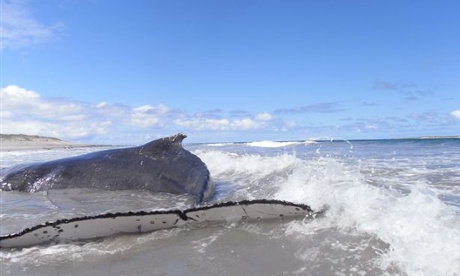
A juvenile humpback whale stranded on a beach
 at Windy Harbour, near Pemberton in WA's
 south-west. Photograph: WA Department of
 Environment and Conservation/AAP

Carly Holyoake, from Murdoch University, at the Australian Veterinary Association's annual conference in Perth on Wednesday, said an unprecedented number of mostly young whales had become stranded on the coast since 2008.

Between 1989 and 2007, the average number of humpback whales coming ashore was two or three, she said.

But in 2008, there were 13 strandings, followed by 46 in 2009 and 16 in 2010.

In 2011, there were 17 strandings involving 14 calves and three juveniles, representing a rise in the number of young whales dying compared with previous years.

Wednesday, 12 March 2014

'Great White' shark washes up on Kerry beach

But don't worry folks it's not Lydia

A 1.8m shark from the Great White family has washed up on an Irish beach.

The female porbeagle shark was discovered by photographer Bernard Fitzgerald as he was walking on Aughacasla beach in Castlegregory, Co Kerry, at the weekend.

The arrival of the adult shark in Tralee Bay comes as a tagged Great White called Lydia is set to be the first recorded member of her species to cross the Atlantic as she swims within 1200km of our shores.

Marine biologist Kevin Flannery admitted the porbeagle shark does bear a close resemblance to the beasts made famous by the Jaws movie.


He said: “The porbeagle does look very like a Great White. People could think the Great White we have been talking about has landed in Kerry.


Saturday, 8 February 2014

More Than 400 Dead Dolphins Found On Peru Beaches In January

Posted: 02/04/2014 12:40 am EST Updated: 02/04/2014 12:59 am

LIMA, Peru (AP) — More than 400 dead dolphins were found last month on the Pacific Ocean beaches of northern Peru where twice that amount were encountered in 2012, officials said Monday.

Authorities never established the cause of the deaths in 2012. They are doing autopsies on the latest dolphins found during January in the Lambayeque region on the northern coast.

Technician Jaime de la Cruz of Peru's IMARPE marine life agency said about 220 dead dolphins were found in the last week of January, the rest during the previous three weeks.

De la Cruz said autopsy results are expected in two weeks. Exams will focus on lungs, kidneys and livers.

Saturday, 14 December 2013

NOAA: 11 Dead Whales Suffered From Malnutrition

SNIPE POINT (CBSMiami/AP) — Eleven of the pilot whales found dead in the Florida Keys were found to be emaciated and suffering from malnutrition, according to federal officials Monday. 

National Oceanic and Atmospheric Administration stranding coordinator Blair Mase said the whales’ empty bellies could be a result of disease or of being out of the deep, cooler waters that form their natural habitat.

“Really we don’t know how long they’ve been in the area and we don’t have any clues of why they got here in the first place,” she said in a conference call with the media. It could be weeks to months before the results of the necropsies come in, she said, and “there is a possibility there could be more whales in the area.” 

Saturday, 16 November 2013

Hundreds of sea turtles found dead along Central American coast


Disagreement over causes of widespread casualties

November 2013: Hundreds of sea turtles, many dead and some with signs of concussion, have been washed up on the Pacific coasts of Costa Rica, Nicaragua, El Salvador and elsewhere in Central America.

Researchers in Costa Rica believe the culprit to be seasonal red tides, which secrete a potent neurotoxin, although conservationists suspect the turtles may have got caught in commercial fishing nets, or trammels.

From late September to mid-October 114 sea turtles – black turtles (Chelonia agassizii), Olive Ridley turtles (Lepidochelys olivacea) and crosses between the two – have been found on the beaches of El Salvador. Another 280 have been found so far in Costa Rica, 115 in Guatemala and an undisclosed number in Nicaragua. In late 2012, 200 were found dead on Panama’s beaches.

Wednesday, 23 October 2013

Second Sea Serpent Washes up in California

If good things come in pairs, the discovery of another giant, nearly mystical sea creature should portend positive things for a bunch of bewildered beachgoers who early Friday evening happened across the second so-called "discovery of a lifetime" in less than a week.

The 13-and-a half-foot-long oarfish, which washed up on a beach in Oceanside Harbor, Calif., is the second of the rarely seen creatures to be found in a matter of days.

"It's so rare to find in Southern California, especially in surface water," Suzanne Kohin, of the National Marine Fisheries Service said. "They thought it was a very rare event the first time, so these two events that we heard of in the last few weeks are the only ones I've ever heard of."

The first discovery was made by a snorkeling marine scientist who wrestled the dead 18-foot monster (with help) to shore near Catalina last Sunday.

"I was thinking I have no idea what that is and like it looks like a snake but it kind of looks like a giant eel," said onlooker Alexandria Boyle, who was one of a class of third-graders on a beach trip when the newest oarfish was found.

Boyle was among a crowd of about 75 who crowded around the creature as police were called, and waited around for the National Oceanic and Atmospheric Administration to come and collect the carcass.

Sunday, 8 September 2013

Second whale stranded in Firth of Forth is put down

A minke whale has been put down by vets after it became stranded in the Firth of Forth just days after the death of a pilot whale in the area.

The 4m long juvenile whale became stuck near the shore at Crombie point in Fife at 07:40.

The animal was in distress "lifting its tail and tremoring". Firefighters had been pouring water over the whale to keep its skin from cracking.

Experts said it was a "long way from the sea".

Medics from the British Divers Marine Life Rescue kept the mammal sedated but with high tide not due until mid afternoon a decision was taken to euthanise the whale because refloating was not possible.

On Tuesday, a pilot whale was stranded north of Edinburgh but later died.

A team from the British Divers Marine Life Rescue had spent the day in the shallows off Silverknowes trying to save the animal.

Sunday, 28 July 2013

Declining Sea Ice Strands Baby Harp Seals

July 22, 2013 — Young harp seals off the eastern coast of Canada are at much higher risk of getting stranded than adult seals because of shrinking sea ice cover caused by recent warming in the North Atlantic, according to a Duke University study.

"Stranding rates for the region's adult seals have generally not gone up as sea ice cover has declined; it's the young-of-the-year animals who are stranding (those less than one year old)," said David Johnston, a research scientist at Duke's Nicholas School of the Environment.
(Credit: Courtesy of IFAW)

"And it's not just the weakest pups -- those with low genetic diversity and presumably lower ability to adapt to environmental changes -- that are stranding," he said. "It appears genetic fitness has little effect on this."

The study, published online this week in the peer-reviewed open-access journal PLoS One, is the first to gauge the relative roles that genetic, environmental and demographic factors such as age and gender may be playing in harp seal stranding rates along the U.S. and Canadian east coasts in recent years.

Saturday, 13 July 2013

Whale carcass may be towed out to sea to save pod

Marine experts are contemplating towing the carcass of a killer whale out to sea to encourage members of its pod to move into deeper waters off Queensland's coast.
Up to eight whales remain near Fraser Island where two whales, a mother and her calf, died after becoming stranded on Wednesday morning.
Rescuers fear the pod could become stranded again.
A Queensland Parks and Wildlife Services spokesman, Peter Wright, says if the whales don't move on they'll look at ways to coax them out to the open ocean.
"The ideal thing to do would be to let them do it themselves," he told reporters in Hervey Bay on Thursday.
But if that doesn't happen, authorities may tow one of the dead whales behind a boat and hope the pod follows it out of the channel.
Five other stranded whales were freed on Wednesday afternoon. They are part of the pod that remains in the channel.
Sea World marine expert, Trevor Long, says the whales may not have moved on because they're mourning the loss of the other whales.
"This is a family unit and the [feeling of] loss of those two whales out of that family unit is extremely strong," he said.
Related Posts with Thumbnails

ShareThis