Showing posts with label Cambodia. Show all posts

Monday, 18 November 2019

Cambodia to ban elephant rides at Angkor temples

NOVEMBER 15, 2019

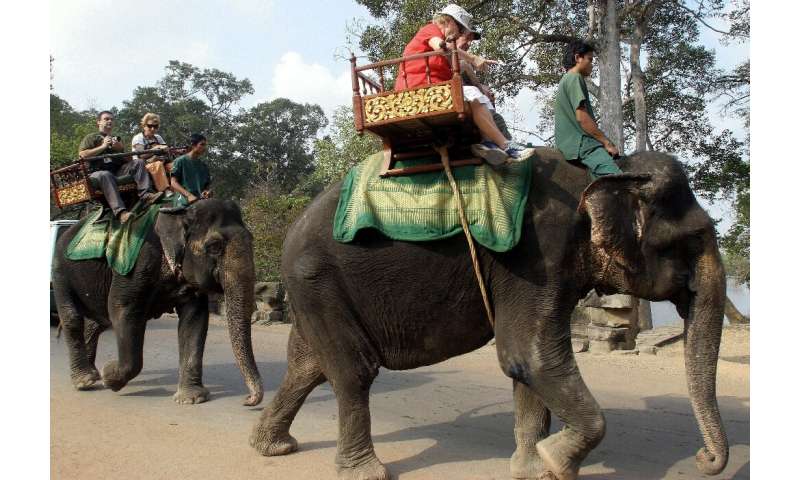
Cambodia's Angkor Wat complex attracts a large number of tourists, and many opt for elephant rides around the ancient temples

Cambodia will ban all elephant rides at the country's famed Angkor temple park by early next year, an official said Friday, a rare win for conservationists who have long decried the popular practice as cruel.

The Angkor archaeological complex in northern Siem Reap attracts the bulk of the kingdom's foreign tourists—which topped six million in 2018—and many opt for elephants rides around the ancient temples.

But these rides "will end by the start of 2020", said Long Kosal, a spokesman with the Apsara Authority, which manages the park.

"Using elephants for business is not appropriate anymore," he told AFP, adding that some of the animals were "already old".

So far, five of the 14 working elephants have been transferred to a community forest about 40 kilometres (25 miles) away from the temples.

"They will live out their natural lives there," Kosal said.

The company that owns the elephants will continue to look after them, he added.

Cambodia has long come under fire from animal rights groups for ubiquitous elephant rides on offer for tourists, also seen in neighbouring Thailand, Vietnam and Laos.

The elephants are broken in during training and rights groups have accused handlers of overworking them.

Friday, 19 July 2019

In the remote Cambodian jungles, we made sure rare Siamese crocodiles would have enough food


JULY 11, 2019

by Paul Mcinerney, The Conversation
For nine hours, my colleague Michael Shackleton and I held onto our scooters for dear life while being slapped in the face by spiked jungle plants in the mountains of Cambodia. We only disembarked either to help push a scooter up a slippery jungle path or to stop it from sliding down one.
With our gear loaded up on nine scooters—200 metres of fishing nets, two inflatable kayaks, food for five days, hammocks, preservation gear for collection of DNA, and other assorted scientific instruments—we at last arrived at one of the few remaining sites known to harbour the critically endangered Siamese crocodiles.
The Siamese crocodile once lived in Southeast Asian freshwater rivers from Indonesia to Myanmar. But now, fewer than 1000 breeding individuals remain.
In fact, during the 1990s the species was thought to be completely extinct in the wild. Then, in 2000, scientists from Fauna and Flora International found a tiny population in the remote Cardamom Mountains region of Cambodia.
We travelled to this remote wilderness in 2017 to determine habitat suitability for the reintroduction of captive-bred juvenile Siamese crocodiles. We wanted to understand the food web there to see whether it contains enough fish to sustain the young crocs.
Our journey would not have been possible without the help of Community Crocodile Wardens—local community members who patrol the jungle sanctuaries for threats and record crocodile presence. Wardens also conduct crocodile surveys further afield to discover new populations or to identify new areas of potential suitable crocodile habitat for juvenile releases.

Thursday, 9 May 2019

Several small steps: Elephant calves caught on camera in Cambodia


APRIL 30, 2019

First, the good news. Footage from the 46 camera traps deployed by Fauna & Flora International (FFI) in Cambodia's Cardamom Mountains is giving us a privileged insight into the lives of the Asian elephants that roam through in one of the continent's last remaining forest wildernesses.
Genetic analysis of elephant dung undertaken by our partner, Royal Zoological Society of Scotland, leads us to believe that the core population in the southern Cardamoms comprises around 50 elephants. And our camera traps have provided us with intimate footage of some of these magnificent beasts, including their calves.
Unfortunately, our monitoring has also revealed that the remaining elephants are under severe pressure, not least from the growing use of snares, a disturbing trend linked to the increased urban appetite for bushmeat.


Thursday, 17 January 2019

Mammoth DNA found in Cambodia market items


January 4, 2019
Scientists tackling the illegal trade in elephant ivory got more than they bargained for when they found woolly mammoth DNA in trinkets on sale in Cambodia, they revealed Friday.
"It was a surprise for us to find trinkets made from woolly mammoth ivory in circulation, especially so early into our testing and in a tropical country like Cambodia," said Alex Ball, manager at the WildGenes laboratory, a wildlife conservation charity based at Edinburgh Zoo.
"It is very hard to say what the implications of this finding are for existing elephant populations, however we plan to continue our research and will use genetics to work out where it has come from."
The giant mammals have been extinct for around 10,000 years and are not covered by international agreements on endangered species.
WildGenes has been using genetic data to tackle wildlife crime by determining the origin of ivory finding its way to the marketplace.

Monday, 31 December 2018

Cambodia seizes record three-tonne haul of African ivory


Discovery of 1,026 tusks at Phnom Penh port follows a tip from the US embassy
Agence France-Presse
Sun 16 Dec 2018 06.04 GMTLast modified on Sun 16 Dec 2018 18.50 GMT
Cambodia seized more than 3.2 tonnes of elephant tusks hidden in a storage container sent from Mozambique, a customs official said on Sunday, marking the country’s largest ivory bust.
The discovery of 1,026 tusks at the Phnom Penh port followed a tip from the US embassy, the official said, and highlights Cambodia’s emergence as a key regional transit point for the multibillion dollar trade in illicit wildlife.
“The elephant tusks were hidden among marble in a container that was abandoned,” Sun Chhay, director of the customs and excise office at the port, said.
He said the ivory was sent from the southern African nation of Mozambique and arrived at the port last year.
The unidentified owner of the shipment did not arrive to pick up the cargo. Pictures of the massive haul showed long rows of confiscated tusks spread out on the ground at the port.
Sun Chhay said he did not know whether the shipment was destined for markets in other countries.

Friday, 28 September 2018

Cambodian reptile cafe slithers into people's hearts - via Herp Digest

AFP, 9/7/18, For anyone terrified of an albino python, an orange corn snake or a scaly, bearded iguana, Chea Raty says getting up close and personal at Phnom Penh's first reptile-themed cafe is the only remedy.

Taking off from the cat cafes already popular in the Cambodian capital, Chea Raty launched his business to revamp the skin-crawling reputation of lizards and snakes and convince haters that they are simply misunderstood.

As customers sip on their lattes and hang out with the reptiles, "they will love them like I do", the 32-year-old told AFP while stroking the scaly neck wattle of an iguana.

The walls of his cafe are lined with lit-up glass tanks containing snakes of various lengths and colours, while a bright macaw screeches in the corner.

Some visitors look hesitantly at the cages, others are bolder in their embrace of the creatures.

There's no entry fee, so visitors can order a coffee and request a sit-down with a serpentine friend from one of the tanks.

An ice tea for a young customer instantly becomes a cool object for a yellow-and-cream-coloured ball python to twist its body around.

A woman giggles as an albino python creeps from her shoulder and wraps behind her head.

Nearby, a bearded dragon iguana perches on a table while a man gently pets it.

Customer Y Navim was wary at first of a corn snake, an orange-coloured serpent that kills its prey through constriction. But it was soon resting on her palm as she sipped her coffee.

"This cafe is quite unique," the 22-year-old said. "I've never seen some of these reptiles before. They are beautiful and scary.”

To critics who say the animals should be left alone in the wild, Chea Raty says his human-bred creatures "cannot survive there”.

All of his cafe creatures are imported from Thailand.

Business is still slow-going due to the common fears of snakes and lizards.
But women, Chea Raty says, are providing an unexpected boost.

"They put the pythons around their neck, take selfies, and they are happy.”

Wednesday, 23 May 2018

Rangers find 109,217 snares in a single park in Cambodia


Snares – either metal or rope – are indiscriminately killing wildlife across Southeast Asia, from elephants to mouse deer. The problem has become so bad that scientists are referring to protected areas in the region as “empty forests.” 

Tue 22 May 2018 08.43 BST

A simple break cable for motorbikes can kill a tiger, a bear, even a young elephant in Southeast Asia. Local hunters use these ubiquitous wires to create snares – indiscriminate forest bombs – that are crippling and killing Southeast Asia’s most charismatic species and many lesser-known animals as well. A fact from a new paper in Biodiversity Conservation highlights the scale of this epidemic: in Cambodia’s Southern Cardamom National Park rangers with the Wildlife Alliance removed 109,217 snares over just six years.

“Some forests in Vietnam don’t have any mammals left larger than squirrels,” Thomas Gray, the lead author of the new paper and the Science Director for Wildlife Alliance, said. “Given how diverse these forests formally were this must be having substantial impacts on ecosystem services and the [forest’s] entire biodiversity.”

According to Gray, the snaring crisis is worst in Vietnam and Laos, but is increasing in Cambodia – where he works – as well as Myanmar, Indonesiaand Thailand. In some places – even protected areas – it is so bad that scientists talk of “empty forests” where hunters have literally stripped the ecosystem of all medium-to-large animals. 

Continued  

Wednesday, 7 March 2018

Cambodia's last leopards on brink of extinction


Date:  March 1, 2018
Source:  Panthera

Summary:
A new study has confirmed that the world's last breeding population of leopards in Cambodia is at immediate risk of extinction, having declined an astonishing 72% during a five-year period. The population represents the last remaining leopards in all of eastern Indochina - a region incorporating Cambodia, Laos and Vietnam.


Monday, 25 December 2017

Nest of endangered giant softshell turtle found in Cambodia


December 19, 2017 by Sopheng Cheang

Conservationists have found a nest of the endangered Asian giant softshell turtle on a Mekong River sandbar in northeastern Cambodia, while 115 new species of various other animal and plant life have been discovered in the greater Mekong region.

The New York-based Wildlife Conservation Society said Tuesday that a nest of Asian giant softshell turtles was found on the Mekong between Kratie and Stung Treng provinces by conservationists from Cambodia's fisheries administration, the WCS and local communities. It said it was the first spotting of such a nest so far this season.

It said the area is the only remaining location in Cambodia where the huge turtles still breed.
The Asian giant softshell turtle has been listed as globally endangered. It was thought to be extinct in the Cambodian portion of the Mekong River until conservationists rediscovered the turtles in 2007 along a 48-kilometer (30-mile) stretch of the river between Kratie and Stung Treng provinces.

Wednesday, 29 March 2017

Elephants in dramatic muddy escape

29 March 2017
From the section Science & Environment


It is a great escape. One by one, 11 Asian elephants manage to drag themselves clear of a muddy hole.

The drama took place in the Keo Seima Wildlife Sanctuary in Mondulkiri Province, Cambodia.

The elephants had gone to drink and bathe in water collected in an old bomb crater - but then got stuck.

Local villagers used vegetation and ropes to help the animals out. Once clear, the elephants ran off into the bush.

Everyone pulled together to avoid a tragedy, said Tan Setha, a Wildlife Conservation Society (WCS) technical advisor to the protected area.

“This herd consisted of three adult females and eight juveniles of various ages, including a male that had almost reached maturity.

"These elephants represent an important part of the breeding population in Keo Seima Wildlife Sanctuary, and their loss would have been a major blow to conservation." Image copyright WCS Image caption The hole is an old bomb crater enlarged to store water

The muddy hole was originally made by a bomb during the Vietnam war, but was later widened by farmers to store water.

When the farmers realised the elephants were trapped in the depression last Friday, they notified the Department of Environment, who in turn notified WCS who were able to mobilise a rescue effort.

Continued

Tuesday, 12 April 2016

Tigers declared extinct in Cambodia

Conservationists say Indochine tigers are ‘functionally extinct’ as they launch action plan for reintroduction

AFP
Wednesday 6 April 201610.38 BSTLast modified on Wednesday 6 April 201618.59 BST

Tigers are “functionally extinct” in Cambodia, conservationists conceded for the first time on Wednesday, as they launched a bold action plan to reintroduce the big cats to the kingdom’s forests. 

Cambodia’s dry forests used to be home to scores of Indochinese tigers but the WWF said intensive poaching of both tigers and their prey had devastated the numbers of the big cats. 

The last tiger was seen on camera trap in the eastern Mondulkiri province in 2007, it said. 
“Today, there are no longer any breeding populations of tigers left in Cambodia, and they are therefore considered functionally extinct,” the conservation group said in a statement.

In an effort to revive the population, the Cambodian government last month approved a plan to reintroduce the creatures into the Mondulkiri protected forest in the far of east the country.

The plan will see a chunk of suitable habitat carved out and protected against poachers by strong law enforcement, officials said, and action to protect the tigers’ prey. 

“We want two male tigers and five to six females tigers for the start,” Keo Omaliss, director of the department of wildlife and biodiversity at the Forestry Administration, told reporters. “This is a huge task.” 

The government needs $20 to $50m for the project, he said, adding talks had begun with countries including India, Thailand and Malaysia providing a small number of wild tigers to be introduced.


Friday, 15 January 2016

Rare footage shows herd of wild Asian elephants in Cambodian jungle


Hidden camera shows 12 wild Asian elephants walking through a Cambodian forest, something which hasn't been seen for a decade

By Telegraph Video, video source Conservation International

2:46PM GMT 15 Jan 2016

Rare video has emerged from the environmental group, Conservation International, showing a herd of 12 elephants in a Cambodian forest.

The footage shows 12 elephants walking through Cambodia’s Central Cardamom Protected Forest in late 2015.

Monday, 7 September 2015

Fishing cat found in coastal Cambodia for first time in 12 years

Camera traps have captured footage and images of the endangered fishing cat (Prionailurus viverrinus) in Cambodia for the first time since 2003.

Researchers from the CBC, a partnership between Fauna & Flora International (FFI) and the Royal University of Phnom Penh, were thrilled by the findings which have allayed grave fears about the status of these animals in Cambodia.

FFI project leader, Ms Ret Thaung said that the fishing cat’s preference for wetland habitat had led to severe population declines throughout much of its Asian range.

“Asian wetland habitats are rapidly disappearing or being modified by human activity, so fishing cat numbers have declined dramatically over the last decade and the remaining population is thought to be small,” she said.

“Fishing cats are believed to be extinct in Vietnam, while there are no confirmed records in Lao PDR and only scarce information about the species in Thailand and Cambodia.

“It is clear that urgent steps are needed to protect these cats from snaring and trapping and to conserve their wetland habitats – but to do this effectively we needed to get a better idea of where they live.”


Monday, 20 July 2015

One of world’s rarest turtles heading back to the wild

Rarest Turtles Heading Back to the Wild

Date:July 15, 2015

Source:Wildlife Conservation Society

Twenty-one captive-raised southern river terrapins have been released back into their native habitat in southwest Cambodia.

WCS (Wildlife Conservation Society) and the Royal Government of Cambodia's Fisheries Administration announced today that 21 captive-raised southern river terrapins have been released back into their native habitat in southwest Cambodia. More than 150 villagers, government representatives, and religious leaders attended ceremonies for the release.


Southern river terrapins were believed extinct in Cambodia until 2000 when a small population was re-discovered by WCS in the Sre Ambel River system. Today, they are critically endangered and considered one of the world's 25 most endangered tortoises and freshwater turtles.

Friday, 16 January 2015

New species of legless amphibian for Cambodia

A new species of legless amphibian has been discovered by scientists in Cambodia's Cardamom Mountains.

Often mistaken for snakes the newly called Ichthyophis cardamomensis is a caecilian, an order of limbless amphibians, with larger species known to grow to 1.5 metres in length. Caecilians have a valuable role in the ecosystems of tropical and subtropical regions, including providing a food source for the red tailed pipe snake (Cylindrophis ruffus). Caecilians eat invertebrates, such as earthworms, ants and termites. 

It is only the second caecilian species ever discovered in Cambodia. The other is the striped Koa Tao Island caecilian, I. kohtaoensis, which is also found in, Laos, Myanmar, Thailand, and Vietnam.

Monday, 29 December 2014

The Englishman returning wildlife to Cambodia's Angkor Wat temple complex

The 're-wilding' of the forests near the ancient site could be a model for other projects


SCIENCE EDITOR 

Sunday 28 December 2014

The forests surrounding the ancient temple complex of Angkor Wat in Cambodia are once more echoing to the eerie, whooping calls of the pileated gibbon, a species, like so many in south-east Asia, that has been decimated by hunting and deforestation.

Conservationists have reintroduced the gibbons as part of an ambitious project for the "re-wilding" of Angkor Wat, a vast "temple city" that was once surrounded by forests teeming with deer, monkeys, birds and big cats before the arrival of commercial hunters with guns, traps and an appetite for money.

The re-wilding is being led by Englishman Nick Marx, a conservationist who believes the project could become a model for other parts of south-east Asia hit by the trade in endangered wildlife.

Angkor Wat, the largest religious monument on earth, was made a World Heritage Site to protect its sprawling network of temples. Now conservationists want to restore the surrounding forests of Angkor Archaeological Park to their former glory, Mr Marx said.

Friday, 10 October 2014

Chinese chamber of commerce at heart of wildlife trafficking route


Chinese chamber of commerce at heart of wildlife trafficking routeOfficals at the Sichuan and Chongqing Chamber of Commerce in Phnom Penh, Cambodia have been discovered running a wildlife trade centre where rare and endangered animals were skinned and processed before being shipped on to their destination countries. After agreeing to pay a fine the officials were released without charge.

The raid on the Sichuan and Chongqing Chamber of Commerce building was undertaken by Cambodia’s Forestry department, military police and officials from the NGO Wildlife Alliance.

The authorities found parts from animals and also live animals being readied for transport. The haul included;
19 clouded leopard skins,
3 leopard skins,
2 Asian golden cat skins,
6 clouded leopard paws,
10 otter skins,
2 fake tiger skins and
other body parts.

After the raid on Tuesday the Wildlife Alliance described how many of the pelts discovered were fresh and still being dried on wooden frames in the building. They explained that this indicated the Chamber of commerce as not just being used as part of a transit route but animals were also being killed and processed at the building.

Thursday, 4 September 2014

Yellow-bellied weasel makes a surprise appearance in Cambodia

A research team got more than they expected when they found that their camera traps had captured the first photograph of the elusive yellow-bellied weasel in Cambodia.

The image was captured on a camera trap, which was part of a joint camera trapping initiative by Fauna & Flora International (FFI) and the University of Oxford’s Wildlife Conservation Research Unit (WildCRU).

The research team ­­– led by FFI field biologist Channa Phan – were conducting a study of clouded leopards in the Central Cardamoms Protected Forest in southern Cambodia. Finding the weasel outside its usual range came as a surprise, as it was previously believed that the animal was found only in the pine forests of Bhutan, China, India, Laos, Myanmar, Nepal, Thailand, and Vietnam.

Friday, 20 June 2014

Distinctive new wolf snake species discovered in Cambodia

A new wolf snake species has been discovered in Cambodia’s Cardamom Mountains. 

Wolf snakes are nonvenomous members of the family Colubridae, and named after their large teeth that are found in both jaws.

This distinctive, almost chequered, coloured snake was discovered by Cambodian herpetologist Neang Thy, Fauna & Flora International’s (FFI) research adviser in Phnom Penh, in a high altitude montane rainforest.

He said: “Given its unique colouration, submontane habitat and altitudinal separation from other wolf snakes in the region, the species will probably prove to be endemic to the Cardamom Mountains.”

The new snake has been named Lycodon zoosvictoriae by Thy in honour of the Zoological Parks and Gardens Board of Victoria in Australia, which has supported FFI's studies in the region for several years.

Saturday, 30 November 2013

EU to ban fish imports from Belize, Guinea and Cambodia

Three countries banned and three more warned in first major sanction against nations that allow illegal fishing operations

Fish imports from Belize, Guinea and Cambodia are to be banned from the European Union, and three more countries have been warned their imports are in danger, in the first major sanction against countries that allow illegal fishing operations to carry on under their countries' flags.

The three countries to be banned were warned last year that the European commission was preparing to end imports of their fish and fish products, because of concerns that they had failed to take action over piracy and illegal fishing. It is the first time imports have been banned as a result of the widespread global trade in landing fish for which vessels do not have the correct fishing permits. EU vessels will also be banned in fishing in the waters of the three offending nations.

Related Posts with Thumbnails

ShareThis