Showing posts with label domestic cats. Show all posts

Monday, 23 November 2015

The adventures of Phileas Mogg: Black cat travels 250 MILES underneath car bonnet

AN adventurous cat has been dubbed Phileas Mogg after an intrepid 250-mile journey trapped under the bonnet of a car.

PUBLISHED: 13:11, Fri, Nov 20, 2015 | UPDATED: 13:57, Fri, Nov 20, 2015

The unlucky black cat was driven through two counties, along motorways and even went through a car wash on his epic odyssey.

It finally took the combined efforts of the RSPCA and AA to free Phileas – named after the heroic protagonist from Jules Verne’s Around the World in Eighty Days – from his bolthole inside an Audi engine.

Although the cat did not quite circumnavigate the planet, he is believed to have endured an incredible 96-hour adventure that took him from Warmingham in Cheshire to nearby Sandbach and Wettenhall, to Bangor-on-Dee racecourse in Wrexham, to Cheltenham racecourse before being rescued in Bristol.

All that time, Phileas is believed to have been trapped under the bonnet of Colin Woodward’s Audi A4.

Mr Woodward, who lives in Warmington, near Crewe, had heard a cat meowing from under his Audi A4, thinking it was a shy feral cat which he feeds.

Before driving off, the retired farmer checked his engine with a torch but because the mewing stopped presumed the cat had gone.

Sunday, 15 November 2015

Three-eared 'Captain Kirk' cat found in Norfolk

12 November 2015

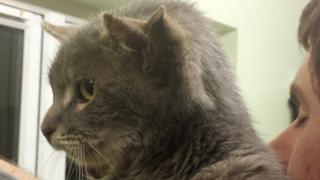
A three-eared cat - who rescuers almost dubbed Captain Kirk due to his "final front-ear" - has been found abandoned near a garage.

The stray stunned staff at Feline Care Cat Rescue, in East Harling, Norfolk, with the "peculiar" birth defect.

Manager Molly Farrar said the centre's vet had not seen a cat with an extra ear in 30 years of practice.

Staff at the centre floated a number of names but settled on Brian, the Eastern Daily Press first reported.

The cat was named after the owner of the garage where he was found.

"It's obviously a really rare thing as our vet hasn't seen it as well," Ms Farrar told the BBC.

Brian the three-eared cat"We see plenty of cats with no tails, some tails, only a little bit of tail missing, cats with three legs, one eye, cats with all kinds of disabilities, but this is something quite special."

Brian, who is thought to be between four and eight years old, almost ended up with a more outlandish moniker, Ms Farrar said.

"We have had suggestions of Spock or Captain Kirk because he's got a left ear, a right ear and a final front-ear," she said.

Brian was discovered on Monday near the remote cat sanctuary, which is on the edge of an industrial estate, and it is thought he may have been dumped or ended up on the back of a lorry.

If Brian's owner cannot be found, he will be re-homed, Ms Farrar said.


This Adorable Kitty Looks Like a Werewolf: Here's Why

by Elizabeth Palermo, Associate Editor   |   November 10, 2015 03:09pm ET

A cute and cuddly kitty cat with strange facial hair and unusual hunting habits is changing the way people think about a not-so-adorable mythological creature: the werewolf.

8-month-old male Lykoi.jpgThe Lykoi breed of domestic cat (its name comes from the Greek wordlykos, or wolf) has an unusual genetic mutation that causes its hair to grow in a werewolflike way. The skin around the cat's eyes, muzzle and chin is hairless, making it resemble a human-turned-werewolf. Lykoi cats are partially hairless on their legs and paws as well, giving them a "hairy hand" appearance (the telltale sign that a person is about to shift into a werewolf), said Johnny Gobble, a veterinarian and Lykoi breeder in Tennessee.

And so-called werewolf cats don't just look like tiny, shape-shifting dogs; they also act a bit like canines, Gobble told Live Science.


Friday, 3 July 2015

Where the wild things aren't: Cats avoid places coyotes roam

Large-scale study sheds light on habits of 74 million U.S. cats

Date:June 30, 2015

Source:North Carolina State University

Domestic cats might be determined hunters, but they stick mostly to residential areas instead of venturing into parks and protected areas where coyotes roam. That's the key finding from a North Carolina State University analysis of more than 2,100 sites -- the first large-scale study of free-ranging cats in the U.S. published in the Journal of Mammalogy.

Why is it important to know where 74 million pet cats spend their time away from home?

"Domestic cats are estimated to kill billions of birds and small mammals each year," says lead author Roland Kays, a zoologist with NC State's College of Natural Resources and the N.C. Museum of Natural Sciences. "Knowing where they hunt helps assess the risk to wildlife."

Monday, 22 June 2015

The curious case of Ozzie the Sydney cat, who turned up in Northern Ireland

Australians have a reputation for being a well-travelled bunch. But the curious case of Ozzie the mystery moggy has taken this jet-setting trend to an entirely new level.

In Northern Ireland, they're calling Ozzie a purrrfect mystery.

Photo: Cats Protection, Armagh Branch
The stray ginger cat was discovered hanging around a backyard in County Armagh in Northern Ireland earlier this week.


When a Cats Protection volunteer picked him up and took him to a vet to scan his microchip, she was astonished to discover that he was registered in Sydney, Australia.
Advertisement

Just as baffling as his 17,000-kilometre journey half way around the world was the date on his microchip: it suggested he was born in 1989, which would make him 25 years old.

The Cats Protection volunteers have nicknamed the cat Ozzie, and have embarked on an international search to reunite him with his owner.

"If only he could tell us of his travels," the organisation wrote on its Facebook page, alongside a photograph of Ozzie enjoying a cuddle with a volunteer. 

Ozzie, described as "very thin but incredibly handsome" and "a gentle affectionate cat", appeared to have been well looked after in the past, Armagh Cats Protection co-ordinator Gillian McMullen said.

Sunday, 18 January 2015

‘I can haz genomes’: cats claw their way into genetics


Canine dominance bows to tabby chic as cat sequencing takes off.
14 January 2015

The cat genome is out of the bag, and has already helped to pinpoint a gene involved in kidney disease.

Cats may have beaten dogs on the Internet but felines have been a rare breed in genetics labs compared with their canine counterparts. Now, at last, cats are clawing their way into genomics.

At a meeting this week in San Diego, California, a close-knit group of geneticists unveiled the first results from an effort to sequence the genomes of 99 domestic cats. The work will benefit both humans and felines, the researchers say, by mapping the mutations underlying conditions that afflict the two species, such as kidney disease.

“It’s a great time to be in cat genomics,” says William Murphy, a geneticist at Texas A&M University in College Station who is involved in the effort. Plummeting costs for DNA sequencing now make it possible to do genomics cheaply — and cat genomics, long under-funded compared with similar efforts in dogs, is benefiting, he says. “We’re finally at the point where we can do all sorts of things we wanted to do 5 or 10 years ago.”

Saturday, 12 October 2013

Stroking Could Stress out Your Cat

Oct. 7, 2013 — A new study by an international team of animal behaviour specialists suggests that cats who reluctantly allow their owners to stroke them could be more stressed out than kitties who carefully avoid being petted.

The surprise conclusion arose in a study conducted by researchers from the University of Lincoln, UK, University of Sao Paulo, Brazil, and University of Veterinary Medicine, Austria, which aimed to better understand how cats cope with living alongside humans and other felines in a single household.

Although many people consider cats to be solitary creatures, the collaborative research, published in the Journal Physiology and Behavior and presented to an international audience in Portugal in September 2013, revealed that cats can live happily together in groups, and that the number of cats is not necessarily a problem.

Sponsored by Ceva Animal Health, the scientists examined cats living alone, in pairs and in groups of three or four in the home, assessing levels of stress hormones on four occasions.

Although the number of cats in the home did not predict background stress levels, the researchers found that younger cats (less than two years old) living on their own were more stressed than younger ones living in the larger groups.

Evidence was also found to suggest that the owner's urge to pet their cat may be a stressful experience.

Professor Daniel Mills, Professor of Veterinary Behavioural Medicine at the University of Lincoln, said: "We chose stable households to look into this question and were quite surprised by the results. Despite typically living on their own in the wild, we have known for some time that cats come together when resources like food are concentrated in a single area, for example when people feed strays. However, it might be that they do this out of need and it is still stressful for them, because they are not a naturally social species.

Wednesday, 30 January 2013

Could a Cat Ban in New Zealand Save Birds?


Megan Gannon, News Editor
Date: 23 January 2013 Time: 02:37 PM ET

"Imagine a New Zealand teeming with native wildlife, penguins on the beach, kiwis roaming about in your garden. Imagine hearing birdsong in our cities."

This is environmentalist Gareth Morgan's vision for his homeland, and to help make it a reality, he has an appeal for his compatriots: Get rid of your cats.

Morgan's newly launched campaign, Cats to Go, is pushing for much tighter controls on New Zealand's cats, which prey on native birds and are considered an invasive species on the island country. He's not asking all cat owners to euthanize their beloved pets (though his website says "that is an option"), but Morgan wrote in a Jan. 23 op-ed in Wellington's Dominion Post that owners should acknowledge that they are harboring "a natural born killer."

"At the very least responsible people should consider not replacing it when it dies and meanwhile either keep it indoors or invest in a cat-proof enclosure in the backyard," he wrote. Morgan also suggested neutering and cat collars with bells, and the campaign's website has a petition to lobby local governments to require that all owners register their cats.

His plea sparked furor among some cat lovers and organizers working to prevent animal cruelty, but are the ideas behind the campaign really that crazy?

Thursday, 24 January 2013

Cats Take on Owners' Habits (Good and Bad)


Jennifer Viegas, Discovery News
Cats really do become part of our families, to the point that they take on human habits -- good and bad -- and adapt their lifestyle with that of their owners, says new research.
The finding shows how profoundly captivity can affect certain animals. While genetics help to explain some aspects of personality and behavior, an individual's environment clearly is a factor too.

"Our findings underline the high influence of human presence and care on the amount of activity and daily rhythm in cats," concluded Giuseppe Piccione and colleagues of the University of Messina's Faculty of Veterinary Medicine.

Wednesday, 23 January 2013

A Cat’s 200-Mile Trek Home Leaves Scientists Guessing

Nobody knows how it happened: an indoor housecat who got lost on a family excursion managing, after two months and about 200 miles, to return to her hometown.


Even scientists are baffled by how Holly, a 4-year-old tortoiseshell who in early November became separated from Jacob and Bonnie Richter at an R.V. rally in Daytona Beach, Fla., appeared on New Year’s Eve — staggering, weak and emaciated — in a backyard about a mile from the Richters’ house in West Palm Beach.

“Are you sure it’s the same cat?” wondered John Bradshaw, director of theUniversity of Bristol’s Anthrozoology Institute. In other cases, he has suspected, “the cats are just strays, and the people have got kind of a mental justification for expecting it to be the same cat.”

But Holly not only had distinctive black-and-brown harlequin patterns on her fur, but also an implanted microchip to identify her.

“I really believe these stories, but they’re just hard to explain,” said Marc Bekoff, a behavioral ecologist at the University of Colorado. “Maybe being street-smart, maybe reading animal cues, maybe being able to read cars, maybe being a good hunter. I have no data for this.”

There is, in fact, little scientific dogma on cat navigation. Migratory animals like birds, turtles and insects have been studied more closely, and use magnetic fields, olfactory cues, or orientation by the sun.

Scientists say it is more common, although still rare, to hear of dogs returning home, perhaps suggesting, Dr. Bradshaw said, that they have inherited wolves’ ability to navigate using magnetic clues. But it’s also possible that dogs get taken on more family trips, and that lost dogs are more easily noticed or helped by people along the way.

Tuesday, 2 October 2012

A year and 200 miles later, cat returned to owner


VISALIA, California — Max the cat is home after a year of being gone.

Max went missing from Beki Osborn's home in Visalia, California last year.

"I called the microchip people and told them what had happened and then waited," Osborn said. "And I didn't hear anything until yesterday."

Somehow, Max made it all the way to the Ghalleger's home in Carmichael, a suburb of Sacramento and 200 miles north of Osborn's home.

They fed him for a few days and then tried to find out where he came from. Karin Ghalleger took the cat to be scanned for a microchip, which identified Osborn as his owner.

The Ghallegers drove Max home earlier this week.

"We want him to be home. He's been gone long enough," Karin Ghalleger said. "A year is a long time to be without your cat."

Osborn had given up on the reunion, and couldn't believe it when the Ghallegers rolled into her driveway.

"I was stunned, I was absolutely stunned. I was so glad I had him micro-chipped," Osborn said. "…My emotions are all over the place with this. I was just like, ‘I can't believe it's him,' ‘I know it's him,' ‘I can't believe this is real.' I am just all over the place with this."


Saturday, 11 August 2012

KittyCam Catches Cats' Killer Side


Video cameras strapped to house cats witnessed tame tabbies transforming into tigers while stalking the backyard wilderness of Athens, Georgia. The kitty-cam provided evidence that house cats allowed to roam outside killed an average of 2.1 animals per week. The risky behavior of prowling pussycats, such as crawling into storm drains and crossing busy roads was also caught on tape.

“We found that about 30 percent of the sampled cats were successful in capturing and killing prey, and that those cats averaged about one kill for every 17 hours outdoors,” said Kerrie Anne Loyd of the University of Georgia in the Chattanoogan. “It was also surprising to learn that cats only brought 23 percent of their kills back to a residence. We found that house cats will kill a wide variety of animals, including: lizards, voles, chipmunks, birds, frogs, and small snakes.”

Continued:
 http://www.livescience.com/22260-kittycam-catches-cats-preying-on-wildlife.html

Sunday, 13 May 2012

Kidney disease a leading killer in cats


LOS ANGELES (AP) — It's one of the leading causes of death for cats, but there is no cure and no known cause: kidney disease.
One in 12 older cats has chronic kidney disease, according toBanfield Pet Hospital's just-released 2012 State of Pet Health Report.
Banfield, the largest veterinary practice in the world with 800 hospitals in 43 states, based its report on medical data from more than 2 million dogs and nearly 430,000 cats seen by its veterinarians.
Acute kidney disease, caused by eating antifreeze, grapes, lilies or other poisons, can be cured if treated quickly enough. "If you catch it, you can treat it," said Dr. Nina Nardi, chief of staff at Banfield's Canoga Park hospital, 25 miles northwest of Los Angeles.
But chronic kidney disease is much more common, more progressive and irreversible, she said. Treatment is aimed at easing pain and prolonging a quality life.
Cats diagnosed in the early stages of chronic kidney disease live two to three years, while those diagnosed in later stages live only a few months. (Dogs can get kidney disease, but it is seven times more common in cats.)
Nate Glass can only try to ease the pain of his cat Girly, who he rescued as a kitten after she'd been shot with a BB gun in an alley behind a dollar store.

Saturday, 12 May 2012

CREWKERNE: Mystery as lost cats reappear


A PAIR of much-loved family pets that mysteriously vanished on the same day in mid-April have just as mysteriously returned.


Cat-lover Margaret Brown believes the four-year-old animals were possibly stolen but later released because of a high-profile community campaign to find them.

The cats, Ginger and Scampy, belong to Mrs Brown and her grandson Peter, 24, who live at Langmead Square, Crewkerne.

The animals disappeared on Friday, April 13th.

After a week of fruitless searching and alerting the police, Cats Protection League, local vets and animal sanctuaries, Mrs Brown asked the Weekender to publicise the animals’ disappearance.

She told us then that her worst fear was that someone malicious had stolen the cats and possibly sold them to get money for drugs.

“It’s very strange that our two cats went missing on the same day,” she added.

But on Monday of last week, Scampy appeared outside the front door, looking fit and well.

And on Monday of this week, Ginger suddenly reappeared in the back garden — 24 days after vanishing.
“He’s half his normal weight. But he seems all right otherwise,” said Mrs Brown.

Since then, Mrs Brown has had both cats “chipped” so that, should they disappear again, they can easily be identified if they are ever taken to a vet.

Mrs Brown said grandson Peter was delighted to have his cats back.


PICTURE: LOST AND FOUND - Margaret Brown is reunited with Ginger and Scampy, the family cats that went mysteriously AWOL

Wednesday, 9 May 2012

Meow, the 37-pound cat passes away in Santa Fe

Meow, the 37-pound cat who captured the national spotlight, died on Saturday afternoon from respiratory distress.


"Meow had been doing so well in his foster home; walking up stairs and seeking affection - that it is so very hard to believe he is gone," Executive Director at Santa Fe Animal Shelter Mary Martin said in a Facebook post.
The Santa Fe Animal Shelter said Meow started wheezing last Thursday in his foster home. The cat saw several veterinarians but they were unable to stop the pulmonary failure.
"We will forever be grateful for the attention Meow’s size brought to pet obesity and to animal shelters across the country. We are especially grateful to all of you who fell in love with this charming cat - as we did – and were so very interested in his progress and success," Martin said.
Marie Stewart's mom raised the cat near Roswell until she could no longer care for the animal.  She says her family is heartbroken, and that she hopes everyone can take something special from Meow's life.  

Friday, 27 April 2012

Residents terrified after 14 cats found dead in Taunton community


A COMMUNITY has been left reeling after more than a dozen cats were found dead following a string of suspected poisoning attacks.
Around 14 cats have died in the space of one month and more are still missing in the Priorswood area of Taunton, residents have said.
Two cats were found together outside the new Tesco Express store in Priorswood Road, and more in Lyngford Place and Lyngford Square have died suddenly of suspected anti-freeze poisoning.
Police believe the killings could be “copycat” attacks after dozens of pets were poisoned in the Bridgwater area over the past four years.
Terrified residents and cat owners have since posted leaflets to over 100 homes in the area and have locked their pets indoors.
Tina Parminter’s five-year-old cat, Fred, died last week, and Tina, who lives in Lyngford Place, told the County Gazette: “I was heartbroken when I found out Fred had died and this was happening.
“I don’t know why anyone would do it, but it needs to be stopped.”
Lucy Watts found her cat, Alfie, dead next to her home in Massingham Park.
A devastated Lucy said: “I found him after a couple of weeks and knew he hadn’t been hit by a car. He has tried to make his way home in the past.
“He looked like he’d been poisoned, and then a few other people I’d spoken to had problems with their cats, too.
“I was shocked when I heard of all these deaths.”
Determined resident Melisa Casey, of Lyngford Square, has campaigned to get to the bottom of the mystery.
She printed dozens of posters, and put them in the shop window and on lampposts in the area.
Melisa said: “It’s very worrying for the whole area. My mum called me and told me about what was going on, and since then I’ve been printing leaflets and making people aware of the issue.
“I put leaflets up around the area, but I noticed some have been ripped down. We need to stop this.”
Sarah-Jane Edmonds, a nearby cat lover who volunteers for the RSPCA, said the attacks have been “severely concerning” for the community.
An RSPCA spokesman said its inspectors were investigating the deaths, and a spokesman for Avon and Somer-set Police said the force had been made aware that cats had been poisoned.
Anyone with information about the cat deaths is urged to contact Sgt Andy Murphy or PC Jon O’Connor by calling the non-emergency number, 101.


Tuesday, 7 February 2012

Domestic Cats, and Wild Bobcats and Pumas, Living in Same Area Have Same Diseases

ScienceDaily (Feb. 6, 2012) — Domestic cats, wild bobcats and pumas that live in the same area share the same diseases. And domestic cats may bring them into human homes, according to results of a study of what happens when big and small cats cross paths.


Initial results of the multi-year study were recently published in the scientific journal PLoS One by a group of 14 authors.
The joint National Science Foundation (NSF) and National Institutes of Health (NIH) Ecology and Evolution of Infectious Diseases (EEID) Program funded the study. Scientists at Colorado State University and other institutions conducted the research.
It provides evidence that domestic cats and wild cats that share the same outdoor areas in urban environments also can share diseases such as Bartonellosis andToxoplasmosis. Both can be spread from cats to people.
"Human-wildlife interactions will continue to increase as human populations expand," said Sam Scheiner, program director for EEID at NSF.
"This study demonstrates that such interactions can be indirect and extensive," said Scheiner. "Through our pets we are sharing their diseases, which can affect our health, our pets' health and wildlife health."

Friday, 5 August 2011

Cat brings entire goldcrest nest, with chicks, into house

August 2011: Most cat owners are used to their pets bringing home the odd bird, frog or other late-night catch. But Bella, a five-year-old tortoiseshell cat, deposited a whole nest - complete with three baby birds - in Vikki and Wesley Spencer's house in Taunton. It was intact with a baby goldcrest sitting inside it.


Vikki said: ‘The nest just looked like a bit of tumbleweed lying on the floor, we didn't know what it was.

‘While we were all looking at it Bella had gone out again and she came back with the two other birds in her mouth and just dropped them on the floor.

One of the birds has survived

‘She looked at Wesley as if to say, "That's my nest, what are you doing with it?!" I couldn't believe it.'

Vikki placed the nestlings in an airing cupboard overnight to keep the birds warm and took them to RSPCA West Hatch Wildlife Centre near Taunton the next morning.

Peter Venn, manager at RSPCA West Hatch, said: ‘Two of the birds sadly died but one of them is doing very well. I've not heard of a cat doing anything like this before but that's not to say it hasn't happened.'

The remaining goldcrest will be cared for at RSPCA West Hatch until it is old enough to be released into the wild.

The goldcrest is the UK's smallest songbird, with adults standing just 9cm high. These birds are dull green above and buff white below with a distinctive orange or yellow crown stripe. It is found almost wherever there are trees and bushes, especially conifers.

http://www.wildlifeextra.com/go/news/goldcrest-cat.html

Saturday, 28 May 2011

First stage play with dog and cat cast debuts in Bangkok

Khoomsap is one of the stars of Thailand
Fantasy The Musichong (EPA)
Theatregoers in Bangkok were treated to the premiere of what was billed as the first ever stage play performed by dogs and cats on Saturday.

METRO WEB REPORTER - 21st May, 2011

'Dog and Cat First on Stage: Thailand Fantasy The Musichong' debuted at M Theatre with a cast that included 11 canines, one feline and six humans.

The charity show, which is raising money for Kasetsart University's animal hospital, tells the story of a group of dogs who help to save Thailand's tourism industry and their owners' travel company.

Scriptwriter and director Wanwilai Boonlon was delighted to put on a groundbreaking play for a good cause, but told the Bangkok Post working with the animal cast had posed some unusual problems.

'There's the challenge of getting man and dog to perform together, and so the human cast have to be animal lovers, who understand and can communicate with the dogs,' she said.

'In addition, the actors as well as the voiceover team have to promptly deal with any mishaps on stage.'

Despite the lack of opportunities for pets who wish to pursue a career on stage, 140 ambitious animals turned up for the auditions.

Some were looking to branch out from their film work, while others were trying to secure their first break in show business.

The male lead eventually went to mongrel Richard, a veteran of soaps and horror movies, while Maltese Porjai grabbed the female lead.

http://www.metro.co.uk/weird/863998-first-stage-play-with-dog-and-cat-cast-debuts-in-bangkok

Monday, 18 April 2011

Bill mandates 'fixing' of cats, dogs before sale

By Rob Shikina

POSTED: 01:30 a.m. HST, Apr 17, 2011

State lawmakers are looking at a bill that would require pet retailers in Hawaii to sterilize all cats and dogs before selling them.

Passing such a law would lessen the suffering of feral cats because of overpopulation and reduce the number of animals euthanized in shelters, said Inga Gibson, state director of the Humane Society of the United States. Many feral cats are the offspring of abandoned house cats that haven't been sterilized, she added.

House Bill 243 notes that an unsterilized female cat can give birth to two litters a year, which, extrapolated over seven years, could lead to 400,000 cats.

Feral cat colonies continue to grow despite various efforts to control the cat population, and the pressures of overpopulation lead to starvation of the weakest and the spread of disease and mange, a form of animal cruelty when uncontrolled, the bill says.

"It's a tremendous issue," Gibson said. "We have a large feral cat issue throughout the state. One of the contributing factors is the sale of unsterilized cats."

Feral cats are also a threat to Hawaii's endangered birds, according to the state Division of Forestry and Wildlife.

The bill is just one version of animal cruelty legislation that is heading to a conference committee to work out differences between House and Senate versions.

State laws mandating the spaying or neutering of dogs or cats appear to be rare. At least one state, Rhode Island, mandates it if the animals are released from a shelter. Some counties on the mainland, however, completely ban the sale of cats or dogs, while a Los Angeles ordinance from 2008 requires pet owners to sterilize their dogs or cats by the age of 4 months.

Despite the large feral cat population, the Humane Society opposes euthanasia and supports managed cat colonies for unsocialized cats, where a caretaker will get the animals sterilized, microchipped, vaccinated, fed and looked after.

"It's not an easy life for a cat that's not part of a managed colony," Gibson said.

Theresa Donnelly, who breeds boxers and is secretary of the Boxer Club of Hawaii, said the bill wouldn't affect purebred dogs because hobby breeders usually sell person to person, which is not regulated by the bill.

"Any reputable breeder would never sell to a pet store anyway," she said. Hobby breeders want to meet potential owners to make sure their dogs will have a safe home and possibly establish a relationship with the new owners to promote ethical breeding, she said. "People who want to breed animals should be mentored."

Tish Rothwell, owner of the Pet Depot in Ewa Beach, said her business has been fixing cats before adopting them out ever since hundreds of animals were rescued from a Waianae no-kill shelter when the owner died in July 2009.

After the rescue, shelters were full and couldn't take animals from people who were trying to give up their pets. Rather than see cats euthanized in shelters, Rothwell's store took the animals and sterilized them before adopting them out for a fee that covered medical costs.

"We want to be responsible and keep that out-of-control cat population down," Rothwell said.

However, she has concerns about mandating the fixing of dogs. They recover slower than cats after being spayed or neutered and require more care, raising the cost of the animals.

Brent Chung, manager of Kalihi Pet Center, said some customers may not mind if the bill becomes law, but pet stores may require breeders to have dogs fixed before selling them to the retailer, reducing the supply of dogs in stores. He said some veterinarians are backlogged and the dogs may be months old by the time an animal can be sterilized, frustrating customers that want dogs as young as 6 weeks old that are easier to train. He suspected the bill could also boost sales of unsterilized dogs outside of stores. "They'll beat the system, no matter what," he said.

The bill has an effective date of January.

Honolulu Star Advertiser: http://www.staradvertiser.com/news/20110417__Bill_mandates_fixing_of_cats_dogs_before_sale.html
Related Posts with Thumbnails

ShareThis