Showing posts with label endangered animal species. Show all posts

Wednesday, 1 April 2020

Endangered sea turtles hatch on Brazil's deserted beaches

Coronavirus keeps crowds that usually greet hatching of hawksbill turtles away

Tom Phillips in Rio de Janeiro
Published onSun 29 Mar 2020 16.49 BST

Nearly 100 critically endangered sea turtles have hatched on a deserted beach in Brazil, their first steps going almost unnoticed because of coronavirus restrictions that prohibit people from gathering on the region’s sands.

The 97 hawksbill sea turtles, or tartarugas-de-pente as they are known in Brazil, hatched last Sunday in Paulista, a town in the north-eastern state of Pernambuco.

Photographs taken by government workers, the only people to witness the event, showed the tiny creatures making their way down the beach and into the Atlantic waves.

Locals have been forbidden from gathering on Pernambuco’s spectacular shoreline since last weekend, when the state governor, Paulo Câmara, ordered a partial shutdown and urged residents to stay indoors to slow the spread of coronavirus.

Speaking to the Guardian last week, Câmara said such measures – which the country’s president, Jair Bolsonaro, has actively undermined – were vital if Brazil were to avoid a crisis similar to the one that has taken hold in Europe. “Only isolation will stop the curve growing at the speed it is growing in other places,” he said.


Thursday, 27 February 2020

Endangered Himalayan Salamander In Crisis (considered one of the most primitive species among living Salamanders) – via Herp Digest


Ganga Parajuli, ILAM: The endangered Himalyan Salamander is on the verge of extinction due to the growing human encroachment in its habitat, use of pesticides in cereal crops and its trafficking.

The Himalayan Newt Tylototriton verrucosusis considered one of the most primitive species among living Salamanders. It lives in water and wetland areas.

The locals also call this amphibian as ‘Pani Kukur (water dog)’. It is light brown in colour. As per a study conducted in 2004, the Himalayan newt which is in the IUCN red list is found in Ilam, Panchthar and Taplejung of Nepal. It is also found in India, China, Bhutan, Myanmar and Thailand. However, biologists have not been able to determine its population.

Another study done in the period from 1980 to 2000 showed that the Himalayan newt is highly endangered due to deforestation, human encroachment and use of harmful pesticides in cereals. Although this species is highly in danger, no initiation has been taken so far to protect it.

Found at an altitude of 1,000 to 3,000 metres, the Himalayan Salamander lives in forest full of lichen, fresh water bodies, ponds, wetland and water sources, according to KR Khumbu, a doctor who has studied this animal. It hibernates during winter and is seen in the summer.

It is stated in the study that the local communities kill the Himalayan salamander for making medicines out of its body parts and it is used for killing fish in Myanmar. Kamal Mukhiya of Maipokhari in Ilam said that this amphibian is used as medicine for back pain.

Researchers have pointed out that smuggling of this amphibian is also increasing from Nepal as its demand for domestication is increasing in the world. The male of the species is 15.3 centimetres while the female is16.4 centimetres long, as per a study conducted in 2004 by Haz and Duty. The study pointed out that the Himalayan salamander will become extinct from Nepal if steps were not taken for its conservation. Another study on it was conducted in the Maipokhari of Ilam in 2016. Even children kill the animal.

The study also showed that the population of Himalayan salamander is declining due to the pollution of the wetlands, water sources and water bodies resulting from the rampant infrastructure construction going on these days. Another reason for decline in its population in Darjeeling area is the expansion of tea plantation, development of tourism areas and building construction and rapid urbanization.

Although the non-governmental organizations have been conducting awareness raising programmes on the protection of Himalayan salamander, these efforts are not adequate. There are no programmes for its conservation from the government side.

Chief administrative officer of Sandakpur Rural Municipality in Ilam, Mahesh Rai said initiatives are being taken from at the rural municipality level for conservation of the Himalayan salamander in and around Maipokhari area, a major habitat of this species. Maipokhari is the first Ramsar site in Ilam. He said efforts are also underway to protect this species of salamander in other habitats in the district as well.

Monday, 10 February 2020

The endangered wolf that walked 8,712 miles to find love

Wolf known as OR-54 left home in Oregon in search of a mate, and scientists tracked her progress – until she died last week

A young female gray wolf bid goodbye to her family, left home and crossed the state line into California to find love.

That was in January 2018. For the next two years, the wolf known by scientists OR-54 wandered through mountains and pastures, occasionally killing livestock for food.

Along the way, scientists tracked OR-54’s movements through a radio transmitter collar.

Twice she went home to her parents in Oregon, perhaps complaining of the lack of dates. She even crossed the state line into Nevada last fall. All the while, she kept walking – an average of 13 miles each day – in search of a mate.

Leaving home is a normal thing for a young wolf, says Amaroq Weiss, a biologist at the environmental not-for-profit Center for Biological Diversity. “When wolves get to one and a half or two years old, they are striking out from their birth pack, they are out there looking for mates and territory of their own,” says Weiss.

Even within her family, this was a common thing: OR-54’s father, OR-7, had looked for a mate in California for years before returning to Oregon to have pups.

OR-54’s story sadly came to a close this week when she was found dead in Shasta county. California’s fish and wildlife department is doing a necropsy to determine the cause of her death; she was only three years old. OR-54’s journey took her further south in California than any other wolf since 1924, when the species was extirpated.

Monday, 9 December 2019

Seahorse breeding project aims to recover endangered species from near extinction

DECEMBER 6, 2019


Following a dramatic decline in numbers over the past decade, White's seahorse, also known as the Sydney seahorse, has recently been listed as an endangered species in NSW. It is now Australia's only threatened seahorse species and the second endangered seahorse species worldwide.

To help recover declining populations, SEA LIFE Sydney Aquarium is implementing an exciting new breeding and conservation project in collaboration with a suite of organizations including the NSW Department of Primary Industries (DPI) Fisheries and the University of Technology Sydney (UTS) who are the two main partners. The project aims to successfully breed, raise, and release White's seahorse back into the wild and monitor their success in helping reverse the decline of this iconic endangered species.

Robbie McCracken, Aquarist and Seahorse Expert at SEA LIFE Sydney Aquarium is leading the project and commented, "I'm thrilled with the progress of the breeding project to date. White's seahorse is an interesting animal and sadly, largely due to natural habitat loss, this species is now classified as endangered.

"For the past six months, we have worked closely with experts from DPI Fisheries and UTS to plan this project which kicked off last month when we collected breeding pairs from Sydney Harbour. This included some pregnant males and we're delighted to confirm that we've already witnessed six births.

Thursday, 5 December 2019

The Romer’s tree frog: green group and scientists thrilled by endangered amphibian’s surprise appearance in Tai Po wetlands survey - via Herp Digest


Once feared extinct, frog found only in Hong Kong is now breeding in more areas

Sha Lo Tung wetlands have shrunk, but ongoing survey records numerous animals
by Zoe Low, South China Morning Post, 11/11/19

An endangered frog native to Hong Kong has been spotted in an ecologically rich wetland region in rural Tai Po, in the New Territories, for the first time by a local green group.

“The Romer’s tree frog is a precious species only found in Hong Kong, so this is an encouraging find,” said Elaine Yuen Yan-ling, assistant education and conservation manager of local non-profit Green Power.

Scientists who have been tracking the tiny frog since the 1950s, and feared at one time that it was extinct, are excited to learn it is breeding in more areas today.

The group first spotted the rare amphibian while doing an ecological survey in Sha Lo Tung in June last year, as part of a management agreement with the government. The survey began in April last year and will continue for two years.

Presenting the preliminary findings of the survey on October 31, Green Power said it had so far found 128 butterflies, 56 dragonflies, 36 amphibians and reptiles, 13 freshwater fish, 11 mammals and 151 plants.

Aside from the Romer’s tree frog, it also spotted several rare animals including the crab-eating mongoose and Ryukyu Dusk-hawker dragonfly.

Sunday, 17 November 2019

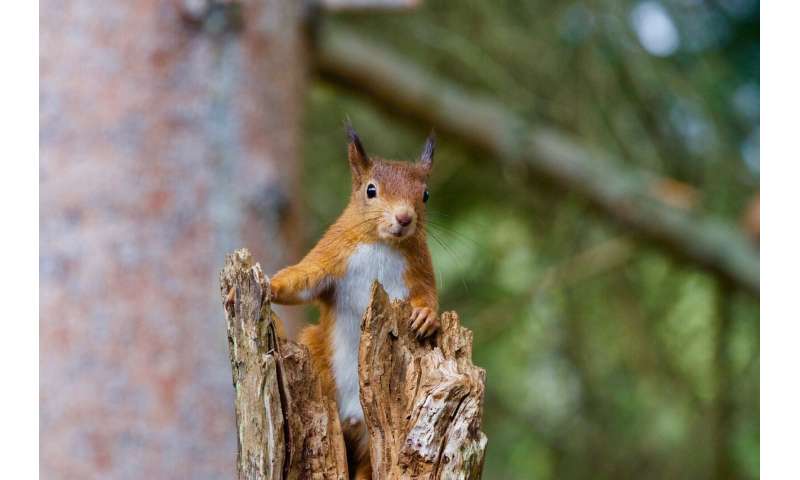
Survey finds gain in endangered red squirrel population

NOVEMBER 16, 2019

Credit: CC0 Public Domain

Wildlife officials say an endangered squirrel subspecies in southeastern Arizona is fighting its way back after much of its mountain habitat was burned by a 2017 wildfire.

The Arizona Game and Fish Department says the Mount Graham red squirrel's population is stabilizing, with a 4% increase recorded in September during an annual survey that produced an estimate of 78 squirrels, up from 75 in 2018.

According to the department, the population peaked at about 550 in the late 1990s. Before the 2017 wildfire, the population ranged between 200 and 300.

Terrestrial wildlife specialist Tim Snow says the results are encouraging though much work remains to help protect the squirrel population.

The squirrel is found only in upper elevation conifer forests of the Pinaleño Mountains.

Thursday, 12 September 2019

Rare giraffes fitted with solar-powered trackers

Conservationists have fitted members of an endangered giraffe species in northern Kenyan with satellite-tracking devices, part of a campaign to monitor and understand them better.

A total of 28 reticulated giraffes have been fitted with the tracking devices, a feat said to be the largest GPS satellite tagging of giraffe in history, the Giraffe Conservation Foundation says.

The species is considered endangered after its population shrank by 60% in three decades, according to the International Union for Conservation of Nature (IUCN).

The solar-powered tracking devices will help conservationists understand their movements and use of the environment.

Approximately 115 giraffes in six African countries have so far been fitted with the trackers, the Giraffe Conservation Foundation says.

“Knowing where giraffe are, how much space they need, and how they move across the landscape seasonally, is vital to inform effective conservation and planning," it said in a statement.

Source

Monday, 5 August 2019

Give endangered jaguars legal rights, Argentina campaigners ask court


With fewer than 20 left in the South American country’s Gran Chaco forest – the big cats could be classed as a ‘non-human person’
Uki Goñi in Buenos Aires
Fri 19 Jul 2019 19.28 BSTLast modified on Mon 22 Jul 2019 10.59 BST
Argentina’s supreme court has been asked to recognize the legal rights of the South American jaguar, of which fewer than 20 individuals remain alive in the country’s Gran Chaco region.
The largest cat in the Americas once roamed the continent as far north as the Grand Canyon, but is now in decline across the entire western hemisphere.
In Argentina, the speckled feline has been driven to the brink of extinction by the destruction of habitat to make way for soy plantations and cattle ranches.
Argentina’s National Parks Administration estimates that fewer than 250 are left alive in the country, and only 20 in the Gran Chaco region, a forest that has lost some 12m hectares (an area larger than Denmark) in the last 35 years.

On Friday, lawyers representing Greenpeace Argentina 
argued in the supreme court that the country should recognize the rights of the entire species.
“If the legal rights of inanimate corporations are recognized, why not the legal rights of a species of nature, which is very much alive,” said the group’s lawyer Enrique Viale.

A strong legal precedent was set in Argentina in 2016 when Argentina’s courts recognized a 29-year-old Sumatran orangutan held at the Buenos Aires zoo, named Sandra, as a “non-human person”.

Greenpeace Argentina is now seeking a similar status for the remaining jaguars in the Gran Chaco. “We now want recognition of the rights of the entire species,” Viale told the Guardian.


Friday, 2 August 2019

Endangered Bornean orangutans survive in managed forest, decline near oil palm plantations


JULY 17, 2019

Recent surveys of the population of endangered Bornean orangutans in Sabah, the Malaysian state in the north-east of Borneo, show mixed results. Populations have remained stable within well-managed forests, where there is little hunting, but declined in landscapes comprising extensive oil palm plantations, according to a new study in the open-access journal PLOS ONE by Donna Simon of the World Wide Fund for Nature—Malaysia, and colleagues. The study is the largest and most complete population survey of orangutans on Borneo, home to this endangered and endemic species.
Lowland forest is the most important habitat for orangutans in Sabah. Over the past 50 years, however, extensive logging and land clearance for agriculture caused habitat loss and fragmentation, which led to a drastic decline in their numbers, but the full extent of the effects on orangutan population have been difficult to estimate.
In the current study, the authors conducted aerial transects totaling nearly 5,500 kilometers across Sabah state, almost three times the length of a previous survey done in 2002-2003. Based on the number of nests, they calculated a population of 9,558 orangutans, including a previously unknown population of about 1,770 orangutans in many widely dispersed sub-populations.


Thursday, 25 July 2019

New research helps managers and ship crews predict locations of blue whales so ships can maintain safe distances


JULY 10, 2019

A new model based on daily oceanographic data and the movements of tagged whales has opened the potential for stakeholders to see where in the ocean endangered blue whales are most likely to be so that ships can avoid hitting them.
The research was published in Diversity and Distributions by Dr. Briana Abrahms, research ecologist at NOAA Fisheries' Southwest Fisheries Science Center, and related the movements of more than 100 tagged blue whales to daily oceanographic conditions. Abrahms found that ocean conditions affected the whales' travels in very predictable ways.
Abrahms and her colleagues are now developing an app that will allow managers and ship crews to predict the location of blue whales as they transit along the West Coast. The app will also be accessible to the public and to managers making recommendation on vessel slow-downs or the use of alternative shipping lanes.
"The more we learn about how the physical ocean affects whales and other marine life, the better we are able to predict where those species will be," Abrahms said. "The goal is to put this technology into the hands of managers, the shipping industry and other users who can most use it to help protect these animals from ship strikes and other human threats."

Wednesday, 24 July 2019

Unprecedented display of concern and 'consolation' toward an unknown monkey offers hope for endangered macaques


JULY 10, 2019

A wild group of endangered Barbary macaques have been observed, for the first time, "consoling" and adopting an injured juvenile from a neighbouring group. The observations by a scientist from Oxford University and the International Fund for Animal Welfare (ifaw) are published today in the journal Primates.
'Pipo', a nearly three-year-old juvenile, was seriously injured and became separated from his group following a road traffic accident.
He was found distressed and alone two days later by a neighbouring Barbary macaque group. Although these monkeys had no social relationship with Pipo, they approached, groomed and affiliated with him, and accepted him into their group. Pipo made a full recovery and stayed with them for four months until returning to his own group.
The observation in Ifrane National Park in the Middle Atlas Mountains of Morocco—one of the Barbary macaque's last remaining areas of habitation—provides valuable information and offers hope to researchers and local communities who are trying to safeguard and boost the endangered species, which is under threat following habitat loss and poaching.


Wednesday, 10 July 2019

As deaths mount, have right whales reached a 'tipping point'?


JULY 8, 2019

by Dinah Voyles Pulver
In February 2016, East Central Florida animal lovers were riveted by an endangered right whale nicknamed Clipper and her baby. Clipper gave birth to the calf off Florida's east coast, then found her way into Sebastian Inlet, giving many people their first look at two of the massive, endangered whales.
This week, right whale biologists and scientists gathered around her body on a distant beach at Grand Etang, Quebec. She is one of six whales found dead in June in Canada's Gulf of St. Lawrence.
Clipper's story illustrates the highs and lows of the efforts in the United States and Canada to save the critically endangered animals.
Jim Hain, senior scientist and program leader for the Marineland Right Whale Project, fears the whales may have reached "a tipping point."
A network of 200 volunteers in Volusia, Flagler and Brevard counties eagerly watch the ocean each winter hoping for a glimpse of any whale, but especially a female right whale with a new calf.
Word of a sighting or a new calf ripples quickly through the community. Whale calving has dropped off dramatically off Florida's coast in recent years, bottoming out with no new calves in 2018. but seven calves were reported this winter, raising hopes that perhaps the whale calving would begin returning to its former numbers.


Wednesday, 3 July 2019

British Columbia’s most endangered amphibians get new lease on life – via Herp Digest


Mia Gordon, Reporter, British Columbia, 6/25/19, Weather Channel,  For video go to https://bit.ly/2RDujNC

Vancouver Aquarium steps in to help the endangered leopard frog.

They may be the most endangered amphibian in British Columbia, but this week more than 1,600 northern leopard frog tadpoles found their way back into the wild with the help of the Vancouver Aquarium.

Back in the 1990s leopard frog numbers started to decline across the country and while they were able to recover in other provinces, their numbers continued to struggle in B.C. because it was difficult for the frogs to cross the Rockies. That is when the Vancouver Aquarium stepped in.

They began breeding frogs to release back into the wild, and since 2013, they have returned more than 7,000 tadpoles to the wild.

While the aquarium continues to do its part, there are things we could do to help the leopard frog as well.


Sunday, 30 June 2019

Rhino release: Endangered animals despatched to Rwanda


By Victoria Gill Science reporter, BBC News
25 June 2019
"It's just fantastic.
"These animals were taken from Africa decades ago to display to the public [in European zoos] and now have a real conservation role in Rwanda," Mark Pilgrim, Chester Zoo's chief executive says proudly.
He is summing up the significance of the largest transportation of rhinos from Europe to Africa to ever happen.
It culminated on Monday as five zoo-born eastern black rhinos were released in the vast Akagera National Park.
The three females and two male rhinos, aged between two and nine years old, came from Flamingo Land in Yorkshire, the Czech Republic's Dvur Kralove safari park and Ree Park Safari in Denmark.
The 6,000km (3,700 miles) journey began at Dvur Kralove - where the animals have been gathered to be prepared for the trip since late last year - and concluded as each animal stepped out of its custom-made transport crate and into a large, temporary enclosure in the 1,000 sq km park.
They will remain in the enclosure, known as a boma, for several months until vets and wildlife experts, who stay in a nearby camp, are happy that they have settled and are ready for life in the wild.
Rhino dating game
The animals' journey to Akagera, via a flight from Prague to the Rwandan capital of Kigali, took around 30 hours. But the project to bring these animals back to Africa began years ago.
The European Association of Zoos and Aquaria has co-ordinated what Dr Pilgrim described as a huge "rhino dating game" and it is something he has been running.
"All the members signed up to move animals around, so we can match the most compatible pairs for breeding," he said.


Friday, 14 June 2019

Environmental Group Sues Federal Government Over Endangered Central Texas Salamanders – via Herp Digest


By Becky Fogel • 6/3/19, KUT.org

An environmental advocacy group has filed a lawsuit against the U.S. Fish and Wildlife Service, claiming federal officials are failing to protect threatened species of salamanders in Central Texas.

The Arizona-based Center for Biological Diversity argues the federal agency has not taken steps to protect the habitats of the Georgetown and Salado salamanders since they were first listed as threatened five years ago.

"This lawsuit is all about making sure that there will be clean water and habitat for these salamanders moving into the future," said Elise Bennett, an attorney with the group.
The salamanders’ habitat includes springs, wet caves, and groundwater around the northern part of the Edwards Aquifer.

"One thing that’s really unique about them and I find particularly endearing is that their heads are crowned by these beautiful fluffy gills," Bennett said. "They use these gills to live their entire lives underwater, and that’s why it’s so important to protect springs for these salamanders.”

Earlier this year, the Center for Biological Diversity and the Save Our Springs Alliance announced plans to sue the Texas Department of Transportation over highway construction in Austin that they said threatened endangered salamanders living in cave systems under the project. 

An attorney with the Center for Biological Diversity told KUT at the time the intent was not to stop the project but to make sure the salamanders were protected going forward.   

Thursday, 23 May 2019

Columbus Zoo & Aquarium Honors Sea Turtle Conservationist (Dr. Karen Eckert, the executive director of the Wider Caribbean Sea Turtle Conservation Network (WIDECAST) with $50K Grant – via Herp Digest


Powell, OH— On Saturday, May 11, the Columbus Zoo and Aquarium will honor Dr. Karen Eckert, the executive director of the Wider Caribbean Sea Turtle Conservation Network (WIDECAST), with its biennial Commitment to Conservation Award. The honor includes a $50,000 grant, made possible with the generous support of award sponsors, Kim and Steve Germain and the Germain Motor Company. Dr. Eckert will be recognized at the Zoo’s 10th annual Wine for Wildlife event, presented by OhioHealth, which raises funds to support the Zoo’s international wildlife conservation grant program.

Dedicated to averting the extinction of six species of endangered sea turtles in the Caribbean basin, WIDECAST embraces the largest network of sea turtle research and conservation projects in the world. Volunteer Country Coordinators serve in more than 40 Caribbean nations and territories, and the network emphasizes science-based tools in national policy-making and community conservation initiatives. Eckert’s leadership of this unique international network constitutes an achievement unparalleled in marine biodiversity conservation as sea turtles face threats, including: the illegal harvest for their shells, meat and skin; getting caught in fishing nets as by-catch; eating or getting tangles in marine debris like plastics; and the loss of nesting beaches due to development rising sea levels.

Saving sea turtles requires the coordination of local communities, governments, scientists, and others, and Eckert’s sea turtle conservation contributions include a landmark series of “Sea Turtle Recovery Action Plans,” the first species-level recovery plans ever developed for many Caribbean nations, providing Caribbean governments and non-governmental organizations (NGOs) with priority recommendations for the recovery of declining sea turtle populations. In addition to convincing governments and rural communities alike to become more involved in conservation, Eckert has guided this vast region in the design and implementation of international programs, including a centralized tag database, index population monitoring, sea turtle-based school curricula, harmonized legislation, alternative livelihood strategies, research on migratory pathways, and more. Eckert has also led the network in peer-training and the development of standardized best practices as a way for the tide to “raise all boats.” Her diverse portfolio of publications includes training modules and handbooks for responding to sea turtles in distress, surveying critical habitat, monitoring reproductive activity, guiding fishers to use less destructive gear, instructing beachfront hotels in protecting adjoining nesting habitats, and much more.

Eckert’s work is one of more than 80 projects in over 40 countries that are supported by funds raised through the Columbus Zoo. Since 1994, the Zoo has contributed over $170,000 to Eckert’s work. She was selected to receive the Commitment to Conservation Award by exemplifying how collaborations between field researchers and zoos can help save wildlife.

“Dr. Eckert is a brilliant scientist, as well as a warm, charismatic, and natural leader who has an incredible capacity for getting people excited about a common goal, and her passion for sea turtle conservation is unrivaled, both in results and its scope,” said Doug Warmolts, Vice President of Animal Care at the Columbus Zoo and Aquarium. “Not only does Dr. Eckert apply the Columbus Zoo’s support to her field work but the information she gains and shares with us is used to help inspire and educate millions of our guests with ways they, too, can be directly involved in sea turtle conservation.”

When Eckert accepted the position of executive director of the fledgling WIDECAST in late 1989, few thought such a network possible. Today, this innovative program is a model for multilateral marine resource management in the Caribbean Sea and throughout the world. Grassroots organizations have been formed in more than 20 nations; remarkably, 70% of Caribbean governments now protect sea turtles, and Eckert has inspired thousands of people, mostly in poor countries, to actively create a more sustainable future. As a direct result of her efforts, the Caribbean Sea is today the only regional sea in the world where selected populations of all native sea turtle species are seen to be rising.

“Dr. Eckert recognizes that with the number of threats that wildlife species face, effective conservation has to address a number of complexities,” said Tom Stalf, President and CEO of the Columbus Zoo and Aquarium. “The Columbus Zoo and Aquarium is proud to be a long-term supporter of Dr. Eckert’s work as her commitment, resolve, and vision continues to inspire individuals, communities, and governments to come together to make a positive impact for sea turtles and their future.”

In 1994, her early achievements also earned her an induction into the “Global 500 Roll of Honor for Environmental Achievement” by the United Nations, when UNEP characterized her as “one of the most important figures in conservation and grassroots community empowerment in the field of endangered species in the Wider Caribbean Region.” In 1996, she was among the first cohort of Pew Fellows in Marine Conservation, a prestigious three-year fellowship that specifically recognized her efforts to restore depleted sea turtle populations and promote sustainable coexistence between Caribbean people and their marine resources. Additionally, she received the 2003 Chevron Texaco Conservation Award for “providing the world with a unique model that shows how people and marine life are not only able to coexist, but to flourish.”

Eckert will be the fourth recipient of the Zoo’s Commitment to Conservation Award. The Columbus Zoo established this award in 2011 to publicly recognize and reward the unsung heroes of global wildlife conservation and to honor the lifetime achievements and dedication of our field conservation partners. The previous recipients are: Claudine Andre, Lola Ya Bonobo founder, who established a sanctuary for bonobos in Kinshasa Province, Democratic Republic of Congo; Marc Ancrenaz, co-founder of the Kinabatangan Orangutan Conservation Program (KOCP) based in Borneo, who works to raise awareness about the orangutan and the importance of protecting the species’ habitat; and Dr. Patrícia Medici, the founder of the Lowland Tapir Conservation Initiative (LTCI; IPÊ – Instituto de Pesquisas Ecológicas, Institute for Ecological Research) in Brazil, who helped discover the vital role tapirs play in the ecosystems they inhabit.


Monday, 20 May 2019

Sea turtle survey shows the endangered animals are making a comeback – via Herp Digest


Hunting bans and other conservation efforts may be paying off — though warming oceans remain a serious threat.Sea turtle survey shows the endangered animals are making a comeback.


May 1, 2019, by Jaclyn Jeffrey- Wilensky, NBCNews.com

A new survey of sea life in the Pacific Ocean suggests that some endangered sea turtles are making a comeback. The survey showed that populations of green sea turtles along dozens of coral reefs in waters around Hawaii and other nearby regions either remained stable or increased from 2002 to 2015.

The scientists behind the survey, which was described April 24 in the journal Plos One, called the finding compelling evidence that conservation efforts like hunting bans are working.

“You often hear such bad and challenging news about the threats that our ocean faces,” said Kyle Van Houtan, chief scientist at the Monterey Bay Aquarium in Monterey, California, and leader of the team of researchers that conducted the survey. “There are places where there are a lot of sea turtles very close to shore. And that’s good news.”

Once hunted for their meat, green sea turtles were designated an endangered species in 1978. They're now protected under U.S. law and international treaties.

The same survey suggested that populations of hawksbill turtles, another protected species that is even more endangered, remain perilously low.

The survey effort began almost by accident, according to Van Houtan. On a research expedition to count fish living on reefs, divers with the National Oceanic and Atmospheric Administration found themselves counting turtles, too.

As it turns out, counting turtles in the water is more reliable than counting them on land, where only egg-laying females and their hatchlings are visible. “Really understanding the dynamics of turtle populations requires more attention to different age classes, and that means getting out on the water,” David Godfrey, executive director of the Sea Turtle Conservancy in Gainesville, Florida, told NBC News MACH in an email.

So Van Houtan and his colleagues decided to formalize the count. Over 13 years, divers trained to count green sea turtles and hawksbills visited 53 reefs across the Pacific, including spots in Hawaii, the Marshall Islands and American Samoa. Towed along by a slow-moving boat for a total of more than 4,500 miles, the researchers tallied more than 3,400 turtles.

The research represented a “Herculean effort,” Van Houtan said, adding, “This is the kind of data and the kind of study we’ve wanted for so long.”

Analysis showed that what the scientists call "turtle density" — the estimated number of animals per kilometer based on the survey counts — had increased by as much as 8 percent each year in some areas.

Turtle density increased the most in areas that tended to have few turtles at the start of the census period, including the Hawaiian Islands. The greatest turtle density was seen In the Pacific Remote Island Areas, uninhabited islands west of Hawaii, with an average of 3.62 green turtles per kilometer.

Hawksbill turtles, meanwhile, were outnumbered by green turtles by 11 to 1. “Their numbers have not really come back,” Van Houtan said of the hawksbills.

The highest turtle densities were seen in regions with plenty of seagrass and algae for the turtles to eat; minimal human presence; and, most important, water temperatures at 80 to 82 degrees Fahrenheit. Sea turtles flourish in that "Goldilocks" environment, which is neither too hot nor too cold.

But as the world's climate continues to warm, turtles and other marine species may be forced to relocate. “As the ocean warms with climate change, that ideal temperature is going to move toward the poles and away from the equator,” Van Houtan said. “As the temperatures change, those distributions are going to change.”

While Van Houten is wary of the effects this move will have on the greater coral reef ecosystem, he’s optimistic about the turtles’ odds for survival.

“They’re very resilient animals, and they’ve lived for millions of years,” he said. “The turtles aren’t going to roll over and die.”

Wednesday, 15 May 2019

Even more amphibians are endangered than we thought


MAY 6, 2019
At least a quarter of the world's approximately 8,000 known species of amphibian are recognized as threatened and at risk of extinction. But due to a lack of data on many amphibian species, only about 44 percent of amphibians have up-to-date assessments on their risk of extinction, compared to nearly 100 percent of both birds and mammals. Now, researchers reporting May 6 in the journal Current Biology have used known ecological, geographical, and evolutionary attributes of these data-deficient species to model their extinction risk—and their assessment suggests that at least another 1,000 species are threatened.
"We found that more than 1,000 data-deficient amphibians are threatened with extinction, and nearly 500 are Endangered or Critically Endangered, mainly in South America and Southeast Asia," said Pamela González-del-Pliego of the University of Sheffield and Yale University. "Urgent conservation actions are needed to avert the loss of these species."
The lack of information on these species results from high rates of new species description together with a lag in assessment rates in the last 15 years, she explains. All told, about 2,200 amphibian species had been deemed data deficient. Their extinction risk status simply wasn't known.

Monday, 13 May 2019

Melbourne zoo hatches plan to save southern corroboree frog

Containers holding more than 1,600 of endangered species’ eggs placed in remote areas of Mt Kosciuszko national park


Sun 12 May 2019 02.19 BSTLast modified on Sun 12 May 2019 02.20 BST

A few days before the United Nations released a report warning that 1 million species, including 40% of all amphibians, could become extinct within decades, staff from Melbourne zoo were nursing chilled containers of frogs’ eggs to be taken to remote areas of sphagnum bog in the Mt Kosciuszko national park.

The containers held 1,673 fertilised eggs of the critically endangered southern corroboree frog, a species near the top of Australia’s extinction watchlist.

The eggs were packed into sphagnum moss for transport. Half were placed in one of 22 special disease-free areas that had been cleared of chytrid fungus, which is responsible for wiping out much of the wild population. The other half were placed in protected tubs in the wild, out of which the tadpoles will be able to climb once the eggs metamorphose.

That will not happen until spring. The tadpoles, which come out of their eggs as soon as they are released into the water, will spend the cold winter months nestled into the moss beneath a layer of snow and ice.

Wednesday, 8 May 2019

Life-threatening foot disease found in endangered in Chile

Virus could pose conservation threat to huemul populations
Date:  April 17, 2019
Source:  University of California - Davis
Scientists report the first cases of foot disease for endangered huemul deer in Chilean Patagonia in a study led by the Wildlife Conservation Society and the University of California, Davis' One Health Institute, with partnering institutions in Chile and the United States.
In the study, published April 17 in the journal PLOS ONE, researchers found foot lesions in 24 huemul deer in Chile's Bernardo O'Higgins National Park between 2005 and 2010. The park remains one of the few strongholds for the species, which lives in the rugged mountainous terrain of southern Argentina and Chile.
The foot disease causes severe pain, swelling, partial or complete loss of the hoof and in many cases, death. Affected animals become unable to move and forage, leaving them susceptible to starvation and predation.
Researchers identified parapoxvirus as the likely cause of the disease. About 40 percent of the 24 affected deer died, suggesting the virus could pose a considerable conservation threat to the already vulnerable species.
"We knew that deer were getting sick and dying from this disease for many years, but we didn't know what was causing it," said corresponding author Marcela Uhart, a wildlife veterinarian with the UC Davis One Health Institute and director of the Latin America Program within UC Davis' Karen C. Drayer Wildlife Health Center. "We're really excited that we found a potential cause for this disease. Now we need to learn from it so we can be better prepared to help this species."


Related Posts with Thumbnails

ShareThis