Showing posts with label Alberta. Show all posts

Monday, 24 February 2020

Diseases spread from wildlife pose risk to livestock and humans in Alberta, scientists find


FEBRUARY 11, 2020
by Katie Willis, University of Alberta
Diseases transmitted from wildlife are a common threat to livestock and humans in Alberta, according to new research by University of Alberta biologists.
"One of the biggest risks to the livestock industry is the transmission of disease from wildlife to livestock," said Mark Boyce, an ecologist in the Department of Biological Sciences.
Boyce said the long list of diseases that occur between livestock and wildlife includes anthrax, bovine tuberculosis, brucellosis, and many species of worms such as tapeworm and roundworm.
"And in addition to infecting one another, many of the diseases that are shared by wildlife and livestock are zoonotic, meaning that they also can infect humans," he noted.
Boyce said the foothills in the southwestern part of the province are home to wild elk as well as cattle on ranchlands—and when the species intermingle, the potential for disease to spread grows.
The researchers used data gathered from GPS-collared elk combined with cattle management information from 16 cattle operations in southern Alberta to identify locations and times where the probability of disease transmission is high.
They found the highest risk occurs in winter months, when livestock and elk are in the same pastures and use the same resources.
Based on their results, the researchers developed guidelines to help producers minimize the risk of infection.
"Livestock management that minimizes the risk of contact with wildlife will reduce the risk of disease transmission," said Boyce. "This includes keeping cattle in pastures near farm buildings during winter and calving season.
"It is also important to keep mineral supplements and hay next to ranch buildings, again to reduce the contact between cattle and elk," he added.

Thursday, 10 January 2019

Snowed in: Wolves stay put when it's snowing


University of Alberta biologists examine the impact of snowfall events on wolves in northeastern Alberta
Date:  December 19, 2018
Source:  University of Alberta
Wolves travel shorter distances and move slower during snowfall events, according to new research by University of Alberta biologists. The effects were most pronounced at night, when wolves hunt, and behaviour returned to normal within a day. Wolf tracks across snow in northeastern Alberta.
Wolf tracks across snow in northeastern Alberta. The study found that wolves travel shorter distances and move slower during snowfall. Photo credit: Amanda Droghini
"Our findings suggest that there is something about actively falling snow that causes wolves to slow down," said Amanda Droghini, a former MSc student in the Department of Biological Science and lead author on the study. "We don't know the exact mechanism behind that. It's unlikely that they were staying still because they were feasting on a recent kill. Instead, active precipitation might affect wolves' hunting abilities. Like rain, snow clears the air column of scent molecules. So, maybe falling snow makes it harder for wolves to detect the smell of prey."
Over the course of two winters, the researchers used remote cameras to identify snowfall events and estimate snow depth. To study wolf movement, they collected telemetry data from 17 wolves to calculate travel speed and duration, as well as resting periods. It is the first study to examine how large carnivores respond to snowfall events.

Thursday, 23 March 2017

Big bat find in Alberta’s boreal forest


Date: March 16, 2017
Source: Wildlife Conservation Society

The Wildlife Conservation Society Canada and Alberta Environment and Parks announced today the discovery last month of the largest Alberta bat hibernation site (based on estimated bat count) ever recorded outside of the Rocky Mountains.

The newly-discovered cave is being used as a hibernaculum by at least 200 Little Brown Myotis bats, listed as Endangered under Canada's Species at Risk Act. Formed by weak sulphuric acid dissolving bedrock, conditions in the narrow, muddy cave make it impossible to fully inspect hand-sized pockets, cracks and fissures that compose roosting sites. "This means population numbers could be significantly higher," suggests Dave Hobson, Senior Wildlife Biologist of Alberta Environment and Parks.

Said Dave Critchley of the Northern Alberta Institute of Technology (NAIT), who co-coordinates WCS Canada's BatCaver program in Alberta, and was one of the cave explorers: "Finding a cave in Alberta's boreal forest inhabited by several hundred bats is a real breakthrough. It demonstrates that this kind of bat habitat may well exist in other non-mountainous areas throughout the boreal forest."

Said Shannon Phillips, Minister of Environment and Parks: "This is a fascinating and important find. Understanding where Alberta's different bat species are living is a crucial part in preventing the spread of white-nose syndrome and in protecting sensitive habitats."

The discovery of hibernation spots has become extremely urgent in western Canada since the 2016 discovery of white-nose syndrome (WNS) in Washington State. Bats with WNS are infected with a fungus that wakes the individual bats and forces them to burn through their precious stored winter fat long before the return of insect season. It spreads throughout hibernation sites and can kill more than 90 percent of resident bats. WNS has devastated bat colonies in Eastern North America and could be about to erupt in the West.

Sunday, 21 August 2016

Alberta weighs ban on spear hunting after man films 'humane' bear killing

Environment ministry describes video of Josh Bowmar fatally spearing a bear ‘archaic’ and ‘unacceptable’ as Bowmar defends killing as ethical

Ashifa Kassam in Toronto and Oliver Milman in New York
Tuesday 16 August 201622.08 BSTLast modified on Tuesday 16 August 201623.53 BST

Authorities in the Canadian province of Alberta have vowed to ban spear hunting and are weighing whether to lay charges against an American hunter after a video surfaced showing him killing a black bear with a spear.

The video – one of several hunting videos posted to the YouTube account of Josh Bowmar – shows Bowmar holding a long spear with a GoPro camera attached to it as a mature bear repeatedly approaches a bait bin set up to lure it to the site.

After the bear nears for the third time, Bowmar, a college javelin champion and Ohio-based fitness trainer, launches the spear. He falls to his knees in excitement as he realises he struck the bear. “He’s going down. I drilled him perfect. That was the longest throw I thought I could ever make,” he tells the camera. “I just did something I don’t think anybody in the entire world has ever done and that was spear a bear on the ground on film. And I smoked him.”

His delight continues as he finds the spear, cast off by the bear as it ran into the woods, and examines the blood marks on it. “Oh yeah, I got mad penetration,” he says. “These things are absolute lethal killing machines.”

The video was seen more than 200,000 times before its setting was changed to private on Monday.

The Alberta environment ministry described the spear hunt seen in the video as “archaic” and “unacceptable”.

A ban on spear hunting will be introduced this fall as part of an update to the province’s hunting regulations, a spokesperson for the ministry said in a statement. “In the meantime, we have asked Fish and Wildlife officers to investigate this incident to determine if charges are warranted under existing laws.”

The video credits Alberta-based outfitters John and Jenn Rivet for organising the hunt. They did not respond to a request for comment.

In an email to the Guardian, Bowmar defended the use of a spear to hunt. “First and foremost, spear hunting gives the animal the greatest chance of escape, considering our ethical killing range is within 10 yards.”


Wednesday, 1 July 2015

Government takes action against the giant goldfish clogging up Canada's lakes and rivers

Goldfish released from domestic fish tanks are growing to gargantuan sizes, and causing problems for Alberta's fragile ecosystem


Thursday 25 June 2015

Giant goldfish released from domestic fish tanks are multiplying like rabbits in the ponds and lakes of Alberta, Canada, and the local government has been forced to take steps to prevent them spreading further.

Some of the rogue fish are growing to the size of dinner plates, and they're causing huge problems for the delicate native ecosystem.

The problem stems from people releasing their pet goldfish into Alberta's streams and lakes once they get sick of taking care of them.

Once in the wild, the fish can survive Alberta's harsh winters and grow to huge sizes. Since they have no natural predators in the province, they can out-compete native fish species for food and other resources and reduce biodiversity in the area.

Kate Wilson, aquatic invasive species coordinator at Alberta Environment and Parks, told CBC Calgary she was surprised at how large some of the fish are, and at the sheer numbers they are finding.

Friday, 29 May 2015

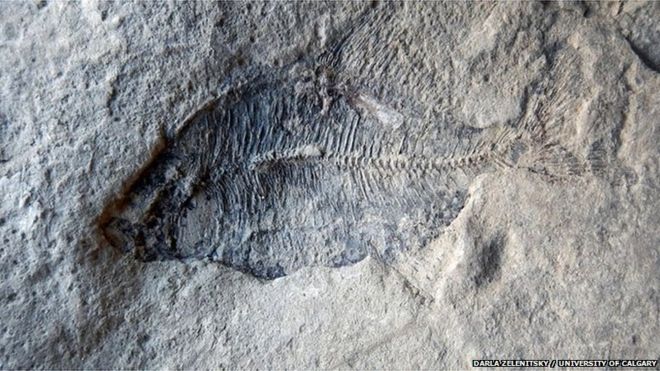
Alberta 'creationist' finds 60m-year-old fish fossils

50 minutes ago 
From the sectionUS & Canada
The fish fossils were found in rocks which are 60 million years old

When Calgary digger driver Edgar Nernberg came across five fish fossils in his digger bucket, he knew right away his find was "extraordinary".

The Albertan, who has a longstanding interest in fossils, was digging a basement for a new home in Calgary's north-west.

Mr Nernberg is, according to reports, a donor to Alberta's Big Valley Creation Science Museum.

However, he realised these fossils should be seen by a palaeontologist.

"When the five fish fossils presented themselves to me in the excavator bucket, the first thing I said was you're coming home with me, the second thing was I better call a palaeontologist," Mr Nernberg said, according to a statement from the University of Calgary.

The specimens were in sandstone from the Paskapoo Formation, a Palaeocene age sedimentary rock which underlies parts of southern Alberta.

'Hasn't changed my mind'
About 60 million years old, these rocks preserve evidence of life from the time following the mass extinction event at the end of the Cretaceous period, which wiped out three-quarters of all species on earth, including the dinosaurs.

"Because complete fossils are relatively rare from this time period in Alberta, any such discoveries are significant as they shed light on the nature and diversity of animals that lived not long after the extinction of the dinosaurs," said University of Calgary palaeontologist Darla Zelenitsky.

Wednesday, 21 January 2015

Wolf cull will not save threatened Canadian caribou

Study suggests Canadian government strategy is not enough to preserve caribou population in the boreal forest.
20 January 2015

Boreal caribou populations have declined as industrial activity in Canada's boreal forest has increased.

Since 2005, the Canadian government has shot nearly 1,000 wolves to protect a herd of threatened boreal caribou in the forests of Alberta, Canada. But a recent study suggests that this approach has limited benefit.

It is enough to keep the population of caribou from shrinking further, but it will not allow the animals — a geographically distinct population ofRangifer tarandus, which in Europe is known as the reindeer — to increase their number, finds the November analysis published in theCanadian Journal of Zoology1. Such an increase would require placing new limits on industrial development in Alberta, a conclusion that adds fuel to an ongoing debate about the ecological consequences of human activity in the boreal forest.

Caribou have been listed as threatened since 2002, mainly because much of their boreal forest habitat has been sliced into small fragments by a web of roads, pipelines, clear-cut swathes and well pads. Moose and other deer species do well in these open areas, and their populations have boomed — supporting an increasing population of wolves, which have learned to use the roads and pipelines to access caribou hiding in the deep woods.

Tuesday, 29 October 2013

Climate Change Has Silver Lining for Grizzy Bears

Oct. 28, 2013 — Global warming and forest disturbances may have a silver lining for threatened species of grizzly bears in Alberta, Canada.

In a 10-year study that monitored 112 bears in Alberta's Rocky Mountain region, University of Alberta biologist Scott Nielsen and his colleagues found that warmer temperatures and easier access to food associated with forest disturbances helped the grizzlies to build more body fat, known to increase the chances of successful reproduction for mothers.

The resulting 'silver spoon effect' shows that bears born into these favourable conditions have a head-start in life, said Nielsen, an assistant professor in the U of A Department of Renewable Resources.

"Understanding variations in body size helps us understand what limits grizzly populations," Nielsen said. "We get clues about the environments that most suit grizzlies by examining basic health measures such as body size. A simple rule is, the fatter the bear, the better. Certain environments promote fatter bears.

The findings, published in BMC Ecology, may help influence forest harvest designs to enhance habitat for the Alberta grizzly, which is classed by the Alberta government as a threatened species. Currently there are only about 750 of the bears in the province, half of them adults.

Monday, 7 October 2013

Oil patch workers stumble upon massive new ‘complete find’ dinosaur fossil in Spirit River, Alberta

EDMONTON — Experts are calling a dinosaur fossil unearthed in northern Alberta this week one of the “most complete finds in this part of the world in a long time.”

Brian Brake, executive director of the Philip J. Currie Dinosaur Museum, said the fossilized remains of a hadrosaur were discovered at an energy company’s work site near Spirit River.

Officials from the pipeline firm contacted the museum, which sent paleontologists to assess the find.

“What we have is a totally composed tail,” Brake said. “It’s beautiful.”

The Currie Museum contacted its counterparts at the Royal Tyrrell Museum in Drumheller, which sent a team to the work site on Wednesday.

The paleontologists will attempt to carefully remove the fossil from the work site as soon as possible, taking it to either the Tyrrell Museum or to the University of Alberta.

The portion of the tail is about three metres long and the bones along its tail can be easily seen. The hadrosaur, a plant-eating dinosaur with a bill that resembled a duck’s, was probably 10 to 15 metres long, Brake said. They existed during the Upper Cretaceous Period.

For the original version of this story, go to the Edmonton Journal

Wednesday, 24 July 2013

Alberta: Bow Valley flooding exposes rotting carcass of a Sasquatch. Legendary Cryptid believed to be a surviving Gigantopithecus

(SNN) – The recent mass flooding in southern Alberta has exposed a rotting corpse of what is believed to be the legendary Sasquatch. Cryptozoologists worldwide are lining up to examine the remains, which were located by a hiker along the Bow River, northwest of Canmore, Alberta.

Eminent Paleontologist Wally Johnson has conducted a preliminary site examination of the remains, and has discovered that the carcass appears to be ancient. “I can report that from the bone structure, stature and a comparison of the mandibles and teeth, that I believe the remains are that of a Gigantopithecus.”

“We have always believed that the Sasquatch, Yeti, or even Bigfoot, if you will, was really a surviving clan of Hominids connected to the line of Gigantopithecus.” stated Cryptozoologist Coren Lowman, “The find near Canmore is extraordinary!”

Friday, 30 November 2012

Human Disturbances Keep Elk On High Alert


ScienceDaily (Nov. 28, 2012) — University of Alberta researchers discovered that elk are more frequently and more easily disturbed by humans such as ATV drivers than by their natural predators like bears and wolves.

The U of A researchers, led by biologist Simone Ciuti, spent 12 months in southwestern Alberta. The study involved elk herds made up of females and their offspring. The researchers observed the animals' reactions to different rates of human disturbances in the form of traffic on nearby roads and off-road, all-terrain vehicles.

The elk in the study were found on a variety of land types -- public, private and inside Waterton National Park.

The research data showed that starting with a rate of just one vehicle passing by an elk herd every two hours, the animals became disturbed and more vigilant. In this state the elk consume less food, which can affect their health and possibly their calving success.

The researchers found that the highest level of disturbance happened on public lands where the effect of hunting and ATV use was cumulative.

Wednesday, 21 November 2012

Skunk Scares Off Cougar in Camera Trap Photo


A skunk-versus-cougar face-off was caught on film by a camera trap in Waterton Lakes National Park, Alberta, Canada.

"The cougar was looking at the skunk like it might be lunch, and the skunk was looking at cougar like 'you're going to regret this decision,'" said Dennis Madsen, resource conservation manager for the park, who helps manage the hidden cameras. "The cougar chose the path of wisdom and decided to go elsewhere," Madsen told OurAmazingPlanet.

The unusual encounter, snapped in March, is one of thousands of camera trap images that reveal the hidden lives of animals in Waterton Lakes. [See the camera trap images.]

Tuesday, 7 August 2012

Saving endangered amphibian starts with counting them - via Herp Digest


Northern leopard frogs considered a threatened species in Alberta-Endangered species population ecologist Lea Randall says, “If you can’t detect frogs then you can’t protect them.”
By Annalise Klingbeil, Calgary Herald July 30, 2012

CALGARY — Sporting breathable chest waders and armed with a GPS device, endangered species population ecologist Lea Randall will spend the next six weeks crawling in and out of bogs, ponds and marshes across southern Alberta.
Her mission: to count every frog she can find.
The ecologist will carry tools including a stopwatch and oxygen meter as she seeks frog habitats, collects water samples and records the abundance of northern leopard frogs across a 90,000-square-kilometre area south of Drumheller.
Randall recently embarked on six weeks of summer field research as part of a study launched in 2009 by the Calgary Zoo’s Centre for Conservation Research.
Through intensive fieldwork and mathematical modelling, the six-year project aims to gain a better understanding of northern leopard frog population dynamics.
The handsome and charismatic spotted amphibian, which can grow to the size of a human fist, is considered a threatened species in Alberta and an endangered species in B.C., said Randall.
The study and accompanying field research comes at a time when frog and toad populations in Alberta and around the globe are decreasing.
“It’s a worldwide phenomenon . . . the decline of amphibians has been noted on all continents on which amphibians occur,” said Anthony Russell, a professor of zoology at the University of Calgary.
Over the past two decades in Alberta, the number of leopard frogs and Canadian toads have diminished drastically, he said. “It’s very, very noticeable”
While there are still three years left in the extensive northern leopard study, early research shows neither a decrease nor increase in the population of the species.
“So far our preliminary data suggests that the populations have at least stabilized,” said Randall. “So, we don’t see evidence of decline, but we also don’t really see any strong evidence that there’s been species recovery during the period of our study.”
Leopard frogs can be difficult to detect in some habitats. In addition to examining population dynamics, the study aims to improve monitoring techniques.
“If you can’t detect frogs then you can’t protect them,” Randall said.
She said researching the frogs is important because Alberta has so few amphibians. “If even one species goes extinct, we will have lost basically a 10th of our diversity in Alberta.”
Amphibians are a good indicator of ecosystem health, and as frogs and toad numbers decrease, fish and insect species may also be affected.
“People have advocated that amphibians act a bit like the canary in the coal mine. Whatever is affecting them now, as those changes become more drastic and abundant, they will affect other things,” Russell said.
Kris Kendell, a senior biologist with the Alberta Conservation Association, is the co-ordinator of the Alberta Volunteer Amphibian Monitoring Program, which encourages “an army of citizen scientists” to submit their observations.
Kendell said while some frog species in Alberta are stable, others appear sensitive to human impact.
“The decline for the species that have suffered losses in numbers and populations is mostly due to habitat — habitat loss and habitat degradation,” Kendell said.
As the population and development in the province increases, there will be increasing pressure on a species that is part of Alberta’s heritage, Kendell said.
“On the most intrinsic level, amphibians are a part of Alberta’s natural heritage,” Kendell said. “A lot of people’s first experiences with nature and wildlife involve catching frogs or toads at their local slough or wetland (and) hearing their voices in the springtime singing. They enrich our lives in ways that are difficult to measure.”

Friday, 22 June 2012

Endangered caribou, birds and frogs among animals threatened by Enbridge pipeline: documents


OTTAWA — Endangered populations of woodland caribou, along with rare types of birds and frogs, are among a list of at least 15 species that face threats from the potential construction of Enbridge's proposed Northern Gateway pipeline from Alberta to British Columbia, reveals newly released government records.

Internal correspondence between the Department of Fisheries and Oceans and Environment Canada warned the project could affect the populations, listed under schedule one of Canada's Species at Risk Act.


Schedule one is considered to be the most serious of three categories under the federal legislation. The designation is issued for species following a scientific evaluation by a committee of government and non-government experts.

Lawyers for Ecojustice, a Canadian environmental law organization, said the correspondence, released to Postmedia News through access to information legislation, raises new questions about the potential impacts of the project and the risks of proposed changes to laws such as the Species At Risk Act that were included in Finance Minister Jim Flaherty's budget implementation legislation, bill C-38.
A spokesman for the Alberta-based energy company that is proposing the 1,200 km pipeline to ship oil from Edmonton to Kitimat, B.C. and send condensate, used to thin petroleum products for transport in pipelines, in the opposite direction, said it wasn't disputing any species listed under the federal legislation.

But the company also told Postmedia News it was working to reduce impacts to species at risk in the $6.6 billion project's design.
"The route selection process includes consideration for avoidance of protected, critical or sensitive habitats and further route refinements may be considered as new species of concern and their habitat are identified," said Todd Nogier, the manager of corporate and western access communications for Enbridge.

"Northern Gateway will contribute toward additional research to help mitigate the effects of the project on the marine, freshwater and terrestrial ecosystems."

The notice about the species at risk was sent on July 21, 2010 by Alastair Beattie, an environmental assessment analyst at the fisheries department, to Jeffrey Barry, the manager of environmental assessment and marine programs section of Environment Canada.

The Northern Gateway project and other proposed pipeline projects would allow Canadian oil companies operating in the oilsands region to expand production and exports to new markets in the United States and Asia.

Apart from the boreal and southern mountain populations of woodland caribou, the list also included sprague's pipit, the short tailed albatross, the pink footed shearwater, the marbled murrelet, the northern goshawk Queen Charlotte (laingii) subspecies, the western toad, the yellow rail, the rusty blackbird, the western screech-owl, the peregrine falcon pealei subspecies, the cryptic paw, the coast tailed frog, and the long-billed curlew.

The 15 species listed in the notice did not include marine mammals such as humpback and fin whales that could be killed or harmed by the increased traffic or unintentional collisions with supertankers transporting the oil from the pipeline.

Continued:  
http://www.theprovince.com/technology/Endangered+caribou+birds+frogs+among+animals+threatened+Enbridge/6814256/story.html 

Rare sighting of muskox reported in northern Alberta - via Chad Arment


When a large, brown animal was spotted near North Leland Lake in northern Alberta on Sunday, people assumed it was a moose. Maybe a bison.

But as the beast stepped out into the open, it became clear that it was actually a muskox.

“They were just overwhelmed to see that and very impressed,” said Dan Wettlaufer, owner of the Andrew Lake Lodge.

Muskox are arctic mammals with thick coats and long, curved horns. Wettlaufer said he normally has to travel 500 kilometres north of Leland Lake, which is near the Alberta/Northwest Territories border, to see one.

“For the casual person that hasn’t seen one, you kind of have to imagine the combination of a bison and a woolly mammoth. They have a real unique prehistoric character,” said Wettlaufer.

He thinks this might be the first sighting in Alberta.

The muskox made a couple of appearances on Sunday, even attracting the attention of the lodge’s resident dogs.

“He decided he wasn’t going to be bossed around by a couple of dogs and he charged on them. They came scurrying out of the bush,” said Wettlaufer.

“It was quite a sight.”

Don Thomas, a former research scientist with the Canadian Wildlife Service, said the incident is definitely rare.

“It would be very unusual for one to come that far into the forested area because they tend to stay mostly on the tundra,” he said.

The animals began expanding their territory 20 to 30 years ago, with some moving further north and others heading into parts of Saskatchewan, he said. The reasons are unknown but could relate to poaching or global warming.


Read more: http://www.edmontonjournal.com/news/Rare+sighting+muskox+reported+northern+Alberta/6781363/story.html#ixzz1yKzG8wBk
Related Posts with Thumbnails

ShareThis