Showing posts with label genetic code. Show all posts

Tuesday, 29 April 2014

Floating Lab Used In Quest To Crack Genetic Code Of Mysterious Marine Life

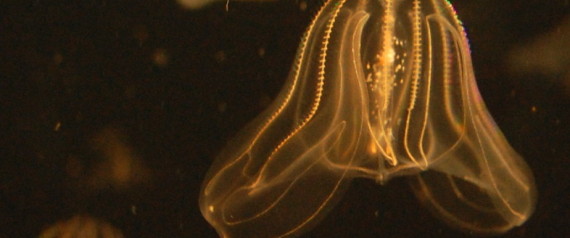
FORT LAUDERDALE, Fla. (AP) — Researcher Leonid Moroz emerges from a dive off the Florida Keys and gleefully displays a plastic bag holding a creature that shimmers like an opal in the seawater.
This translucent animal and its similarly strange cousins are food for science. They regrow with amazing speed if they get chopped up. Some even regenerate a rudimentary brain.

"Meet the aliens of the sea," the neurobiologist at the University of Florida says with a huge grin.
FLOATING LAB GENOME
They're headed for his unique floating laboratory.

Moroz is on a quest to decode the genomic blueprints of fragile marine life, like these mysterious comb jellies, in real time — on board the ship where they were caught — so he can learn which genes switch on and off as the animals perform such tasks as regeneration.

Sunday, 23 March 2014

Sea Anemones Are Half-Plant, Half-Animal, Gene Study Finds


By Tia Ghose, Staff Writer | March 20, 2014 02:43pm ET

The sea anemone is an oddball: half-plant and half-animal, at least when it comes to its genetic code, new research suggests.

The sea creature's genes look more like those of animals, but the regulatory code that determines whether those genes are expressed resembles that in plants, according to a study published Tuesday (March 18) in the journal Genome Research.

What's more, the complicated network of gene interactions found in the simple sea anemone resembles that found in widely divergent, more complex animals. 

Sunday, 2 February 2014

Ancient Plague's DNA Revived From A 1,500-Year-Old Tooth

January 29, 2014 2:59 AM

Scientists have reconstructed the genetic code of a strain of bacteria that caused one of the most deadly pandemics in history nearly 1,500 years ago.

They did it by finding the skeletons of people killed by the plague and extracting DNA from traces of blood inside their teeth.

This plague struck in the year 541, under the reign of the Roman emperor Justinian, so it's usually called the Justinian plague. The emperor actually got sick himself but recovered. He was one of the lucky ones.

Friday, 14 December 2012

Honey bees' genetic code unlocked


Researchers say they have unlocked the genetic secrets of honey bees' high sensitivity to environmental change.

Scientists from the UK and Australia think their findings could help show links between nutrition, environment and the insects' development.

It could, they suggest, offer an insight into problems like Colony Collapse Disorder, a mysterious cause of mass bee deaths globally.


"Honey bees live in complex societies comprising tens of thousands of individuals," explained study co-author Paul Hurd from Queen Mary, University of London.

"Most of these are female 'worker' honeybees that are unable to reproduce and instead devote their short lives to finding food in flowers... and other tasks such as nursing larvae inside the hive."

But the hive has a queen as well - the much longer-lived, reproductive head of the hive,

Continued:  http://www.bbc.co.uk/news/science-environment-20667948

Saturday, 22 September 2012

Genome-Invading Retroviruses Have a Nasty Surprise for Koalas: Serious Pathological Impact for Centuries

ScienceDaily (Sep. 20, 2012) — By integrating themselves into the germ line of their host, retroviruses change the genetic code of their host. The only known case where this process can be currently observed is in Koalas. As an international team of scientists from Australia, Europe and North America just found out, this process may take longer than expected, with the virus continuing to have a serious pathological impact on the host which may go on for centuries.

These findings have been just published online in Molecular Biology and Evolution.

"The process by which a retrovirus invades the host germ line appears to be quite drawn out in this case, so that the koala population has suffered the strongly pathological effects of the virus for many generations during the process of retroviral endogenisation," said Alfred Roca of the University of Illinois at Urbana-Champaign, one of the authors of the study. Koala retrovirus is associated with Chlamydia infection and leukemia in modern koala populations. Given the similarity between ancient and modern koala retrovirus (KoRV) sequences, ancient KoRV would have caused similar pathologies.

Continued:
 http://www.sciencedaily.com/releases/2012/09/120920135313.htm


Friday, 12 August 2011

Animal's genetic code redesigned (via Dawn Holloway)

Researchers say they have created the first ever animal with artificial information in its genetic code.


The technique, they say, could give biologists "atom-by-atom control" over the molecules in living organisms.

One expert the BBC spoke to agrees, saying the technique would be seized upon by "the entire biology community".

The work by a Cambridge University team, which used nematode worms, appears in the Journal of the American Chemical Society.

The worms - from the species Caenorhabditis elegans - are 1mm long, with just a thousand cells in their transparent bodies.

What makes the newly created animals different is that their genetic code has been extended to create biological molecules not known in the natural world.

Genes are the DNA blueprints that enable living organisms to construct their biological machinery, protein molecules, out of strings of simpler building blocks called amino acids.

Just 20 amino acids are used in natural living organisms, assembled in different combinations to make the tens of thousands of different proteins needed to sustain life.

Expanded palette
But Sebastian Greiss and Jason Chin have re-engineered the nematode worm's gene-reading machinery to include a 21st amino acid, not found in nature.

Dr Chin of the Laboratory of Molecular Biology (where Francis Crick and James Watson first cracked the structure of DNA) describes the technique as "potentially transformational": designer proteins could be created that are entirely under the researchers' control.

The development builds on techniques first developed at the Scripps Research Institute, in La Jolla, US, where Dr Chin worked 10 years ago.

The genetic code comes in four DNA letters, A,C,G and T; the genetic machinery reads it in words three letters long, called codons, which stand for the individual amino acid blocks to be built into a growing protein.

At Scripps, researchers showed in a paper in PNAS how one of those three letter words could be re-assigned, so that cells would read it as an instruction to incorporate an unnatural amino acid, one not normally found in living organisms. But that was in the bacterium E. coli; until now, no one had succeeded in doing the same in a whole animal.

Jonathan Hodgkin, professor of genetics at Oxford University, welcomes the new development, saying it "creates exciting new opportunities for research on C. elegans".

New tricks
Closer to home, Dr Mario de Bono, an expert on C elegans, who is also at the Laboratory of Molecular Biology, predicts "this sort of news travels like wildfire" among research biologists, adding that the method could be applied to a wide range of animals.

So far it is just a proof of principle - the artificial protein that is produced in every cell of the nematode worm's tiny body contains a fluorescent dye that glows cherry red under ultraviolet light. If the genetic trick failed, there would be no glow.

But Dr Chin says any artificial amino acid could be chosen to produce specific new properties. Dr de Bono suggests the approach could now be used to introduce into organisms designer proteins that could be controlled by light.

Indeed, the two are planning to collaborate on a detailed study of neural cells in the nematode brain, aiming to activate or deactivate individual neurons in precise ways with tiny laser flashes.

Dr Chin rather modestly admits he's "incredibly pleased" to have succeeded in a project he had avoided until a year and a half ago, for fear that other well-established competitors would get there quicker.

On the other hand, Dr de Bono compares the invention with the Nobel-prize winning work on green fluorescent protein, which are now part of the standard kit in biology labs across the world.


By Roland Pease

BBC Radio Science
http://www.bbc.co.uk/news/science-environment-14492948
Related Posts with Thumbnails

ShareThis