Showing posts with label habitat loss. Show all posts

Monday, 19 August 2019

Mass starvation of reindeer linked to climate change and habitat loss


AUGUST 6, 2019
by Ilona Kater, The Conversation
Reindeer are incredibly hardy creatures—they survived the last Ice Age and today live in some of the world's most inhospitable landscapes. Despite their fine-tuned adaptations to life in the Arctic and after over 600,000 years of living there, reindeer are struggling to survive the rapid changes happening all around them.
In the winter of 2013-14, 61,000 reindeer starved to death in the Yamal peninsula of Russia. The population crashed, devastating the Yamal Nenets—an indigenous people who herd the reindeer for food. A more recent census found that 200 reindeer in Svalbard, Norway didn't survive the winter of 2018-19.
These mass starvations were largely due to climate change, which is causing unusual spikes of warm winter weather in the Arctic. The higher winter temperatures cause snow to melt and refreeze, or to fall as rain which also refreezes. The icy sheet encases lichen on the ground—the reindeers' main winter food supply. The reindeer can't dig through it and often the ice freezes over such a large area that they starve while wandering, trying to reach the plants they can smell beneath them.

Sunday, 23 December 2018

Invasive species and habitat loss our biggest biodiversity threats


Date:  December 10, 2018
Source:  University of Queensland
Invasive species and habitat loss are the biggest threats to Australian biodiversity, according to new research by the Threatened Species Recovery Hub in partnership with The University of Queensland.
Lead researcher Stephen Kearney from UQ's School of Earth and Environmental Sciences said Australia was rich in unique biodiversity, but has had a poor track record since European settlement.
"Australia is one of only 17 'megadiverse' countries globally, with more than 12 per cent of the world's vertebrate species -- more than four out of five of our species are found nowhere else on Earth," Mr Kearney said.
"The country has recorded 90 extinctions since European settlement -- 36 plants, 27 mammals, 22 birds, four frogs and an earthworm, and extinction rates per decade are not improving.
"One of the major causes of Australia's ongoing extinction crisis is our insufficient response to threats to our biodiversity.
"To support improvements in this area we have reviewed the major threats facing over 1500 species listed as Critically Endangered, Endangered or Vulnerable under Australian environmental law.
The top factors impacting Australia's threatened species are invasive species, which affect 82 per cent of our threatened species, and changes in habitat, which affect 74 per cent of species.
"Invasive species include pest animals, plants and diseases, while changes to habitat include things like altered fire patterns and degradation from human activities," Mr Kearney said.
"Around the world the top two impacts on threatened species are habitat loss and change due to agriculture, closely followed by overexploitation activities, such as hunting or timber harvesting.
"Overexploitation threatens around three quarters of imperilled species globally, but only about one quarter of Australian species.
"The large impact of invasive species sets Australia apart from the global trend.


Friday, 7 December 2018

Saving the last West African giraffes in Niger


4 December 2018
For almost 50 years, the highly threatened West African giraffe has been absent from Niger's Gadabedji Biosphere Reserve.
Illegal hunting, climate change and habitat loss have all contributed to the population's decline.
An ambitious conservation initiative has now re-introduced eight giraffes into the reserve, in the first conservation effort of its kind for the West African subspecies.
Under the initiative, spearheaded by the Nigerien authorities, the eight giraffes were captured in the country's Giraffe Zone, a government-defined region approximately 60km (37 miles) south-east of the capital, Niamey.
Until this move, the world's last West African giraffes had only been found in and near this Giraffe Zone.
There, West African giraffes share their habitat with local communities, and compete with them for space and natural resources.
The animals face a number of threats, including human population growth, hunting and agricultural encroachment.
Giraffes have now started to migrate out of the Giraffe Zone as a result of the growing population of both humans and giraffes themselves.
As a result, the animals have come into conflict with humans who are not used to their presence, and also stray into restive areas on the border with Mali.

Thursday, 16 November 2017

Zebra scat science improves conservation efforts


Date:  November 1, 2017
Source:  University of Manchester

Summary:
How can zebra excrement tell us what an animal's response to climate change and habitat destruction will be? That is what scientists have been investigating in South Africa. Together the team have been using zebra stools to understand how challenges or 'stressors', such as the destruction and breakup of habitats, impact on populations of South Africa's Cape mountain zebra.


Wednesday, 19 July 2017

Hedgehogs at risk from food scarcity, habitat loss and badgers


Experts say hedgehogs face crisis in towns and countryside, as RSPB records fewer sightings of the animals for third year in a row
  

Friday 7 July 2017 18.10 BST First published on Friday 7 July 2017 16.36 BST

During the day they curl up in nests of shredded paper but when night falls those that are well enough scurry and snuffle around the old fish boxes that serve as their temporary homes.

These hedgehogs at the RSPCA’s West Hatch animal centre in Somerset have had a tough time of it. Some have tangled with dogs, strimmers, bonfires, fruit netting or vehicles; others have been brought in as tiny unseeing hoglets, having lost their parents.

The hedgehogs, which arrive here from as far afield as south Wales and Cornwall, will be nursed back to health by vets and animal carers, and released either close to where they were found or into a hog-friendly piece of West Country countryside.

They are – relatively speaking – the lucky ones. Figures out this week show a deeply worrying wider trend.

In the RSPB’s annual garden watch survey, hedgehogs were spotted in fewer gardens for the third consecutive year. One quarter of the 139,000 gardens surveyed did not record a single sighting in the whole of 2016.


Friday, 11 November 2016

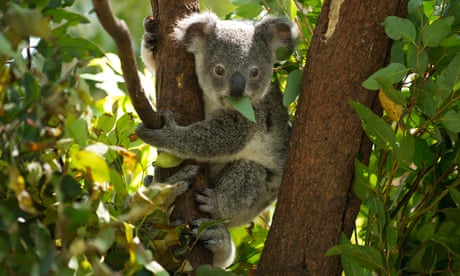
Koalas 'under siege' from policy changes set to destroy habitat, report finds


New South Wales government is failing to protect koalas by allowing further land clearing, logging and habitat destruction, National Parks Association says

Michael Slezak

Sunday 6 November 2016 19.15 GMT Last modified on Sunday 6 November 2016 19.17 

Koalas are “under siege” across NSW, with three separate policies poised to be implemented set to destroy their remaining habitats, according to a briefing paper written by the National Parks Association of NSW.

In light of the increasing threats, the paper calls on the NSW EPA to protect koala habitats.

“The NSW government is completely failing to conserve and protect koala habitat,” the report says. “Koalas can lay claim to be the most poorly managed species in eastern Australia at present – which is hugely disappointing in light of their beloved status.”

The report finds the habitats of the declining koala populations are being threatened on public land by plans to renew agreements allowing the logging of native forests; on private lands by weakened clearing laws proposed by the Baird government; and by a failure of local government protections to identify more koala habitats as they are intended.

Between 1990 and 2010, Koala populations in NSW were estimated by the federal government to have declined by 30%. And a report released in May by the NSW Environmental Protection Agency found that all koala populations in NSW, with one possible exception, have continued to decline, with at least one population now considered endangered.

That EPA report also found there were more koalas in forests that were more mature. It therefore concluded that logging was bad for koalas, since even if the forests are replaced, it reduced the maturity of the forests.


Continued

Sunday, 4 September 2016

American pika vanishing from western US as 'habitat lost to climate change'


The small mammal – ‘one of the cutest animals in America’ – is struggling to survive as summers get hotter and drier

Associated Press
Friday 26 August 201601.39 BST

Populations of a rabbit-like animal known as the American pika are vanishing in many mountainous areas of the west as climate change alters its habitat, according to findings released by the US Geological Survey.

The range for the mountain-dwelling herbivore is shrinking in southern Utah, north-eastern California and in the Great Basin that covers most of Nevada and parts of Utah, Oregon, Idaho and California, the federal agency concluded after studying the mammal from 2012-2015.

This study’s conclusion marks a more authoritative statement about the role of global warming on the animal compared to research released in 2003 that found climate change was at least partly contributing to the animal’s decline.

“The longer we go along, the evidence continues to suggest that climate is the single strongest factor,” said Erik Beever, a research ecologist with the USGS and lead author.

The pika’s habitat on mountain slopes, known as talus, are becoming hotter and drier in the summer and harsher in the winter with less snowpack to serve as an insulator, Beever said.
The study bolsters the long-running efforts of wildlife advocacy groups to have the animal added to the endangered species list amid concerns about global warming.

The US Fish and Wildlife Service rejected a request in 2010, saying not all populations were declining. A new request was made this April by a high school student in New York state.

Read more  

Friday, 29 July 2016

Loss of habitats and local species extinctions

Study of extinction rates following habitat loss offers hope that some species can be saved

Date: July 25, 2016
Source: University of Utah

Unfortunately, loss of plant and animal habitat leads to local species extinctions and a loss of diversity from ecosystems. Fortunately, not all of the extinctions occur at once. Conservation actions may still be able to save threatened species, according to William Newmark, a vertebrate zoologist at the Natural History Museum of Utah at the University of Utah.

In the study, published today in Nature Communications, Newmark and colleagues complied data from biodiversity and extinction reports, finding that patterns of species loss following habitat disruption are similar among birds, mammals, plants, reptiles and invertebrates. Newmark and colleagues also found that while species loss commences quickly, timely action could slow extinction rates and save species.

In deep debt
When natural habitats are lost, species lose the physical space and resources they need to continue growing and expanding. Habitats are usually lost due to human activity, such as building roads or clear-cutting a forest. After such a disturbance, the habitat can no longer support the number of species that live there and species begin to disappear until the habitat reaches a new normal. The difference between the old and new amounts of biodiversity the habitat can support is called the "extinction debt."

The research team, which included John M. Halley and Nikolaos Monokrousos from the University of Ioannina, and Antonios D. Mazaris and Despoina Vokou from the University of Thessaloniki, reviewed 43 previous studies spanning 1971 to present that included descriptions of biodiversity loss following habitat fragmentation in five taxonomic groups: mammals, plants, birds, reptiles and invertebrates.

Newmark and his colleagues found a shallow J-shaped curve, nearly identical in each taxonomic group, that described how the rates of extinction loss change over time. At first, extinction rates are high, and then decelerate until the point at which half of the extinction debt is paid off. After that point, species loss continues but at a slower rate until a new equilibrium is reached.

Several factors influence the timeline in which the biodiversity loss process plays out, but Newmark says that all groups they studied, even those thought to be resistant to extinction such as plants, showed the same pattern. These similar patterns emerge if species loss is calculated in terms of average population size and time for a new generation to arise for these taxonomic groups.


Friday, 6 May 2016

Leopards have lost 75% of their historical habitat

New research shows the big cats’ global range has shrunk by a shocking amount over the last 250 years


Wednesday 4 May 201614.20 BSTLast modified on Wednesday 4 May 201615.30 BST 

The area of the world roamed by leopards has declined by three quarters over the last two and a half centuries, according to the most comprehensive effort yet to map the big cat.

Researchers said they were shocked by the shrinking of the spotted hunter’s range, and that the decline had been far worse for several of the nine subspecies of leopards and in some parts of the world.

“We found the leopard had lost 75% of its historical habitat, we were blown away by that, it was much more than we feared,” said Andrew Jacobson, a conservationist at the Zoological Society of London and lead author of a new study on their range published in the journal PeerJ.

“Our goal has to be to raise consciousness about the plight of the leopard, it’s been flying under the conservation radar for a while. We hoped to raise its profile and say ‘this cat needs your attention’.”

The new work is the first known attempt to draw up a global, historical map of the leopard. Jacobson and researchers found that in 1750 it occupied a vast 35m sq km (13.5m sq mile) area throughout Africa, the Middle East and Asia. But after centuries of habitat loss and hunting caused by humans, that area shrank to just 8.5m sq km.

Leopards in Asia have been particularly badly hit, with six regions losing over 95% of habitat where the species has been, in Jacobson’s view, “almost completely wiped out”.

There appeared to be a clear link between Asia’s economic development and the leopard’s decline there, he said. “South-east Asia and China have been developed for a long period of time and that’s seriously constricted habitat in that area for decades. We worry this will be the trend we will see in Africa in coming decades, as economies grow.”


Sunday, 6 March 2016

Orangutan population up but threats remain

By Helen BriggsBBC News

4 March 2016 

There are more Sumatran orangutans in the wild than previously thought, according to a new survey.

The latest estimate puts the population at about 14,600 - more than twice the previous figure, based on a survey of nests where the apes sleep.

Ecologists say the rise is not due to population growth but because some apes were missed in past surveys.

The species remains at serious threat from poaching and loss of forests, they report in Science Advances.

Orangutans are the world's largest tree-climbing mammal - and Asia's only great ape.

They were once found across South East Asia, but today are confined to two islands, Borneo and Sumatra.

Their forest habitat is rapidly disappearing, putting their future in jeopardy.

Higher estimate
Until now, the total Sumatran orangutan population was put at 6,600 individuals, based on data from 2004.

In the new survey in 2015, orangutans were found in unexpected places, including at higher altitudes in the mountains, forests recovering from logging and areas west of the Toba Lake that had not been previously examined.

An international team of scientists says that while there are evidently more Sumatran orangutans remaining in the wild than once thought, the species remains under serious threat.

It is very important that these findings are not interpreted as suggesting that numbers have increased, nor that their range has expanded, the group reports.

"The known current range is now 17,797 sq km (6,871 sq miles), roughly 2.56 times larger," said a team led by Serge Wich, professor of primate biology at Liverpool John Moores University.

"Since 2004, Sumatran orangutan numbers have undoubtedly declined, and they continue to do so at an alarming rate because of ongoing deforestation and poaching/persecution," they wrote in Science Advances.

Friday, 23 January 2015

Endangered chimpanzees may experience drastic habitat loss within 5 years

Date:
January 21, 2015

Source:
BioMed Central

Summary:
Dramatic habitat loss by 2020 threatens the population of the planet's most endangered chimp subspecies, according to new research. The work suggests that climate change could do more harm to chimpanzee populations than previously realized.

Monday, 25 August 2014

Habitat loss and fragmentation reduce chameleon population in Tanzania

25th August 2014 
1 hour ago by Sathya Achia Abraham

(Phys.org) —Tucked away among the lush rainforests of the Eastern Arc Mountains of Tanzania are a host of species of plants and animals found nowhere else in the world.

Among them are a variety of chameleon species differing in size, color and how they use their forest dwelling. However, all of them rely on the rainforest for survival.

In the past 50 years, the chameleon populations in the montane rainforests of Tanzania have declined by more than 60 percent from historical levels due to habitat loss and fragmentation, according to a new study by Virginia Commonwealth University biologists.

In the study, published in Diversity and Distributions, a top organismal conservation journal, researchers surveyed three chameleon species in the East Usambara Mountains of Tanzania using a hierarchical, distance-sampling model.


Thursday, 14 August 2014

Seagrass fish feeding grounds 'lost like rain forests'

12 August 2014 Last updated at 08:12

Seagrass is found just off the shoreline so is vulnerable to pollution and disturbance by marine anchors

Underwater fish "meadows" are being lost at the same rate as the Amazon rain forests, researchers have warned.

Seagrass is a key habitat for feeding and sheltering young fish, including plaice, haddock and pollock.

But every hour an area the size of two football pitches is destroyed.

Scientists from Swansea University believe the habitats need to be protected otherwise fishing stocks could be affected.

Lead researcher Dr Richard Unsworth says more sensitive boat mooring could help

"The rate of loss is equal to that occurring in tropical rainforests and on coral reefs yet it receives a fraction of the attention," said Dr Richard Unsworth, lead researcher.

"If you're a small fish, like a juvenile cod, then you need food and shelter. Seagrass meadows provide both."

Thursday, 5 December 2013

The unlucky 7 Animals going Extinct before our Eyes

December 1, 2013. There’s always been great disagreement over the crossroads where humans overlap with nature. Experts estimate that billions of animal species have gone extinct, the vast majority before mankind set foot on planet Earth. But with the world’s population exploding at a rate faster than previously estimated, a number of beloved animals are scheduled for extinction sooner than we may have time to save them.

One week ago, Live Science published their list titled, ‘7 Iconic Animals Humans are driving to Extinction.’ The authors set the grim setting with the report’s opening sentence. ‘It's hard to imagine a world in which elephants, orangutans, lions and other iconic wildlife only exist in stories, photos and zoos,’ the authors soberly write, ‘But that may be where the future is heading for some of these animals. Several creatures around the world are being pushed toward extinction by humans, through hunting and habitat loss.’


Wednesday, 6 November 2013

Dormice at risk from disappearing habitat

November 2013: The hazel or common dormouse is an important ‘bio indicator’, preferring to live in rich, well, managed native woodland with a mix of species for seasonal food. Yet its range has decreased by half over the last century; once widespread in England and Wales, it is now found mainly in southern England, parts of Wales and a handful of isolated northern populations.

Poor management, ancient woodland and hedgerow loss and damage, and tree diseases, are all threatening its survival.

The Woodland Trust is aware of the loss or damage of at least 90 ancient woods with another 202 now under threat. Loss of trees and woods from diseases such as ash dieback and many others is now adding to the pressure dormice face in their search for rich, well managed native woodland.

Monday, 11 March 2013

Ringwood's Gorley Road toad crossing volunteers sought


Volunteers are being sought to save hundreds of amorous toads from being killed on a road in Hampshire.

Common toads cross Gorley Road in Ringwood to spawn in nearby lakes, from early March until the end of April.

Ringwood Amphibian Conservationists runs an annual patrol by volunteers who assist the toads with the crossing. Last year they saved about 400.

Volunteer numbers have declined from 28 to 12 this year and organisers are worried this will affect toad numbers.

'Painful death'
Common toads are believed to be declining across the UK because of habitat loss, according to amphibian and reptile conservation group Froglife.

Saturday, 16 February 2013

Early life care shapes African elephants' future


By Mark Kinver, Environment reporter, BBC News

An African elephants mother's ability to feed and care for its calf has "long-lasting consequences" into adulthood, a study has suggested.

Researchers identified a link between the quality of maternal care in the first two years of a calf's life and reduced growth and delayed maturity.

They added that projected climate change and habitat loss could have a profound impact on the species.

Details of the findings appear in the journal Biology Letters.

"Early maternal care in the first two years of life actually affects an elephant's survival over 40 years - it has long lasting consequences," explained co-author Phyllis Lee from the University of Stirling.

"It is a problem we tend to overlook, unless we are looking at humans: how animals respond over the very long-term to apparently small events that happen in their lives."

Prof Lee and colleague in the international team of researchers said inexperienced mums often provided "inappropriate care".

"Often, they are not only inexperienced but if an elephant gives birth aged 10-12, she's tiny so she does not have the physical resources to devout to the calf.

Friday, 12 October 2012

Haiti's Frogs, Losing Habitat, Find a Home at Philadelphia Zoo– via Herp Digest


September 28, 2012|By Faye Flam, Inquirer Staff Writer
Haiti has lost 99 percent of its native forest, but every time Pennsylvania State University biologist Blair Hedges explores the tiny patches that remain, he finds dozens of species of frogs, some previously unknown to science.
With their forest habitat fast disappearing, the only future for these creatures may be here in Philadelphia.
On Wednesday, a group of Haitian government officials and environmental activists visited their country's native frogs at the Philadelphia Zoo, the only facility in the world raising these critically endangered animals in captivity.
"We're hoping to show the Haitians that these frogs have value," Hedges said. Over several expeditions, he and Carlos Martinez, a zoo conservation biologist, have brought 154 live frogs from Haiti. Their number at the zoo has climbed to an estimated 1,400. Of 10 original species, nine have produced young.
Reptile keeper Joyce Foreman works with Martinez to figure out what to feed the frogs and their tiny offspring. In an adjoining room, Parker shows the various insects she's raising in plastic containers.
The zoo has tried fruit flies, she said, but the frogs tend to ignore them. Other menu options are live pill bugs, crickets, bean beetles, and springtails.
Parker and Martinez have experimented with temperature and humidity, hoping to re-create the conditions of the cool mountain forests where the frogs were caught. "We don't know the exact ecology," Martinez said. "We're learning along the way."
The most prolific species are the La Hotte frog, the breast-spot frog, and a tuneful frog named after Wolfgang Amadeus Mozart.
Another musical species, the La Hotte glanded frog, has a metallic chime to its call, Parker said, but this creature is more difficult to breed. The offspring are tiny and so far haven't survived in captivity.
The frogs are not currently on display, though some hardier species may become part of an exhibit.
While North American frogs go through a tadpole stage, many tropical species either give live birth to tiny frogs or lay eggs that hatch into froglets, Martinez said.
Some of the Haitian frogs are so small the adults can fit on a quarter. Some are greenish, some reddish, some spotted, some pudgy, and some leggy.
Haitian officials asked about the living conditions and the frogs' safety. Lyonel Valburn, the director general of the Haitian Ministry of Agriculture, said he was pleased he could count on Philadelphia to take care of Haiti's frogs.
The zoo is no substitute for the rich forests that once made Haiti a paradise. The nation is home to 50 known species of frog, though Hedges has found enough new ones to suspect Haiti is losing frogs that will never be known to humanity. On an evening trek, he once discovered five new species.
Though Haiti has set aside national parks, the government hasn't been able to enforce the boundaries, Hedges said. People still come in and cut down trees to make charcoal, which they depend on for cooking.
After the morning tour, Hedges and Martinez spent the afternoon with the Haitian officials, trying to work out some plan to preserve Haiti's tiny but diverse patches of forest. Along with the agriculture official were two people from the division of parks and soils, and leaders of the Haiti Audubon Society.
The participants discussed many possibilities, including educational programs, building "ecolodges" for tourism and research, farming trees for charcoal, and paying people not to destroy the forest.
Some scientists view Haiti as a microcosm of the world and an example of what can happen when human beings put extreme stress on the environment.
Hedges said he and other biologists were not balancing the lives of humans against those of frogs. If people remain dependent on cutting trees, then when the last forests collapse, they will die too.

Thursday, 24 November 2011

Devastating impact of palm oil on orang-utans

Land fragmentation causes population to plummet

November 2011: 300 orang-utans have been lost in just seven years in Lower Kinabatangan on Sabah's east coast. Forest isolation and loss of habitat are to blame according to Dr Marc Ancrenaz, scientific director of HUTAN - Kinabatangan Orang-utan Conservation Programme (KOCP).

‘What we are seeing with our latest surveys within the Lower Kinabatangan is a clear population decline of the orang-utans,' said Dr Ancrenaz who hoped such issues would add urgency to events such as the Roundtable for Sustainable Oil Palm (RSPO) being held this month in Kota Kinabalu.

Isolated islands of forestThe biggest threat to orang-utan and other wildlife populations in Sabah is fragmentation. What this means is that agriculture development - primarily oil palm -has created small islands of forest which are isolated and completely surrounded by human-made landscape.

‘Because it is difficult for wildlife to move from one forest patch to the next, this situation leads to inbreeding and eventual population decline, which is what we are witnessing today in the Lower Kinabatangan,' said Dr Ancrenaz.

He points out that this issue is inherently related to the oil palm industry and he believes it should take action to rectify the situation. ‘We can still improve the situation for the Lower Kinabatangan's orang-utan and other wildlife by actually replanting and planning for actual wildlife corridors or patches of forest to support wildlife movement between protected or forested areas,' Dr Ancrenaz added.

http://www.wildlifeextra.com/go/news/orangutan-sabah.html

Tuesday, 22 November 2011

Amphibians face spread of 3 threats

WASHINGTON — Frogs, salamanders and other amphibians might eventually have no haven left on the globe because of a triple threat of worsening scourges, a new study predicts.

Scientists have long known that amphibians are under attack from a killer fungus, climate change and shrinking habitat. In the study, appearing online in the journal Nature, computer models project that
in about 70 years, those three threats will spread, leaving no part of the world immune to one of them.

Several important U.S. amphibian species — such as boreal toads in the Rocky Mountains, and the mountain yellow legged frog in the Sierra Nevada — are shrinking in numbers, said zoologist Steve Corn, who is part of the U.S. Geological Survey’s Amphibian Research and Monitoring Initiative. The problem is worse in the western United States.

About one-third of the world’s amphibian species are known to be threatened with extinction.
“It’s no fun being a frog,” said biodiversity conservationist Stuart Pimm of Duke University, who wasn’t part of the study or the USGS effort. “They are getting it from all three different factors.”

http://www.dispatch.com/content/stories/national_world/2011/11/19/amphibians-face-spread-of-3-threats.html
Related Posts with Thumbnails

ShareThis