Showing posts with label poaching. Show all posts

Friday, 15 May 2020

Rhino killed as poaching attempts increase amid India virus lockdown

MAY 11, 2020
A rare one-horned rhino has been killed as poaching attempts increase in one of India's best-known national parks during the coronavirus lockdown, officials said Sunday.

The lack of vehicles on the highway near Kaziranga National Park in Assam state—home to the world's biggest population of one-horned rhinos—amid the lockdown has seen animals move towards the boundaries, making them vulnerable to poachers.

"It is suspected that the rhino was killed at least two to three days ago," the park's director P. Sivakumar told AFP, adding that the rhino's horn was also missing.

Hunters can earn as much as $150,000 for one rhino horn or around $60,000 per kilo on a black market according to media reports, serving foreign demand for its use in traditional Chinese medicine.

"We have also recovered eight rounds of empty cartridge of AK 47" automatic rifle, Sivakumar said.

The rhino carcass was found near a water body inside the park, he said, adding that it was a confirmed poaching incident.

Officials said it was the first poaching case in the UNESCO-listed heritage site in a year. Previous years had seen numerous poaching incidents.

Thursday, 19 March 2020

Two of the last white giraffes on Earth were slaughtered by poachers


There may be just one white giraffe left, conservationists said.


Two rare white giraffes spotted in Kenya's Ishaqbini Hirola Community Conservancy in 2017.
(Image: © Hirola Conservation Program)


Rangers at a nature conservancy in Garissa County, Kenya, have discovered the skeletal remains of two rare white giraffes that went missing several months ago. 

According to a statement issued on Twitter, the carcasses belong to a mother and her 7-month-old calf — two of only three white giraffes living in Ishaqbini Hirola Community Conservancy — and appear to have been there for four months. All signs indicate that the animals were killed and butchered by armed poachers.

"This is a very sad day for the community… and Kenya as a whole. We are the only community in the world who are custodians of the white giraffe," Mohammed Ahmednoor, manager of the conservancy, said in the statement.

Monday, 22 July 2019

Comment: lion and tiger farming may not be cause of increased poaching


JULY 12, 2019

by Niki Rust And Amy Hinsley, The Conversation
It is never pleasant to see wild animals caged and abused. A new report by the NGO World Animal Protection suggests that captive-breeding operations for lions and tigers have expanded to meet an increasing demand for big cat products used in traditional Asian medicine. While this is clearly bad news for the captive cats themselves, confined in often horrible conditions, we are not convinced by the report's findings on what this means for wild populations.

Sunday, 2 June 2019

Africa's elephant poaching rates in decline, but iconic animal still under threat


MAY 28, 2019

Elephant poaching rates in Africa have started to decline after reaching a peak in 2011, an international team of scientists have concluded.
However, the team say the continent's elephant population remains threatened without continuing action to tackle poverty, reduce corruption and decrease demand of ivory.
The research, which included scientists from the universities of Freiburg, York and the Convention for the International Trade in Endangered Species (CITES), reveals a decline in annual poaching mortality rate from an estimated peak of over 10 % in 2011 to less than 4 % in 2017.
It is estimated there are around 350,000 elephants left in Africa, but approximately 10-15,000 are killed each year by poachers.

Monday, 26 November 2018

Sumatran elephant found dead with missing tusks in Indonesia


November 17, 2018
Rampant deforestation has reduced the species' natural habitat and brought them into conflict with humans
A Sumatran elephant has been found dead with its tusks removed in an apparent poaching case targeting the critically endangered animal, an Indonesian conservation official said Friday.
The 10-year-old male's rotting corpse was found in Blang Awe village in Aceh province earlier this week.
"His tusks were missing and there were traces of blood in the location where he was found," Aceh conservation centre head Sapto Aji Prabowo told AFP.
Officials estimated the animal had been dead for at least a week when the carcass was discovered.
The cause of death was not immediately clear because the body was badly decomposed, Prabowo said.
Tissue samples will be analysed for signs of poisoning.
Rampant deforestation has reduced the species' natural habitat and brought them into conflict with humans, while their tusks are prized in the illegal wildlife trade.
At least 11 wild elephants died in Aceh last year, most of them killed by humans.
In July, a Sumatran elephant was found dead from apparent poisoning in a palm oil plantation.
The environment ministry estimates only around 500 Sumatran elephants remain in Aceh.


Thursday, 22 November 2018

Hawksbill turtle poaching to be fought with DNA technology


Project will trace tortoiseshell products in shops back to where they were poached
Mon 12 Nov 2018 17.00 GMTLast modified on Mon 12 Nov 2018 17.02 GMT
The population of hawksbill turtles has declined more than 75% in the Pacific Ocean in the past century. Photograph: Ruby Blunt
Researchers will use DNA technology to try to stop the illegal poaching of hawsksbill turtles for use in tortoiseshell products.
The population of the critically endangered species has declined by more than 75% in the Pacific Ocean in the past century and a key threat to the species’ survival is illegal trade.
Hawksbills are the only sea turtles hunted for their shells, despite international trade in hawksbill products being banned more than 20 years ago.
Scientists and researchers from WWF and the National Oceanic and Atmospheric Administration in the US have begun a three-year project that will trace tortoiseshell products such as earrings and bracelets sold in market stalls and specialty shops back to where they were poached.
They’ll do this by DNA-testing both products and live turtles throughout the Asia-Pacific region to create a DNA map that will pinpoint where the turtles had come from and identify the hawksbill populations most at risk.
“The major part of the project is looking at how we can trace turtles from sale back to source,” WWF’s Christine Madden Hof, the project manager for the study, said.
“WWF is going to work with multiple partners across the region to work out where the turtles are poached. We’re mapping where they come from to what products they’ve been sold into.”
Similar technology has been used in the past to study the trade in rhino horn.
Hawksbill products are typically found in countries throughout Asia such as China, Japan, Hong Kong and Taiwan.

Wednesday, 26 September 2018

Botswana poaching spree sees 90 elephants killed in two months


Charities and ministers voice concern after discovery of carcasses with tusks hacked off
Agence France-Presse
Tue 4 Sep 2018 17.21 BSTLast modified on Tue 4 Sep 2018 18.07 BST

Ninety elephant carcasses have been found in Botswana with their tusks hacked off, in what is believed to be one of Africa’s worst mass poaching sprees.
Most of the animals killed were large bulls carrying heavy tusks, Elephants Without Borders said on Tuesday.
The discovery was made over several weeks during an aerial survey by scientists from Elephants Without Borders and Botswana’s Department of Wildlife and National Parks.
Mike Chase, the charity’s director, said: “We started flying the survey on 10 July, and we have counted 90 elephant carcasses since the survey commenced. Each day, we are counting dead elephants.”
The wild pachyderms were shot with heavy-calibre rifles at watering spots near a wildlife sanctuary in the Okavango Delta.
According to Chase, the carcasses’ skulls were “chopped open by presumably very sharp axes, to remove their tusks”. In some cases, the trunks were also removed.

Wednesday, 9 May 2018

Could seismology equipment help to protect elephants from poachers?


Date: May 7, 2018
Source: Cell Press

Summary:
Using tools developed to monitor earthquakes, an interdisciplinary team of researchers have found that it's possible to eavesdrop on elephants by listening in to vibrations through the ground as they move about and vocalize. The findings support theories that elephants use ground vibrations for long-distance communication among themselves. They might also lead a new kind of alarm system for detecting elephant behaviors, such as panic running.


Thursday, 11 January 2018

DNA evidence used to protect the rhinoceros from extinction


Genetic evidence helping match confiscated rhinoceros horns to crime scenes -- Already used in scores of successful prosecutions

Date:  January 8, 2018
Source:  Nova Southeastern University

Summary:
A new study shows that genetic database now being used in the fight against poaching the rhinoceros.


Friday, 18 August 2017

Popular sungazer lizards under threat from poaching

Poaching, habitat destruction put this unique and highly vulnerable species under pressure to survive

Date: August 16, 2017
Source: University of the Witwatersrand

Summary:
The sungazer (Smaug giganteus), a dragon-like lizard species endemic to the Highveld regions of South Africa, is facing an assault on two fronts as farming and industrialization encroaches on its natural habitat -- which already consist of only a several hundred square kilometers globally -- while the illegal global pet trade is adding pressure on pushing the species into extinction.

Wednesday, 28 June 2017

Nemley Junior: chimp rescued from traffickers dies

David Shukman Science editor
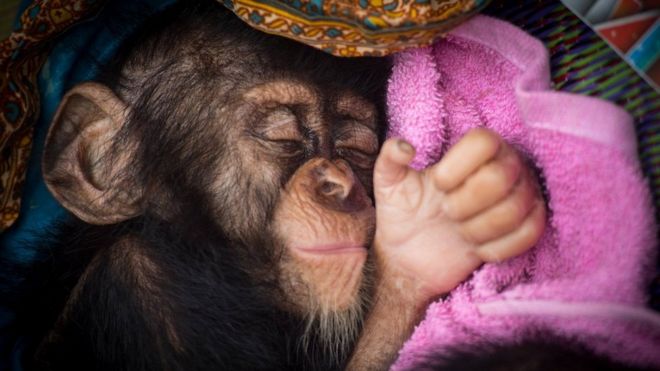
Nemley JrAn orphaned baby chimpanzee whose plight moved people around the world has died.

Nemley junior had been seized by poachers in West Africa and offered for sale but was then rescued following a BBC News investigation.

Despite dedicated care in the past few weeks, he succumbed to a series of illnesses including malaria.

A leading vet who helped care for him said that, without his mother, Nemley suffered from a "failure to thrive".

In the wild, baby chimps usually live with their mothers for at least four to five years.

During his capture, Nemley would have witnessed the killing of his mother during a poaching raid that would have seen as many as 10 adults in his family shot. The two men who were found guilty of his trafficking were released from jail 10 days ago.

Sarah Crawford, an American NGO worker who had been caring for Nemley full-time for the past three weeks, said: ''He died in my arms. He did not die alone in a cage. He really fought to stay alive. He was taking fluids until 30 minutes before he died. I am still in shock. None of us can quite believe what has happened.''


Continued

Monday, 26 June 2017

Crocodile Poaching Booms as Egypt Tourism Crumbles - via Herp Digest


Fewer foreign visitors and political chaos has led some Egyptians to turn to hunting Nile crocodiles as a source of revenue.

By Peter Schwartzstein, National Geographic, 6/23/17 

LAKE NASSER, EGYPT—If they’re small, you use the bulk of the boat to hustle them into the shallows, then snag them by hand, Mahmoud tells me. He should know, having spent the past decade poaching the scaly beasts around the southern city of Aswan.
If they’re medium-size, perhaps the length of a kayak, he says (he won’t tell me his family name because of the illegal nature of his work), you noose them with barbed wire traps. And if they’re monsters—up to 18 feet of whiplashing tail, bristling teeth, and relentless aggression—you dazzle them with a spotlight, entangle them in fishing nets, and subdue them with a shot to their exposed underbelly.

“There’s not a crocodile I can’t catch, or a hunting ground I don’t know,” Mahmoud bragged. “I’ve made my life doing this.”

Mahmoud hunts the Nile crocodile, the world’s second largest reptile. Found across much of sub-Saharan Africa, mostly in large lakes and rivers, it’s renowned for its ferocious behavior. 

The Nile crocodile’s fortunes have veered from one extreme to the other over the millennia. From an object of veneration in some ancient Egyptian temples—and even the namesake of an entire city, Crocodilopolis—the species was extinct along the lower Nile by the 1950s as people encroached on its habitat.

The Aswan High Dam, finalized in 1970, created Lake Nasser, and with it a 250-mile-long croc-friendly mecca in Nubia, Egypt’s sparsely populated south. The species began recovering.

Now, thanks to a dwindling tourism industry and an unstable political system, the pendulum has swung back the other way as people look to make a profit off illegal sales of the reptile.

High prices for crocodile skin, meat, and penises—used as an aphrodisiac across East Africa— have attracted some professional hunters, even as larger numbers of impoverished local people try to muscle in on the trade.

On top of that, some lake fishermen are killing crocodiles to stop them gobbling up their catches of Nile perch and other fish, such as tilapia, environmental officials say. (Read about how tiger eyes and crocodile penises are hot on the black market.)

According to Mahmoud, smugglers are exporting record numbers of crocodiles—perhaps up to 3,500 eggs and hatchlings and a few hundred adult live crocs a year—abroad mostly via Egyptian ports, mainly to the Arabian Gulf.

The Egyptian government’s last large-scale survey of lake crocodiles, in 2008 and 2009, estimated the population at anywhere between 6,000 and 30,000. Its historic numbers are unknown.

Even with limited resources, Egyptian environmental officials have seen the species’ numbers decline precipitously in their 60-mile study area of Lake Nasser’s shorelines.

“The population was down by half between [2008 to 2009] and 2012, and then from [2015 to 2016], it was down again,” says Amr Hady, a researcher in the Crocodile Management Unit of the Egyptian Environmental Affairs Agency, which was established to watch over the lake’s largest residents.

“The habitat is the same, the pollution is the same. It’s because of the hunting,” Hady said in his Aswan office, where a small mountain of confiscated crocodile carcasses—all seized from the city’s airport and ferry port since 2013—gather dust in the corner.

If Nile crocodiles disappeared from Lake Nasser, the environment would suffer. Vociferous consumers of dead fish, insects, rodents, and invasive marine species, the reptiles occupy a key role in Lake Nasser’s ecosystem.

Moreover, part of the country’s heritage would disappear with it. The beasts were once so synonymous with Egypt that crocodiles often served as its symbol during the Roman era, says Salima Ikram, a professor of Egyptology at the American University in Cairo.

It’s illegal to hunt Nile crocodiles in Egypt, and the International Union for Conservation of Nature lists the species as least concern, while noting its population is falling in many countries.

In 2010, the Convention on International Trade in Endangered Species of Wild Fauna and Flora (CITES), the body that monitors global wildlife trade, downgraded Egypt’s Nile crocodiles from the highest level of protection.

This means that some trade in the species is permissible once a quota is agreed, but many hunters have interpreted this as legalizing their activities, Hady says.

“People always do what they must to survive—they make money where they can,” says Abdelhalim Tolba, whose family is heavily involved in the illicit and legal wildlife trade in Egypt. He estimates that his relatives illegally take at least 500 crocodiles from Lake Nasser every year.

“Right now, the crocodile is very much in demand.”

People in the Aswan area, just north of Lake Nasser, have long dabbled in small-scale crocodile poaching, but it wasn’t until the Tahrir Square uprising of 2011 and the ensuing chaos that hunting really took off.

Political instability and the specter of terrorism have tanked the tourism industry, hurting local economies that have long depended on foreign dollars. Hotel occupancy in Aswan fell by more than 70 percent between 2010 and 2015, says hotelier Hussein Mohammed, proprietor of the Suheil House. 

Guesthouse owners and tour guides have been struggling.

Many appear to have resorted to hunting crocodiles to make ends meet, for example by offering illegal hunting trips on the lake, promising skins as souvenirs. “You have to understand, they’re desperate,” Mahmoud says.

Meanwhile, villagers on the Nile’s west bank have been illegally raising crocodiles as tourist attractions. In some upscale lodges and hotels, staff occasionally offer guests hatchlings as gifts.

In the past, local security services cracked down on illegal wildlife trafficking, even conducting shop-to-shop searches in Aswan’s downtown bazaar. But since the 2011 revolution, there’s been none of that.

The governor’s office, responsible for local administration, is loath to pick a fight over animals at a time of hardship, and the security services are preoccupied with other types of smuggling—drugs and weapons, for instance—and with foiling political dissent. (Read about unusual wildlife smuggling busts.)

“The police are not a big obstacle because they know that this is just good people making their living,” says Assad Tolba, Abdelhalim’s brother.

Because there are increasingly fewer and smaller fish in Lake Nasser, some fishermen reason crocodiles are to blame, and kill them out of revenge.

“They’re enormous, so obviously they have huge appetites,” says Abdullah Salem Abdelaziz, a fisherman who plies the lake’s northwestern reaches with his two young sons.

But that supposition, according to biologists, is misguided. The crocodiles actually have relatively small stomachs, and they mostly eat species unappealing to fishermen, such as catfish, says Sherif Baha El-Din, co-founder of Nature Conservation Egypt, a local nonprofit.


Some fishermen have also gone into the trafficking business, looking to supplement their meager earnings by selling a croc or two on the black market.

“You have fisherman who catch these things, and they just want to make an extra buck, so they put these things on the market,” says El-Din.

The problem could get worse as more fishermen from farther north and places like Lake Qarun, where pollution has eviscerated fish stocks, move south into the Lake Nasser area, El-Din adds. (Also see “Nearly 400 Rare Baby Crocodiles Saved From Becoming Purses.”)

As with the police in Aswan, marine authorities appear to be turning a blind eye, according to Abdelaziz.

“In the past they supervised everything,” he says. “They actually weighed your catch and checked to make sure you hadn’t caught small fish. But what happens now is that you can take anything—small fish, all the fish in the lake, crocodiles, and no one will notice.”

Some smugglers ferry live crocs across the Red Sea to Saudi Arabia to be sold as household ornaments. According to Mahmoud, crocs have allegedly been hidden in shipments of frozen vegetable shipments out of the port of Safaga.

“The Saudis alone could take 10,000 a year if they were available,” Abdelhalim Tolba says.

Other smugglers send crocodile meat abroad, especially to Southeast Asia and sub-Saharan Africa. (Many Muslims won’t consume carnivorous animals due to their religious beliefs.)

Crocodile skins are big business. After skinning an animal, hunters soak it in saltwater, then leave it to dry in the dark, before selling it on to leather dealers, usually in Khartoum, the Sudanese capital.

“It’s a real art—it’s ruined if it sees any sunlight,” says Assad Ibrahim, a former hunter who now works as a tailor just off Aswan’s riverside boardwalk. (See pictures of the life-giving Nile.)

He once sold large skins for around $400 a pop, most of which ended up in China, he says. By the time they’ve been treated, and molded into clothing accessories, they can sell for up to $2,500 a wallet.

Then there’s the appetite for crocodile genitalia. According to Ibrahim, some Egyptians—and people in East Africa—eat the animal’s penis (the largest ones sell for more than $100) crushed up with honey and ginger, believing it will improve their sex lives.

The fate of Egypt’s Nile crocodiles depends on how authorities in Cairo respond. The Crocodile Management Unit is severely underfunded, with only two researchers on staff.

The small team has no access to aerial surveillance, which is necessary to properly survey Lake Nasser’s jagged 3,700-mile shoreline. “It’s a big issue, you often feel like you’re working alone,” Hady says.

Coordination among the dozen or so ministries and agencies responsible for managing the lake and its wildlife is poor, according to an agricultural official, who spoke off the record for fear of publicly criticizing the government. He says that enforcement of wildlife protection laws is so lax that some of those involved in the trafficking business genuinely appear to believe what they’re doing is legal—in particular due to the change in the species’ CITES designation.

And no one has yet come up with a plausible plan for what the hunters and smugglers could do instead. Jobs are scarce in rural areas, and so there’s little incentive for them to change their ways.

“Maybe 30,000 or 40,000 depend on [reptile dealing] as our main source of bread,” Abdelhalim Tolba says, and with large crocodiles selling for up to $1,200 each, it will be difficult if not impossible to staunch the illicit trade.

There are some signs of progress. In 2016, the Egyptian Ministry of Environment announced its intention to start raising crocodiles—in partnership with the army—on a farm a few miles from Lake Nasser. They’ll take eggs from the lake, incubate them, and then harvest a certain number of crocodiles every year for legal sale in skins.

With the lake’s crocodile population acting “as an open bank,” Hady says, both the authorities and local villagers, some of whom will be hired to work on the farm, will, in theory at least have a stake in protecting the wild population.

Egypt’s Nile crocodiles have come back before, and there’s reason to hope they can do it again.

Sunday, 30 April 2017

Eel patrol: Tracking down poachers with the wildlife police

21 April 2017

Fishing for the endangered European eel is allowed only under strict rules. Clare Wilson joins the environmental officers patrolling the banks of the UK’s River Severn

It’s a cold clear night and the River Severn is sparkling under a full moon. Tonight, I’m on eel patrol – out with staff from the UK’s Environment Agency on the watch for illegal fishing of the critically endangered European eel.

This mysterious creature with a mind-boggling life cycle has crashed in numbers by 95 per cent in the past three decades.

European eels spend most of their lives lurking in muddy rivers. At about 10 years old, they swim thousands of kilometres out to the ocean, until they reach the Sargasso Sea in the western Atlantic. There they spawn – and die.

Their tiny offspring then make the opposite journey. The Gulf Stream sweeps them to the mouths of European rivers and during the large spring tides the young elvers, about the size of an earthworm, come swarming up the waterways.

The Severn gets a large share because of its prime location facing the Atlantic Ocean and the huge funnel shape of its estuary. They once came in such numbers locals would catch them in pillow cases and hold elver-eating contests. They are supposed to be tipped into a hot frying pan still live and wriggling, in recipes such as elvers with eggs and bacon.

Now elver fishing is only allowed on a few rivers and under strict rules: the “elvermen” must use dip nets below a certain size. And, they can sell only to licensed dealers who must then send 60 per cent for restocking less favoured rivers, with the rest going to aquafarms and restaurants in Europe.

Then there’s the black market, in which elvers are illegally exported to meet demand in China and Japan. Last month, a batch of 600,000 live elvers was found at London Heathrow Airport in a container headed for Hong Kong. That batch probably came from France, but the illegal trade goes on in the UK too, says Chris Bainger at the Environment Agency.


Read on

Thursday, 20 April 2017

Crime 'threatens nearly half the world's natural heritage sites'

By Matt McGrath Environment correspondent

18 April 2017

Poaching, illegal logging and fishing are threatening endangered species in some of the world's most iconic natural sites, according to a report.

Conservation charity WWF says almost half of the world's 200 designated natural heritage sites are "plagued" by wildlife criminals.

These include the last refuges for critically endangered javan rhinos and wild tigers.

The authors say more co-ordination is needed to target the whole crime chain.

From the Great Barrier Reef to the Galapagos Islands and at many other locations across the globe, Unesco has designated around 200 natural World Heritage sites as being of outstanding international importance and deserving of the highest levels of protections.

WWF looked at the threats to species that are already protected under the Convention on the International Trades in Endangered Species (CITES).

The authors found that these threatened animals and plants are poached or illegally harvested in 45% of natural World Heritage sites.

Many of the parks in the study are home to critically endangered creatures - including Ujung Kulon National Park in Indonesia, which is the last stand for around 60 javan rhinos.

Continued

Wednesday, 1 March 2017

Poaching drives 80 percent decline in elephants in key preserve


More than 25,000 elephants slain over a decade in Gabon park

Date: February 20, 2017
Source: Duke University

Forest elephant populations in one of Central Africa's largest and most important preserves have declined between 78 percent and 81 percent because of poaching, a new Duke University-led study finds.

"Our research suggests that more than 25,000 elephants in Gabon's Minkébé National Park may have been killed for their ivory between 2004 and 2014," said John Poulsen, assistant professor of tropical ecology at Duke's Nicholas School of the Environment.

"With nearly half of Central Africa's estimated 100,000 forest elephants thought to live in Gabon, the loss of 25,000 elephants from this key sanctuary is a considerable setback for the preservation of the species," he said.

While some of the poaching originated from within Gabon, findings from the new study indicate that cross-border poaching by hunters from neighboring nations -- chiefly Cameroon to the north -- largely drove the precipitous decline.

Poulsen and his colleagues published their peer-reviewed findings Feb. 20 in the journal Current Biology.


Related Posts with Thumbnails

ShareThis