Showing posts with label Arctic Ocean. Show all posts

Wednesday, 6 December 2017

Nations agree to ban fishing in Arctic Ocean for at least 16 years


By Hannah HoagDec. 1, 2017 , 1:30 PM

Nine nations and the European Union have reached a deal to place the central Arctic Ocean (CAO) off-limits to commercial fishers for at least the next 16 years. The pact, announced yesterday, will give scientists time to understand the region’s marine ecology—and the potential impacts of climate change—before fishing becomes widespread.

“There is no other high seas area where we’ve decided to do the science first,” says Scott Highleyman, vice president of conservation policy and programs at the Ocean Conservancy in Washington, D.C., who also served on the U.S. delegation to the negotiations. “It’s a great example of putting the precautionary principle into action.”

The deal to protect 2.8 million square kilometers of international waters in the Arctic was reached after six meetings spread over 2 years. It includes not just nations with coastal claims in the Arctic, but nations such as China, Japan, and South Korea with fishing fleets interested in operating in the region.


Monday, 2 October 2017

How did that get there? Plastic chunks on Arctic ice show how far pollution has spread


Discovery by UK scientists prompts fear that melting ice will allow more plastic to be released into the central Arctic Ocean – with huge effects on wildlife

Sunday 24 September 2017 00.01 BST

A British-led expedition has discovered sizeable chunks of polystyrene lying on remote frozen ice floes in the middle of the Arctic Ocean.

The depressing find, only 1,000 miles from the north pole, is the first made in an area that was previously inaccessible to scientists because of sea ice. It is one of the most northerly sightings of such detritus in the world’s oceans, which are increasingly polluted by plastics.

A team of scientists drawn from the UK, US, Norway and Hong Kong, headed by marine biologist Tim Gordon of Exeter University, said the discovery confirmed just how far plastic pollution has spread. It has prompted fears that plastic waste is flowing into the Arctic as the ice melts because of climate change. The thaw is simultaneously releasing plastic that has long been trapped in the ice.


Friday, 22 November 2013

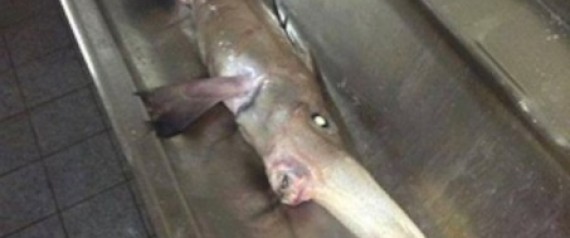
Knifenose Chimaera, Arctic Mystery Fish, Is Even Weirder Than It Looks (PHOTO)

A university researcher in Canada claims he knows the identity of a mysterious sea creature that was recovered by a fishing boat in the Arctic Ocean.

Knifenose Chimaera
Some people postulated that the Arctic mystery fish was a goblin shark, but Nigel Hussey, a post-doctoral fellow at the University of Windsor who's made a name for himself discovering hybrid manta rays, says it belongs to the long-nosed chimaera family -- fish with cartilage skeletons that have lived in the oceans for more than 350 million years.

The photo went viral after it was posted to CBC North's Facebook page Nov. 10.

Monday, 12 August 2013

Is this starved polar bear which died as ‘skin and bones’ the 'categorical proof' that climate change is wiping out the species?

  • Experts found the carcass of a polar bear in Svalbard in the Arctic Ocean
  • Lack of sea ice and seals forced the bear to search further afield for food
  • Scientists claim climate change has reduced sea ice to record lows and is to blame for the death of this animal
  • But some experts add that commercial trade in Canada is also to blame for falling polar bear numbers

The skin and bones of a male polar bear, that is believed to have starved to death, has been discovered washed up in Svalbard, in the Arctic Ocean. 

Experts claim low sea ice levels caused by climate change meant the bear couldn't hunt seals and this caused the bear to unsuccessfully search more than 150 miles for food. 

Climate change is said to have reduced sea ice in the Arctic region to record lows and is 'absolutely, categorically and without question' the reason why polar bears are dying out, according to one wildlife expert.

Dr Ian Stirling from Polar Bears International has studied polar bears in the region for the past 40 years. 

He told The Guardian that the way the bear was found, lying on its stomach, suggests that it starved to death and just dropped to the ground when it died.

Tuesday, 4 June 2013

Russian scientists make rare find of 'blood' in mammoth

Russian scientists claimed Wednesday they have discovered blood in the carcass of a woolly mammoth, adding that the rare find could boost their chances of cloning the prehistoric animal.

An expedition led by Russian scientists earlier this month uncovered the well-preserved carcass of a female mammoth on a remote island in the Arctic Ocean.

Semyon Grigoryev, the head of the expedition, said the animal died at the age of around 60 some 10,000 to 15,000 years ago, and that it was the first time that an old female had been found.

But what was more surprising was that the carcass was so well preserved that it still had blood and muscle tissue.

"When we broke the ice beneath her stomach, the blood flowed out from there, it was very dark," Grigoryev, who is a scientist at the Yakutsk-based Northeastern Federal University, told AFP.

Read more at:
Related Posts with Thumbnails

ShareThis