Showing posts with label exotic pets. Show all posts

Thursday, 5 December 2019

How Do We Prevent Pets from Becoming Exotic Invaders? – via Herp Digest


Outlawing possession does not appear to stem the release of alligators, snakes and other problematic species

Scientific American 10/6/19

This summer a professional trapper caught an alligator in a lagoon in Chicago’s Humboldt Park, following a weeklong search that drew crowds of onlookers and captured national headlines. Dubbed “Chance the Snapper,” after a local hip-hop artist, the five-foot, three-inch reptile had likely been let loose by an unprepared pet owner, say experts at the Chicago Herpetological Society (CHS). This was no anomaly: pet gators have recently turned up in a backyard pool on Long Island, at a grocery store parking lot in suburban Pittsburgh (the fourth in that area since May) and again in Chicago.

Keeping a pet alligator is illegal in most U.S. states, but an underground market for these and other exotic animals is thriving—and contributing to the proliferation of invasive species in the U.S. and elsewhere. As online markets make it steadily easier to find unconventional pets such as alligators and monkeys, scientists and policy makers are grappling with how to stop the release of these animals in order to prevent new invasives from establishing themselves and threatening still more ecological havoc. 

New research suggests that simply banning such pets will not solve the problem and that a combination of education, amnesty programs and fines might be a better approach. Many people who release pets may simply be unaware of the dangers—both to the ecosystem and the animals themselves—says Andrew Rhyne, a marine biologist at Roger Williams University who studies the aquarium fish trade. People may think a released animal is “living a happy, productive life. But the external environment is not a happy place for these animals to live, especially if they’re not from the habitat they’re being released into,” he says. “The vast majority of [these] species suffer greatly and die out in the wild.”

EXOTICS TO INVASIVES
Owners sometimes release alligators, as well as other exotic pets such as snakes and certain varieties of aquarium fish, when they prove too big, aggressive or otherwise difficult to handle. But unleashing them on a nonnative habitat risks letting them establish themselves as an invasive species that can disturb local ecosystems. According to one estimate, nearly 85 percent of the 140 nonnative reptiles and amphibians that disrupted food webs in Florida’s coastal waters between the mid-19th century and 2010 are thought to have been introduced by the exotic pet trade.

A study published in June in Frontiers in Ecology and the Environment found this trade is already responsible for hundreds of nonnative and invasive species establishing themselves in locations around the world. Examples range from Burmese pythons—which can grow more than 15 feet long and dine on local wildlife in the Florida Everglades—to monk parakeets, whose bulky nests atop utility poles and power substations around the U.S. cause frequent fires and outages. And because of the growth of direct-to-consumer marketplaces on Web sites and social media, “the trade in exotic pets is a growing trend,” both in terms of the number of individual animals and the variety of species kept, says study leader Julie Lockwood, a Rutgers University ecologist. “Together, those increase the chances that this market will lead to an invasion” of an exotic species, she says.

To date, the main way officials have tried to combat the problem is with laws that simply prohibit keeping certain categories of animals as pets. But the effectiveness of this approach is unclear. Even though Illinois has outlawed keeping crocodilians as pets for more than a decade, Chance is just one of many CHS has had to deal with this year alone, says its president Rich Crowley. He likens the problem to illegal fireworks, noting that bans on exotic pets are inconsistent from one state to the next. For Illinois residents, “there’s still a supply that is readily available, legally, across the border” in Indiana, he says. “There are people out there who are willing to take the chance of skirting the law because the reward of keeping [these] animals is worth the risk.”


New research published recently in Biological Invasions underscores this point, finding that banning the sale and possession of invasive exotic species in Spain did not reduce their release into urban lakes in and around Barcelona. “For these invasive species, legislation for the management of invasions comes too late,” because they have already established themselves in the local environment, says University of Barcelona ecologist Alberto Maceda-Veiga, the report’s lead author.
Phil Goss, president of the U.S. Association of Reptile Keepers, says that instead of blanket bans, he would like to see ways for responsible pet owners to still possess exotic species—with laws targeting the specific problem of releasing animals into the wild. “We’re certainly not against all regulation,” he says. “What we’d like to see is something that will punish actual irresponsible owners first rather than punishing all keepers as a whole.”

TRAINING AND TAGGING

Instead of bans, Maceda-Veiga’s study recommends educating buyers of juvenile exotic animals about how large they will eventually grow and taking a permit-issuing approach that requires potential owners to seek training and accreditation. “You need a driving license to drive a car,” and people should be similarly licensed to keep exotic pets, Maceda-Veiga says. He and his co-authors contend that licensing, combined with microchips that could be implanted in pets to identify owners, could curb illegal releases.

Rhyne agrees that giving buyers more information would likely help. “I think the education part is really important,” he says. “We should not assume that the average consumer understands (a) how big the animal will get once it’s an adult and (b) what the harm could be if it got out in the wild.” Crowley concurs and says CHS has worked with municipal authorities to make sure pet owners who might have a crocodilian that is getting too big for the bathtub are referred to the organization for assistance. Also, some state agencies offer alternatives to dumping an animal in the wild that protect owners from legal repercussions. 

Lockwood says devising responsible ways for owners to relinquish such pets could help. But for this to work, “you need to make it as easy as possible” to turn in an animal, she says. In 2006 Florida’s Fish and Wildlife Conservation Commission (FWC) established an amnesty program that allows owners to surrender their exotic pets with no questions asked. So far more than 6,500 animals have been turned over to the program, says Stephanie Krug, a nonnative-species education and outreach specialist at FWC. A few other states have followed Florida’s lead in establishing amnesty initiatives.

Rhyne says some of the onus for controlling exotic animals should fall on the pet industry itself. “If you don’t regulate yourself and make sure you’re doing your best not to trade in species that are highly invasive, you’re going to create a problem that [lawmakers] are going to fix for you,” he adds. Mike Bober, president of the Pet Industry Joint Advisory Council, says the pet care community is considering ways to proactively address the problem. “We look at that being primarily based in education and partnership,” he says.

As for what became of Chance, the erstwhile Windy City denizen is acclimating to his new home at the St. Augustine Alligator Farm Zoological Park in Florida. An aerial photograph of the Humboldt Park lagoon adorns his enclosure—but he is back where he belongs.

Wednesday, 7 August 2019

Snake on a building site shock for Ipswich workmen


Builders found a brightly-coloured albino milk snake on their construction site.
The 1.5 ft (0.5m) red and white reptile was discovered slithering around in the dirt in Europa Way, Ipswich.
The snake appeared to be in good health. It is not venomous or dangerous to humans.
The RSPCA said it was not clear if it was an escaped pet or had been abandoned, but was taken to a local specialist to be looked after.
The RSPCA revealed it rescued more than 4,000 exotic animals - including 500 snakes - across England and Wales in 2018.
A large corn snake nicknamed Dave was found by police officers in a street in Cambridge in May, while a 9ft (2.7m) python that escaped from its owner, also in Cambridge, was recaptured earlier this month after several days on the slither.

Monday, 29 April 2019

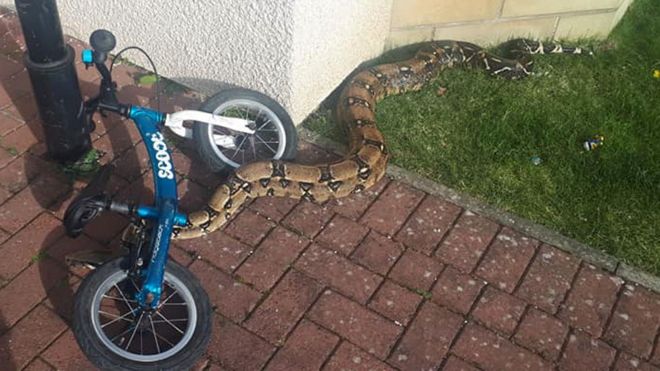
Dad's shock after children find boa constrictor in garden - via Richard Muirhead


23 April 2019


Image copyrightBRUCE BAKER

A father has spoken of his shock after his children found a seven-foot boa constrictor in their garden.

Bruce Baker thought the youngsters were playing a prank when they told him to come and see the 2.1m-long snake.

He and a neighbour had to coax the boa constrictor into a plastic box until the Scottish SPCA arrived at his home in the Scottish Borders.

Efforts are continuing to try and trace the owner of the stray snake, which was captured in Innerleithen on Sunday.

The boa constrictor, which is thought to be an escaped pet, has been taken to the Scottish SPCA rehoming centre in Edinburgh.

Monday, 25 March 2019

Florida moves to ban anacondas, raccoon dogs, gigantic bats – via Herp Digest


By Kimberly Miller, Daily Commercial, 2/26/19

With invasive pythons running rampant in the Everglades, the state is trying to keep additional exotics from gaining a foothold with new rules approved this week.

Invasive pythons run rampant in the Everglades and imported iguana burrow into canal banks with abandon, but Florida is trying to keep additional exotics from gaining a foothold in the state with new rules approved this week.

Critters, including several species of anaconda, the raccoon dog and a freaky fruit bat called the flying fox were added to the state’s prohibited species list by the Florida Fish & Wildlife Conservation Commission on Thursday in Gainesville.

The animals are already on the U.S. Fish and Wildlife Service’s list of “injurious” species, meaning they can’t be imported into the country. But because they aren’t on Florida’s list of prohibited species, they can come into the state from other states, be used for commercial purposes, and kept as pets.

“I think there could be a case for educational purposes, but for the guy on roller blades at the beach with a snake around his neck, does he really need a yellow anaconda?” said Audubon Florida Executive Director Julie Wraithmell, who supported the ban. “Floridians are with you on this and so is Florida’s wildlife, they just can’t speak here today.”

Yellow anacondas, one of the three species of anaconda put on the prohibited list this week, can grow to 15 feet long, according to a University of Florida research paper. In the wild, they could also eat just about everything they find, including “nearly all fish, amphibians, reptiles, birds and mammals native to Florida,” the paper notes.

“This is what we are trying to prevent,” said FWC spokesperson Carli Segelson.

In 2015, the U.S. Fish and Wildlife Service listed three anaconda species and the reticulated python as “injurious reptiles” noting that it was criticized for waiting until 2012 to escalate the Burmese python threat.

It’s unknown how many Burmese pythons roam the Everglades, but estimates are in the tens of thousands. Hunters with the 2-year-old water management district’s python elimination program had killed 1,985 snakes as of Tuesday.

“Every python removed from the system gives native animals down there a fighting chance,” said Mike Kirkland, a South Florida Water Management District scientist and project manager for its python elimination program. “Our program is the most successful management tool to date, but it’s just one tool in a large toolbox.”

Segelson said there are no reports of raccoon dogs — a fox-like animal indigenous to East Asia — in the wild in Florida. Also, no flying foxes — giant fruit bats with wing spans of up to 6 feet — have been spotted. But they are considered high-risk species that could make a home in the state.

Other animals on the list for prohibition include the brown tree snake, mongoose, brushtail possum and Java sparrow.

Several speakers Thursday urged commissioners to put anacondas in a less restrictive management category saying an outright ban will push people underground or cause them to release snakes that are no longer marketable.

“I don’t want people to get ticked off at the commission and go to the black market,” said Eugene Bessette, owner of Ophiological Services in Archer. “These snakes are valuable. They are worth hundreds of dollars as a baby and thousands as an adult.”

The new prohibition would grandfather in anacondas kept as a pet and give dealers a chance to sell their current snakes outside of the state. Other states don’t have the same restrictions on importation because the animals are less likely to survive in the wild. The rule also allows for the use of anacondas in zoos, and for research and educational purposes.

According to the FWC, more than 12 million wild-caught reptiles from elsewhere in the world were imported into the U.S. between 1999 and 2010. That included more than 9 million that came through Florida ports.

“The yellow anaconda is one of the few opportunities where you are at the very edge of the invasion curve where it hasn’t happened yet,” said Kipp Frohlich, FWC’s director of habitat and species conservation about the anaconda. “This is the time to put them on the prohibited list.”


Friday, 24 August 2018

For exotic pets, the most popular are also most likely to be released in the wild

Date:  August 22, 2018
Source:  Rutgers University

Among pet snakes and lizards, the biggest-selling species are also the most likely to be released by their owners -- and to potentially become invasive species, according to a Rutgers study published today in the Journal of Applied Ecology.

The study by Rutgers University-New Brunswick ecologists provides new clarity on how and why the exotic pet trade has become the primary venue by which reptiles and amphibians arrive in non-native lands, the first step to becoming ecologically damaging invaders.

The researchers documented 1,722 reptile and amphibian species in the U.S. exotic pet trade from 1999 to 2016. They compared the list with previous research and data from a citizen science project that records sightings in the U.S. of non-native species. They found that the most popular pets -- those imported in high numbers and sold at low prices, usually when they're small and cute -- are the most likely to be dumped into the wild later on.


Thursday, 14 September 2017

Conservationists See a Hurricane Risk: Florida’s Exotic Pets Could Escape - via Herp Digest


By Livia Albeck-Ripka, New York Times, 9/8/17

Some conservationists worry that exotic species like the Nile crocodile, left, could escape during Hurricane Irma. The number of Burmese python, right, boomed in Florida after Hurricane Andrew destroyed a reptile breeding warehouse in 1992.Credit
Left, Joe Wasilewski/Associated Press; right, U.S. Fish and Wildlife Service; photo illustration by The New York Ti

When Hurricane Andrew battered South Florida in 1992, conservationists say, a slithering, voracious species escaped a breeding facility and made its way toward Everglades National Park. There, the Burmese python, originally from Southeast Asia, would feast on raccoons, eggs and deer, multiplying into the tens of thousands until it had ravaged the ecosystem. 

Now, with Hurricane Irma fast approaching Florida, wildlife organizations are concerned that other nonnative species could be unleashed in the state. There are more than 1,200 species of reptiles and amphibians kept in captivity in Florida, according to the United States Association of Reptile Keepers. Many of them, like the veiled chameleon, Mexican spinytail iguana and Javan file snake, are nonnative.    

“You’ve got a lot of exotic pet breeders down in South Florida,” said Bruce Stein, associate vice president for conservation science at the National Wildlife Federation. “The question is: What’s next?”

There is no definitive proof that Hurricane Andrew was responsible for the invasion of the Burmese python, which was first spotted in the Everglades in the 1980s. Exotic pets are frequently released in the wild by their owners. But after a reptile breeding warehouse was destroyed in the 1992 hurricane, the python population boomed.

Dr. Stein said he feared that amid the chaos of a powerful hurricane, amphibians and reptiles like the “extremely aggressive” Nile crocodile could break loose from breeding centers and private collections. “It’s not inconceivable that we have a repeat of what truly is an ecological disaster in the Everglades,” he said. “It’s a ‘black swan’ event: low probability, high risk.”

Florida, with its muggy, swamp-like conditions, has long been a hub for exotic breeding. More wildlife shipments pass through Miami’s ports than anywhere else in the country except New York and Los Angeles. Once a year, the Florida Fish and Wildlife Conservation Commission organizes an amnesty pet drop-off: Keepers can give up their king cobras, Komodo dragons and other exotic species, no questions asked.

Commercial keepers need a permit for certain nonnative species. Those who apply must submit a disaster plan to the wildlife commission, but they create the plan themselves. “It’s really just for their own use,” said Gaby Vega, a spokeswoman for the commission’s Captive Wildlife Office.

In an evacuation, the reptile keeper’s association advises slipping snakes into a bag and putting the bag, tied closed, inside a crate. Owners can take the crate with them or anchor it to the ground with a rope, so that the snake doesn’t drown or float away.

“To have something happen similar to what happened with Burmese python, that’s extremely unlikely,” said Phil Goss, the association’s president. “We only advocate for responsible keeping.”

Mike Van Nostrand, who owns Strictly Reptiles, a reptile wholesaler and breeder in Hollywood, Fla., said he wasn’t worried about the 10,000 animals inside his shop, many of which are exotic. “I don’t have a plan,” he said. “My building is a fortress. It isn’t going anywhere.”

Tony Daly-Crews, who keeps about 70 animals, lives in Jacksonville, which is expecting only a Category 2 or 3 storm. He said he would be bagging, crating and locking his eastern diamondback rattlesnakes inside his breeding facility. Had the forecast called for a Category 4 or 5 hurricane, he said he would have tried to evacuate his home. (On Tuesday, the Florida Department of Agriculture and Consumer Services waived regulations that restricted interstate reptile travel.)

Conservationists also worry about other types of animals. Peter Jenkins, president of the Center for Invasive Species Prevention, said nonnative tropical fish could enter waterways from breeding ponds during storm surges.

Hurricane Andrew nearly wiped out the Schaus swallowtail butterfly, a native species that lives only in the Florida Keys. An estimated 350 butterflies remain today, and Dr. Stein said they were at risk again from Hurricane Irma


Low-lying islands, like Bahia Honda State Park, located in the Keys, were also at risk, Dr. Stein said. He described them as harboring “an extraordinary number” of rare and endangered species and “ecologically precious” ecosystems.

Thursday, 16 March 2017

Venomous Snakes in South Florida Neighborhoods-Florida recently toughened the rules for keeping venomous reptiles at a home. – via Herp Digest


By Tony Pipitone and Pedro Cancio 2/27/17, NBCMaiami

For video article is based on:

Nick Bishop likes to go by his nickname, the Wrangler. He’s an aspiring TV wildlife host.

The videos of his escapades capturing venomous snakes could bring two thoughts to cross your mind. You wonder if he has a death wish and you may not want his as your neighbor if he keeps the snakes he loves at home.

Bishop has kept a venomous snake in his Hallandale Beach condo.
           
“There was a pink rattlesnake, blue eyes, white background,” he said. “It was gorgeous.”

After getting a tip, Florida’s Fish and Wildlife Conservation Commission inspected his home and confiscated the rattlesnake. He now faces a misdemeanor charge for having the illegal snake without having a license for it.
“I totally understand,” Bishop said. “I mean if I lived next door, I wouldn’t want a rattlesnake living in my neighbor’s apartment.”

To reduce the risk of venomous snakes in neighborhoods, Florida’s FWC recently changed the rules to make it tougher to keep a venomous reptile.

The new rule changes include requirements for enclosures holding venomous reptiles. The changes impact the container the reptile is held in as well as the room that holds that container. There are also new regulations on handling reptiles outside the enclosures.

There are more than 1100 license holders in Florida listed between 2014 and 2016. The new rules add steps for people seeking to be licensed to have a venomous reptile.

Florida’s Poison Control Centers keeps track of snake bites reported in Florida. Over 900 people have reported snake bites in the last three years. That’s almost a bite per day. Two people died in 2014 from snake bites. 70 percent of those who report bites are men.

When a snake gets loose or bites someone, Miami-Dade Fire Rescue Lieutenant Scott Mullin is likely to get the call.
Mullin’s Venom One unit is the only government-run, 24-hour, seven day a week antivenin operation in the United States.
He knows the excruciating symptoms that a snake bite victim suffers.

“They say it’s like that part of their body being put over a hot grill with someone taking a railroad spike and a hammer and just hitting it with every heartbeat,” Mullin described about a rattlesnake bite.

Coral Snakes kill with a neurotoxin.

“Once you can’t expand your lungs you can’t breathe and when you can’t breathe you got about six minutes before you die,” Mullin said.

Sometimes he says the victims are bitten while keeping snakes illegally.

“In one case it was a cobra bite and the gentleman didn’t want to volunteer to help us because he didn’t want to face prosecution,” Mullin said.

Police had to get a warrant to enter his house in order to identify the species and use the correct antivenin to help save him.

A more regular call for Mullin is to recover the popular Burmese Python.

“It’s illegal to have one of these as a pet,” he said
Back at Nick the Wrangler’s house, he says only legal reptiles and mammals are there now including two snakes, a turtle, a monitor lizard, a monkey and a dog.

“Yeah I keep it simple,” Bishop said. “I don’t tangle with FWC anymore.”

Sunday, 8 January 2017

The Tegu Problem: Exotic Lizard Is Legal But Poses Threat To Everglades (and other herps. They…invade the nests of crocodiles and alligators, consuming the eggs. They invade gopher tortoise burrows and eat young tortoises.”) - via Herp Digest


Sun-Sentinel.com, 1/7/17, by David Flesher 

Anyone can buy an Argentine black and white tegu lizard for less than $200 at exotic pets stores in Deerfield Beach, Miami and other cities.

But down in the Everglades, state wildlife officers are trapping and killing those same South American reptiles as nuisance animals. The escaped and released pets are chomping their way through bird and turtle nests and threatening to spread around the state.

A Miami state senator has introduced a bill to pay for hunters to go into the Everglades of Broward, Miami-Dade and Palm Beach counties to kill tegus, which can reach a length of four feet. But despite calls to ban sales to the public, the state wildlife commission says it is not contemplating any restrictions.

Like Burmese pythons, green iguanas and other non-native species that have established themselves in Florida, tegus in the wild are a by-product of the exotic pet business. Unlike Burmese pythons, they can tolerate cold, which means that can spread farther than pythons. And unlike pythons, they can still be bought at Florida pet stores or purchased over the internet for shipment to a Florida address.

Kate McFall, Florida director for the Humane Society of the United States, which has gone to court to restrict reptile imports, says banning sales would be more effective than mounting an elaborate hunting campaign.

"Kudos to the lawmaker for trying to do something to address this, but this seems more like a recreational opportunity to hunt them," she said. "Banning them would make a lot more sense. We've learned our lesson in Florida from other species.”

Tegus are native to Brazil, Paraguay, Uruguay and Argentina. There are two known breeding populations: one around Homestead in southern Miami-Dade County, where there have been more than 2,000 sightings; the other in Hillsborough County, where the number is less than 200, according to a database operated by the University of Georgia's Center for Invasive Species and Ecosystem Health.

About two dozen have been spotted in Broward and Palm Beach counties, but they are thought to be isolated released pets, not a breeding population.

As non-picky eaters that grow big enough to discourage all but the largest predators, tegus have treated Florida as a vast buffet table. They eat fruit, vegetables, insects and lizards and love dog and cat food. They invade the nests of ground-nesting birds, crocodiles and alligators, consuming the eggs. They invade gopher tortoise burrows and eat young tortoises.

"Tegus negatively impact native wildlife because they compete with them for both food and habitat," said Carli Segelson, spokeswoman for the state wildlife commission. "Tegus are generalist feeders and can eat a wide variety of prey items.”

The silver lining in the case of Burmese pythons is they may not be able to survive year-round much farther north than their current habitat in the Everglades. Biologists are still debating the northern limits of their range.
But tegus can survive temperatures as low as 35 degrees, theoretically opening up much of the southern United States to colonization.

With concern about the tegu growing, state Sen. Frank Artiles, R-Miami, has introduced a bill to fund teams of hunters to go after them.

The bill calls for spending $300,000 a year for each of the next two years in a part of the Everglades managed by the state called the Everglades and Francis S. Taylor Wildlife Management Area.

It covers much of the Everglades of western Broward, Miami-Dade and Palm Beach counties. The bill also calls for seeking permission from the National Park Service to send hunters into Everglades National Park.

Michael Barrera, owner of Snakes at Sunset, said such spending would be unnecessary because people would catch them for free if the United States would loosen export restrictions.

A market for tegus exists in China, Indonesia and other countries as pets, food and sources of leather. He said he would offer trappers bounties, if it were legal, so he could obtain them and export them.

"If they want to catch and sell tens of thousands or whatever number they claim is out there overseas and out of our hair they should let the permit process be a lot faster for those animals because they could be exported every month by the thousands," he said.
Related Posts with Thumbnails

ShareThis