Showing posts with label caterpilars. Show all posts

Friday, 22 April 2011

Outbreak of toxic caterpillars in Pangbourne

The oak processionary moth caterpillar feeds on oak tree leaves
18 April 2011

Residents in Pangbourne and parts of west London have been warned to steer clear of a toxic caterpillar.

The Forestry Commission has issued a caution not to touch the caterpillars of the oak processionary moth.

Their hairs contain a toxin that can cause itchy skin rashes as well as eye and throat irritations.

The Forestry Commission's Stewart Snape said residents can report sightings but that the caterpillars should only be removed by pest control operators.

Officials are now dealing with outbreaks of the moth in Pangbourne in West Berkshire and the London boroughs of Ealing, Brent, Hounslow, Richmond upon Thames and Hammersmith & Fulham.

Health Protection Agency director Dr Brian McCloskey said: "We strongly advise people not to touch or approach the caterpillars or their nests because of the health risks caused by the toxin-containing hairs.

"Pets can also be affected and should be kept away as well".

He added that anyone who experiences an itchy skin rash or other allergic symptoms after being near oak trees in these areas should consult their GP.

As a caterpillar, each oak processionary moth has around 62,000 hairs, which they can eject.

Hairs that fall to the ground can be active for up to five years.

The moths only live for two to three days in July or August.

It is thought that the moths were brought into the UK on trees imported from Europe for a landscape project.

A population of oak processionary moths then established itself in the west London area in 2006.

The species was discovered in Pangbourne in 2010.

Sighting reports can be sent to Forest Research, part of the Forestry Commission, on 01420 22255 or via christine.tilbury@forestry.gsi.gov.uk.

Residents having oak trees pruned or felled in any of the affected areas should first contact the Forestry Commission's Plant Health Service on 0131 314 6414 or via plant.health@forestry.gsi.gov.uk.

http://www.bbc.co.uk/news/uk-england-berkshire-13116458

Thursday, 27 May 2010

Tent caterpillar plague

http://minnesota.publicradio.org/display/web/2010/05/27/forest-tent-catepillars/

http://images.publicradio.org/content/2010/05/26/20100526_tent-caterpillars02_33.JPG

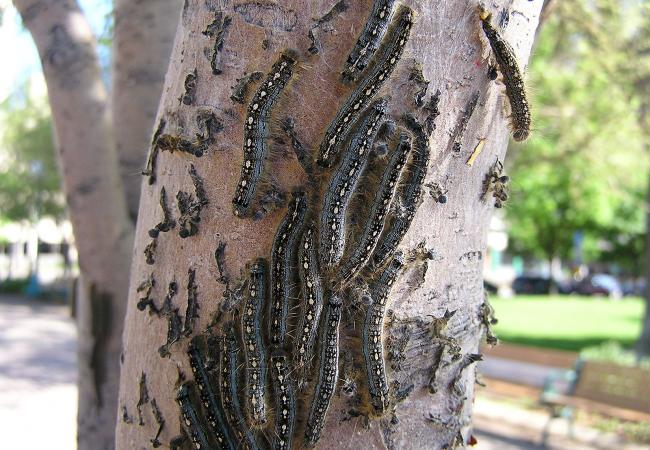
St. Paul, Minn. - They don't really make tents, but forest tent caterpillars can be a nuisance.

If they're not in your yard -- yet -- you can look at some close-up at one of the city parks, like Kellogg Mall Regional Park in downtown St. Paul. Adam Robbins with the St. Paul Parks and Recreation Department examines a clump of the soft, squishy creatures, wriggling their way up a crab apple tree.

"The forest tent caterpillar has keyhole-shaped or footprint-shaped white dots along its back, with long hairs. You also see a greenish-blue stripe along the sides of the caterpillar," he says. That doesn't sound so bad. But wait til you see them in a writhing mass the size of your hand, worming their way up your favorite shade tree or even up the side of your house.

Up north, when you walk through an aspen forest, you can hear them eating.

- Adam Robbins

"Right now they're about an inch-and-a-half to 2 inches long, which means they're nearing the end of their life cycle, ready to pupate and turn into moths," Robbins says.

The moths are tan, and they only live for about a week. They fly around at night and lay eggs in cylindrical masses around twigs. The next generation of caterpillars will emerge from the eggs next spring. This year the caterpillars are stalking trees in the Twin Cities in much greater numbers than usual. Chris Boche, St. Paul's arborist, said he hasn't seen this kind of attack in his 35 years with the city.

"I remember the canker worm wars we used to have, but the tent caterpillar is real sporadic, and we don't have trees they like here," Boche said. "They love aspen, that's why they have the outbreak up in Duluth. They'll eat for two or three years, there'll be a big population, and then they'll just disappear."

Nearly everything about this caterpillar is ishy. Adam Robbins points to some brown scum on the paving at Kellogg Park. "That's actually the caterpillar excrement, called frass. It'll fall on our park benches, it'll fall on areas where people like to eat lunch," he says. "It's not a health concern, but it is an annoyance, and if more people knew what it was, they might be a little bit grossed out by the caterpillar excrement."

"Up north, when you walk through an aspen forest, you can hear them eating. You can hear the frass hitting the leaves too, it sounds like a light rain, but it's a hard rain because it bounces off." Another thing about tent caterpillars in the north woods: For about a month it can feel like midsummer, but the woods have a strange winter look to them because all the branches are bare.

Adam Robbins says healthy trees here in the metro should recover. "Even though they're mostly defoliated in some cases, they will send out another set of leaves, so in about a month's time, if we take good care of
them, they should recover fully," Robbins says. "We shouldn't see any ill-effects of the caterpillar this season."
Next year could be another story. Robbins says trees can begin to suffer if they're defoliated too often. So the city might go out in the early spring with shop vacs to suck up caterpillars as they huddle in clumps on tree
trunks.

Yet another way for this unloveable creature to gross us out.

Monday, 10 August 2009

Dancing caterpillars put off predators

Caterpillars have been spotted 'dancing' to put off predators as they eat their way through a leaf.

Published: 7:00AM BST 10 Aug 2009

All six bugs reared up with their back legs in the air to make themselves more imposing to potential predators, and look just like they're dancing.

The sight was captured by keen amateur photographer Desmond Cannon in the back garden of his home in Brae, County Wicklow, Ireland.

Mr Cannon, 46, was playing football in his garden with his nine year old son James when the youngster spotted the birch sawfly larvae.

Mr Cannon, a medical sales rep, fetched his camera and macro lens.

He then spent an hour snapping away at the bugs, which measured less than one centimetre each, as they ate their way through the silver birch leaf.

Mr Cannon said: "My son is very observant and he called me over to have a look after he spotted the caterpillars.

"I was about to flick them away from the tree when they started to rear up and perform for me.

"It was incredible to see them rear up like this.

"You don't see many butterflies around these days so I was delighted to get pictures of the butterflies of the near future.

"They put on an amazing performance for about an hour.

"When I started taking pictures they had barely touched the leaf but by the end it was virtually all gone."

Mr Cannon took the sequence of shots with a Canon 50d camera.

Geoff Read, head of reptiles and inverterbrae at Marwell Wildlife, near Winchester, Hants, said the behaviour was perculiar to sawfly larvae.

He said: "It is a defence mechanism. If you go too near them they rear up like this to try and scare off predators.

"It is only this family of caterpillars that do this - it's incredible to see."

http://www.telegraph.co.uk/news/newstopics/howaboutthat/6001083/Dancing-caterpillars-put-off-predators.html
Related Posts with Thumbnails

ShareThis