Showing posts with label Gulf of Mexico. Show all posts

Thursday, 27 June 2019

Scientists capture first-ever video of giant squid in U.S. waters


JUNE 24, 2019

FIU marine scientists Heather Bracken-Grissom and Lori Schweikert were among a team of researchers gathered around a monitor when the tentacle first came into view. It floated in and out of the darkness offering no hint of what was on the other end. Then, in an elegant explosion of arms and tentacles, the creature revealed itself—the phantom of the deep, known simply as the giant squid.
It is the first time the elusive creature has been caught on camera in U.S. waters—about 100 miles southwest of New Orleans in the Gulf of Mexico. It is only the second time the creature, which can grow up to 40 feet, has ever been captured on camera. The discovery was made toward the end of a 17-day research mission dubbed Journey into Midnight which began June 7.
"It was magical and surreal to see how the animal behaves in nature," Bracken-Grissom said. "To know that I was witnessing something that had only been seen once before in nature filled me with an overwhelming sense of gratitude and respect for what still is to be discovered."

Friday, 7 August 2015

Alien of the Deep Has Needle-Sharp Teeth & a Shiny Head Lure

Lurking in the dark depths of the sea, a new species that looks more like an alien than a fish has been discovered, a creature with needlelike teeth and a glowing fishing pole of sorts atop its head.

Scientists spotted three females of the new species of anglerfish between 3,280 feet and nearly 5,000 feet (1,000 and 1,500 meters) beneath the Gulf of Mexico. The little fish, whose bodies ranged in length from 1.2 to 3.7 inches (30 to 95 millimeters), live under extreme conditions: No sunlight penetrates their deep habitats where they endure immense pressures of more than 2,200 pounds (1 ton) per square inch.

Now called Lasiognathus dinema, the anglerfish stood out from other species in its genus by the curved appendages jutting out from its so-called esca, or the organ at the tip of the "fishing rod" that contains light-producing bacteria. The species name dinema comes from the Greek words "di" for "two" and "nema" for "thread," referring to the threadlike extensions sprouting from the bases of the light organ's hooks, the researchers, Tracey Sutton of Nova Southeastern University in Florida and Theodore Pietsch of the University of Washington, write in the journal Copeia (published by the American Society of Ichthyologists and Herpetologists). 

Sunday, 24 May 2015

Deepwater Horizon oil spill contributed to high number of Gulf dolphin deaths

Date: May 20, 2015

Source: NOAA Headquarters

Summary: As part of an unusual mortality event investigation, a team of scientists has discovered that dead bottlenose dolphins stranded in the northern Gulf of Mexico since the start of the Deepwater Horizon oil spill have lung and adrenal lesions consistent with petroleum product exposure according to a paper published today in the peer-reviewed online journal PLOS ONE.

These findings support those of a 2011 health assessment of live dolphins in Barataria Bay, Louisiana, a heavily oiled area during the spill which showed those resident dolphins had poor health, adrenal disease, and lung disease.

The timing, location, and nature of the detected lesions support that contaminants from the Deepwater Horizon oil spill caused these lesions and contributed to the high numbers of dolphin deaths within this oil spill's footprint. Increased dolphin deaths following the oil spill are part of the northern Gulf of Mexico unusual mortality event investigation.


Monday, 11 May 2015

Whales in Gulf of Mexico face endangered status as drilling moves in

Associated Press in New Orleans

Sunday 10 May 2015 15.40 BST
Last modified on Sunday 10 May 201516.01 BST

With as few as about a dozen of the mammals left, federal regulators say a unique species of baleen whales in the Gulf of Mexico about 70 miles off the Florida Panhandle may be threatened with extinction and could get special protection from federal regulators.

In April, the National Marine Fisheries Service announced it was looking at granting endangered or threatened status to the small population of Bryde’s whales (pronounced Bru-dihs whales) that live in the DeSoto Canyon region, a deep-water area about 50 miles east of the site of BP’s catastrophic oil spill five years ago.


Sunday, 30 November 2014

Texas releases more than 50 sea turtles treated for cold-stunning

By Amanda Orr

HOUSTON (Reuters) - More than 50 green sea turtles were released into the Gulf of Mexico off the Texas coast on Friday after recovering from cold-stunning, or hypothermia, brought on by a drastic drop in water temperature.

The release has taken place in phases, with Friday being the last major release for sea turtles rescued after a mid-November cold snap in Texas sent temperatures below freezing in large parts of the state.

"We wait until the Gulf waters are warm enough to prevent a repeat cold-stunning event for these individuals," said Donna Shaver, chief of the Division of Sea Turtle Science and Recovery at Padre Island National Seashore.

As with other reptiles, sea turtles rely on their external environment to regulate body temperature and cold-stunning occurs when water temperatures drop below 50 degrees Fahrenheit (10 degrees Celsius), she said.

Symptoms include decreased heart rate and lethargy, which renders the turtles virtually paralyzed and leaves them vulnerable to injury or death by predators and boats.

Monday, 11 August 2014

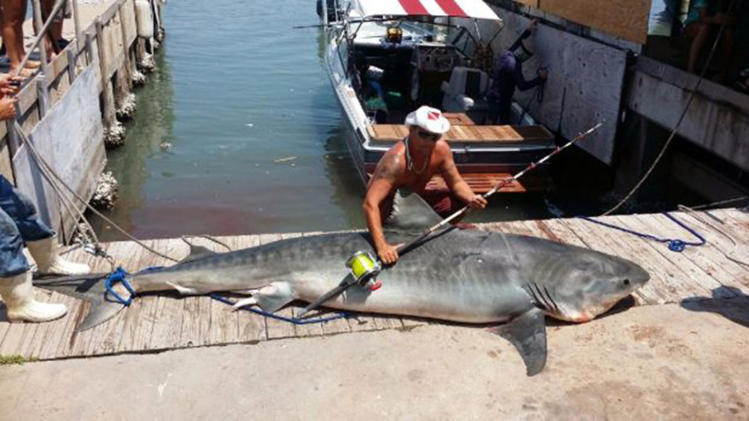
Texas fisherman catches 809-pound tiger shark

18 hours ago
6th August 2014

PORT ARANSAS, Texas (AP) — A Texas fisherman has landed an 809-pound tiger shark in the Gulf of Mexico after reeling it in for more than seven hours.

Ryan Spring of San Antonio says he caught the shark Sunday about 5 miles off Port Aransas (uh-RAN'-suhs). He says the 12-foot, 7-inch shark was about as big as his boat. He says it pulled the vessel south for more than 15 miles.

It took about a dozen men to haul the male shark onto the dock. Spring plans to donate meat from the shark to charity.

The catch falls short of the tiger shark state record, which according to the Texas Parks and Wildlife Department says is 1,129 pounds.

Saturday, 21 June 2014

Experts finally end two-year mystery of giant sea monster caught on camera

The deepest depths of the ocean are home to all sorts of weird creatures but it has taken experts two years to identify this huge sea monster.

This mysterious creature was captured on camera 5,000ft deep in the Gulf of Mexico two years ago, but it has only just been identified by marine biologists.

The camera operator on an oil rig was surveying the structure when the browny-orange coloured giant blob floats into view.

The rare discovery left marine biologists scratching their heads as experts delved into the history books and old files in a bid to find out what it was.


Tuesday, 22 April 2014

Four Years Later, Marine Life Still Feeling Significant Impacts From Deepwater Horizon Oil Spill

April 18, 2014

Lawrence LeBlond for redOrbit.com – Your Universe Online

As the fourth anniversary of the Deepwater Horizon accident in the Gulf of Mexico approaches, much of the region’s environment and marine life are still feeling the effects of the largest accidental oil spill in US history.

Despite the continued impact on the environment and wildlife, BP – formerly British Petroleum – said in a statement on Tuesday that it has ended its “active cleanup” of Louisiana’s coast. This follows last year’s end of active cleanup in Florida, Alabama and Mississippi.

BP’s announcement also follows a directive issued by the US Coast Guard transitioning the active cleanup phase to a new response phase in which crews and equipment will be pre-positioned for future response to cleanup if new reports of oil surface.

“Our response posture has evolved to target re-oiling events on coastline segments that were previously cleaned,” said Coast Guard Capt. Thomas Sparks, who serves as federal on-scene coordinator for the BP response to the spill. “But let me be absolutely clear: This response is not over – not by a long shot. The transition to the Middle Response process does not end clean-up operations, and we continue to hold the responsible party accountable for Deepwater Horizon cleanup costs.

“We are absolutely committed to continuing the clean-up of Deepwater Horizon oil along the Gulf – for as long as it takes, and to surge as necessary and as the situation dictates,” Sparks said, as cited by Manuel Torres of The Times-Picayune.


Wednesday, 25 December 2013

Study links BP oil spill to dolphin deaths

US government scientists have for the first time found direct evidence of toxic exposure in the Gulf of Mexico

US government scientists have for the first time connected the BP oil disaster to dolphin deaths in the Gulf of Mexico, in a study finding direct evidence of toxic exposure.

The study, led by scientists from the National Oceanic and Atmospheric Administration, found lung disease, hormonal abnormalities and other health effects among dolphins in an area heavily oiled during the BP spill.

Monday, 22 July 2013

Nesting Gulf of Mexico Loggerhead Turtles Face Offshore Risks

July 15, 2013 — Threatened loggerhead sea turtles in the northern Gulf of Mexico can travel distances up to several hundred miles and visit offshore habitats between nesting events in a single season, taking them through waters impacted by oil and fishing industries.

Evidence from a U.S. Geological Survey study challenges the widely-held view that sea turtles remain near one beach throughout the nesting season and suggests the threatened species may require broader habitat protection to recover. The findings also cast new uncertainties on current estimates of the size of the species' Gulf of Mexico subpopulation.

"This is the first study to locate and quantify in-water habitat use by female loggerheads in the Northern Gulf of Mexico subpopulation during their reproductive periods," said lead author Kristen Hart, a USGS research ecologist. "Our tracking results show they depend on a much broader range of habitat during this critical part of their lives than was previously thought to be required."

The study reveals detailed loggerhead movements during "inter-nesting" periods, showing patterns that vary for individual turtles. Generally, this period begins when a female returns from open seas around May and lasts roughly until September. Up until now, efforts to protect the species generally centered on beaches with high nesting activity under the assumption that once turtles had nested on those beaches, they either remained in their immediate vicinity or migrated back out to sea.


Monday, 24 June 2013

Huge 'Dead Zone' Predicted in Gulf of Mexico

By Douglas Main, Staff Writer
updated 6/19/2013 7:48:48 AM ET

A very large dead zone, an area of water with no or very little oxygen, is expected to form in the Gulf of Mexico this year — a trend in recent years, according to the National Oceanic and Atmospheric Administration (NOAA).

Computer models put together by scientists predict that the zone will cover an area between 7,286 and 8,561 square miles (18,871 to 22,173 square kilometers) this summer, the typical time for such zones to form. The large end of the estimate is roughly the size of the state of New Jersey, and would be the largest dead zone ever recorded. The biggest one recorded to date, in 2002, reached 8,481 square miles (21,966 square km).

Meanwhile, models predict the dead zone in the Chesapeake Bay will be smaller than usual.

The makings of a dead zone begin with nutrient pollution, primarily fertilizers and agricultural runoff. Once these excess nutrients reach the ocean, they fuel algae blooms. The algae then die and decompose in a process that consumes oxygen and creates lifeless areas where fish and other aquatic creatures can't survive. This zone can have serious impacts on commercial and recreational fisheries on the Gulf Coast.

Conditions are ripe for a large dead zone this summer, thanks to heavy rains throughout much of the Midwest this spring that have caused water nutrient runoff (for example, from farm fertilizer) with it, according to a NOAA statement.

Sunday, 23 June 2013

How Landmark Noise Settlement Protects Oceans and Industry (Op-Ed)

Michael Jasny, Natural Resources Defense Council (NRDC)
Date: 20 June 2013 Time: 05:10 PM

Michael Jasny, director of the NRDC Marine Mammal Project, contributed this article to LiveScience's Expert Voices: Op-Ed & Insights.

Here’s a recipe for an environmental train wreck: Take one of the world's most powerful industries, allow it to conduct harmful activities for years without obtaining the basic authorizations required by law, and produce a wealth of science making it plain that those harmful activities are putting endangered and vulnerable species at risk.

Today (June 20, 2013), a number of conservation groups, including my own, announced a landmark agreement that may prevent one such train wreck — this one in the already scarred Gulf of Mexico.

Tuesday, 28 May 2013

Fishery Rule Could Benefit Sea Turtles - via Herp Digest

By Cameron Jaggard, Pew Charitable Trust, 5/7/13

Weighing up to 2,000 pounds, the leatherback is the largest sea turtle on Earth. Their wide ranging migratory patterns overlap with those of other severely depleted ocean wildlife, including western Atlantic bluefin tuna. Unfortunately, surface longlines fishing for yellowfin tuna and swordfish also catch and kill these and more than 80 other species accidentally, including sharks, marine mammals, blue marlin, and sailfish. More than half of the catch is thrown back and the vast majority of that discarded catch is dead. 

In an effort to protect bluefin spawning grounds in the Gulf of Mexico, scientists are now working with commercial fishermen to determine if two highly selective fishing methods can provide a viable alternative to surface longlines. Research conducted to date indicates that 87 to 91 percent of the catch on these alternative gears is comprised of target catch of yellowfin tuna and swordfish. Furthermore, neither gear has yet interacted with any bluefin tuna or sea turtles in the Gulf. Oil spill restoration monies made available by BP could help pay to transition Gulf surface longline fishermen to these more selective gears and smaller, more economical, and efficient fishing vessels. 

The National Oceanic and Atmospheric Administration's Fisheries Service (NOAA Fisheries) also has a rare and important opportunity to help. The agency is developing a new bluefin rule that could ensure the long-term success of this gear transition program, help end the waste of bluefin and other species in the Gulf and Atlantic incidentally caught on surface longlines, and support increased fishing opportunities for selective bluefin fishermen. A prohibition on surface longlining in the Gulf and a strict annual limit on bluefin mortality in the Atlantic surface longline fishery could do just that. 

Sea turtles stand to benefit greatly, if these measures are implemented. This rule would eliminate an estimated 169 harmful interactions with endangered leatherback and threatened loggerhead sea turtles in the Gulf annually. A hard limit on bluefin mortality in the Atlantic surface longline fishery will also encourage more selective fishing practices that could further reduce the fishing gear's impact on protected marine life and encourage the rebuilding of sea turtles species that the U.S. has listed on the Endangered Species Act for more than three decades. 

NOAA Fisheries plans to release the bluefin proposed rule for public comment this summer. This comment period will provide the best opportunity for conservationists, fishermen, and other stakeholders to encourage NOAA Fisheries to issue a strong bluefin rule. Visitwww.PewEnvironment.org/GulfTuna or contact cjaggard@pewtrusts.org to learn how you can submit a comment.

Tuesday, 30 April 2013

Gulf Of Mexico Dolphin, Sea Turtle Deaths Point To Continued Effects Of BP Oil Spill, Group Alleges – via Herp Digest


By JANET McCONNAUGHEY
NEW ORLEANS (AP) 4/2/13— Continuing deaths of dolphins and sea turtles are a sign that the Gulf of Mexico is still feeling effects from the 2010 spill that spewed 200 million gallons of oil from a well a mile below the surface, a prominent environmental group said Tuesday.

The deaths — especially in dolphins, which are at the top of the food chain — are "a strong indication that there is something amiss with the Gulf ecosystem," said National Wildlife Federation senior scientist Doug Inkley.

"Both species have very high mortality the first year, slightly lower the second year and the third year even lower, but still well above average," Inkley said. "To have these deaths above average for so long a period of time is unprecedented."

The National Oceanic and Atmospheric Administration's fisheries service has said previously that many turtles probably drowned in shrimp nets and that brucellosis, a bacterial infection, was the only common thread in the dolphin deaths.

NOAA cannot comment about Inkley's statement because its investigation of the deaths is part of the federal tally of environmental damage for oil spill litigation, spokeswoman Connie Barclay said.

The federation's report, "Restoring a Degraded Gulf of Mexico: Wildlife and Wetlands Three Years into the Gulf Oil Disaster," was based on previously reported research by other scientists, including NOAA's updates on the dolphin and sea turtle strandings.

The key to restoring the Gulf is conserving coastal wetlands, and it's critical to make sure that any fines imposed from the trial now in progress in New Orleans go to that purpose, said Inkley and David Muth, director of the federation's Mississippi River Delta Restoration Program.

The trial will assign a percentage of responsibility among BP PLC and other companies involved in the Deepwater Horizon drilling rig explosion April 20, 2010. It will also decide penalties under both the Clean Water Act and the National Resource Damage Assessment process.

NRDA uses scientific research to assess environmental damage and decide how to fix it. Under the RESTORE Act of 2012, 80 percent of all Clean Water Act fines will go to Louisiana, Mississippi, Alabama, Florida and Texas.

The federation looked at how coastal wetlands and six species of animals are doing in the Gulf three years after the spill, basing its assessment on historical status and what the future looks like as well as the spill's effect.

It rated the status of coastal wetlands, Atlantic bluefin tuna, and sea turtles as poor; bottlenose dolphins and deep-sea coral as fair; and shrimp and brown pelicans as good.

Thursday, 18 April 2013

Dead dolphins and shrimp with no eyes found after BP clean-up

Chemicals used to disperse Gulf of Mexico spill blamed for marine deaths and human illness

Hundreds of beached dolphin carcasses, shrimp with no eyes, contaminated fish, ancient corals caked in oil and some seriously unwell people are among the legacies that scientists are still uncovering in the wake of BP's Deepwater Horizon spill.

This week it will be three years since the first of 4.9 million barrels of crude oil gushed into the Gulf of Mexico, in what is now considered the largest marine oil spill in the history of the petroleum industry. As the scale of the ecological disaster unfolds, BP is appearing daily in a New Orleans federal court to battle over the extent of compensation it owes to the region.

Infant dolphins were found dead at six times average rates in January and February of 2013. More than 650 dolphins have been found beached in the oil spill area since the disaster began, which is more than four times the historical average. Sea turtles were also affected, with more than 1,700 found stranded between May 2010 and November 2012 – the last date for which information is available. On average, the number stranded annually in the region is 240.

Contact with oil may also have reduced the number of juvenile bluefin tuna produced in 2010 by 20 per cent, with a potential reduction in future populations of about 4 per cent. Contamination of smaller fish also means that toxic chemicals could make their way up the food chain after scientists found the spill had affected the cellular function of killifish, a common bait fish at the base of the food chain.

Wednesday, 27 March 2013

Scientists Confirm First Two-Headed Bull Shark


Mar. 25, 2013 — Scientists have confirmed the discovery of the first-ever, two-headed bull shark.The study, led by Michigan State University and appearing in the Journal of Fish Biology, confirmed the specimen, found in the Gulf of Mexico April 7, 2011, was a single shark with two heads, rather than conjoined twins.

There have been other species of sharks, such as blue sharks and tope sharks, born with two heads. This is the first record of dicephalia in a bull shark, said Michael Wagner, MSU assistant professor of fisheries and wildlife, who confirmed the discovery with colleagues at the Florida Keys Community College.

"This is certainly one of those interesting and rarely detected phenomena," Wagner said. "It's good that we have this documented as part of the world's natural history, but we'd certainly have to find many more before we could draw any conclusions about what caused this."

The difficulty of finding such oddities is due, in part, to creatures with abnormalities dying shortly after birth. In this instance, a fisherman found the two-headed shark when he opened the uterus of an adult shark. The two-headed shark died shortly thereafter and had little, if any, chance to survive in the wild, Wagner added.


Thursday, 13 December 2012

Sea Turtle protection device plans shelved by NOAA – via Herp Digest


MELINDA DESLATTE, Associated Press 11/27/12-— New regulations that would have forced shrimpers in the bays and marshes of the Gulf of Mexico to install devices on their nets to save endangered sea turtles were scrapped Tuesday by federal officials.

The National Oceanic and Atmospheric Administration said it is withdrawing plans by its fisheries service to require "turtle excluder devices" for small fishing operations that trawl for shrimp in state waters.

NOAA said data collected over the summer showed the devices — which are escape hatches for sea turtles on nets — may not keep small turtles from being caught in the shallower waters that would have been subject to the requirement.

"The information we now have suggests the conservation benefit does not justify the burden this rule would place on the industry. We need more research looking at different options," Roy Crabtree, southeast regional administrator for NOAA Fisheries, said in a statement.

The rules had been set to take effect by spring. Gulf of Mexico shrimpers had said the requirement could push them out of business. The change would have affected 2,600 fishermen, including an estimated 2,300 vessels in Louisiana.

Crabtree said federal officials will continue their research to help prevent turtle deaths.

"We're not abandoning this issue. There's just more work that needs to be done to get it right," he said.

A spike in turtle deaths in the Gulf since 2010, environmental lawsuits, the BP PLC oil spill and the endangered status of sea turtles have spurred federal officials to look at stronger protections for vulnerable turtle populations.

In the past two years, more than 1,100 dead sea turtles have been found in Louisiana, Mississippi and Alabama waters. Federal scientists estimate about 28,000 sea turtles are caught each year in nets.

The Center for Biological Diversity, a national conservation group that sought the protections, criticized the decision to shelve the proposed federal rules, saying further delay will cause unnecessary turtle deaths.

"The agency's failure to protect these species is tragic. Despite its own claim that the Fisheries Service is not abandoning its promise to protect sea turtles, it is in fact maintaining the deadly status quo by failing to move forward with any protective measures," said Jaclyn Lopez, a lawyer for the center.

Turtle excluder devices have been required for larger shrimp vessels that work in federal waters for more than two decades, according to NOAA, but not in state waters, with shallower areas and smaller turtles.

Instead of the devices, fishermen in state waters are supposed to lift their nets out of the water every once in a while to help trapped turtles breathe and get out of nets. NOAA officials said they've had trouble with low compliance and difficulties in enforcement.

The proposed rules targeted three common types of nets called skimmer trawls, pusher-head trawls and wing net trawls. Other states that would have been included in the rules, according to NOAA spokeswoman Allison Garrett, were Mississippi, Alabama, North Carolina and Florida.

Fishermen have long resisted moves to force the turtle-saving gear on the fleet. Shrimpers said there was little evidence that they were responsible for the spike in sea turtle deaths and said the cost of the new rules could destroy the industry.

Thursday, 22 November 2012

Government to impose new limits on shark fishing


The government plans to require almost all sharks landed by recreational fishermen off the Atlantic Coast and the Gulf of Mexico to measure at least 8 feet from nose to fork in the tail, a move that some recreational fishermen said will end their sport but that conservationists say is needed to save an imperiled species.

The debate over how best to protect the dusky shark — which can migrate hundreds of miles in a season but whose juveniles return every summer to the mid-Atlantic — highlights the complicated task of recovering shark species.

The National Oceanic and Atmospheric Administration has prohibited the catch of dusky sharks since 1999, but scientists found its population to be so depleted that it will take 100 years for it to recover.

The dusky shark, which averages nearly 12 feet in length and 400 pounds, takes two decades to reach sexual maturity and has small litters every three years, which makes it vulnerable to overfishing.

The environmental group WildEarth Guardians has petitioned to list the dusky shark under the Endangered Species Act.

Sunday, 26 August 2012

Shrimpers Battling Over Turtle Rules - via Herp Digest


By Cain Buedeau, AP, Wed Aug 1, Lafayette, La. — Efforts to protect endangered sea turtles in the Gulf of Mexico have prompted strenuous complaints from the dwindling fleet of shrimpers blamed for drowning them in their nets, who say their own livelihoods are threatened.

By next March the federal government wants about 2,435 shrimp boats — most run by mom-and-pop operations — to install turtle-saving gear in their nets to protect the Kemp's ridley turtle, whose survival has gained renewed concern after BP's catastrophic 2010 Gulf oil spill. The spill prompted closer study of turtle deaths, though scientists have concluded that most were due to drowning, most likely in nets, and not effects of the oil spill.
Fishermen say the gear will cause them to lose shrimp, cut into their paltry profits and drive their waning industry into an even deeper hole. The fishermen also insist the new gear is unnecessary because they hardly ever catch turtles.

The gear is already required for trawlers in federal waters. The new rule would apply to nets used in state waters, closer to shore, where many shrimpers operate.

"These people are trying to put us out of work and put us on the food stamp line," said Clint Guidry, president of the Louisiana Shrimp Association.

Fishermen feel like they can't catch a break. Imports of cheap farm-raised shrimp, hurricanes, high fuel prices and the BP oil spill have driven about 4,000 boats off the water in Louisiana over the past decade. The number of commercial shrimpers is declining elsewhere, too.

The new measures are meant to protect turtles — and especially the endangered Kemp's ridley turtle. Measuring 100 pounds and 2 feet in length as adults, they're considered the world's smallest marine turtles.

Since the 1980s Mexico and the United States have partnered to bring the species back from the brink of extinction. After the BP oil spill began, scientists along the Gulf Coast rushed to collect Kemp's ridley and loggerhead turtle eggs from beach nests for incubation in Florida with the intent of releasing hatchlings in the safer waters of the Atlantic. Mexico also has taken measures to protect beach nesting areas and hatchlings.

Earlier this year the National Marine Fisheries Service — under pressure by environmental lawsuits — said it would develop rules to make nearly every commercial shrimper along the Gulf and South Atlantic install in nets the grill-like apparatus called a "turtle excluder device" to propel ensnared turtles to freedom. The grills are known as TEDs.

The agency says it hopes the rules will be completed and in effect by March 2013. 

Shrimpers, meanwhile, are sour and angry at the prospect.

That was the mood at Robert Boudreaux's net shop in Lafitte on Barataria Bay on a recent morning where a handful of the only shrimpers left in this town drank coffee as they watched the lightning-fast fingers of net makers knit nylon webbing.

"The net is like a giant funnel and as it funnels down; right when it gets to the point like that of a bottle you install the TED," Boudreaux, the net maker, explained.

But he said TEDs present many problems for small boats.

"You're not dragging in a swimming pool where everything's clean," he said. "You're dragging in water with trash and debris. Debris comes in there, jams in the TED, and then shoots out your shrimp!"

The TED has a contentious history.

In the 1980s, regulators first proposed Gulf fishermen use them, sparking what fishermen still refer to as the "the TED wars."

During the summer of 1989, an armada of shrimp boats, some flying skull and bones flags, formed blockades into the ports of Lake Charles, Houston and Corpus Christi to protest TED rules. Things got ugly with gunshots reported; a Coast Guard cutter's window was broken; boaters tried to run the blockades and protesters were sprayed with water cannons.
TEDs became the law anyway for trawlers in offshore federal waters. In response, many shrimpers stopped going far offshore.

Now, regulators want to close that loophole by requiring fishermen in state waters use TEDs. Regulators estimate about 5,515 turtles would be saved each year.

"It's clear that the skimmer fleet is taking a massive toll on sea turtles," said Teri Shore, program director of the Sea Turtle Restoration Network, a California-based group that's filed lawsuits to protect sea turtles.

A spike in dead turtles along the northern Gulf since early 2010 has added urgency. Since then, 1,519 sea turtles have been found stranded or dead. About 85 percent are Kemp's ridley turtles, National Marine Fisheries Service data shows. Federal scientists say most of the turtles died due to drowning, most likely in nets, and not from BP's oil spill.

Environmentalists say increased monitoring of the Gulf since the spill shows the shrimp fleet is killing turtles.

"What the oil spill did was shine a great big spotlight on dead turtles and they weren't covered in oil," said Carole Allen, founder of Help Endangered Animals-Ridley Turtles, a Texas group that's pushed for more regulations on the shrimp fleet since the 1980s.
Environmentalists also say the price for TEDs is small. Federal scientists say about 5 percent of a fisherman's catch is expected to be lost due to the gear, which costs up to $400 a net to install.

Yet shrimpers insist that's not the case.

"I've caught three turtles in my whole career," said Pete Gerica, 59.

Matthew Moreau, a 37-year-old shrimper, said he's caught a few turtles but when he does he returns them to the water. "Why would we keep them?"

To prove how many turtles are caught, this year the National Marine Fisheries Service is spending $2 million to send contractors out on shrimp boats to catalogue the catch. So far, 24 Kemp's ridley turtles have been caught while observers were onboard, NMFS said.

Shrimpers are hardly happy about observers on their cramped boats.

"Me and him didn't see eye to eye," said Henry Hess, a 53-yer-old fisherman about the observer he had on his boat. "I don't like people trying to get rid of my job. I wanted to throw him off my boat."

Requests by The Associated Press to interview the observers, hired by Florida-based IAP World Services Inc., were denied.

Fishermen aren't the only ones questioning the need for TEDs.

"Without doubt, uncategorically, it's the shrimper (who's more endangered)," said Jerald Horst, a retired Louisiana State University fisheries specialist.

In the late 1980s, there were roughly 16,500 shrimp net licenses issued in Louisiana. The number dropped to about 5,240 in 2007, according to the Louisiana Department of Wildlife and Fisheries.

Meanwhile, the number of Kemp's ridley turtles is on the rebound. In 2009, more than 20,000 nests were counted on the same Mexican beaches where only 702 were found in the 1980s.

TEDs, though, may be the fishermen's best hope to survive, said Roy Crabtree, Southeast regional administrator at NMFS.

"Folks can say, `TEDs put us out of business,'" Crabtree said. "But the fact is TEDs saved the (offshore) shrimp fishery. It would have ended up being closed down under the Endangered Species Act. So, TEDs gave us a technological solution to a very serious problem."

Tuesday, 24 July 2012

BP Oil Spill May Have Contributed to Dolphin Deaths, Study Finds


The 2010 BP oil spill contributed to an unusually high death rate for dolphins in the Gulf of Mexico, a new study suggests.

Between January and April 2011, 186 dead bottlenose dolphins washed ashore between Louisiana and western Florida. Most alarmingly, nearly half of these casualties were calves, which is more than double the usual proportion of young to old dolphins found dead. Scientists now blame both natural factors and human catastrophe for the unusual die-off.

"Unfortunately, it was a 'perfect storm' that led to the dolphin deaths," study researcher Graham Worthy, a biologist at the University of Central Florida, said in a statement. "The oil spill and cold water of 2010 had already put significant stress on their food resources. … It appears the high volumes of cold freshwater coming from snowmelt water that pushed through Mobile Bay and Mississippi Sound in 2011 was the final blow." 

Related Posts with Thumbnails

ShareThis