Showing posts with label Cambridgeshire. Show all posts

Wednesday, 24 October 2018

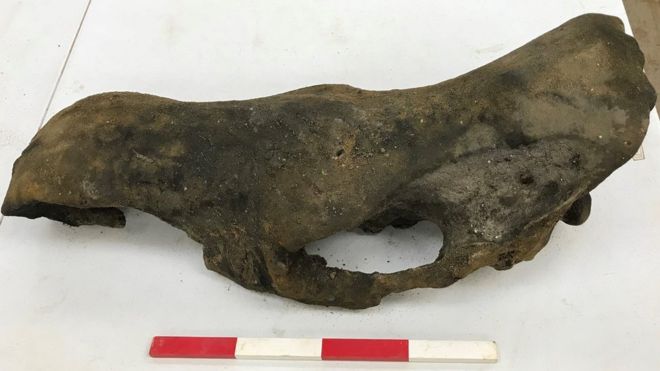
A14 road workers find woolly mammoth bones

19 October 2018


Image captionThe remains are thought to date back to the last Ice Age

Road workers building a new bypass have unearthed the Ice Age remains of a woolly mammoth and a woolly rhino.

The team, working on improvements to the A14 between Cambridge and Huntingdon, discovered a number of bones while digging near Fenstanton.

Experts believe the remains, found in what was once an ancient river, could be at least 130,000 years old.

Palaeontologist Dean Lomax said discoveries like this were "exciting" and "quite uncommon".

Highways England confirmed the prehistoric bones will be sent to specialists in London for further analysis.


Sunday, 24 January 2016

Cambridgeshire plesiosaur 'sea monster' could be 'new species'

22 January 2016 

A Jurassic "sea monster" found in Cambridgeshire could prove to be a new species of plesiosaur, scientists said.

Oxford archaeologists discovered the 165 million-year-old reptile bones at Must Farm quarry near Whittlesey.

Dr Carl Harrington and his team dug up more than 600 pieces of bone as well as the skull, still preserved in clay.

"Eve", described as "a fantastic fossil", has anatomical features only before seen in plesiosaurs half her size, a palaeontologist said.

Plesiosaurs were sea creatures that lived at the time of the dinosaurs.

Tuesday, 28 July 2015

Unique opportunity to celebrate International Bat Night

On Friday 28 August, to mark International Bat Night, The Churches Conservation Trust (CCT) is offering wildlife enthusiasts, their families and friends the opportunity to stay overnight in a 13th century church inhabited by a colony of Natterer’s bats.

Guests are invited to sleep in the aisle of the church and sample “champing” (church camping) whilst learning more about the mysterious creatures overhead from bat experts on site.

The event will take place at The Church of St John the Baptist in Parson’s Drove, Cambridgeshire, a stunning Grade II* church which has been in The CCT’s care since 1974 and which is a long-time favourite of both bats and architecture enthusiasts.

An expert bat-handler will lead the evening with a presentation about the fascinating animals and everyone will have a chance to try out the bat detectors.

After sunset, the bats will appear from under the church roof and guests can help The CCT count them as they emerge for their night's feeding. 

Tuesday, 12 May 2015

Sunbathing seal spotted 40 miles inland in Cambridgeshire


Animal pictured soaking up sun and splashing around in river in St Ives, 40 miles from nautral sea habitat

By Agency, video source SWNS

2:03PM BST 11 May 2015

A sunbathing seal has been spotted in a river 40 miles from the sea in Cambridgeshire.

Nathaniel Gore, 33, was out walking near his home in St Ives on Sunday when he spotted the animal splashing around in the water.

The editorial project manger stopped to film the seal and said it was not put off by the attention.

He added: "I've heard stories of seals being found inland before and he seemed perfectly happy so I wasn't too concerned.

"I stopped for about 20 minutes and he seemed to be enjoying the attention. He was splashing around in the water and sunbathing by the side of the river. I was able to get within three feet and it was a great sight to stop and enjoy."

Continued ...


Sunday, 4 January 2015

Linton Zoo lions play with old Christmas trees

Lions at a Cambridgeshire zoo are being given old trees to play with as a post-Christmas treat.
Real Christmas trees are "like catnip" to lions, Linton Zoological Gardens' director Kim Simmons said.

The trees are used as toys by the big cats while others are used in the zoo's bio-burner to provide additional heating for the buildings.
Zuri the lion with Christmas treePeople have been dropping off individual trees and a number of nurseries have donated unsold ones.

Monday, 6 January 2014

Linton Zoo lions 'recycle' discarded Christmas trees

A pair of African lions have gone wild for Christmas trees after a Cambridgeshire zoo appealed for people to donate them for recycling.

The trees are being reused by Linton Zoological Gardens as big cat toys, bio-fuel and, if they still have roots, to enrich the zoo's enclosures.

Manager Dawny Greenwood said the scented trees are "almost like catnip" for the resident big cats.


Thursday, 7 November 2013

Hedgehogs given GPS 'backpacks' to boost survival rates

Hedgehogs which have been nursed back to health are being fitted with GPS "backpacks" to find out how they go on to survive in the wild.

The 24 hedgehogs, cared for at Shepreth Wildlife Park in Cambridgeshire, will have their movements tracked.

The animals will be released in Suffolk and Cambridgeshire on Wednesday.

Rebecca Willers, chairwoman of Shepreth Wildlife Conservation Charity, hopes the study can eventually boost survival rates of rehabilitated hedgehogs.

The £150 devices weigh just over 1.8oz (50g) and have been designed for the project by Dr David Wallis of Ecometry Technologies.

Tuesday, 18 June 2013

Rare dragonfly returns to Cambridgeshire after 120 years

Rare Norfolk Hawker moves to Cambridgeshire!

June 2013. The British Dragonfly Society has confirmed that a new breeding population of rare Norfolk Hawker dragonflies has been found at Paxton Pits Nature Reserve, Little Paxton, Cambridgeshire, a reserve managed by Huntingdonshire District Council Countryside Services. This is the first breeding site to be discovered outside of the species' Norfolk and Suffolk stronghold since Norfolk Hawkers were lost from the Cambridgeshire fens 120 years ago!

Endangered
Dr Pam Taylor, President of the British Dragonfly Society, said: "The Norfolk Hawker is an endangered dragonfly protected by law, so the discovery of a totally new population is very exciting indeed. The main threats to the species in its Norfolk Broads and coastal Suffolk habitats are sea level rise and saline intrusion into freshwater dykes and ditches. The discovery of a new inland site, well protected from these threats, could help to preserve the future of Norfolk Hawkers in the UK."

Monday, 12 November 2012

Fens are rare wildlife 'hotspot', a new report finds


The Fens are home to 25% of Britain's rarest wildlife and 13 globally rare species, according to a new report.
Researchers from the University of East Anglia studied over one million records collected by scientists and amateur enthusiasts that date back to 1670.
The Fens Biodiversity Audit details evidence of 13,474 species of plants, insects, birds, fish and mammals.
The area covered 3,800 km sq, spanning the Fenlands of Norfolk, Suffolk, Cambridgeshire and Lincolnshire.
Christopher Panter, an ecologist from the school of Environmental Sciences at the University of East Anglia and one of the authors of the audit, commented: "One of the most surprising things was that, despite it being a very large area, most of the area was previously unrecorded."

Sunday, 11 November 2012

Reintroduced dormice thriving in Cambridgeshire wood


Dormouse doing well in Bedford Purlieus Wood.
Branching out - dormouse on the march in Peterborough wood

November 2012. Dormice are thriving in a Peterborough wood - and now a local farmer is helping then to branch out even further afield.

The Forestry Commission found 27 dormice in boxes in Bedford Purlieus Wood, near Peterborough, during the final monthly check of the year in October. Adults, juveniles and babies were recorded, most in good health and with plenty of fat to see them through their winter hibernation.

The checks - carried out by rangers and volunteers - have been crucial in charting the progress of the endangered mammals since they were released in the 200 hectare beauty spot in 2001 after becoming extinct locally.
Cheryl Joyce, Forestry Commission ranger, said: "Finding so many dormice in our final check is great news. But what has really excited us is that some animals were found a long way from the original release point, adding to our hopes that they might soon spread into the surrounding countryside. That really is the next major project landmark. It just shows what sensitive habitat management allied to the passion of volunteers can achieve."
Dormice boxes
Spurred on by the dormouse revival, Clive Fuller from 1150 acre Cross Leys Farm, is working with Cambridgeshire Wildlife Trust and volunteers to erect boxes in hedgerows in his fields bordering Bedford Purlieus Wood. 

Thursday, 2 August 2012

RSPB proves you can farm for wildlife


RSPB farm proves ‘you can have your cake and your skylarks too’
August 2012. Profitable farming and increasing the populations of threatened wildlife can go hand-in-hand, says the RSPB. The Society has shared its 12 years of experience of managing an arable farm, where crop yields have stayed competitive and, against the national trend, numbers of farmland birds have tripled.
Hope Farm managed by the RSPB
The RSPB took over the management of Hope Farm, near Cambridge, in 2000. To celebrate the anniversary it has published a report looking at some of the achievements and lessons learnt from over a decade of wildlife-friendly farming.
Martin Harper is the RSPB’s conservation director. He said: “It is clear that agricultural production and environmental challenges remain inextricably linked, but Hope Farm – and other wildlife-friendly farms across the country – are living proof it’s possible to boost one while addressing the other.
Wheat yields and skylarks both up
“By applying good farming practice underpinned by wildlife-friendly payments available to every arable farmer, we have been able to increase our skylark population while increasing our wheat yields: you can have your cake and skylarks too.”
Poul Christensen is the Chair of Natural England – the government's advisor on the natural environment. Visiting the farm to see the RSPB’s work first hand, he said: “Hope Farm shows what can be done with support from entry level Environmental Stewardship. Farmland birds are returning and the local environment is in great shape - water courses are full of life and the field margins are buzzing.”
Ian Dillon is the RSPB’s Hope Farm manager. Commenting on the RSPB report, he said: “Through careful consideration of the quantity and positioning of habitats on the farm, we have seen an incredible increase in bird numbers. If such increases were replicated elsewhere, they would reverse many of the declines in farmland wildlife that have occurred.


Thursday, 26 July 2012

Flatworm with 60 eyes recorded in UK for the first time


Originally from Australasia - Is it an invasive species?
July 2012. A flatworm with between 50-60 eyes has been discovered at Shepreth L Moor nature reserve in Cambridgeshire.

The flatworm is believed to be a completely new, undescribed species to Britain and was found by Chief Executive of the Wildlife Trust for Bedfordshire, Cambridgeshire and Northamptonshire, Brian Eversham.
Leading biology expert Dr Hugh Jones believes the flatworm is of antipodean descent but may carry out DNA testing to determine its exact ancestry. Dr Jones has only seen one specimen of the species in the Netherlands in April this year before Mr Eversham's discovery. It is thought the flatworm could have originated from New Zealand or Australia.
Brian Eversham said, "I was taking wildlife pictures one Sunday morning and turned over a log to reveal this rather cute flatworm. It is likely to be a close relative of a species found in Northern Ireland called Kontikia andersoni. Britain is one of the best countries for documenting wildlife so it's quite unusual to find a species here which has not been seen before."
Brian Eversham said "New Zealand seems to be the centre of diversity for land flatworms worldwide, and its climate is very similar to Britain, and we have strong historical links, which can result in species being transported accidentally to Britain.  I guess there are not very many land flatwork enthusiasts in New Zealand, so it’s escaped notice in its native land."  

Saturday, 10 March 2012

Mystery of 12ft gorilla dumped near Ely

Police and a council are investigating an unusual act of fly-tipping after a 12ft gorilla statue was found on a bridleway in Cambridgeshire.

A dog walker saw the ape in Witchford, near Ely, on Thursday, and reported it to East Cambs District Council.

Enforcement officer Mark Mehaffey said: "In all our years of investigating cases of fly tipping none of us have ever come across a 12ft metal gorilla."

Anyone with information is asked to contact the council.

"Although not in the best of condition, the ape clearly came from somewhere so we are keen to hear from anyone who has any information about how the animal got there or knows who owned it," added Mr Mehaffey.

"Flytipping is something we take very seriously and there are fines of up to £50,000 and five years imprisonment for anyone who is caught dumping waste illegally."

The gorilla is being removed by the authority's waste contractors for storage until investigations have been completed.

http://www.bbc.co.uk/news/uk-england-cambridgeshire-17244351

Monday, 22 November 2010

Rosser's sac photographed

First pictures of rare wetland spider in Cambridgeshire

A spider that was feared extinct in the UK has been photographed for the first time after a new colony of the species was found.

The Rosser's sac spider, which had not been seen for 10 years, has been discovered at Chippenham Fen in Cambridgeshire.

It makes its home in wetland areas and had been found only once before, at Lakenheath Fen in Suffolk.

Fears were growing that the spider had died out due to loss of habitat.

The light brown spider was first discovered in the 1950s, but the draining of the fens and changing farming practices since the World War II had put it under threat.

Spider enthusiast Ian Dawson spotted a Rosser's sac spider in September at the Cambridgeshire site, and a further search in October revealed 10 spiders.

He said: "I was extremely surprised to find the first one and then when we went back a month later it was great to find more of them.

"If we've managed to find 10 of them, I think there must be quite a sizeable population of Rosser's at that particular site."

The first photographs of live Rosser's sac spiders were taken by Peter Harvey, who took part in the second survey.

'Still creeping around'
Matt Shardlow, chief executive of insect conservation charity Buglife said: "This spider is globally endangered.

"It's fantastic that it's still creeping around in the British countryside and we're ecstatic that people can now see what it looks like for the first time in history.

"If we want future generations to be able to see the live animal, we will need to take great care of the tiny remaining fragments of wild wetlands in this country and reinstate large areas of lost fen."

Mike Taylor, of Natural England, which manages the Chippenham Fen reserve, said: "Rosser's sac spiders spend their days hidden in tubular silken retreats, often in a folded leaf, a bit like a sleeping bag.

"It's a member of the clubionid family of spiders who like to hunt their prey rather than catch them in a web.

"We were delighted that they have been spotted recently."

http://www.bbc.co.uk/news/uk-england-11806723
Related Posts with Thumbnails

ShareThis