Showing posts with label chipmunks. Show all posts

Wednesday, 22 February 2012

Yosemite's Alpine Chipmunks Take Genetic Hit from Climate Change

ScienceDaily (Feb. 19, 2012) — Global warming has forced alpine chipmunks in Yosemite to higher ground, prompting a startling decline in the species' genetic diversity, according to a new study by researchers at the University of California, Berkeley.


The study, appearing Feb. 19, in the advance online publication of the journal Nature Climate Change, is one of the first to show a hit to the genetic diversity of a species because of a recent climate-induced change in the animals' geographic range. What's more, the genetic erosion occurred in the relatively short span of 90 years, highlighting the rapid threat changing climate can pose to a species.
With low genetic diversity a species can be more vulnerable to the effects of inbreeding, disease and other problems that threaten species survival, the researchers said.
"Climate change is implicated as the cause of geographic shifts observed among birds, small mammals and plants, but this new work shows that, particularly for mountain species like the alpine chipmunk, such shifts can result in increasingly fragmented and genetically impoverished populations," said study lead author Emily Rubidge, who conducted the research while a Ph.D. student at UC Berkeley's Museum of Vertebrate Zoology and the Department of Environmental Science, Policy and Management. "Under continued warming, the alpine chipmunk could be on the trajectory towards becoming threatened or even extinct."

Thursday, 23 September 2010

Warning issued after chipmunks sighted

RIGHT: A photograph of one of the chipmunks sighted in Waterford. The rodents are regarded as a threat to the survival of red squirrels.
The Irish Times - Thursday, September 23, 2010

WILDLIFE EXPERTS have issued an “invasive species alert” following sightings of Siberian chipmunks on the loose in Co Waterford. The striped rodents, native to northern Asia, are regarded as a “significant threat” to the survival of the Irish red squirrel, which is already imperilled by the grey squirrel.

Colette O’Flynn, manager of the National Invasive Species Database, explained that “Co Waterford remains a stronghold for red squirrels as the invasive grey squirrel has not as yet, penetrated into the heart of the county” but the chipmunk has “similar habitats and food requirements”.

She said the authorities were “alarmed” by sightings of chipmunks last month in Colligan Woods near Dungarvan. It is believed the creatures were bought as pets and escaped or were deliberately released into the wild. The first sighting occurred on August 10th when a member of the public spotted and photographed a chipmunk crossing a road.

The sighting sparked concern among officials at the National Biodiversity Data Centre and the National Parks and Wildlife Service. There was relief three days later when a dead chipmunk was found in the area. Officials hoped the sighting was “a one off”. However, a fresh sighting occurred on August 15th when a local resident, Dina Walshe saw and photographed another chipmunk whose behaviour suggested it might have been a former pet “as it did not shy away from close human contact”.

She submitted photographs to the National Biodiversity Data Centre, which then issued the invasive species alert. The Siberian chipmunk (Eutamias sibiricus) is normally found in woodlands in northern Russia, China, Korea and Japan and is distinguished by five longitudinal stripes along its back. The rodent can grow to a length of 25cm and lives on a diet of shrubs, mushrooms, berries, birds and other small animals.

Chipmunks can spread rabies and also carry the ticks which harbour Lyme disease. In Russia, they are regarded as pests which cause widespread destruction of nut and grain crops and can also threaten ground-nesting birds.

Ms O’Flynn confirmed it was “illegal to release any non-native species into the wild in Ireland without a licence” and that it was also “cruel to release a pet into the wild”. She pointed out that “Siberian chipmunks do not make ideal pets” as they “do not suit confinement and are difficult to contain”.

She also appealed to people who spot a chipmunk in the wild to take a photograph if possible and report the sighting. Ms O’Flynn added, “during 2009 and 2010, we have seen a number of species associated with the pet trade end up in the wild in Ireland”.

http://www.irishtimes.com/newspaper/ireland/2010/0923/1224279504217.html

Wednesday, 5 August 2009

The silly season: Benson the carp and other fishy tales

The Times's front-page story is part of a tradition including great white sharks in Cornwall, killer chipmunks and runaway pigs

In pictures: classic silly season stories

There's a carp story on the front of today's Times.

No, that's not a misprint – there really is a great big fish pictured across the top of the paper, beneath the solemn headline, "Benson, Britain's best-loved carp, 1984-2009".

And lo, just a few days into August, the silly season has arrived.

It has to be said that Valentine Low's story about Benson – a female carp, named after a hole in her dorsal fin that resembled a cigarette burn, who was caught at least 60 times – is an extremely enjoyable read.

The quote from Tony Bridgefoot of the Bluebell Lakes complex is a classic. "We are all rocked by Benson's death. She was an iconic carp. We are all still trying to come to terms with her death. Money could not have bought Benson. She had that celebrity status. I can't stress how famous she was in the angling world."

And then turn to today's Daily Telegraph, which has a delightful story about dolphin sign language. A flop on to its side means "Let's go", a roll on to its back with tail fin waving means "Let's eat", and a rapid movement of its fins means "Let's bash out 300 words on this - there's nothing else going on".

The Sun tends to keep the silly season going all year round, but it has enjoyed a good run of "killer chipmunk" stories.

Here's a recent example – make sure you click on the graphic of the chipmunk launching itself at the lady.

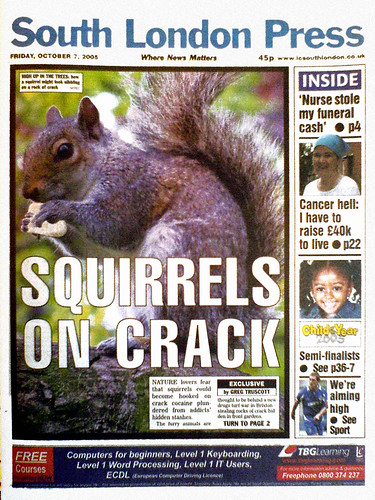
The story is reminiscent of a classic tale from October 2005 – it was an Indian summer that year, clearly – when the South London Press reported that squirrels were digging up crack cocaine hidden by drug dealers.

Here's the front page that Chris Morris would be proud of.

Some silly season stories are so good they have to be repeated year after year.

Back in August 2003, there were reports that a great white shark had been seen off the coast of Devon.

The story resurfaced in July 2007, this time in Cornwall – only to be rubbished by a Falmouth coastguard:

"There has never been a confirmed sighting of a great white off the Cornish
coast. It's utter rubbish. We have never had a shark attack down here and we
would urge people to take this with a pinch of salt. They are not the man-eating
Jaws."
Clearly, animals are the essential ingredients of classic silly season tales.

Back in 1987 there was Blackie the Donkey, saved from being crushed at a Spanish fiesta and then brought to England by the Daily Star.

Then there were the Tamworth Two, a pair of piglets who broke out of a Wiltshire abattoir and spent a week on the run in January 1998 (OK, that wasn't really the summer).

The Daily Mail bought the pigs, named them Butch and Sundance and paid for them to live at the South of England Rare Breeds Centre near Ashford, Kent.

But sometimes it's possible to contrive a magnum opus of daftness that doesn't involve beasts.

Take the Sun's classic tale from August 2005 that Victor Meldrew had been found in space, the apotheosis of the I-saw-Jesus-in-my-toast story genre.

Here's a collection of holy relics, Daily Mail-style.

But this is far from an exhaustive list – have you noticed any corkers this year, or do you have any favourites from silly seasons past?

http://www.guardian.co.uk/media/organgrinder/2009/aug/04/newspapers-silly-season-stories
Related Posts with Thumbnails

ShareThis