Showing posts with label calves. Show all posts

Tuesday, 14 June 2016

Elephant calves more likely to survive in the care of their grandmothers


Date: June 10, 2016
Source: Suomen Akatemia (Academy of Finland)

Among the Asian elephants, the grandmothers have a significant role. They ensure the survival of the calves and breeding success for their daughters.

Grandmothers often provide vital childcare in human communities across the world. In traditional societies such help even increases grandchildren's survival prospects and leads to shorter birth intervals for the daughters. In a new study, a research group from the University of Turku in Finland has now discovered that a similar phenomenon exist among the elephants in Myanmar.

"We found that calves of young elephant mothers under 20 years of age had eight times lower mortality risk if the grandmother resided in the same location compared to calves whose grandmother was not present," says Dr. Mirkka Lahdenperä, the lead author of the study.

Resident grandmothers also decreased their daughters' inter-birth intervals by one year, so that altogether more grandcalves were born when the grandmothers were part of the family. Grandmothers with own recent calves were as beneficial to their daughter's calves as grandmothers who had already stopped reproducing.

"Grandmothers may be particularly important for the reproductive success of their inexperienced adult daughters. Older daughters, on the other hand, would have already gained enough experience in calf rearing to succeed without the help of their mother," says Academy Professor Virpi Lummaa.


Monday, 14 September 2015

Three critically endangered Javan rhinoceros calves spotted in Indonesia


Three critically endangered Javan rhinoceros (Rhinoceros sondaicus sondaicus) calves have been seen on camera in Ujung Kulon National Park, Indonesia, the WWF have reported. This discovery of the calves raises the number of critically endangered Javan rhinos from 57 to 60.

Javan rhinos are the most threatened of the five rhino species, and according to the IUCN there are three recognised subspecies Rhinoceros sondaicus sondaicus, Rhinoceros sondaicus annamiticus, and Rhinoceros sondaicus inermis (Extinct) The subspecies Rhinoceros sondaicus sondaicus formerly occurred from Thailand through Malaysia, to the islands of Java and Sumatra (Indonesia). However today the only remaining population occurs on the Ujung Kulon Peninsula (which forms the westernmost extremity of the island of Java. They are a dusky grey colour and has a single horn of up to about 10 inches


Watch some footage of one above (Credit: Ujung Kulon National Park)

Thursday, 2 October 2014

Quebec's whale population faces catastrophe


Beluga calves are dying at an unusual rate around St Lawrence estuary, Quebec

The beluga whale population in St Lawrence estuary, Quebec, is facing troubling times, with an unusually high number of beluga whale calves turning up dead.

2012 was the most difficult year for the calving season on the estuary, with a total of 16 beluga calves found dead. So far during this years’ calving season – which officially ends on 15th October – five young whales have been found dead.

Stephane Lair, a veterinary professor at University of Montreal, undertook the autopsies of the carcasses to try to determine the cause of death. He says, “What we think is that either the calf is too weak to follow the mother, or there is a bonding problem between the calf and mother.”In addition, autopsies revealed that the whales were dying of cancer at unusually high rate.Richard Michaud, scientific director of Quebec’s Marine Mammals Research and Education Group, says that the beluga population in the area has been in a slow decline for the past decade. “It’s a catastrophic trajectory we’re observing,” he says, “and we don’t yet know exactly what [the causes are] for that.” In order for the population to recover, Michaud argues that effort must be made to reduce the sources of stress on the mammals, particularly in areas that mothers and calves frequent.


Friday, 10 January 2014

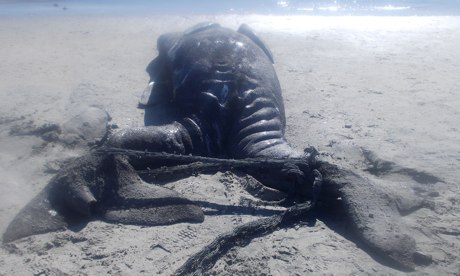
Conjoined grey whale calves found in Mexico

Conjoined gray whale calvesFishermen in Mexico have found rare conjoined grey whale calves that died shortly after being born.

Benito Bermudez, a marine biologist, says the whales were found alive in the Ojo de Liebre lagoon in the Baja California peninsula but lived only a few hours.

Bermudez said they were linked at the waist, with two full heads and tail fins.

Bermudez works with the National Natural Protected Areas Commission.

Tuesday, 5 February 2013

In Beef Production, Cow-Calf Phase Contributes Most Greenhouse Gases


Jan. 30, 2013 — Scientists have long known that cattle produce carbon dioxide and methane throughout their lives, but a new study pinpoints the cow-calf stage as a major contributor of greenhouse gases during beef production.

In a new paper for the Journal of Animal Science, scientists estimate greenhouse gas emissions from beef cattle during different stages of life. They show that, depending on which production system farmers used, beef production has a carbon footprint ranging from 10.7 to 22.6 kg of carbon dioxide equivalent per kg of hot carcass weight.

According to study co-author Frank Mitloehner, an associate professor in the Department of Animal Science at UC Davis, one source of greenhouse gases was surprising.

"If you look at everything that contributes to greenhouse gases through the beef supply chain, then it is the cow-calf that produces the greatest greenhouse gases," Mitloehner said.
In the cow-calf phase, the cow gives birth and nurses the calf until the calf is six to 10 months old. During this time, the cow eats rough plants like hay and grasses. The methane-producing bacteria in the cow's gut thrive on these plants.

Tuesday, 8 May 2012

4 white Southern Right whale calves spotted off South Australia

Great Australian Bight Marine Park zones closed to protect whales
April 2012. Great Australian Bight Marine Park manager Saras Kumar said "May signals the start of the southern right whale breeding season as the mammals migrate from their summer sub-Antarctic feeding grounds to their winter breeding and nursery grounds along the southern coastline of Australia."

Ms Kumar said the Head of the Bight is one of the most important calving sites in Australia and each year between 25 and 67 calves are born at or near the Head of Bight.
"More than 1000 whales have been recorded in the region and some whales have been observed returning to the Great Australian Bight Marine Park regularly since 1991," she said.
Four white calves
"Last year DENR staff counted 67 calves born at the Head of Bight, including four white calves.
"Cows (pregnant whales) give birth once every three years, they nurse calves for up to one year before having a year to recover (cows lose up to 20 tonnes during the calving season because they don't feed while in Australian waters) before returning the following winter to mate."

Wednesday, 15 December 2010

Fright as calf born with five legs

Jonathan King got the fright of his life when he helped deliver a calf with five legs.


The Reporoa dairy farm manager said he thought it was a bit odd to find the calf with an extra leg attached to its neck when he and farm worker Ben Shaw helped a struggling cow give birth recently.

"At first I thought I was dreaming as I gave it an extra tug," he said.

"I thought 'that's not right'. It was a bit odd ... It's like an extra shoulder on its neck with a hoof on it."

However, the animal isn't at all perturbed by the extra limb draped across her neck - she's doing everything every other growing calf is doing.

"She's perfectly healthy," he said. "In fact she's really healthy and not fazed at all by it." He's not sure what went wrong but another calf born this season had no tail and a few years back one was born with a third eye while another didn't have any bones.

"I think something strange must have happened at the last mating. I reckon it could have something to do with the new staff," he said jokingly.

"It's weird though because it's a Friesian calf but the extra leg looks like an angus."

He plans to put the animal on Trade Me but if it doesn't get any bites she's heading for the freezer.

"I might get an extra corn beef off that extra leg," he told The Daily Post.


Odd One: Reporoa dairy farm manager Jonathan King with the Friesian calf born with an extra leg, seen draped across its neck.


Reporoa veterinarian Mike Beavon said it was unusual for an animal to be born with an extra limb but not impossible.

"Most vets see the odd lamb with five or six legs every season," he said.
Related Posts with Thumbnails

ShareThis