Showing posts with label marine life. Show all posts

Sunday, 5 July 2020

Catastrophic disease events in marine mammals mostly caused by viruses


Date: June 18, 2020
Source: Virginia Tech
As the COVID-19 pandemic sweeps across the globe, people are beginning to understand, at a very personal level, the ways in which infectious diseases can devastate life. But disease outbreaks are not confined to just humans or to life on land.
"We are perhaps more alert than ever to the catastrophic impacts of infectious disease in both humans and animals. Our task now is to begin to understand what drives these events, particularly in species like marine mammals, where our knowledge is even more limited," said Claire Sanderson, a research associate in the Department of Fish and Wildlife Conservation within the College of Natural Resources and Environment and the research coordinator of the Center for African Resources: Animals, Communities, and Land Use (CARACAL).
In 2000, over 10,000 endangered Caspian seals died in less than a four-month span. Researchers later discovered that the culprit behind this devastating mass mortality event was canine distemper virus.
Infectious disease-induced mass mortality events are known to afflict a variety of species, including invertebrates, birds, fish, and both land and aquatic mammals. However, these events in aquatic mammals are understudied compared to their land-dwelling counterparts.

Thursday, 18 July 2019

From Krill to Whales, Marine Life Is Washing Up Dead in the Bering Strait


By Davis Hovey | July 5, 2019 | 0 
THROUGHOUT THE MONTH OF JUNE, dead marine life was being reported on a weekly basis in the Bering Strait region.
First it was a dead walrus in St. Michael, then a large group of blue mussels near Port Clarence, and more recently, it was several types of seabirds and fish near Shishmaref.
“People in Shishmaref reported some birds washing up: sounds like mostly thick-billed murres, and people in Savoonga also had a murre die-off earlier in May.”
That’s Kathy Kuletz, the seabird coordinator for the U.S. Fish & Wildlife Service. She’s been working with local observers like Andrew Kakoona and Ken Stenek as well as other scientists. During the last three weeks of June, Stenek reported over 30 dead birds on a stretch of Shishmaref’s east beach, under a mile and a half long.
Gay Sheffield, with Alaska Sea Grant, confirmed she returned from her travels in the Bering Strait region this week to take samples and report on some of those die-offs. However, Sheffield said she could not provide more details until her reports are finished.
While Sheffield is tending to that, Kuletz’s role involves coordinating shipments of samples and carcasses of the dead seabirds, so they can be sent to the National Wildlife Health Center in Wisconsin. 
“We will be getting some carcasses from Shishmaref of sick or dying birds that had washed up sick and then died. In that case, there were also reports of mounds of krill that was dead and mixing with some fish. So that’s a concern; that indicates something else is going on in the system.”
According to Kuletz, the numbers reported are relatively small: there have not been any big die-offs so far this season. And she says there are usually some dead birds found on the coast every year. 
“But in concentrated numbers, where you get 20, 30, 50 or more birds at a time, that’s unusual. And it’s also very unusual up in the far north, in the Bering Strait Region.”
Something else unusual happening in the region that some scientists say could be related, is ocean waters getting drastically warmer. Climatologist Rick Thoman, with the Alaska Center for Climate Assessment and Policy, says by the end of June, sea surface temperatures in the Norton Sound were anywhere from six to 12 degrees Fahrenheit above normal.


Thursday, 9 May 2019

Global warming hits sea creatures hardest


Marine life more sensitive to warming, less able to escape from heat
Date:  April 24, 2019
Source:  Rutgers University
Global warming has caused twice as many ocean-dwelling species as land-dwelling species to disappear from their habitats, a unique Rutgers-led study found.
The greater vulnerability of sea creatures may significantly impact human communities that rely on fish and shellfish for food and economic activity, according to the study published in the journal Nature.
The study is the first to compare cold-blooded marine and land species' sensitivity to warming and their ability to find refuge from the heat while staying in their normal habitats.
The authors combed through worldwide research on nearly 400 species from lizards and fish to spiders. They calculated safe conditions for 88 marine and 294 land species as well as the coolest temperatures available to each species during the hottest parts of the year.
"We find that, globally, marine species are being eliminated from their habitats by warming temperatures twice as often as land species," said lead author Malin Pinsky, an associate professor in the Department of Ecology, Evolution, and Natural Resources at Rutgers University-New Brunswick. "The findings suggest that new conservation efforts will be needed if the ocean is going to continue supporting human well-being, nutrition and economic activity."
The researchers found that marine species are, on average, more likely to live on the edge of dangerously high temperatures. Additionally, many land animals can hide from the heat in forests, shaded areas or underground, a luxury not open to many sea animals.

Friday, 1 March 2019

Marine life typically thrives in the tropics – so why do whales prefer the poles?


February 12, 2019 by Sarah Marley, The Conversation
Life in the sea isn't easy. Talk to most people about the ocean and they are likely to imagine a tropical scene with a stretch of golden sand and warm, clear water. The reality is often quite different – the marine environment can be a surprisingly cold place.
Water conducts heat far more effectively than air, which means that submerged animals quickly lose their body heat. It's also harder to warm up again than on dry land, where animals often have the option of basking in the sun or on hot rocks. Finally, many aquatic animals use gills to get oxygen – great for breathing, but essentially another source of heat loss due to all the of water flowing across them and sucking away warmth.
All this contributes to making it much harder for aquatic animals to regulate their body temperature. So surely it would make sense to find more marine animals in warmer waters rather than in colder ones?
Not necessarily. A new study published in Science by a team of US researchers led by John Grady reports higher levels of marine biodiversity in polar waters than tropical ones – but only for some types of animals.
This goes against the longstanding idea that species richness is always highest in the tropics. The theory was that tropical waters provide a less thermally-extreme environment than polar ones – compare, for example, the Caribbean with Antarctica. Tropical areas often provide greater stability and productivity, giving benefits such as a predictable environment and plenty of food. As a result, scientists typically report high levels of biodiversity in warmer waters, with a multitude of species making the most of these favourable areas.

Thursday, 15 December 2016

New marine life found in deep sea vents

By Helen Briggs BBC News


Six new animal species have been identified at deep-sea vents beneath the Indian Ocean.

The remote area is home to life not seen elsewhere in the world's oceans, yet has been earmarked for future mineral exploration.

Hydrothermal vents form at locations where seawater meets magma. They are surrounded by a large number of organisms that are new to science.

The latest finds include worms, snails and a crab.

UK researchers explored an area of the Southwest Indian Ridge, which bisects the ocean between Africa and Antarctica, in 2011.

Scientists at Southampton University revealed they had found many new creatures using a remote-operated underwater robot.

Species spotted at deep-sea vent

They have now analysed samples from the site, known as Longqi, or "Dragon's Breath", and compared them with known species based on the animals' genetic make-up.

The study, published in the journal Scientific Reports, shows six animals new to science.
 
The six new species
a "Hoff" crab
a "giant peltospirid" snail
a whelk-like snail
a limpet
a scaleworm
a polychaete worm 
 

Thursday, 26 May 2016

Northern invaders threaten Antarctic marine life


Date: May 24, 2016
Source: Australian National University

An international study led by The Australian National University (ANU) has found evidence that marine life can easily invade Antarctic waters from the north, and could be poised to colonise the rapidly-warming Antarctic marine ecosystems.

The Antarctic Polar Front, a strong ocean front formed where cold Antarctic water meets warmer waters to the north, has historically been seen as a barrier preventing movement of marine life.

But the study has found the Antarctic Polar Front is often crossed by floating kelp that can form rafts carrying crustaceans, worms, snails and other seaweeds across hundreds of kilometres of open ocean.

"So far, the northern species don't seem to be surviving long in the cold, icy Antarctic. But with climate change and warming oceans, many non-Antarctic species could soon colonise the region," said lead researcher Dr Ceridwen Fraser, from the ANU Fenner School of Environment and Society.

"We now know marine species from the north can easily get into Antarctic waters. The Antarctic is one of the world's fastest warming regions, and the consequences of new species establishing there could lead to drastic ecosystem changes," Dr Fraser said.

The evidence was collected by surveys of floating kelp. On three different ship voyages in 2008, 2013 and 2014, researchers counted drifting seaweed species in both sub-Antarctic and Antarctic water.


Friday, 1 April 2016

Deafening Atlantic oil prospecting to go ahead despite threat to marine life

The Obama administration is to allow surveying of the seabed using seismic airguns that have been likened to a ‘grenade blast’ for whales and other creatures
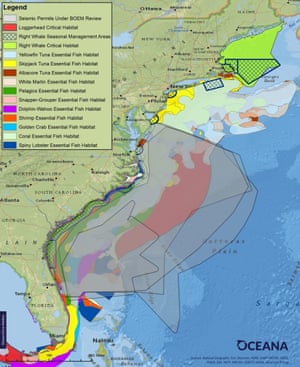
Overlap of proposed seismic airgun blasting areas and essential fish habitat and critical habitat in the Atlantic.
 Overlap of proposed seismic airgun blasting 
areas and essential fish habitat and critical 
habitat in the Atlantic. Photograph: Oceana

Wednesday 30 March 2016 13.00 BSTLast modified on Wednesday 30 March 201613.01 BST

The Obama administration is to press ahead with proposals to allow loud underwater prospecting for oil and gas off the east coast, even though the practice has been likened to being at the “epicenter of a grenade blast” for whales and other marine creatures sensitive to noise.

The federal Bureau of Ocean Energy Management(BOEM) is considering eight applications for seismic airgun testing which environmentalists say would imperil at-risk whales, sea turtles, sharks and other fish species.

Despite the Obama administration’s recent decision torule out oil and gas drilling in the Atlantic Ocean, the airgun testing applications will still be assessed. The seismic airguns are used to emit repetitive blasts of compressed air through the water until they hit the seabed. The echoes from this process can be used to determine if there are deposits of oil and gas beneath the sea floor.

Applications for this testing cover vast areas of the Atlantic stretching from Delaware to Florida. Opponents of the testing claim it could potentially drive whales and fish from their habitat and interfere with their ability to find food and mate.

“We know that endangered whales and fish all change their behavior because of these blasts,” said Dr Ingrid Biedron, marine scientist at conservation group Oceana. “Whales use sound to find partners and food and we are worried these behaviors will be interrupted, or they may be displaced.

Wednesday, 10 June 2015

Few opportunities to change: Ocean warming, oxygen loss putting marine life under increasing pressure

Date:
June 4, 2015
Source:
Alfred Wegener Institute, Helmholtz Centre for Polar and Marine Research
Summary:
If you want to live, you need to breathe and muster enough energy to move, find nourishment and reproduce. This basic tenet is just as valid for us human beings as it is for the animals inhabiting our oceans. Unfortunately, most marine animals will find it harder to satisfy these criteria, which are vital to their survival, in the future.
Read more ...

Wednesday, 29 April 2015

Harbor lights can adversely affect marine life

April 29, 2015

Chuck Bednar for redOrbit.com – @BednarChuck

The artificial lights used in harbors during the nighttime is changing the behavior of animals that attach themselves to the hulls of sailing vessels, causing some creatures to be lured and others to be scared off by the illumination, according to a new study.

In research published Wednesday in the journal Biology Letters, University of Exeter ecologist Dr. Thomas Davies explained that the artificial lighting is attracting types of marine life that could damage ships and boats, and that light pollution from coastal development and other sources could be altering the composition of marine epifaunal communities.

“The presence of lighting at night can change the composition of these marine communities,” Dr. Davies told BBC News. “There is also what we call an ‘ecosystem disservice’. The presence of artificial lighting might actually increase ‘fouling’ species that can damage boats.”

Measuring the impact of light pollution

According to the British news agency, researchers have estimated that nearly 25 percent of the world’s coastal regions (not including Antarctica) are subject to some form of artificial lighting at night. Harbors, marinas, fisheries, and oil rigs all contribute to this phenomenon.


Friday, 13 March 2015

Dolphins, diatoms and sea dragons join census of all known marine life


Near-complete tally lists more than 220,000 species and deletes 190,400 duplicates.
12 March 2015

Taxonomists undertaking the daunting task of compiling a list of every species in the sea say that there are 228,445 known marine organisms. The team from the World Register of Marine Species (WoRMS) has eliminated 190,400 previously listed species, because they were duplicate identities.

WoRMS, hosted by the Flanders Marine Institute in Belgium, has more than 200 editors around the world combing through the published literature to tally what lives under the waves. In its latest update, published on 12 March, the organization said that it had added 1,451 creatures in 2014 alone. Jan Mees, the director of the Flanders Marine Institute and WoRMS co-chair, says that after a decade of work, the team has "nearly completed the inventory of all marine organisms that have ever been seen and described". The world's oceans are thought to contain somewhere between 700,000 and 1 million eukaryote species, however, so WoRMS has plenty more work to do.

Among the additions since 2008 are the Australian humpback dolphin (Sousa sahulensis). Originally proposed as a separate species in 2013 on the basis of skull and tissue analysis1, this animal was formally named last year2.

Wednesday, 4 February 2015

Marine life at risk as number of new Marine Conservation Zones are cut

The Marine Conservation Society (MCS), the UK’s leading marine charity, has expressed great disappointment in the latest round of Marine Conservation Zone designation in English waters.

Thirty seven sites had been proposed to go forward to a second public consultation on Marine Conservation Zones (MCZs), all identified by Government’s scientific advisers as vital to plugging “major gaps” that currently exist in the development of a UK network.

However, only 23 sites have made the final list when the consultation was launched on Friday 30th January.

The Marine Conservation Society (MCS) is supported in its criticism by the National Trust, which owns 750 miles of England’s coastline.

The Trust says the underwater landscape of England’s coastline must be protected in the same way the visible land is and the protection must be put in place now before it’s too late.


Friday, 22 August 2014

Porlock Bay rare species found in marine study

22 August 2014 Last updated at 02:22

For the first time in 30 years, marine life in Porlock Bay, in Somerset, has been studied by divers for a scientific survey commissioned by the Wildlife Trusts.

Four professional divers took part in the study where they unexpectedly found two different and diverse sea bed habitats.

Crustaceans such as this long clawed squat lobster were recorded in a boulder reef north of Gore Point in the Bristol Channel, along with many sponge species. The other site studied was a sand and shell plain in the centre of Porlock Bay.

These large molluscs are called sea hares of which several were found during the two dives held at the beginning of August.

It is the first time this rare stalked jellyfish was recorded in this area. This jellyfish features in the UK Biodiversity Action Plan which means it could need targeted protection in the future as it is sensitive to environmental changes in its habitat.

Divers brought back small samples which have been analysed microscopically so they can be identified by species type. This record will help build up a picture of the biodiversity of each site. This particular species is called a branching sponge.

On both occasions, divers experienced difficulties in getting to the two dive sites due to strong currents which affected visibility. It is because of these challenges that the sites have not been explored for 30 years. The Wildlife Trusts said they have been surprised by the variety of species found in this area. They hope by knowing more about the habitat they can conserve it more effectively in the future.

Friday, 27 June 2014

'Immediate protection' needed for Pitcairn's marine bounty

Matt McGrath
Environment correspondent, BBC News

Researchers say that "immediate protection" is required for the waters around the remote Pitcairn Islands in the Pacific, home to one of the world's rarest and most valuable collections of marine species.

The waters have "unique global value that is irreplaceable" says the report, from an international team of scientists.

They've carried out the first underwater surveys of the deep and shallow waters around the islands, best known for their connection to the mutiny on the Royal Navy ship, Bounty, in the 18th century.

Some of the mutineers settled on Pitcairn and around 50 of their descendents still live there, governed as a British overseas territory.

The four islands in the group lie halfway between New Zealand and South America.

They are said to be further from a continent than any other inhabited island.

The extremely remote location has prevented prior scientific exploration of the unsullied waters.

"It is a treasure trove of marine species," Dr Enric Sala told BBC News.

"People know about the mutiny on the Bounty but the true bounty of the Pitcairn's is underwater."

The scientists found healthy coral reefs and an abundance of fish, around half of them not found anywhere else in the world.

Tuesday, 29 April 2014

Floating Lab Used In Quest To Crack Genetic Code Of Mysterious Marine Life

FORT LAUDERDALE, Fla. (AP) — Researcher Leonid Moroz emerges from a dive off the Florida Keys and gleefully displays a plastic bag holding a creature that shimmers like an opal in the seawater.
This translucent animal and its similarly strange cousins are food for science. They regrow with amazing speed if they get chopped up. Some even regenerate a rudimentary brain.

"Meet the aliens of the sea," the neurobiologist at the University of Florida says with a huge grin.
FLOATING LAB GENOME
They're headed for his unique floating laboratory.

Moroz is on a quest to decode the genomic blueprints of fragile marine life, like these mysterious comb jellies, in real time — on board the ship where they were caught — so he can learn which genes switch on and off as the animals perform such tasks as regeneration.

Tuesday, 22 April 2014

Four Years Later, Marine Life Still Feeling Significant Impacts From Deepwater Horizon Oil Spill

April 18, 2014

Lawrence LeBlond for redOrbit.com – Your Universe Online

As the fourth anniversary of the Deepwater Horizon accident in the Gulf of Mexico approaches, much of the region’s environment and marine life are still feeling the effects of the largest accidental oil spill in US history.

Despite the continued impact on the environment and wildlife, BP – formerly British Petroleum – said in a statement on Tuesday that it has ended its “active cleanup” of Louisiana’s coast. This follows last year’s end of active cleanup in Florida, Alabama and Mississippi.

BP’s announcement also follows a directive issued by the US Coast Guard transitioning the active cleanup phase to a new response phase in which crews and equipment will be pre-positioned for future response to cleanup if new reports of oil surface.

“Our response posture has evolved to target re-oiling events on coastline segments that were previously cleaned,” said Coast Guard Capt. Thomas Sparks, who serves as federal on-scene coordinator for the BP response to the spill. “But let me be absolutely clear: This response is not over – not by a long shot. The transition to the Middle Response process does not end clean-up operations, and we continue to hold the responsible party accountable for Deepwater Horizon cleanup costs.

“We are absolutely committed to continuing the clean-up of Deepwater Horizon oil along the Gulf – for as long as it takes, and to surge as necessary and as the situation dictates,” Sparks said, as cited by Manuel Torres of The Times-Picayune.


Saturday, 4 January 2014

Major Reductions in Seafloor Marine Life from Climate Change by 2100

Dec. 31, 2013 — A new study quantifies for the first time future losses in deep-sea marine life, using advanced climate models. Results show that even the most remote deep-sea ecosystems are not safe from the impacts of climate change.

An international team of scientists predict seafloor dwelling marine life will decline by up to 38 per cent in the North Atlantic and over five per cent globally over the next century. These changes will be driven by a reduction in the plants and animals that live at the surface of the oceans that feed deep-sea communities. As a result, ecosystem services such as fishing will be threatened.

Saturday, 7 December 2013

New limpit species discovered in Amundsen Sea


More than thirty new, and, as yet unclassified, species of marine life were discovered during a science expedition to the Amundsen Sea off Pine Island Bay in Antarctica.

The Amundsen Sea is one of the least explored areas of the Southern Ocean. It contains several deep troughs and basins formed during previous ice ages. Some are more than 1,600 metres deep.

Sunday, 22 September 2013

Molasses Spill Suffocating Hawaiian Reef Fish

The spill that dumped hundreds of thousands of gallons of molasses into Honolulu Harbor last week is suffocating the harbor's underwater inhabitants.

The thick brown goop displaces oxygen-rich water that fish, crustaceans and corals need to breathe. Direct contact with the viscous syrup can clog a fish's gills. And the sugary liquid causes bacterial blooms, which use up the remaining oxygen.

Most of the creatures living in the harbor need oxygen to survive. "It's affecting all levels of the food chain," said Keith Korsmeyer, a marine biologist at Hawaii Pacific University in Honolulu.

The Hawaii Department of Health is monitoring the spill. Officials can remove the dead fish, but there's no way to extract the molasses, because it's dissolved in the seawater. Over time, bacteria will break it down, and the tides will bring in clean water, though "it will be a while before we know how quickly the molasses will move out," Korsmeyer told LiveScience.

The spill occurred when a pipeline carrying molasses from an onshore tank to a ship burst, turning the harbor into a sugary mess. Though it's still early to know the extent of the spill's impact, underwater video footage revealed massive die-offs of fish.

Friday, 3 May 2013

Hope for Galapagos wildlife threatened by marine invaders

National Oceanography Centre research non-native species in the Galapagos

April 2013. Increasing tourism and the spread of marine invasive non-native species is threatening the unique plant and marine life around the Galapagos Islands. UK scientists from the Universities of Southampton and Dundee are currently investigating the extent of the problem following a grant from the UK Government's Darwin Initiative, which aims to protect biodiversity and promote sustainability around the world.

UK Environment Minister Richard Benyon said: "The UK has played a major role in supporting the establishment of the Galapagos Marine Reserve and our Darwin Initiative has funded a range of important projects protecting and enhancing both marine and terrestrial wildlife. Invasive non-native species can cause huge damage to local ecosystems and I am delighted that action is being taken to monitor this threat." 

Tourism to blame?
Project leader Dr Ken Collins, Ocean and Earth Science of University of Southampton based at the National Oceanography Centre said: "Tourism is partly to blame for the influx of invasive non-native species, due to the huge rise in ships and planes from mainland Ecuador bringing in pests. In recent years, it was realised that cargo ships were carrying disease-infected mosquitoes, which were attracted to the ship's bright white deck lights. Simply changing from conventional filament bulbs to yellow sodium lamps, along with fumigation in the hold has substantially reduced the threat. 

Wednesday, 14 November 2012

Great Barrier Reef in danger from new mega-ports


Queensland Government ignores UNESCO on Great Barrier Reef
November 2012. Australia's snubfin dolphin and other marine life face new threats to survival after the Queensland Government revealed draft plans for massive industrial development along the Great Barrier Reef coast.
WWF-Australia have expressed alarm over the Queensland Government's draft plans to open up sites up and down the Queensland coast to huge new port developments and said the strategy pushed the Great Barrier Reef one step closer to being listed on UNESCO's ‘World Heritage in Danger' list.

"Earlier this year, UNESCO delivered a ‘show cause' notice to the Australian and Queensland Governments and requested that no new port development or associated infrastructure outside of the existing and long-established major port areas be permitted," said WWF spokesperson Richard Leck.

Continued:  http://www.wildlifeextra.com/go/news/barrier-reef-port.html
Related Posts with Thumbnails

ShareThis