Showing posts with label humpback whale. Show all posts

Friday, 15 May 2020

Humpback whales may risk collision with vessels in the Magellan Strait

MAY 14, 2020


Every summer (November-April), the Magellan Strait in the southwestern part of Chile becomes a popular feeding area for migrating humpback whales (Megaptera novaeangliae). The narrow strait is also a heavily used shipping route. A new study by scientists at the Smithsonian Tropical Research Institute (STRI) and collaborating institutions tracked and modelled the movement of individual whales in order to evaluate the potential of vessel collisions and provide policy recommendations for the protection of whale species.

Humpback whales have the longest migratory journeys of any mammal on Earth. The Southern Hemisphere population spends its summer months feeding in the Antarctic and Chile and their winters in the warmer tropical Pacific waters of northern South America and Central America, as far as Nicaragua. Their movements often overlap with boat traffic and may put them at risk of collision, leading to injury or death. Years ago, STRI researcher Héctor M. Guzmán led a study that resulted in international regulations to separate vessel traffic from whale routes near the Panama Canal and in southern Costa Rica, which drastically reduced collision rates in the breeding areas.

"Designing and implementing traffic-separation schemes for Panama and Costa Rica was difficult, because any measures had to be adopted by the International Maritime Organization," said Guzmán, also lead author of the new study in Chile. "It was achieved by having the scientific information explain the whale movements and thanks to the unconditional support of both governments."

The new study, published in Marine Policy, took place in southern Chile, where about 100 humpback whales feed each summer: a population small enough for occasional ship strikes to have important consequences. By tagging and tracking 25 individuals over different years and comparing their movements with available records of vessels traversing the Strait, the team found that, on average, each whale was near a ship about seven times per season. Due to the detailed tracking records of multiple whales, the researchers were able to show that individual animals differed enormously in how often they encountered ships: from less than one to as many as 18 encounters per season.

Monday, 12 August 2019

Stunning Photo Captures the Moment a Sea Lion Was Nearly Swallowed By a Whale

By Mindy Weisberger 12 days ago

A group of sea lions in Monterey Bay, California were chasing fish alongside a pod of humpback whales when the hunt took an unexpected turn. As a whale hurtled up from the deep to swallow fish near the surface, it nearly swallowed a sea lion in a single gulp.

Wildlife photographer Chase Dekker captured the astounding image while on a whale-watching boat with the tour agency Sanctuary Cruises, and he shared the photo on Facebook and Instagram on July 23.

In the image, the alarmed-looking seal rests on the whale's lower jaw, poised to slide down into its throat. 

However, the seal was spared that gruesome fate. Dekker posted on Facebook that he was "100% confident" that the sea lion escaped, because "the whale kept its mouth wide open as it sank back down into the sea," he wrote.


Sunday, 17 February 2019

See a Newborn Baby Humpback Whale Swim with Its Mom, Minutes After Being Born


By Brandon Specktor, Senior Writer | February 4, 2019 03:30pm ET
Humpback whales are born swimming, but they still need a little help from mama to find their sea legs. In an intimate new video posted by researchers at the University of Hawai'i at Mānoa's Marine Mammal Research Program (MMRP), a very-very-fresh baby humpback experiences its first swimming lesson next to, behind and on top of its mama, which is still bleeding from her labor.
According to MMRP director Lars Bejder, who took the drone footage in January off the Maui coast, the condition of both mother and baby whale suggests that the little humpback was mere minutes old. [Photos: World's Cutest Baby Wild Animals]
"[Local tour operators] had just seen all this whitewater and commotion in the water and weren't quite sure what it was," Bejder said in a statementfrom UH. "Suddenly there was all this blood in the water, which made us go over there and that's what we discovered — a newborn calf."
As the baby whale takes its fist "steps," so to speak, you can see how its never-used fins and tail flukes wobble around in the water. Sometimes, Bejder noted, the mama humpback could be seen supporting the baby on its back as they moved through the water together. (That gives "humpback" a new meaning, eh?)

Wednesday, 3 October 2018

This Beached Shark Tore a Beached Whale to Shreds (And It's All on Video)


By Brandon Specktor, Senior Writer | October 2, 2018 12:32pm ET
When a beached whale arrives on your local shore, it's sad, but not too surprising. When a live, thrashing tiger shark arrives right next to it, it's a good time to dust off your favorite expletives.
That's what some Ponta, Mozambique residents did when they saw a massive, 13-foot-long (4 meters) tiger shark (Galeocerdo cuvier) seemingly beach itself in order to chow down on the 30-ton humpback whale carcass bedecking the local shore.
According to Lorrayne Gaymer, a Mozambique dive instructor who filmed the incident (and the community's shocked response), the 66,000-lb. (30,000 kilograms) whale washed up on Ponta beach in early September. [13 Bizarre Things That Washed Up On Beaches]
"Initially, a rescue attempt was made for the whale, but after the locals of Ponta contacted a whale expert it became clear that the whale was very sick and shouldn't be moved," Gaymer told The Daily Mail. "It had passed away, and as the tide went out, hundreds of locals of Ponta all came down to take their share."
Then, Gaymer said, the sharks descended. According to Caters New Agency, an estimated 60 sharks of different species — including tigerbulland dusky sharks — took turns ripping hunks of meat and blubber out of the whale's side. By the time Gaymer arrived on the scene and started filming, one giant tiger shark had swum so close to shore that it temporarily beached itself on the sand near the whale.
As you can intuit from the sundry shrieks and bleeped-out expletives that begin Gaymer's video, the sight of a tiger shark so close to shore was both exciting and terrifying for many spectators.

Wednesday, 6 June 2018

Humpback whale trapped in netting off Bondi beach


Whale watchers attempt to disentangle mammal but darkness stops rescue efforts

Tue 29 May 2018 09.01 BSTLast modified on Tue 29 May 2018 13.02 BST

A 10-metre humpback whale trapped off in netting off Bondi beach in Sydney may have to wait until Wednesday morning to be freed after darkness hampered rescue efforts.

Whale watchers were able to free the mammal of some of the netting but a rescue team from National Parks New South Wales was unable to fully release the whale before night fell.


Wednesday, 19 July 2017

Whale attack simulations reveal prey escape strategies


Date:  July 5, 2017
Source:  Society for Experimental Biology

Summary:  Humpback whales feed from a range of species that have adapted to escape their fate in a variety of ways. As much as humans track their prey according to the species they are stalking, so whales lunge open-mouthed in different ways depending on the target they are hunting.


Sunday, 9 October 2016

Whale calf seen pushing stranded mother off sandbank

7 October 2016

A humpback whale which was stranded on an Australian sandbank has freed itself after its calf was seen apparently nudging it into deeper water.

The whale was spotted near North Stradbroke Island, about 80km (50 miles) east of Brisbane, early on Wednesday morning.

Her distressed calf was later seen apparently pushing her as she splashed in the water to get free.

About 40 minutes after getting stuck, the whale was able to dislodge herself.

Queensland Parks and Wildlife Services (QPWS) personnel were despatched to help the pair and planned to stabilise them until a team from Sea World, further along the coast, could arrive to help free them.

But incoming tides and the efforts of the young whale helped the mother get off the sandbank before they arrived. Image copyright QPWS Image caption The pair are also believed to have been stranded nearby overnight, before becoming stuck again

"The whale was able to free itself and the adult and the calf were able to swim away," a spokesperson for QPWS told the BBC, adding that they successfully helped the pair out through shallow waters to the open sea.

"The mother was a bit tired and distressed". Image copyright QPWS Image caption QPWS followed the pair to help them make it to deep water and avoid "restranding"

Whales are common at this time of year on the Queensland coast, where many go to give birth and begin rearing their calves before heading back to Antarctic waters.

Sunday, 14 August 2016

Humpback whales saving other species from orcas found to be common and maybe altruistic


August 10, 2016 by Bob Yirka 

A team of researchers led by Robert Pitman, a marine ecologist with NOOA Fisheries' Southwest Fisheries Science Center, has found evidence that suggests humpback whales may engage in altruistic behavior during encounters with killer whales attacking other marine species. In a paper available on the open access site Marine Mammal Science, the team describes their analysis of humpback whale encounters with killer whales and why they believe it is possible the whales are intentionally helping other creatures to escape certain death by orcas.

The research began, the team notes, when Pitman observed a humpback whale come to the rescue of a seal after a pod of killer whales had knocked it off an ice floe back in 2009. Also, another team member had witnessed a group of humpback whales driving off a pod of killer whales that had killed a grey whale pup—they surrounded it and prevented the orcas from eating it for several hours. Such incidents prompted the group to look a little deeper—they conducted searches of both published and unpublished papers detailing humpback observations and discovered among them 115 incidents of humpback whales rescuing other creatures from orca attacks. They noted that just 11 of the incidents involved rescuing humpback whale calves—the rest involved rescuing a variety of other marine creatures such as sea lions, gray whales, sunfish and harbor seals.

The researchers found that many of the humpback whales that engaged in rescue attempts had scars on their bodies, indicating that they were survivors of orca attacks in their youth—it seemed plausible that they were simply responding to an unpleasant memory.

Sunday, 7 August 2016

Saved by the Whale! Humpbacks Play Hero When Orcas Attack


By Mindy Weisberger, Senior Writer | August 3, 2016 02:07pm ET

The photo is extraordinary. In waters near the Antarctic peninsula, an enormous humpback whale floats on its back, cradling a Weddell seal on its chest and elevating it above the ocean surface. Only moments earlier, the seal was perilously close to becoming dinner for a group of hungry killer whales.

Biologist Robert Pitman snapped the image while on a research expedition in 2009 — but it wasn't the first time he had observed this unusual protective behavior.

Just one week earlier, Pitman, a researcher with the Southwest Fisheries Science Center in the NOAA Fisheries Service in California, saw a pair of humpbacks aggressively confronting killer whales that were circling a lone seal on an isolated ice floe. The humpbacks plowed between the killer whales and the trapped seal, vocalizing and churning the water with their flippers, and shielding the seal until the orcas gave up and swam away.

Pitman wrote about both encounters in an article published in the November 2009 issue of the magazine Natural History, but that was only the beginning of a much longer and more in-depth investigation. In a new study, Pitman explores dozens of examples presenting humpback whales as unlikely marine vigilantes, ganging up on predatory killer whales that try to attack other species.


Tuesday, 8 March 2016

Video: Sea Shepherd Launches Viral Video of Whale Captured in Net

BAJA CALIFORNIA, Mexico – February 24, 2016: Sea Shepherd Conservation Society has launched a video of this weekend's rescue of a humpback whale, entangled in an illegal gillnet. The video received over 113,000 views on Facebook after its first day, almost 4,000 shares and hundreds of excited comments from fans. In total, over 543,000 people have been exposed to the video on Facebook. The Sea Shepherd video shows the humpback whale desperately trying to free itself from the net while Sea Shepherd urgently works to save the whale, with assistance from the Mexican Navy.

On Friday, February 19, 2016, the crew of Sea Shepherd's research vessel of R/V Martin Sheen spotted a humpback whale entangled in an illegal gillnet within the Vaquita Refuge in the Gulf of California, Baja California, Mexico. While Captain Oona Layolle, campaign leader and captain of the M/V Farley Mowat, notified the Mexican Navy and the Federal Attorney for Environmental Protection (PROFEPA), the crew began the rescue operation. The whale was estimated to be 35 feet long and crews from both vessels worked to free the whale by cutting the gillnet off the whale's head and torso.


Monday, 28 December 2015

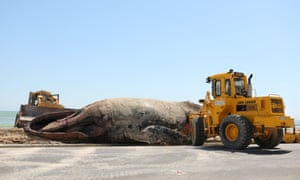
Dead whale closes popular South African beach amid shark concerns

Strand Beach near Cape Town has been shut as experts fear the corpse of the 14 metre whale may attract sharks

Thursday 24 December 2015 05.33 GMTLast modified on Thursday 24 December 201509.13 GMT

A South African beach popular with Christmas holidaymakers has been closed until the carcass of a beached whale is removed amid concerns its blood may attract sharks, the City of Cape Town said.

Photograph: Reuters
Local media described it as a humpback whale measuring over 14 metres (46 feet) in length and said two sharks had been spotted in the area.

“The immediate area around the whale carcass has been cordoned off and this area is closed to members of the public ... The blood and debris from the carcass can attract sharks to the area,” the city said in a statement.

Workers remove the carcass of a whale on Strand Beach, near Cape Town. The South African beach, popular with Christmas holidaymakers, has been closed until the carcass is removed amid concerns its blood may attract sharks. 

The affected area was the Strand Beach, a stretch of sand east of Cape Town.

Great whites, the largest predatory species of shark, are common in the cool Atlantic waters off Cape Town and sometimes attack surfers or swimmers. They would not be expected to attack a whale and it was not immediately clear how the humpback had died.

Monday, 30 November 2015

Humpback Whales Make Migration Pit Stops at Underwater Mountains

by Charles Q. Choi, Live Science Contributor | November 27, 2015 02:41pm ET

Underwater mountains are key stopovers in the migratory routes of an endangered population of humpback whales in the South Pacific, new research shows.

Humpback whales are found in all of the world's oceans, from icy to tropical waters. They migrate farther than any other mammal, traveling great distances from their summer feeding grounds to their winter breeding and birthing grounds. In fact, a record-setting female humpback was recently discovered swimming from Brazil to Madagascar, a voyage of at least 6,090 miles (9,800 kilometers).

Many aspects of humpback migrations remain mysterious, as they mostly occur far away from humans. Previous research had revealed that humpback whales migrating from breeding grounds off the east coast of South America and the west coast of Africa swim in nearly straight lines in the Atlantic Ocean without noticeable stops and in relatively narrow corridors. Similar migration patterns were seen among humpbacks migrating from breeding grounds off Madagascar in the Indian Ocean.


Sunday, 15 November 2015

Humpback whale masterfully photobombs couple’s holiday picture

The moment a massive humpback whale photobombs a Dublin couple's holiday picture in Australia has been caught on camera

By Claire Lomas, video source Caters
10:08AM GMT 10 Nov 2015

Incredible video footage shows the moment a Dublin couple’s holiday photo was made a little more special than usual.

Whilst Declan and Mandy O'Donoghue posed for a picture on a boat tour in Australia, a massive humpback whale can be seen lurking in the background.

As the pair wait for the photo to be taken, the huge mammal stretches out one of its fins and starts waving it around in the background.

The photobomb was captured by Peter Lynch on one of his Blue Dolphin Tours around Hervey Bay in Queensland, Australia.

He said: "It's really special to see something like this in person - even more so when it's a mother and her calf right beside her.

"It's extremely rare for it to happen this close to the vessel.

"This is why we run the tours, allowing guests such a close encounter.

"We always hope they make a connection with the whales which will affect their choices regarding the environment and conservation."

Peter and his wife Jodie have been running their tours since 1997, but have been working with dolphins and whales since 1983.


Friday, 6 November 2015

Rescuers work to free humpback whale from fishing line off California

The adult animal, seen off Newport Beach, was struggling to escape a potentially deadly situation as line was tangled in its mouth

Joanna Walters in New York
Saturday 31 October 2015 20.18 GMTLast modified on Saturday 31 October 201520.20 GMT

Marine experts were on Saturday trying to save a humpback whale that was struggling off the coast of California, with a length of commercial fishing line tangled in its mouth.

Rescuers were following the whale, trying to figure out if they could free it from the potentially deadly hazard. The adult humpback was off the coast of Laguna Beach, south of Los Angeles.

It was first spotted on Friday morning off Newport Beach, a few miles north, showing distress and swimming near the surface. A whale-watching boat noticed that the whale was trailing a length of the kind of line which is used to connect surface buoys to seabed lobster pots.

The Orange County sheriff harbor patrol and whale disentanglement experts from the National Oceanic and Atmospheric Administration (NOAA) were called out and spent hours on Friday tracking the whale and attempting to free it. But the distressed whale kept diving out of sight or trying to leap, despite showing increasing fatigue, according to local TV reports.

Teams managed to cut away about 150ft of rope. On Saturday, the experts were back in pursuit in inflatable boats, trying to use underwater cameras to figure out exactly how badly the whale’s mouth was entwined.


Thursday, 30 July 2015

Humpback whale recovery in Australia: A cause for celebration

Australian humpback whales be downlisted from threatened species status

Date:July 28, 2015

Source:Elsevier

Summary:Australia has one of the highest rates of animal species that face extinction in the world. However, over the last decade, there have been animals that are rebounding. One example is the conservation success story of the recovery of the humpback whales that breed in Australian waters. A new study reviews data collected in past studies and proposes a revision of the conservation status for humpback whales found in Australian waters.

Friday, 19 June 2015

Record number of humpbacks spotted around UK

Record numbers of humpback whales are being spotted around the UK’s coast by wildlife enthusiasts and members of the public, the Sea Watch Foundation have reported. 

Reports, photographs and videos of humpbacks have been flooding in to researchers at the Sea Watch Foundation. The latest in a recent spate of humpback whale sightings took place just off one of the UK’s largest cities, Liverpool.

Local boat worker, Lee Sparks, filmed the distinctive pectoral fin slapping of a humpback as he helped guide large boats in and out of the world famous port. Mr Sparks sent in his video to Sea Watch Foundation. Sea Watch Foundation monitors whales, dolphins and porpoises (cetaceans) all over the UK. Having been set up over forty years ago, Sea Watch operates one of the first ‘citizen science’ schemes in the world, utilising cetacean sightings from the public to inform policy on how best to conserve these species given all the changes happening around our coasts. 

“Sightings of both harbour porpoise and bottlenose dolphins seem to have increased in Liverpool Bay in the last few years, corresponding perhaps to an improvement in water quality as well as increased effort with more dedicated watches and surveys being conducted by our Regional Coordinators and local volunteers, but no one was expecting a humpback whale,” said Katrin Lohrengel, Monitoring Officer for Sea Watch.

“In fact, this may well be the first sighting of a humpback whale in Liverpool Bay on record but we will be delving into our records and historical archives to confirm! Either way this is a very exciting sighting.”

Other recent humpback whale sightings this year include one off Aberdeen on 18th May, one off the Cornish coast on 28th May and another animal in the Sound of Raasay between Rona and Skye in the Hebrides, north-west of Scotland on 7th June.

Saturday, 21 February 2015

Authorities work to free humpback whale tangled near Hawaii

KAILUA-KONA, Hawaii (AP) — Poor weather and dangerous seas have hampered authorities in their efforts to free a humpback whale tangled in a strong synthetic line.

The 45-foot, 45-ton whale was first noticed approximately 45 miles northwest of Hilo late Friday afternoon, too late to assess it situation and reach it. There were no reports of the whale being seen on Saturday, which West Hawaii Today reported (http://is.gd/yzYDUE) was likely due to stormy conditions.

Wednesday, 15 October 2014

Rare Footage of a Humpback Whale Sleeping

What is a whale's favorite bedtime story? A whale of a tale, of course!

Although we had never really thought about how whales sleep, this video, uploaded to YouTube, shows just how the giant aquatic mammals do it in their very own way.

Courtesy of underwater photographer Kieran Bown and his Panga MX production crew, the video is a snippet from the full 20 minutes of unique footage they captured while in the Turks and Caicos Islands for a research project.

They captured this footage of an inverted humpback whale in the waters surrounding Great Sand Cay.

"The whale was completely at peace in the water," Bown says.

While humans may shift between their back and side while sleeping, whales drift into sleep and end up vertical.

Saturday, 2 August 2014

Investigators probe whether ferry killed humpback whale in Alaska

By Steve Quinn


JUNEAU Ala. (Reuters) - Authorities in Alaska are investigating whether a state ferry killed a 30-foot (9-meter), 25-ton (22.6-tonne) humpback whale in a collision near Kodiak Island, or whether the giant mammal was already dead when it was struck, officials said on Friday.

Kate Wynne, a marine mammal specialist for the University of Alaska Sea Grant Program, said there was no doubt the whale died from being hit by a sea-going vessel.

Monday, 14 July 2014

Well-known humpback whale killed in boat collision

JUNEAU, Alaska (AP) — Federal law enforcement officials are investigating after a 48-foot female whale well-known in the waters of southeast Alaska was killed in a collision with a boat.

A tour-boat operator found the whale, which had been seen in the waters of southeast Alaska for nearly 40 years, near Funter Bay on July 1. The carcass was hauled to a nearby beach, where a necropsy was performed July 3, officials said Friday.

"The left mandible was fractured and the right mandible was traumatically dislocated from the cranium," Dr. Kathy Burek of Alaska Veterinary Pathology Services, the lead veterinarian on the necropsy, said in a statement Friday. "Cause of death was determined to be ship strike."

Related Posts with Thumbnails

ShareThis