Showing posts with label feral cats. Show all posts

Wednesday, 28 August 2019

What's killing sea otters? Parasite strain from cats


Genetic link found between deadly pathogen and wild and feral cats on land

Date: August 22, 2019
Source: University of California - Davis

Many wild southern sea otters in California are infected with the parasite Toxoplasma gondii, yet the infection is fatal for only a fraction of sea otters, which has long puzzled the scientific community. A new study identifies the parasite's specific strains that are killing southern sea otters, tracing them back to a bobcat and feral domestic cats from nearby watersheds.

The study, published this week in the journal Proceedings of the Royal Society B, marks the first time a genetic link has been clearly established between the Toxoplasma strains in felid hosts and parasites causing fatal disease in marine wildlife.

The study builds on years of work by a consortium of researchers led by the UC Davis School of Veterinary Medicine's Karen C. Drayer Wildlife Health Center and the California Department of Fish and Wildlife (CDFW). The scientists were called upon in the late 1990s to help decipher the mystery when Toxoplasma caused deaths in sea otters along the California coast.

Wednesday, 1 May 2019

Dogged researchers show that dingoes keep feral cats in check


APRIL 8, 2019

by Lachlan Gilbert, University of New South Wales
Dingoes play a key role in the conservation of Australian outback ecosystems by suppressing feral cat populations, a UNSW Sydney study has found.
A UNSW Sydney study has ended an argument about whether or not dingoes have an effect on feral cat populations in the outback, finding that the wild dogs do indeed keep the wild cat numbers down.
In a paper published recently in Ecosystems, the researchers compared dingo and feral cat populations either side of the world's longest fence that also doubles as the border between South Australia and New South Wales.
The fence was erected in the 1880s to in an attempt to keep dingoes from attacking sheep flocks in NSW and Queensland.
With a very small number of dingoes on the NSW side of the fence and much larger number on the SA side, the fence offered a perfect opportunity to observe feral cat numbers in identical environments with and without the influence of dingoes.
Professor Mike Letnic from the Centre for Ecosystem Science, UNSW School of Biological, Earth and Environmental Sciences, says that over the course of a six year study – between 2011 and 2017 – he and his fellow researchers compared the numbers of dingoes, cats and their major prey species either side of the dingo fence in the Strzelecki Desert.
"We collected dingo scat and cat scat and analysed them to compare diets, while we also used spotlight searches to record numbers of each as well as two of their common food sources – rabbits and hopping mice," he says.


Wednesday, 18 July 2018

Is it a panther? Is it a puma? No, just a cat and a huge claws for frustration

Rangers are sick of mistaken panther sightings, which detract from the fight against feral cats 


Fri 6 Jul 2018 23.26 BST 

A large cat in Western Australia that was mistaken for a panther is the latest in a long line of mythical big cat sightings that wildlife rangers say are unhelpful. 

The large black feline – estimated to be 50% larger than a house cat – was spotted in the town of Coorow, 275km north of Perth, in late June, and reported to wildlife authorities as a potential panther or big cat. 

But local wildlife ranger Tim Gilbertson told the ABC he was getting sick of panther reports. 

“People need to get over the idea the cats are panthers,” he said. “It is just not on. They are big feral cats, at least 50% bigger than a house cat and they are powerful.” 

Gilberston believes that mistaking cats for panthers detracts from the fight against feral cats, which cover 99% of the Australian continent and kill 1 million native birds a night

“If you are getting larger cats, you have to ask what they are eating,” he said. “They are eating native animals.” 


Wednesday, 4 January 2017

Cat–astrophe! Feral Cats Have Invaded Nearly 100% of Australia

By Mindy Weisberger, Senior Writer | January 4, 2017 11:13am ET


The cat's out of the bag — and all over Australia. A new study finds that feral cats inhabit 99.8 percent of the continent's landmass, including 80 percent of the land that makes up its islands.

Feral cats have long been recognized as a grave and widespread threat to vulnerable native wildlife — particularly in Australia, where species found nowhere else in the world are ill-equipped to deal with these invasive and deadly predators. But despite conservationists' efforts to track the felines' environmental impacts, the number of cats roaming Australia has remained elusive.

To put a number to the catastrophic invasion, 40 environmental researchers compiled data from nearly 100 relevant studies, finding that Australia hosts at least 2.1 million feral cats when prey is less abundant; when prey are plentiful, that number jumps to as many as 6.3 million.

European explorers first introduced cats to Australia in the 18th century. With no large predators and easy access to tasty small animals, the invasive felines swiftly adapted to the hospitable continent. Since then, feral cats have contributed to the extinction of close to 30 native mammal species — such as the big-eared hopping mouse, the Eastern hare-wallaby and the pig-footed bandicoot — and are instrumental in the current decline of many more, the study authors wrote.

"Australia is the only continent on Earth other than Antarctica where the animals evolved without cats, which is a reason our wildlife is so vulnerable to them," Gregory Andrews, Australia's Threatened Species Commissioner, said in a statement.

Prior approximations of feral cat populations by Australia's Department of the Environment, Water, Heritage and the Arts suggested there could be as many as 18 million cats roaming the country. However, that number was a far-from-certain estimate, the researchers said. Also, it didn't include information about population densities and variations based on seasonal changes or environmental factors to help conservationists design focused strategies for getting rid of the invasive pests. 
 
A fluctuating population
In the study, researchers created more accurate estimates by dividing Australia's landmass — islands included — into a grid, with each cell measuring 0.6 mile by 0.6 mile (1 kilometer by 1 kilometer). Using data from existing studies on feral cat numbers in locations across the continent, they predicted cat population size for each grid cell and then calculated the population sum across all cells, factoring in variations in population size based on food availability.

"Australia's total feral cat population fluctuates between 2.1 million when times are lean, up to 6.3 million when widespread rain results in plenty of available prey," study co-author Sarah Legge, a principal research fellow with the School of Biological Sciences at the University of Queensland, said in a statement.


Read on

Wednesday, 16 December 2015

Where did Australian cats come from?

Date:December 4, 2015
Source:BioMed Central

Researchers have found that cats in Australia are most likely descended from those brought by European settlers. Feral cats found on the islands surrounding Australia may represent founding populations from Europe, introduced in the 19th century, according to research published in open access journal BMC Evolutionary Biology. Identifying the timing of the founding of these cat populations increases our knowledge of the effects this invasive species had when introduced to Australia.

Feral cats (cats that are free-living and independent of humans, but are descended from those that did rely on humans) have established invasive populations over large geographic areas of Australia. There has been much debate about how they arrived in Australia. Cats were often transported on sailing vessels as a means of controlling rodents or as pets, initially on board and then in new settlements. One theory suggests that cats arrived in Australia with European explorers in the late 18th century. Another hypothesis is that cats accompanied Malaysian trepangers -- fishers of sea cucumbers -- to Northern Australia in around 1650.

Friday, 2 October 2015

Tracking Cats from Space: Satellites Estimate Feral Ranges

by Stephanie Pappas, Live Science Contributor | October 02, 2015 07:21am ET

How far feral cats roam can now be estimated from space, a new study finds.

No, satellites haven't become so sensitive as to be able to follow the movements of individual felines. But a new study finds that the productivity of a landscape — measured by vegetation-tracking satellites — determines the range of feral cats.

This matters because feral cats (domesticated cats that live in the wild) are major predators for native birds and small mammals the world over. A 2013 study published in the journal Nature Communications estimated that cats kill between 1.4 billion and 3.7 billion birds and as many as 20.7 billion small mammals each year.

Monday, 15 June 2015

What is the best way to control feral cat populations?


Yes, some people hate living in proximity to feral cats. But, as a recent local protest highlights, there are right and wrong ways to deal with them


2:40PM BST 08 Jun 2015


I'm not a regular attendee of anti-authority demonstrations, but this morning was an exception: I've just come back from a street protest. What was the theme: austerity cuts? Human rights? Gay pride? In fact it was something much tamer, although tame is an inappropriate word in the circumstances: it was about feral cats.

The protest was at a local apartment complex in Bray, County Wicklow in Ireland, home to around 100 human families. There's a strict "no pet" rule for residents, but around a dozen cats lurk around the place. They are mostly feral, and they have upset a small number of residents: some people cannot abide the sight or proximity of cats.

Last week, the apartment management company circulated a letter stating that there was a plan to "engage with a pest control company and remove the feral cats", commencing on June 8. Although it was not explicitly stated, many people suspected that this meant a "cat death squad" was being summoned, to remove the cats, and then to euthanase them.

Tuesday, 3 March 2015

It's raining cats and tourists on a Japanese island

By Chris Meyers

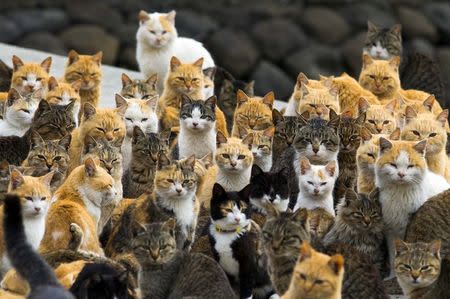
AOSHIMA, Japan (Reuters) - An army of feral cats rules a remote island in southern Japan, curling up in abandoned houses or strutting about in a fishing village that is overrun with felines outnumbering humans six to one.

Originally introduced to the mile-long island of Aoshima to deal with mice that plagued fishermen's boats, the cats stayed on - and multiplied.

More than 120 cats swarm the island with only a handful of humans for company, mostly pensioners who didn't join the waves of migrants seeking work in the cities after World War Two.

Aoshima, a 30-minute ferry ride off the coast of Ehime prefecture, had been home to 900 people in 1945. The only sign of human activity now is the boatload of day-trippers from the mainland, visiting what is locally known as Cat Island.

Tuesday, 4 February 2014

That One Time A CATNADO Actually Happened In England

Severe weather swept across parts of the United Kingdom earlier this week, bringing heavy downpours and strong winds that left thousands without power and "lifted cats in the air," according to the BBC.

Yes, you read that right. A "catnado" -- a tornado filled with cats -- actually occurred. (Seriously.)

According to a witness of the event in Chobham, Surrey, England, a “mini tornado” lifted up a horse stable and shattered the structure. The strong funnel winds then picked up several feral cats.

"We've got four feral cats in the yard and they were being lifted off the ground - about 6ft off the ground," Shirley Blay told the news outlet."They just went round like a big paper bag."

Sunday, 22 December 2013

Feral cats away in a meow-nger

Next stop Noah's ark.

A group of feral cats has taken over a nativity scene in Brooklyn, N.Y., and not for the first time, DNA Info New York reports.

The cats recently took up residence in the seasonal holiday display, organized by Brooklyn residents Annette and Susane Amendola. Apparently the cats are drawn to the warm lights (and perhaps the sly wit of the three wise men). Naturally, their appearance draws a crowd of appreciative onlookers.

It's all in good fun on the days leading up to Christmas (plenty of room in the barn, and all). But what about when baby Jesus makes his appearance on the 25th? Do the cats give the Son of God some room to stretch out in the manger?

Monday, 18 November 2013

Feral Cats Avoid Urban Coyotes, Are Surprisingly Healthy

Nov. 13, 2013 — Cats that live outdoors in the city do their darnedest to steer clear of urban coyotes, a new study says.

The cats cause less damage to wildlife in urban green spaces, such as city parks and nature preserves, because of that dodging, the study suggests. And they live longer and are healthier than previously thought.

"Free-roaming cats are basically partitioning their use of the urban landscape. They're not using the natural areas in cities very much because of the coyote presence there," said the study's lead author, Stan Gehrt, associate professor of environment and natural resources at The Ohio State University.

Wednesday, 31 July 2013

En Garde! Gang of Feral Cats Attack Woman, Dog in France

One more reason to love dogs: A gang of feral cats in France attacked a woman and her poodle, forcing both victims to seek medical attention for their injuries.

The cat-attack occurred Sunday (July 21) near the city of Belfort in eastern France. The 31-year-old woman was walking her dog near a wooded area when six felines set upon her, knocking her to the ground, The Independent reports.

The victim was treated for injuries at a nearby hospital where she was also given an injection for rabies. Her poodle was treated at a nearby veterinary clinic. 

Josette Galliot, the mother of the victim, said, "The cats jumped on my daughter and managed to knock her over. They bit her on the leg and on her arms. They even pierced an artery."

"My daughter thought it was a living nightmare. She's still traumatized and is bordering on depression," Galliot said.

Veterinarians and local residents are divided over what may have provoked the feline fury. According to some observers, a recent heat wave in the area may have played a part in the unusual mauling.

Veterinary specialist Valerie Dramard believes the cats were protecting their territory from the poodle, and the woman simply got in the way.

Friday, 12 July 2013

Evaluating and predicting risk to a large reptile (Varanus varius) from feral cat baiting protocols - via Herp Digest

August 2013, Volume 15, Issue 8, pp 1653-1663 
Author Affiliations
1. Department of Zoology, University of Melbourne, Parkville, 3010, Australia
2. Australian Research Centre for Urban Ecology, Royal Botanic Gardens, Melbourne, c/o School of Botany, University of Melbourne, Victoria, 3010, Australia
3. Department of Sustainability and Environment, Arthur Rylah Institute, Heidelberg, 3084, Australia


Abstract

Control of introduced predators to mitigate biodiversity impacts is a pressing conservation challenge. Across Australia feral cats (Felis catus) are a major threat to terrestrial biodiversity. Currently feral cat control is hindered by the limited utility of existing predator baiting methods. Further proposed control methods include use of the novel poison para-aminopropiophenone (PAPP) which may present a hazard to some native animal populations. Here we used experimental and predictive approaches to evaluate feral cat bait take by a large native Australian predatory reptile the Lace monitor (Varanus varius). These lizards would be expected to readily detect, ingest and consume a lethal dose (depending on toxin) from surface-laid baits intended for feral cat control if a precautionary approach was not adopted when baiting. We modelled V. varius bait take using experimental and predictive biophysical modelling approaches to evaluate temporal effects of climate variables on V. varius activity and hence potential for bait removal. Finally we conducted a pre-PAPP baiting site occupancy assessment of V. varius within Wilson Promontory National Park (WPNP) to provide a basis for monitoring any longer term population effects of cat baiting. V. varius removed 7 % of deployed baits from 73 % of bait stations across another study area in Far Eastern Victoria. Daily bait removal was positively correlated with maximum temperature and solar radiation. Biophysical modelling for Far Eastern Victoria predicted that maximum temperatures <19 .5="" i="" nbsp="" prevented="">V. varius
activity and hence opportunity for bait removal. V. varius in WPNP was undetectable suggesting aerial baiting posed limited hazard to this species at this location. Depending how climate influences annual activity patterns and the specific poison, surface-laid baits could pose a significant mortality risk to V. varius. However, use of biophysical models to predict periods of V. varius inactivity may provide a novel means to reduce non-target bait take by this predator.

Friday, 21 September 2012

US Feral cats spreading ‘serious public health diseases ‘

Free-roaming cats pose threat from "serious public health diseases"
September 2012. A new study in the USA has found that free-roaming cats pose a threat from "serious public health diseases" to humans, domestic animals, and wildlife.

"This is a significant study that documents serious wildlife and public health issues associated with 125 million outdoor cats in the United States. Decision-making officials need to start looking at the unintended impacts these animals have on both the environment and human health when they consider arguments to sanction Trap, Neuter, and Return (TNR) cat colonies. These colonies are highly detrimental to cats, wildlife, and people, and only serve to exacerbate the cat overpopulation problem," said Darin Schroeder, Vice President for Conservation Advocacy at American Bird Conservancy.

Thursday, 21 June 2012

Feral cats a problem for rare ground parrot


HALTING THE DECLINE of one of Australia's most threatened birds is proving difficult, say researchers in south-western Australia.
Recent tracking of feral cats - funded by a generous $19,000 donation from the Australian Geographic  Society - may help explain why only 100 western ground parrots (Pezoporus wallicus flaviventris) are believed to remain in the wild.
Ecologist Sarah Comer says cats in the wild are, quite literally, eating into the parrot populations. "They are the ultimate hunting machine," she says.
Sarah, who is coordinating a ground parrot recovery team in the WA Department of Environment and Conservation, says Australian Geographic's donation has enabled the team to collar feral cats and lay baits at Cape Arid National Park, 120km east of Esperance.
"We were surprised how many cats are out there. We collared 20 cats with GPS tags that allow us to follow their movements and see how effective our baits are in ultimately removing cats from the landscape."

Western ground parrot highly vulnerable to extinction

Two areas in Western Australia's coastal southwest are the last known refuge of this Endangered bird: Cape Arid and Fitzgerald River national parks. With numbers reduced to such small known populations, this mottled green and black parrot remains highly vulnerable to being wiped out by events like bushfire.

Recent monitoring of western ground parrots' main haunts has recorded fewer bird calls than five years ago. The parrots call at dusk as they fly back to their night roosts; they can be heard clearly after other bird species have ceased tweeting.
"In some places there used to be a cacophony of parrots, and every now and then you could see them against the dimming light in the sky," says Sarah. "More often, you'd just hear them, up to 300 to 400 metres away."
The drop in recorded calls in several key locations is puzzling, she says. "The parrots have always been fairly sedentary, and a few years ago you would have heard a lot of birds, so we're very worried."
Her colleague Dr Allan Burbidge, a senior DEC researcher, says that a research team, in 2000, surveyed the same part of Fitzgerald River National Park and heard at least 90 calls on some nights. 
"There were times when, in such areas, you might even flush a bird out walking back to your vehicle," he says. "But not now."

Wednesday, 25 January 2012

Bid to save wildcats from amorous cousins

DUBAI // Volunteers at a nature reserve are taking part in a conservation project to save the rare Gordon's wildcat.
The story of this species' plight is not the usual one of overhunting or habitat loss; its nemesis is none other than … the domestic pussycat.
The wildlife expert Peter Roosenschoon, who launched the project at the Dubai Desert Conservation Reserve, says the wildcat's survival as a distinct species is threatened by interbreeding with domestic and feral cats.
And he has made an important discovery towards ensuring the feline's survival: nine out of 10 wildcats prefer sardines with chillies.
He tried many different baits for his traps, including cat food, tuna, raw meat and quails' entrails. None worked, however, until he experimented with tinned sardines and chillies and found that cats were turning up regularly in the traps.
"We want to see what the interaction is between feral cats and Gordon's wildcats within the reserve," Mr Roosenschoon said. "That means capturing as many cats - feral or Gordon's - as possible."
Six volunteers are taking part in the first UAE project by Biosphere Expeditions, a UK-based non-profit company that runs conservation holidays around the world.
The trips give members of the public a chance to contribute to serious scientific research, and the manpower they provide makes it possible to collect more data than would otherwise be possible.
The group consists of visitors from the United States, Australia, France, Germany and Austria who have flown in specially for the expedition, plus the Austrian Evelyn Brey, who lives in the UAE. They are spending a week at the reserve, where 16 cage traps and 14 camera traps have been set up.
Each evening they bait the cages, and the following morning they return to see if anything has been caught overnight.

“With the Biosphere Expeditions team we are looking for the range: how many cats we’ve got throughout the reserve,” Mr Roosenschoon added. “It’s a real help having these guys.”

The trapped animals are microchipped and a tiny piece of tissue is taken from their ears for DNA testing before they are released. The results will be used to determine whether each individual is a pure Gordon’s or a hybrid, and any which are found to be the result of interbreeding will be removed from the reserve.

This will open up more territory to the Gordon’s wildcat and enable a pure population to develop. In the future, specimens obtained from captive breeding centres may be introduced and it is hoped that lessons learnt from the project can be applied elsewhere.

The volunteers also weigh and measure the cats, and are working on a second project to evaluate the reserve’s Arabian Oryx population.

Ms Brey said: “If I can help in any way, if what we are doing here is actually giving great data that takes these projects forward, then I’m very happy.”

The National spent a day with the volunteers, staying overnight at their base camp, and found they were learning the frustrations as well as the satisfactions involved in desert conservation.

The group’s fleet of three Land Rovers frequently became trapped in soft sand when venturing off established tracks. What is more, problems with GPS equipment meant the teams could not find some of the traps, which proved to be as elusive as the rarely seen wildcat.

“It wasn’t only us inexperienced drivers getting stuck, it was also the staff from the reserve taking us into the dunes,” said the expedition leader Malika Fettak, from Germany. “It’s unpredictable, if you come to a very soft spot you just sink in and there’s nothing you can do.”

The long day, which had started at 6am with saucepan lids being struck together as a wake-up call, ended with dinner around the campfire followed by shisha. The volunteers then retired early to their tents, exhausted from digging out all that sand from beneath the cars.
csimpson@thenational.ae

Friday, 11 November 2011

Call to halt spread of feral cats in the US

‘This is a human-caused tragedy'November 2011: American Bird Conservancy (ABC) is calling on US mayors to stop the epidemic spread of feral cats that threaten national bird populations as well as scores of other wildlife.

Letters have been mailed to mayors of the fifty largest cities in the Unites States, urging they support responsible pet ownership and oppose Trap-Neuter-Release (TNR) programmes that promote the feeding of outdoor cats.

‘Cat overpopulation is a human-caused tragedy that affects the health and well-being of cats, our native wildlife, and the public,' says Darin Schroeder, Vice President for Conservation Advocacy for ABC in a letter to the mayors. ‘Numerous published, scientific studies have shown that trap, neuter, re-abandon programmes do not reduce feral cat populations and that outdoor cats, even well-fed ones, kill hundreds of millions of wild birds and other animals each year in the US, including endangered species. Birds that nest or feed on the ground are especially vulnerable to cat attacks.

'About as fair as shooting of fish in a barrel'‘The domestic cat is an extremely effective predator that has been introduced by modern man into an environment whose species have evolved few, if any natural cat defences. Non-native, well-fed, inoculated, healthy cats versus defenseless prey is about as fair in the world of nature as the proverbial shooting of fish in a barrel,' he said.

Studies indicate that there are 95 million outdoor and feral cats in the United States that kill at least 532 million birds, and possibly significantly more. Given the well-documented impacts of cat predation on wildlife, ABC urges the mayors to oppose TNR programmes and the outdoor feeding of cats as a feral cat management option.

Through the Cats Indoors! campaign, ABC and its many partners encourage people to keep their cats indoors, train them to go outside on a harness and leash, or build outdoor cat enclosures. Cats should be spayed or neutered before they can produce an unwanted litter, and should never be abandoned. Abandoning cats is illegal in many areas, is extremely cruel to cats, and is harmful to birds and other wildlife.

‘TNR is not humane to the cats or the wildlife. Free-roaming cats are in constant danger of being hit by cars, contracting diseases and parasites, or being attacked by other animals or people,' said Schroeder. ‘Colonies often become dumping grounds for unwanted pets, thus continuing the inhumane cycle.'

http://www.wildlifeextra.com/go/news/feral-cat1112011.html

Monday, 18 April 2011

Bill mandates 'fixing' of cats, dogs before sale

By Rob Shikina

POSTED: 01:30 a.m. HST, Apr 17, 2011

State lawmakers are looking at a bill that would require pet retailers in Hawaii to sterilize all cats and dogs before selling them.

Passing such a law would lessen the suffering of feral cats because of overpopulation and reduce the number of animals euthanized in shelters, said Inga Gibson, state director of the Humane Society of the United States. Many feral cats are the offspring of abandoned house cats that haven't been sterilized, she added.

House Bill 243 notes that an unsterilized female cat can give birth to two litters a year, which, extrapolated over seven years, could lead to 400,000 cats.

Feral cat colonies continue to grow despite various efforts to control the cat population, and the pressures of overpopulation lead to starvation of the weakest and the spread of disease and mange, a form of animal cruelty when uncontrolled, the bill says.

"It's a tremendous issue," Gibson said. "We have a large feral cat issue throughout the state. One of the contributing factors is the sale of unsterilized cats."

Feral cats are also a threat to Hawaii's endangered birds, according to the state Division of Forestry and Wildlife.

The bill is just one version of animal cruelty legislation that is heading to a conference committee to work out differences between House and Senate versions.

State laws mandating the spaying or neutering of dogs or cats appear to be rare. At least one state, Rhode Island, mandates it if the animals are released from a shelter. Some counties on the mainland, however, completely ban the sale of cats or dogs, while a Los Angeles ordinance from 2008 requires pet owners to sterilize their dogs or cats by the age of 4 months.

Despite the large feral cat population, the Humane Society opposes euthanasia and supports managed cat colonies for unsocialized cats, where a caretaker will get the animals sterilized, microchipped, vaccinated, fed and looked after.

"It's not an easy life for a cat that's not part of a managed colony," Gibson said.

Theresa Donnelly, who breeds boxers and is secretary of the Boxer Club of Hawaii, said the bill wouldn't affect purebred dogs because hobby breeders usually sell person to person, which is not regulated by the bill.

"Any reputable breeder would never sell to a pet store anyway," she said. Hobby breeders want to meet potential owners to make sure their dogs will have a safe home and possibly establish a relationship with the new owners to promote ethical breeding, she said. "People who want to breed animals should be mentored."

Tish Rothwell, owner of the Pet Depot in Ewa Beach, said her business has been fixing cats before adopting them out ever since hundreds of animals were rescued from a Waianae no-kill shelter when the owner died in July 2009.

After the rescue, shelters were full and couldn't take animals from people who were trying to give up their pets. Rather than see cats euthanized in shelters, Rothwell's store took the animals and sterilized them before adopting them out for a fee that covered medical costs.

"We want to be responsible and keep that out-of-control cat population down," Rothwell said.

However, she has concerns about mandating the fixing of dogs. They recover slower than cats after being spayed or neutered and require more care, raising the cost of the animals.

Brent Chung, manager of Kalihi Pet Center, said some customers may not mind if the bill becomes law, but pet stores may require breeders to have dogs fixed before selling them to the retailer, reducing the supply of dogs in stores. He said some veterinarians are backlogged and the dogs may be months old by the time an animal can be sterilized, frustrating customers that want dogs as young as 6 weeks old that are easier to train. He suspected the bill could also boost sales of unsterilized dogs outside of stores. "They'll beat the system, no matter what," he said.

The bill has an effective date of January.

Honolulu Star Advertiser: http://www.staradvertiser.com/news/20110417__Bill_mandates_fixing_of_cats_dogs_before_sale.html

Saturday, 4 December 2010

Feral cats kill 480 million birds in US every year - Responsible for 33 extinctions

480 million birds killed by feral cats each year

December 2010: A new report has put the annual economic loss from feral cat predation on birds in the US at a alleged $17 billion (Some of the maths involed in this figure are interesting, to say the least).

The report, Feral Cats And Their Management, analyses existing research on management of the burgeoning feral cat population - over 60 million and counting - in the United States, including the controversial practice of Trap, Neuter, Release (TNR).

Trap, Neuter & Release doesn't work
‘This report is a must read for any community or government official thinking about what to do about feral cats. It encapsulates the extensive research on this subject and draws conclusions based on that data. Not surprisingly, the report validates everything the American Bird Conservancy (ABC) has been saying about the feral cat issue for many years, namely TNR doesn't work in controlling feral cat populations,' said Darin Schroeder, Vice President for Conservation Advocacy for American Bird Conservancy, US's leading bird conservation organisation.

'These animals live short, miserable lives'

‘Communities seeking a solution to their feral cat problems need to consider the science on the issue and the well being of animals impacted by feral cats as well as the cats themselves. These other animals - birds especially - don't deserve to die at the hands of a predator introduced into their environment by irresponsible pet owners.

‘A humane decision-making process on this issue must also recognise that feral cats live short, miserable lives because of disease, other predators, severe weather and traffic hazards. Their life expectancy is about one third as long as owned cats,' Schroeder added.

More than 30 bird species have been wiped out
A key finding of the report was the statement by the authors that they do not recommend the TNR method to eliminate colonies of feral cats. In their extensive research, they were unable to find a single real-world example of TNR succeeding in eliminating a feral cat colony.

Some of the many findings of the report include:
Feral cats are invasive and pose a threat to native fauna and public health.

Three separate studies showed that most feral cats (62 to 80 per cent) carry the parasite responsible for toxoplasmosis - a condition of special concern to pregnant women.

Cats are responsible for the extinction of at least 33 species of birds.

Feral cats kill an estimated 480 million birds in the US each year.

Feeding feral cats encourages them to congregate which encourages the chances of diseases being transmitted.

The supplemental feeding of feral cats should be prohibited.

Cats will kill wildlife no matter how well they are fed.
Related Posts with Thumbnails

ShareThis