Showing posts with label bobcats. Show all posts

Monday, 12 May 2014

Reports of using live animals as bait in trapping prompt calls for new law


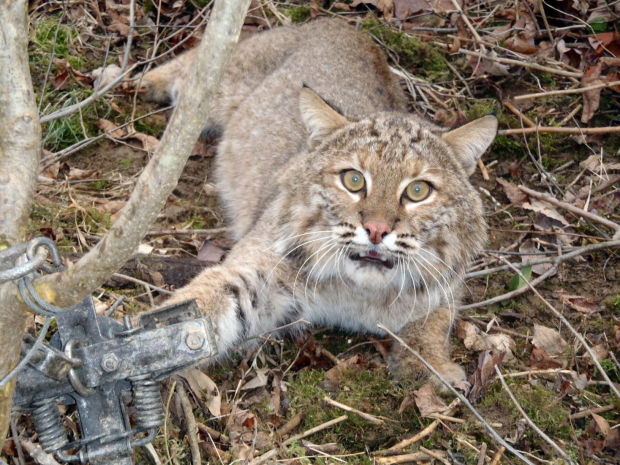
Bobcats are a popular prey for trappers and hunters including untrained and unscrupulous trappers who may have used live bait to entice the cats into traps. State officials hope to outlaw the use of live bait for trapping and state trapping associations are firmly in favor of the proposal.
3 hours ago • Jim Holland Journal staff


Bobcat trapping basics

Bobcats are a wily prey for hunters and trappers.

Also known as lynx, bobcats are found in most areas of the continental United States from southern Canada to southern Mexico.

In South Dakota, the meat-eating cats are most prevalent in the western half of the state, and rarely seen in the northeast part of the state.

Their keen eyesight and hearing make them always wary of danger.

According to the National Trapper's Association Trapping Handbook, larger foothold (spring) traps, cage traps and medium- to large-size body-grip traps can be used to catch bobcats.

Foothold and body-grip traps are sometime hidden in holes or a cubby, a concealment made up with rocks, sticks or logs. 

Bobcats trapped alive are usually killed by choking with a catch pole, or by a gunshot or sharp blow to the head. Body-grip traps kill by asphyxiation.

Trappers use fresh meat and catnip to lure bobcats. Rabbits, squirrels and birds are regular parts of its diet.

Strips of colored cloth or a shiny metal object hung from a string blowing in the breeze near a trap set can be used to lure bobcats.

In South Dakota, bobcat trapping season runs from late December to mid-February. 

State game officials say it's time to outlaw the use of live mammals as bait in trapping fur-bearing animals.

And representatives from trapping and fur-harvesting organizations in the state agree.

"We were appalled that there isn't a law on the books and that it was even allowed," said Anna Hermanson of Newell, president of the South Dakota Trapping Association. "Everybody pretty much agreed that live animals should not be used for bait."

Reports of live animals — including domestic cats, rabbits and birds — used to bait coyote and bobcat traps prompted the South Dakota Game, Fish & Parks Commission to propose a ban at its May meeting.

Sunday, 24 February 2013

Kevin Martuscello Films Bobcat Standoff On Carrollton, Tex. Lawn


Me-yowza!
A man from Carrollton, Tex. recorded two bobcats seemingly about to fight -- right in someone's front yard.

Kevin Martuscello filmed the massive felines with a smartphone while he sat feet away in his car. In the video, uploaded to YouTube, the two cats are in a loud and aggressive standoff.
Carrollton residents are used to seeing bobcats, but not in such close vicinity, CBS Dallas/Fort Worth reported.

Mike Martuscello, Kevin's father, told the station that moments before the standoff, the cats actually fought.

“They were clawing and scratching, biting at each other, jumping up and down in the air. It was a wild scene,” he said. “Literally, it was a real cat fight."

Bonnie Bradshaw, wildlife specialist, says the cats were both two males, most likely "squabbling over territory," as mating season approaches, according to Fox 4 News.

However, it's rare for two bobcats to be seen together in an urban setting, John Padgett, a game warden for the Texas Parks and Wildlife Department, told the Dallas Morning News.
Animal Control officials in Carrollton said that no reports of injuries to either pets or people have come in, CBSDFW reported. Still, residents are being asked to keep pets and children indoors if possible.

Bradshaw noted that bobcats are not a threat to children, but instead to small animals like rabbits and squirrels.

Padgett had a similar sentiment, stating: "We're not on their menu."


http://www.huffingtonpost.com/2013/02/21/bobcat-standoff-carrollton-kevin-martuscello-video-_n_2733106.html?utm_hp_ref=weird-news

Friday, 20 April 2012

Deadly Cat Disease: Effective Treatment for Bobcat Fever


ScienceDaily (Apr. 18, 2012) — Lone Star ticks, which are notorious carriers of many diseases including cytauxzoonosis, or "bobcat fever," have been spreading across the nation in recent years. As a result, cats across much of the country are now exposed to the deadly disease. University of Missouri veterinarian Leah Cohn, a small animal disease expert, and Adam Birkenheuer from North Carolina State University, have found an effective treatment for the dangerous disease.

"Previous treatment methods have only been able to save less than 25 percent of infected cats, but our method, which is now being used by veterinarians across the country, has been shown to save about 60 percent of infected cats," Cohn said. "While that number isn't as high as we'd like due to the deadly nature of the disease, our method is the first truly effective way to combat the disease."

Routinely carried by bobcats and mountain lions, Cohn and Birkenheuer also found that bobcat fever can even infect tigers. All types of cats, but only cats, can catch bobcat fever. Cohn calls the disease the "Ebola virus for cats," saying that it is a very quick and painful death for cats that succumb from the infection. Bobcat fever is easily spread between cats through tick bites, but Cohn and Birkenheuer found that the disease is not readily passed down through birth like malaria and many other protozoan diseases.


Related Posts with Thumbnails

ShareThis