Showing posts with label trapping. Show all posts

Thursday, 28 June 2018

Initial results of Orkney trapping trial revealed


The results of the trapping trial designed to help inform plans to remove stoats from Orkney in order to protect Orkney’s internationally important wildlife have been revealed.

The Orkney Native Wildlife Project carried out the trial as part of the nine month development phase that was funded by the Heritage Lottery Fund as part of the work to optimise technical aspects of the planned eradication. This will be the world’s largest stoat eradication to date and a first for Europe, so it was important to test some elements of the methodology to ensure it will be successful and to investigate differences in stoat behaviour in Orkney.

In December 2017, lethal humane traps were positioned at three trial sites west of Kirkwall – Grimbister, Hobbister and Wideford. In order to determine their effectiveness, a range of trap types and trap housings and a range of habitats were tested. The traps were then checked eight times between mid-December and the end of February with number, gender and trap location of each stoat caught being recorded.

A total of 41 stoats were caught across the three sites with nearly half (49%) of these caught at the Grimbister site. Overall, eighty-five percent of stoats caught were captured in the double set traps (where there were two traps in each box with an entrance at both ends). Trap were set in improved grassland, rough grassland and moorland, with the vast majority of stoats caught in moorland followed by on the edges of moorland and the coast.

The main finding was that the density of stoats in these three trial areas appears to be high compared to other islands around the world where stoat densities have been estimated during eradications. The estimated density of stoats in the three Orkney areas was 2-4 per km2 compared to the total density of stoats from Secretary Island and Resolution Island in New Zealand of 1.1-1.4 per km2 and 0.7 per km2, respectively. This difference in density is likely to be an underestimate too as the calculated density of stoats caught would be considerably higher over many years of trapping (like that which took place on the New Zealand Islands) compared to the 12 week trapping trial in Orkney. This is the first time that an indication of the abundance of stoats in Orkney has been available.

Sunday, 14 May 2017

Ban Sought on Commercial Wild Turtle Trapping in Oklahoma-Unlimited Numbers Can Now Be Caught, Sold - via Herp Digest


Press Release 5/11/17- OKLAHOMA CITY— The Center for Biological Diversity and several Oklahoma-based environmental organizations petitioned the Oklahoma Department of Wildlife Conservation today to end commercial collection of the state’s wild turtles, which are critical to the health of freshwater ecosystems. Turtle trappers can now legally collect unlimited numbers of eight turtle species from waterways on private lands to sell domestically or export for Asian food and medicinal markets.

“Turtle trappers shouldn’t be allowed to pad their pocketbooks by putting the state’s precious wildlife at risk,” said Collette Adkins, the Center biologist and senior attorney who authored the petition. “For the sake of our native turtles and all of us who care about them, Oklahoma has to rein in exploitative turtle trapping.” 

Commercial traders bought nearly 1 million wild turtles from Oklahoma between 1994 and 2014, according to reports submitted by turtle buyers to the Oklahoma Department of Wildlife Conservation. Asian food and medicinal markets drive most of the trade. Because turtles accumulate toxins from prey in their bodies and burrow into contaminated sediment, their meat is often laced with mercury, PCBs and pesticides, posing a health risk. Adult turtles are also taken from the wild to breed hatchlings for the international pet trade.

Scientists have repeatedly documented that freshwater turtles cannot sustain any significant level of wild collection without population declines. For example, a 2011 Oklahoma study showed a significant reduction, in comparison to baseline data from 1997-1999, in “catch per unit of effort,” an index of turtle abundance, across eastern Oklahoma for the three turtle species primarily targeted by commercial trappers: common snapping turtles, softshells and red-eared sliders.
“Commercial trapping is devastating to turtle populations that are already suffering from multiple other threats, including habitat loss, water pollution and vehicular collisions,” said Michael Beilfuss, executive committee chair for Oklahoma Chapter Sierra Club. “Unless the state bans commercial turtle trapping, Oklahoma’s turtle populations will continue to plummet.”

In response to a 2008 Center petition, Oklahoma prohibited commercial collection of turtles from the state’s public waters. That prohibition, while an important step, insufficiently protects the state’s turtles because approximately 95 percent of the state’s land is privately held and therefore open to turtle trapping. And enforcement is difficult because turtle traders can claim that turtles illegally collected from closed public waters were collected from waters on private land.

Today’s petition was submitted by the Center for Biological Diversity, Oklahoma Chapter Sierra Club, Save the Illinois River and Local Environmental Action Demanded.

Background

As part of a campaign to protect turtles in the United States, the Center has been petitioning states that allow commercial turtle collection to improve their regulations. In 2009 Florida responded by banning almost all commercial turtle collection from public and private waters. In 2012 Georgia approved state rules restricting commercial turtle collection, and Alabama completely banned it. Most recently, in Iowa in March, new regulations setting closed seasons and possession limits for commercial turtle trappers went into effect.

As for states neighboring Oklahoma, Colorado and Kansas prohibit commercial turtle collection, and New Mexico strictly regulates it with annual bag limits. In addition, last fall Missouri announced — in response to a Center petition — that it will consider ending unlimited commercial turtle collection through a formal rulemaking proceeding.   

Contacts: 
Collette Adkins, Center for Biological Diversity, (651) 955-3821, cadkins@biologicaldiversity.org
Michael Beilfuss, Oklahoma Chapter Sierra Club, (979) 218-8941, mbeilfuss@yahoo.com
Ed Brocksmith, Save the Illinois River, (918) 284-9440, info@illinoisriver.org
Rebecca Jim, Local Environmental Action Demanded, (918) 256-5269, rjim@neok.com

Monday, 12 May 2014

Reports of using live animals as bait in trapping prompt calls for new law


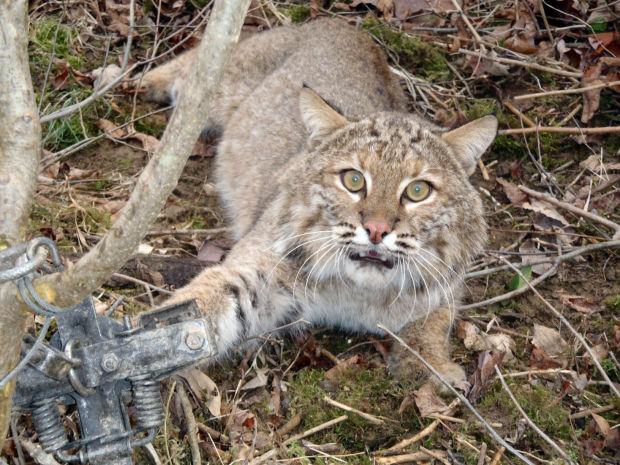
Bobcats are a popular prey for trappers and hunters including untrained and unscrupulous trappers who may have used live bait to entice the cats into traps. State officials hope to outlaw the use of live bait for trapping and state trapping associations are firmly in favor of the proposal.
3 hours ago • Jim Holland Journal staff


Bobcat trapping basics

Bobcats are a wily prey for hunters and trappers.

Also known as lynx, bobcats are found in most areas of the continental United States from southern Canada to southern Mexico.

In South Dakota, the meat-eating cats are most prevalent in the western half of the state, and rarely seen in the northeast part of the state.

Their keen eyesight and hearing make them always wary of danger.

According to the National Trapper's Association Trapping Handbook, larger foothold (spring) traps, cage traps and medium- to large-size body-grip traps can be used to catch bobcats.

Foothold and body-grip traps are sometime hidden in holes or a cubby, a concealment made up with rocks, sticks or logs. 

Bobcats trapped alive are usually killed by choking with a catch pole, or by a gunshot or sharp blow to the head. Body-grip traps kill by asphyxiation.

Trappers use fresh meat and catnip to lure bobcats. Rabbits, squirrels and birds are regular parts of its diet.

Strips of colored cloth or a shiny metal object hung from a string blowing in the breeze near a trap set can be used to lure bobcats.

In South Dakota, bobcat trapping season runs from late December to mid-February. 

State game officials say it's time to outlaw the use of live mammals as bait in trapping fur-bearing animals.

And representatives from trapping and fur-harvesting organizations in the state agree.

"We were appalled that there isn't a law on the books and that it was even allowed," said Anna Hermanson of Newell, president of the South Dakota Trapping Association. "Everybody pretty much agreed that live animals should not be used for bait."

Reports of live animals — including domestic cats, rabbits and birds — used to bait coyote and bobcat traps prompted the South Dakota Game, Fish & Parks Commission to propose a ban at its May meeting.

Wednesday, 22 January 2014

Snapping turtle trapping law-Immediate Action Needed - via Herp Digest

IGNORE ORIGINAL I SENT OUT WHICH HAD YOU SEND AND CONTACT ASSEMBYLEMEN 
THEY MOVED IT TO THE SENATE ENVIRONMENTAL COMMITTEE AND IT IS SCHEDULED FOR VOTE THIS THURS. 

(Below is from TurtleRescue of Long Island. Thanks for putting this together.) 

Stop NY Turtle Trapping Bill!

A new Turtle Trapping Bill, S2170b, comes up for a vote in the Senate Environmental Committee this Thurs. (Jan. 23). Because this committee passed a similar bad bill in 2013 to legalize trapping of Snapping Turtles, the NY state reptile, it’s imperative to stop this one ASAP. Please immediately contact:

Senator Klein, IDC Senate Leader: jdklein@nysenate.gov, (518) 455- 3595. 

Urge him to defeat the Turtle Trapping Bill, S2170b. Our state reptile is already in trouble from traffic accidents and habitat loss (please see #1 below). Plus, other NY wildlife, such as the endangered Bog Turtle and the threatened Blanding’s Turtle, will also die in the non-selective traps. Leave your name and politely ask for a response about his action on this bill.


If you can—please also contact: NYS Senate Majority Leader Skelos: skelos@nysenate.gov, (518) 455-3171 and Environmental Committee Chair Senator Grisantigrisanti@nysenate.gov, (518) 455-3240, plus your own senator.


More about Bill S2170b


1. New York’s State Reptile, the Snapping Turtle, already faces an uphill battle for survival due to habitat loss, toxic run-off and traffic accidents that kill many females as they try to lay eggs along roadsides. Because Snapping Turtles do not reproduce until at least eight years old, and only about 3% survive from egg to adult, even a slight rise in the number killed could make the population crash.

2. This proposal will hinder law enforcement authorities from controlling illegal trapping, since poaching can occur under the guise of permitted activity. A 2009 investigation revealed that thousands of New York turtles were being illegally shipped to China. Allowing trapping of NY Snapping Turtles would sacrifice our State Reptile to the inexhaustible appetite of the Asian food trade. This should not be the fate of New York's majestic state reptile.

3. Trapping causes the accidental deaths of non-targets, in this case the Endangered Bog Turtle and Threatened Blanding’s Turtle, as well as other NYS wildlife, would be at risk.

4. The justification for S2170B includes the historic use of these turtles for food, but the NYS Dept. of Health has issued an advisory warning that Snapping Turtles often are contaminated with PCB’s and other toxins.

5. Snapping Turtles are magnificent creatures that play a key role in maintaining healthy ecosystems. For example, these turtles eat dead fish - thus acting as an environmental sanitation crew.

6. The Snapping Turtle was chosen by school children to be the NYS Reptile. New York’s turtles need more protection, not less.

7. There is no reason to inflict pain and suffering on individual turtles and risk destroying NY turtle populations.

Monday, 19 August 2013

How an Expert Trapper Catches Huge Snapping Turtles in Indiana – via Herp Digest


Article by Ben Romans. Field & Stream, July 23, 2013


When Bill Haywood was 10 years old, he was trapping snapping turtles that weighed more than he did using traps he built, local bait, and self-taught techniques. Decades later, he’s teaching his 16-year old son Canaan all he's learned and is seeing more success than he ever did trapping solo. On Memorial Day weekend, acting on his trapper’s instincts, the duo caught the largest snapper Haywood has seen in 17 years—one that could claim the title for largest living snapping turtle.

Raised in rural Indiana, Haywood says his lifelong fascination with snapping turtles began with stories from his grandfather; folk legends replete with massive snappers, unconfirmed sightings, and nicknames like The Beast of Busco.

“I heard my grandpa tell a story of a giant turtle in Churubusco, Indiana. According to him, this farmer claims he saw a huge turtle that weighed hundreds of pounds. Word spread, and people came by the scores to try to find it,” Haywood says. “They named it Oscar, and newspaper reporters, scuba divers, and fortune seekers went looking for it. But in the end, nobody found it, and the farmer nearly went broke trying to find the turtle... I think he ended up draining the lake but there was no sign of it. The story actually became part of the town’s identity—it has a statue of a turtle, and they have a Turtle Days festival every year.”

Without access to some of the farm ponds, Haywood learned to trap on public creeks and rivers. Though he now has access to several properties, he still builds his own traps and uses the same techniques he did as a kid.

“I build traps out of 12 gauge horse fencing so they’re three feet wide, five feet long, and two feet deep with an entrance at one end and place it shallow enough so a trapped turtle can breathe, otherwise they drown. Anyways, Indiana state law says the opening of the trap has to be above water level. Turtles find their way in, but have trouble finding their way out,” Haywood says.

“For bait, I think carp work the best. I put them in gunny sacks and drop a few in the freezer. Once they’re frozen, I chop one up with an ax and hang big chunks in empty coffee cans on the inside of the traps. As the carp thaws, the oil seeping from the meat really draws the turtles in. One 20 pound carp is enough to fill up about six traps.”

Most people wince at the idea of oily carp and catching or handling something as unattractive, or as dangerous as a snapping turtle. But Haywood, who’s also an avid hunter, says turtle trapping offers a great reason to get outside, and those that cringe at the idea, probably don’t know turtle makes excellent table fare.

“I trap a lot of muskrat, beaver and mink, and I big game hunt. But in the middle of the summer, there’s not a lot to hunt or trap, so I just trap turtles,” Haywood says. “Turtle meat is very tasty. I like to brown it in a skillet and eat it with gravy. Other people put it in a pressure cooker or make soup; however you do it, it’s really good. I keep some of the turtles that are 20 pounds or bigger. But there are still a lot of old timers around here that still love to eat turtle. I just go around and give a turtle to whoever wants one.”

While he enjoys it, Haywood points out trapping isn’t without its share of danger. Along with its hard shell, the business end of a snapping turtle is its best defense.

“It was only a matter of time before one clamped down on my hand. One bit me so hard the beak punctured through my hand and ripped off a big chunk of skin. I have a nice scar to remember that one,” Haywood says. “Once they bite down and realize they have flesh, they start pulling their head back into the shell and they don’t let go. It’s excruciating, but there’s nothing you can do. You can’t get loose. You just have to wait until they let go.”

Aside from the taste of turtle meat, returning home with all his fingers, and the sense of accomplishment from hanging a trophy turtle shell among his big game trophies on the wall, Haywood says he likes the challenge of it all, and each time he ventures out, he tries to trap a turtle that beats his personal best of 43 inches in length. It's a record he hasn't topped in 17 years.

This past Memorial Day weekend, accompanied by his son Canaan on their first father-son trapping outing, Haywood was finally able to break that record.

“I told [my son] my goal has always been to beat that personal record,” Haywood says. “That Friday before Memorial Day, we caught a 38 pounder that was 44 inches long, so we did what we set out to do. I jokingly said ‘take a good look at this turtle, cause it may be 17 years before you see one bigger.’”

But the next morning, in a new lake they’d never explored before, they did.

“I love trapping turtles around beaver lodges. That’s where you find the big ones. This place just looked like perfect turtle habitat. I just had a feeling about it,” Haywood says. “Tag teaming that turtle was just a great father-son experience. There were three or four other turtles in the trap with it, and when we started getting it out of the water, the big one started tearing that trap apart. I think the trap weighed over 100 pounds, and in the confusion, I accidentally knocked my son out of the boat trying to load it.”

Some states recognize record turtles, but Indiana is not one of them. However, Haywood did a little research and had the animal measured by a certified herpetologist. From what he can tell, his recent catch is one of the biggest on record.

“The shell was 19.62 inches long, but the turtle’s total length was 50.87 inches from nose to tail,” Haywood says. “There was one in Massachusetts with a 19.8 inch shell, but I think it died about three years ago, so my understanding is this could be the largest, living, wild snapping turtle on record. I’m not sure if that will ring true if I let it go, but I’m trying to find out. I still have the turtle [alive], and I can’t keep it forever.”

Haywood laughs knowing that as quickly as he helped his son set the bar to judge future turtle catches, he helped him raise it, but insists even if it takes another 17 years to break his personal record, he’ll enjoy every second of it.

“So far this year, my son and I have been trapping three weekends and have got 123, which came out to 1,400 pounds of turtle,” Haywood says. “We just enjoy it. It’s simple fun, and that’s sometimes hard to find.”

Thursday, 24 January 2013

Improved Stink Bug Trapping Methods


Jan. 18, 2013 — Baited black traps in a pyramid shape attract significantly more brown marmorated stink bugs than other traps, according to U.S. Department of Agriculture (USDA) scientists. Evaluating stink bug responses to different visual stimuli may help manufacturers design better traps for monitoring the bugs.

Entomologist Tracy Leskey at the Agricultural Research Service (ARS) Appalachian Fruit Research Station in Kearneysville, W.V., focused on visual stimuli that can attract the stink bugs to traps that will help farmers monitor the level of infestation in their fields and orchards.

In field trials in 2009 and 2010, Leskey and her colleagues found that significantly more stink bug adults and juvenile bugs, called nymphs, were captured in the baited black pyramid traps than in other traps. The researchers also found that more adults and nymphs were captured in a trap placed on the ground than in a commercially available trap hung from a tree limb.

These prototype pyramid traps may serve as monitoring tools to assess the presence, abundance and seasonal activity of pests and natural enemies to determine the need for insecticide applications.

Leskey and her colleagues also found that in 2010, 2011 and 2012, stink bugs produced two generations in one year in Kearneysville, based on the presence of eggs and newly molted adults in field cage experiments. Although it has been reported that these bugs produce only one brood annually in eastern Pennsylvania, it appears that in more southerly locations within the Mid-Atlantic region, they can produce two generations per year, according to Leskey.

Sunday, 8 July 2012

Australia to bait and trap cane toads – via Herp Digest


SYDNEY, June 13 (UPI) -- Australian scientists say the poison invasive cane toads use to devastate native species could be turned into a weapon against the toads themselves.
Researchers at the University of Sydney, in collaboration with the University of Queensland, have determined the poison can be used as 'bait' in traps set in bodies of water to catch toad tadpoles.
The biggest hurdle to eliminating cane toads is that a single clutch of eggs laid at a time by one female can number 30,000 or more, they said.
"This means that even if you catch and kill 99 percent of the adult toads in an area, the few that are left can produce so many offspring that before you know it you are back to where you started -- just as many cane toads as ever," Sydney researcher Rick Shine said.
The scientists found secretions from the shoulder glands of dead toads can be used to bait traps, as it is cheap, easy to obtain and highly attractive to cane toad tadpoles but repels the tadpoles of native frogs.
"A chemical 'bait' created from the toads' poison is a real magnet for [cane] toad tadpoles," Shine said.
"When we use this chemical as bait in a funnel-trap we catch thousands of toad tadpoles and almost nothing else," he said. "In one natural pond, we collected more than 40,000 toad tadpoles in less than a week. And I think we got them all -- over the next few weeks, not a single toad emerged from that pond."
Cane toads, initially brought into the country to control beetles threatening sugar cane plantations, are spreading through tropical Australia with a devastating impact on native species, researchers said.
For a photo of Rick Shine: http://www.upi.com/Science_News/2012/06/13/Australia-to-bait-and-trap-cane-toads/UPI-39571339621575/#ixzz1xxeNOmVP

Tuesday, 19 June 2012

European BirdLife Partners take action against European bird crime


Across Europe, birds suffer from a wide range of persecution: illegal poisoning, shooting, trapping, and the theft of chicks for the bird trade are common practices. Recently, five European countries were confronted with cases of illegal killing. The common, even if illegal, practice of using poison baits to eradicate carnivores and rodents causes huge damage to wildlife as well as to livestock and crops. In some cases it can explain the decline of specific bird populations in Europe. Moreover, the poisons used are usually unnecessarily strong and often illegal.
The BirdLife Partners in Hungary, Greece, Cyprus, France and Malta have s taken different types of measures to halt illegal killing of bird practices and to limit their damages on biodiversity. 
In Hungary, illegal killing of birds threatens rare majestic birds
Over the last decade in Hungary, more than a thousand protected birds have been poisoned including White-tailed Eagles, Saker Falcons, and Common Buzzards. More birds have been, and are still, the victims of other illegal practices such as trapping or shooting.
MME (BirdLife in Hungary) has just begun the coordination of a new Life+ project (co-financed by the EU) in cooperation with eight other organisations, aimed at supporting the slow growth of the Eastern Imperial Eagle population in Hungary, and more widely, at finding solutions to control illegal hunting of birds.

Thursday, 3 May 2012

Two tigers caught in poachers' traps in India

One tiger dies, a second badly injured
May 2012. Two tigers were caught in steel traps set by professional tiger poachers in a heart-rending incident that took place in Palasgaon Range in Maharashtra. One tiger died and the other has been rescued by the Forest Department but has serious injuries.
Clubbed to death
The scene of the crime was a small pond in scrub forest, only 2.5 km from the nearest village Gondmohadi. The Forest Department had been setting up camera traps there to monitor a tigress with her two cubs. One evening the guards noticed a young male tiger lying by the pool. It later transpired that it was caught in a trap and it appears that it was clubbed to death by the poachers.
Second tiger caught
The guards then noticed a second tiger, presumed to be the mother, caught in a trap on the opposite side of the bund. One of the guards got his foot caught in a third steel trap but managed to get out of the device by removing his shoe. The poachers had ringed the waterhole with the tiger traps. More forest staff soon arrived but they could do little to help. A third tiger which was lurking in the vicinity, menacingly snarled and charged at the rescue party in the fast fading light.
Large male tiger
Senior forest officers and two personnel from the Wildlife Protection Society of India (WPSI) rushed to the spot. Finally, at 3:15 am, nearly 8 hours after the trapped tigers were first seen, the forest officers managed to dart the trapped tiger that was still alive. To everyone's surprise it turned out to be a large male tiger. The tiger was badly injured; three of the toes on its front leg had been torn off and its foot was fractured.
WPSI is now pulling out all stops to assist the Forest Department in its investigation to nab the culprits. Coming only a few days before the First Stocktaking Conference to review implementation of The Global Tiger Recovery Program in New Delhi from 15-17 May, this distressing incident illustrates that tiger poaching continues to be a major threat to the future of wild tigers.
http://www.wildlifeextra.com/go/news/tiger-trap.html

Monday, 2 April 2012

Dead wolf photos stir tensions in West


SALMON, Idaho (Reuters) - Photos of dead and maimed wolves have pervaded the Internet in recent weeks, raising tensions in the Northern Rocky Mountains over renewed hunting and trapping of the once federally protected animals.
Escalating rancor between hunters and animal rights activists on social media and websites centers on pictures of wolves killed or about to be killed. Many have text celebrating the fact that Western states are allowing more killing of the predators.
Commenting on a Facebook-posted image of two wolves strangled to death by cable snares, an individual who identified himself as Shane Miller wrote last month, "Very nice!! Don't stop now, you're just getting started!"
A person going by the name Matthew Brown posted the message, "Nice, one down and a BUNCH to go!" in response to a Facebook image of a single wolf choked to death in a snare.
Such pictures and commentary have intensified online arguments over the ethics of hunting and trapping wolves. The debate took a threatening turn this week with an anonymous email warning thatanimal rights advocates will "be the target next."
In Idaho and Montana, hundreds of the animals have been killed -- mostly through hunting -- less than a year after being removed from the U.S. endangered species list.
Stripping the wolves of federal protection last spring opened the animals to state wildlife management, including newly licensed hunting and trapping designed to reduce their numbers from levels the states deemed too high.
Since the de-listing last May, Idaho has cut its wolf population by about 40 percent, from roughly 1,000 to about 600 or fewer. Some 260 wolves have been killed in Montana, more than a third of its population, leaving an estimated 650 remaining.
The U.S. Fish and Wildlife Service has also proposed lifting the protected status for another 350 wolves in Wyoming.
The threatening note received by an anti-trapping group based in Missoula, Montana, this week has drawn scrutiny from federal and local law enforcement.
The group says it was likely singled out because it had criticized and widely circulated a snapshot of a smiling trapper posed with a dying wolf whose leg was caught in the metal jaws of a foothold trap on a patch of blood-stained snow.

Tuesday, 28 February 2012

Pine marten fear for capercaillie


Gamekeepers are warning capercaillie could be lost from Scotland for a second time, unless steps are taken to control pine marten numbers.
The pine marten is one of Scotland's rarest native mammal species but the capercaillie population is falling.
The Scottish Gamekeepers' Association believes pine martens are having a major impact on the iconic species.
RSPB Scotland says the SGA's position is "riddled with basic inaccuracies and sheer prejudice".
The capercaillie, a huge, woodland grouse, became extinct in Scotland around 1785 but was reintroduced, using birds from Sweden, just over 50 years later.
Important factor
There are fears that the capercaillie will once again become extinct in Scotland, although the reasons for the population decline are complex and often disputed.
Gamekeepers argue predation by pine martens is an important factor which has been ignored by scientists and conservation groups.
The SGA is calling on the government agency, Scottish Natural Heritage, to introduce licences to allow pine martens to be controlled.
That could involve trapping and relocation or culling.
A spokesman for the SGA said: "Predation levels across the board have risen and are now far too high for capercaillie numbers to get above the levels required to be safe.

Monday, 30 January 2012

Turtle Rules Limit Harvest (via Herp Digest)

At the end of the month the Georgia Department of Natural Resources Board will vote on new rules for taking turtles out of the wild. On Thursday the DNR held a public hearing in Macon.

Right now there are no limits on the number of freshwater turtles trappers and farmers can catch or breed. In 2010 lawmakers passed legislation requiring the DNR to come up with rules on commercial turtles.

David Hem's been a turtle farmer in North Georgia for 20 years. He takes mature snapping turtles from the wild and harvests their eggs on his farm.

"Most of it's going to China, the baby turtles. So, all I do, I don't sell the meat or anything. I have my own turtles, my own ponds. I dig eggs every season and sell the babies after I hatch them and they get shipped. Probably 99 percent of them go to China."

New rules would require reporting harvest numbers and species. That would limit Hem's take to 300 snapping turtles a year. DNR officials say the Chinese are buying American turtles for food and medicine after decimating their own wild populations.
Related Posts with Thumbnails

ShareThis