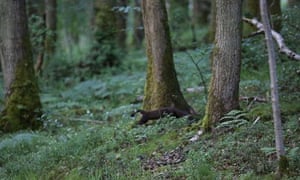
Showing posts with label pine marten. Show all posts

Friday, 13 December 2019

Northern Ireland's recovering pine marten population benefits red squirrels


DECEMBER 13, 2019


The recovery of pine marten in Ireland and Britain is reversing native red squirrel replacement by invasive grey squirrels, according to new research presented at the British Ecological Society's annual meeting in Belfast today.

Researchers at Queens University, Belfast and National Museums Northern Ireland have found red squirrels are responding positively to the increased presence of pine martens across Northern Ireland. So, where pine martens occur, it increases the chances of red squirrels occurring, simultaneously reducing the likelihood of grey squirrels being present.

Historically, persecution of pine marten and loss of their preferred habitat led to severe declines across Ireland and Britain. In Northern Ireland, small, remnant populations were all that remained, but today, the species is recovering, and this comeback may help ensure the long-term future of the red squirrel in Ireland.

Joshua Twining, who will be presenting the research at the conference, commented "the red squirrels 'positive response' is likely due to grey squirrel disappearance rather than red squirrels and pine martens working together." Pine martens eat both red and grey squirrels, though the key difference is that red squirrels have evolved alongside pine martens over millennia, making them able to coexist.

Twining said, "The ability of the pine marten to control the grey squirrel and help red squirrel recovery in Ireland and Britain is limited by three things; its ongoing recovery, the lack of forest cover on the island and the presence of urban areas. Twining and co-authors suggest that grey squirrels will persist in the latter as results show pine marten are forest specialists and avoid urban areas.

Although the red squirrel population is increasing in Northern Ireland, the researchers warn that "unless the issue of control within populated areas is addressed, we risk creating a situation where marten-savvy grey squirrels could recolonise the wider landscape in the future".

Thursday, 16 July 2015

Pine marten spotted in England for the first time in over 100 years

Elusive cat-sized member of the stoat and weasel family believed to be extinct may have been living in the Shropshire hills for years


Wednesday 15 July 2015 15.35 BSTLast modified on Thursday 16 July 201500.00 BST

This is the first confirmed sighting
 of a pine marten in England for a
 century. Photograph: Shropshire Wildlife Trust
The first conclusive sighting of a pine marten in England in over 100 years suggests that the elusive domestic cat-sized member of the stoat and weasel family may have been living in the Shropshire hills for years.

Amateur wildlife recorder Dave Pearce took two photographs of the dark brown creature thought to be extinct, in a wood in south west Shropshire last week. The photographic evidence has now been verified by Stuart Edmunds, chair of the Shropshire mammal group.

“The pictures proved conclusive. We matched the exact tree that the pine marten was passing with the pictures that were taken. We have now put out lots of camera trails [traps] to see if the animal or his family – lives in the area. There is a real possibility that they may have been living here right under our noses for a long time.

“There have been rumours of pine martens in England on and off for years. Most of these, on close enquiry, have proved to be domestic cats, mink and even black squirrels. A sighting in Staffordshire in 2007 was almost certainly an escapee from a nearby wildlife sanctuary,” said Edmunds.

Friday, 9 May 2014

Scots pine marten recovery spreads south

A new report has shown pine martens are starting to re-colonise the south of Scotland after being absent from most of the area for nearly 200 years.

The Scottish Natural Heritage (SNH) study, with The Vincent Wildlife Trust (VWT), found them in three areas.

The new sites are south and west of Glasgow, the Upper Tweed Valley and Annandale and Eskdalemuir.

VWT survey coordinator Lizzie Croose described the discovery of the rare animals as "significant".

Pine martens were once found throughout the UK, but suffered a dramatic decline in the 19th century due to woodland clearance, trapping for fur, and predator control by gamekeepers.

In the last half of the 20th century, however, populations recovered in Scotland and are now established in most areas north of the Central Belt, including the northern fringes of Glasgow and some other parts of the Central Belt.

Friday, 2 May 2014

Rare pine marten 'photo-bombs' red squirrel survey


Scientists behind a red squirrel monitoring project in County Fermanagh have been surprised after finding an even more elusive mammal has been 'photo-bombing' their research.

Pine martens have been spotted by cameras in the Fermanagh woodlands, more than red or grey squirrels.

The animal is considered to be Ireland's rarest native mammal.

The results have forced researchers to rethink and they will now include pine martens in the survey.

They are now recruiting volunteers to take the project forward and get a better picture of both the red squirrel and pine marten populations in Northern Ireland.

The Fermanagh Citizen Science Red Squirrel Project originally set up cameras in 70 woodlands across the county.

Tuesday, 26 November 2013

Nature Studies: Could we one day see pine martens in the woods of southern England?

The radical idea that we should bring back to Britain the large carnivores we long ago wiped out – lynx, wolf, even brown bear – is increasingly being discussed as part of the topic of “rewilding” the impoverished natural world of our country; and it is provoking a fair amount of heated debate. Just a fortnight ago, Paul Lister, the multimillionaire heir to the MFI furniture fortune, told The Independent that he wanted to bring back all three – yep, bears included – to his large private estate in the wilds of northern Scotland.

Wednesday, 30 October 2013

Plans to help the pine marten recover in southern Britain

Pine marten struggling to re-establish itself in England and Wales
October 2013. The Vincent Wildlife Trust (VWT), with support from statutory agencies and other conservation organisations has decided to carry out a new study to look at the feasibility of boosting pine marten numbers in England and Wales.
Pine martens are doing well in Scotland - recovering naturally from their Highland stronghold. In England and Wales, however, the picture is far from rosy and it now seems that pine marten numbers in England and Wales dipped too low during the last century for the population ever to recover naturally.

No recent evidence of breeding or natural recovery
Chairman of the VWT, Dr Tom Tew said: "With no recent evidence of breeding or natural recovery, reinforcement of the existing UK population could be the only way to restore a viable pine marten population in southern Britain. This would mean supplementing the current pine marten populations in England and Wales with animals from elsewhere".

Embarking on this new study is the culmination of more than 30 years of pine marten research and survey work carried out by the VWT: research that has given a clear picture of the causes of the pine marten's decline and the requirements for its survival. A data base of sightings collected over this period has allowed the Trust to identify pine marten ‘hot spots' in which to focus its efforts. However, despite the use of sophisticated detection equipment, such as remote cameras offering 24/7 surveillance opportunities and, more recently, advanced DNA techniques, there has only been a handful of unequivocal records in the last 20 years.


Continued

Friday, 19 April 2013

Pine marten showing signs of recovery in Scotland


Numbers increasing and range expanding
April 2013. One of Scotland's rarest carnivores is showing encouraging signs of recovery, a new report has highlighted. From Argyll to Aberdeenshire and Caithness to the central belt the pine marten is proving that rare mammals can recover their numbers, given the right conditions. And in the Year of Natural Scotland, it is a real success story for an animal which has vanished from much of England and Wales.

A joint survey by Scottish Natural Heritage (SNH) and The Vincent Wildlife Trust (VWT) shows the pine marten population has regained ground across much of Scotland. It is now re-colonising areas from which it has been absent for more than 100 years.

Pine martens are still absent from much of Britain
"At a time when some native mammals are declining it is fantastic to see the pine marten population is recovering and expanding its range in Scotland. Pine martens are still absent from much of Britain so the recovery in Scotland is significant," Lizzie Croose, VWT's survey coordinator, confirmed.

As in the rest of Britain, Scotland's pine marten population suffered a major decline as a result of historical persecution and woodland loss. By the early 20th century it was found only in the North West Highlands.

Pine marten in UK
The pine marten (Martes martes) was extinct throughout much of Britain by the early 20th century. Small populations survived in Wales and the Marches and in areas of northern England, but the most viable populations were still to be found only in North West Scotland.

This study has shown that the pine marten in Scotland is making a good recovery. South of the Scottish border the situation is very different, and the recovery taking place in Scotland has not yet occurred in those parts of England and Wales where a few pine martens survived. Until the road casualty found last year near Newtown, the last known carcass recorded in Wales was in 1971.

Making a comeback across much of its former Scottish range
The species was given full legal protection in 1988 and following the expansion of plantation forest cover during the last century, is making a comeback across much of its former Scottish range. Signs of this gradual recovery were first recorded in surveys in the 1980s and 1990s.

This latest survey was carried out last summer (2012) when surveyors collected possible pine marten scats (droppings) along survey areas on woodland tracks and paths. This was DNA-tested to confirm its origin. Records of marten presence were also collected from other sources, including Local Biological Record Centres and other wildlife organisations.

Saturday, 10 November 2012

Pine Marten found in Wales – the first in 40 years!

Sadly, the proof is a victim of the roadkill

November 2012. A road casualty pine marten has been found near Newtown in Powys - the first known carcass in Wales since 1971.

‘The significance of this find cannot be overstated,' said Natalie Buttriss, Chief Executive with The Vincent Wildlife Trust. ‘It adds to the body of evidence supporting the long-held view of mammal experts that this attractive tree-dwelling animal does exist in Wales, but in such low numbers that very few people ever see one.'

The carcass was found by local resident Olly Amy on the roadside close to the village of Aberhafesp near Newtown. Olly contacted The Vincent Wildlife Trust after correctly identifying it as a pine marten. DNA analysis carried out at Waterford Institute of Technology in Ireland has provided unequivocal evidence that this is a pine marten native to the British Isles. The animal was a young male.

300 reported sightings
In the last 20 years, The Vincent Wildlife Trust has received more than 300 credible reports of sightings of pine martens in Wales and has built up a map of ‘hot spot' areas. Until today, however, the most recent unequivocal evidence was a pine marten scat (dropping) found in Cwm Rheidol forest (Some 40-50 miles from the location of this animal) in 2007 and later positively DNA tested.


Continued: http://www.wildlifeextra.com/go/news/pine-marten-wales.html

Tuesday, 28 February 2012

Pine marten fear for capercaillie


Gamekeepers are warning capercaillie could be lost from Scotland for a second time, unless steps are taken to control pine marten numbers.
The pine marten is one of Scotland's rarest native mammal species but the capercaillie population is falling.
The Scottish Gamekeepers' Association believes pine martens are having a major impact on the iconic species.
RSPB Scotland says the SGA's position is "riddled with basic inaccuracies and sheer prejudice".
The capercaillie, a huge, woodland grouse, became extinct in Scotland around 1785 but was reintroduced, using birds from Sweden, just over 50 years later.
Important factor
There are fears that the capercaillie will once again become extinct in Scotland, although the reasons for the population decline are complex and often disputed.
Gamekeepers argue predation by pine martens is an important factor which has been ignored by scientists and conservation groups.
The SGA is calling on the government agency, Scottish Natural Heritage, to introduce licences to allow pine martens to be controlled.
That could involve trapping and relocation or culling.
A spokesman for the SGA said: "Predation levels across the board have risen and are now far too high for capercaillie numbers to get above the levels required to be safe.

Friday, 9 July 2010

Wildwood has mounted a "24 hour love patrol" to watch Britain's most dangerous & energetic lovers.

Conservationists and members of Wildwood's "24 hour Love Patrol" will wait with bated breath as a tunnel of love will bring together two pairs of pine martens.

The pine marten is a solitary and fiercely territorial creature and will often attack a potential mate. This behaviour is often made worse in captive situations, making the pine marten Britain's most dangerous lover.

Not only are pine martens Britain's most dangerous lovers but they are also its most energetic. These creatures mate 3 or 4 times a day for up to a staggering 2 hours at a time.

Efforts to breed them have been helped by the creation of a 'Tunnel of Love' allowing two of the Wildwood Trust's pine martens to start a romance, the barriers have been brought down over the past few days.

In an effort to mimic the ideal natural breeding environment the Kent-based wildlife charity have created the 'Tunnels of Love' which winds around both the female enclosures which was used last year for the third time. The system was a great success and two pine marten young were produced this year.

Wildwood's six pine martens each have to be kept in their own enclosure. They regard this as their territory and would defend it against intruding other pine martens of either sex. However, this summer two pairs of Wildwood's pine martens will be introduced to each other in the hope that they may breed in captivity.

Wildwood's Keepers are mounting a "24hr love patrol" to make sure the pine martens play fair and can separate them in an instant by the use of special sliding panels.

Leading the "24 Hour love patrol" is Wildwood Keeper, Karen Price:

"For the last week our male pine martens, have been investigating the tunnel. The females have has also been allowed to explore the tunnel, although not at the same time as the males!"

"We have learnt a lot over the past three years and this year we are keeping our fingers crossed that we will can repeat our success of last year with more pine marten young born at Wildwood."

The pine martens at Wildwood Trust are helping scientists to discover more about this secretive and endangered mammal in the forests of Ireland.

Our martens are testing out special tubes attached to tree branches, which will be baited with food and sticky tabs on which the martens leave their fur. DNA can be extracted from the hair follicles to help scientists at the Institute of Technology in Waterford to identify individual pine martens. Then they can estimate how many martens are using local forests, if there are differences in the areas of forest martens use and, if so, how to manage the rest of the forests to make them more hospitable for martens.

Pine Martens are just one of the huge range of British animals that can be seen at the Wildwood Discovery Park, for more information visit the website at www.wildwoodtrust.org or telephone 0871 7820087.

Wildwood's 'Wildlife Conservation Park' is an ideal day out for all the family where you can come 'nose to nose' with British Wildlife. Wildwood offers its members and visitors a truly inspirational way to learn about the natural history of Britain by actually seeing the wildlife that once lived here, like the wolf, beaver, red squirrel, wild boar and many more.

Wildwood is situated close to Canterbury, just off the A291 between Herne Bay and Canterbury.

PINE MARTEN BACKGROUND INFORMATION

Until about 1800, the pine marten was widespread throughout Britain, but today it is confined mainly to remote, forested areas in the north and west of Scotland, with a few small isolated populations surviving in north Wales and northern England. Its range reached a minimum at the beginning of the 20th century, as a result of habitat loss through deforestation and conversion of the land to agriculture, hunting for its fur and persecution for predation on game birds and chickens.

Since then, its range in Scotland has increased due to the expansion of commercial forestry plantations, and more recently, the regeneration of native woodlands. The pine marten prefers well-wooded areas with plenty of cover, but it lives in more open habitats as well. There is a captive breeding programme underway in Kent, and suggestions have been made for the pine marten to be reintroduced to parts of southern England.

CONSERVATION STATUS

The pine marten is listed as a protected species in Appendix III of the 1979 Bern Convention on the Conservation of European Wildlife and Natural Habitats. It is also included in Annex V of the European Community's Habitat and Species Directive of 1992, as a species 'of Community interest whose taking in the wild and exploitation may be subject to management measures'.

In the UK, the pine marten is protected under the Wildlife and Countryside Act of 1981, and it cannot be trapped, disturbed or sold without a specific licence from the relevant government conservation agency - in Scotland this is Scottish Natural Heritage. However, despite this legal protection, martens are still killed inadvertently each year by traps or poisoned bait set out for crows or foxes.

PHYSICAL CHARECTERISTICS

The pine marten adult is the size of a small domestic cat; it is slender with dense, chocolate-brown fur and a long bushy tail. It has a cream-coloured bib on the throat. The male measures on average 68 cm from nose to tip of tail. The female is slightly smaller. It is a member of the weasel family. In continental Europe another species, the beech or stone marten (Martes foina) is also found. In North America there are two species of the marten, the fisher (Martes pennanti) and the American marten (Martes American) which are very similar to the pine marten.

They move quickly along the ground, rarely emerging into open spaces. They are expert at climbing trees. They are mostly likely to be seen in the evening or at night, although they do come out during the daytime in summer months. They have an alert and timid presence.

Pine martens hunt in trees and on the ground. They like to roam in broad-leafed or conifer woodlands, and the destruction of these is a threat to the species. They find most of their food on the ground, and they hunt for small mammals, birds, insects, fungi, berries, birds' eggs and carrion (dead animals). Contrary to some opinions, they do not eat significant quantities of squirrels, red or grey. Pine martens avoid areas away from woodland or scrub, probably because other predators (especially foxes) can catch and kill them in the open.

Martens have territories that vary in size according to the availability of food. For males, the territory is about 10-25 square kilometers, and for females, about 5 - 15 kilometers. They are not aggressively territorial, some animals' territories overlapping those of others. Sometimes, however, they mark their trail with faeces ("scats"). Even in places where they are at their most numerous, pine martens are thin on the ground compared with other carnivores like foxes, stoats and badgers. They can be very playful and curious in their behaviour.

Pine martens breed only once a year. Mating takes place in July or August, but the female's pregnancy does not begin until January. (This delayed implantation also occurs in the badger.) A litter of about three babies is born in late March or April. At birth, the young are blind and covered in a coat of yellow-white hair which changes to grey, and then to brown as they mature. The babies spend at least six weeks in the den before they venture out, and the family stays together until they are six months old. They may live to 11 years old, but the normal lifespan is three to four years.

Monday, 21 June 2010

Carnivorous mammals track fruit abundance

Photo: Minette Layne
14-Jun-2010

The scientific community already knew that many carnivores eat fruit, but had thought this was something purely anecdotal. Now researchers from the University of Santiago de Compostela (USC) have shown that carnivorous animals such as foxes and martens play an important role in helping fruiting plants to reproduce and disperse their seeds.

Far from viewing the relationship between carnivorous mammals and plants as irrelevant, a team of researchers from the USC studied how foxes and (Vulpes vulpes) and the European pine marten (Martes martes) consumed the fruit of the rowan tree (Sorbus aucuparia) in the Cordillera Cantábrica mountain range, and found that both species were capable of tracking yearly differences in the abundance of rowan fruit in Cantabrian forests, and in addition showed a marked preference for the most productive trees.

"Carnivores are not indifferent to seasonal and spatial variations in the amount of fruit they can obtain from the rowan tree", Ignacio Munilla, co-author of the study and a researcher at the USC' Department of Botany, tells SINC.

The study, published in the journal Acta Oecologica, suggests that some of the ecological paradigms about seed dispersal developed in tropical environments should be reconsidered for temperate climates. Munilla says: "The rowan is important to carnivores and carnivores are important to the rowan".

The rowan appears at altitudes of over 1,000 metres in the mountains of the Cordillera Cantábrica, and is a pioneer species that colonises secondary scrub and "prepares the way towards mature forest".

"Given its abundance and wide distribution, the rowan is a very important resource in European forests, from the mountains of the south of the continent right up to Scandinavia", says José Guitián, another co-author of the report and a researcher at the Department of Cell Biology and Ecology of the USC.

However, the amount of fruit this tree produces varies widely from year to year. Periods without any fruit alternate with years of extremely abundant harvests with more than 50,000 fruits per tree. Despite these enormous year-on-year fluctuations, a study over an uninterrupted test series of 11 years into the significance of the rowan in the diet of the fox and marten compared with the environmental abundance of this resource showed that both factors – harvest and consumption – followed very similar patterns.

Monitoring of 20 trees

The same research team also carried out another study published in the same article, in which they monitored 20 rowan trees over 10 days and nights. They found that carnivores visited the 10 trees with the largest fruit production most often, picking up fallen fruit and helping to disperse the seeds.

"The probability of a tree being visited by a carnivore seemed to depend directly on the number of fruits that had fallen below it. The carnivores went off with a considerable proportion of the fallen fruit (much more than the amount destroyed by rodents during the same period)", says Guitián.

The carnivores also help the rowan to thrive by dispersing the seeds contained inside the fruits that fall from the tree.

According to the researchers, the rowan-fox-marten system could be important in mountain ecosystems on the Iberian Peninsula. In addition, the fruit falling under the mother plant may not necessarily represent a failure in terms of dispersal "since there could be a high likelihood of these seeds being mobilised by carnivores".

###

References:

Guitián, J.; Munilla, I. "Responses of mammal dispersers to fruit availability: Rowan (Sorbus aucuparia) and carnivores in mountain habitats of northern Spain". Acta Oecologica 36: 242-247, 2010. doi:10.1016/j.actao.2010.01.005

http://www.eurekalert.org/pub_releases/2010-06/f-sf-cmt061410.php
(Submitted by Chad Arment)

Saturday, 12 June 2010

Pine martens make comeback in UK after leading a secret life for decades

The pine marten, one of Britain's rarest and most elusive mammals, is back - and the reason is it never quite went away. A new report reveals pine martens are not confined to the fringes of the UK as was assumed, but that they have been living a secret life under our noses for decades.


Photograph: Natural England/PA

Pine martens are related to weasels and otters and are agile, inquisitive, and about the size of a small cat. With their deep chestnut fur and yellow bib they are one of Britain's prettiest mammals. They are also supreme forest predators and hunt voles, rabbits, squirrels, birds with a taste for honey, nuts, fruit and fungi.

The beautiful fur made their pelts valuable, and their killer instinct, particularly when it came to pheasants and partridges, made them enemies of gamekeepers. Pine martens were consequently persecuted to extinction in most parts of Britain but, even with full legal protection in 1988, only small enclaves hung on in remote parts of northern Scotland, Cumbria and north Wales. Or so it was thought.

The report from the Vincent Wildlife Trust, based on 12 years of research and sightings, reveals a surprise: pine martens are largely still present in the same parts of England and Wales from which they were recorded in the past. This includes areas such as Carmarthenshire, Montgomery, North York Moors and the Cheviots but also sightings in Cambridge, East Sussex and Northampton.

How did this 80cm-long nocturnal tree dweller pass unnoticed for so long? The report's author, pine marten expert Johnny Birks, told the Guardian: "Not everybody overlooked the pine martens. Some dedicated naturalists, who had been watching them for many years, kept hope burning that the species' presence would be recognised. The trouble is the authorities are used to cheap and easy survey methods which don't work on something as elusive and scarce as pine martens and the wrong perception has arisen that there were none left."

For the period 1996 to 2007, researchers analysed records, talked to people with convincing sightings, collected roadkill and used DNA testing on scat – pine marten poo – to slowly piece together the true picture.

The story also tells us how important the observations of amateur naturalists are, said Birks. "There are cultural changes towards instant results and fewer people dedicated to plugging away, building up their skills hoping to strike it lucky in pursuit of rare animals. These sorts of naturalists are as rare as the animals themselves."

The presence of pine martens in England and Wales is not thought to depend on escapes from zoos or reintroductions but it seems the tenacious little martens have been hanging on despite us. "They tell us about a species' resilience to tick over until conditions improve," said Birks. "With fewer killed and more woodland planned, there is hope and optimism the pine martens can keep going."

The "reappearance" of the pine marten is a further encouragement to create new woods and protect old ones, particularly old trees with breeding holes in them, said Birks, as well as championing greater connectivity between woodlands so pine martens can stay aloft and away from predatory foxes.

The new coalition government has pledged to launch a national tree planting campaign, with a target of a million trees. It is expected to begin in the autumn.

(submitted by Chad Arment)

Tuesday, 6 April 2010

Wildwood hosts Countryfile

RIGHT: John Craven and Peter Smith. Photo: Wildwood.
Countryfile have been filming (Tuesday 30th March 2010) at Wildwood, Kent's award winning woodland discovery park for a programme to be aired on Sunday 11th April 2010.

The programme being filmed was dealing with the disappearing species of the UK, and will feature a Wildwood hedgehog and pine marten.

John Craven came to the park especially to do the filming and Wildwood has featured a number of times on Countryfile.

Hugh Warwick who has written a book recently "A Prickly Affair - My life with Hedgehogs" was interviewed with a hedgehog, Tony Mitchell-Jones of Natural England was filmed with the pine martens all to illustrate the fact that many species are in danger of disappearing.

RIGHT: John Craven and hedgehog. Photo: Wildwood.
"Wildwood is a great resource for this type of filming" commented Peter Smith Chief Executive of Wildwood Trust "There are animals here that would take a film crew a long time to get good shots of and it gives us the opportunity to let people know about the work we do"

A huge range of British animals can be seen at the Wildwood Discovery Park , for more information visit the website at www.wildwoodtrust.org/ or telephone 01227 712111.

Wildwood is an ideal day out for all the family where you can come 'nose to nose' with British Wildlife. Wildwood offers its members and visitors a truly inspirational way to learn about the natural history of Britain by actually seeing the wildlife that once lived here, like the wolf, beaver, red squirrel, wild boar and many more.

Wildwood is situated close to Canterbury , just off the A291 between Herne Bay and Canterbury. For more information visit our website at www.wildwoodtrust.org or telephone 01227 712111.

Hedgehog Facts

The Hedgehog - Erinaceus europaeus

Recognition: Unmistakeable, the only spiny British mammal. Head/body length: 150-300mm, depending on age, tail about 10-20mm. Weight: Up to 2kg, heaviest in autumn.

General Ecology: The hedgehog is common in parks, gardens and farmland throughout mainland Britain and Ireland. It has also been introduced to many islands including Orkney, Shetland, Isle of Man and some of the Channel Islands. Hedgehogs prefer woodland edges, hedgerows and suburban habitats where there is plenty of food for them. Intensively farmed arable land is probably a poor habitat, as are moorlands and dense conifer forests. They eat beetles, worms, caterpillars, slugs and almost anything they can catch, though little plant material. They will take eggs and chicks of ground-nesting birds though rarely in large numbers and far fewer than foxes or crows.

Females have litters of 4-5 young (sometimes more), between April and September. Males do not assist in rearing them. Young born late often die, being too small to survive hibernation. They need to weigh at least 450g (1lb.) or they are not fat enough to last the winter. Hibernation usually begins about November and ends around Easter, but is much affected by the weather. Hedgehogs normally wake up several times over winter and often build a new nest. In the spring they commonly spend a few days active then enter hibernation again during a cold snap. The winter nest ("hibernaculum") is made of leaves, tucked under a bush or log pile or garden shed, anywhere that offers support and protection.

Hedgehogs travel about 1-2km each night, males more than females. They return to the same daytime nest for a few days then use another, perhaps returning to an old nest at a later date. Hedgehogs live for up to 10 years, but this is exceptional; over half die before their first birthday and average life expectancy is about 2-3 years. Hedgehogs carry several diseases, but none that are dangerous to humans. They carry a specific flea, which they sometimes pass to dogs, but do not carry the usual cat and dog fleas, which bite humans.

Conservation: Hedgehogs are partially protected under the Wildlife & Countryside Act and may not be trapped without a licence from Natural England, the Countryside Council for Wales or Scottish Natural Heritage.

The biggest threat to hedgehogs is probably habitat loss, with the change from pastoral farming to arable crops, over the last 30 years. The use of chemicals in gardens and for intensive farming kills the creatures hedgehogs need for food and may also poison them directly. Many are also killed on the roads. Hedgehogs may become locally scarce or even disappear, but nationwide extinction is unlikely. Nevertheless, hedgehogs appear to be in decline. The total population is unknown.

Hedgehogs survive well in gardens, particularly assisted by food put out for them. This should be encouraged because modern tidy gardens may not otherwise provide sufficient food. Gardens are also hazardous. Strimmers (cutters with a rotating strip of cord) cut back rank vegetation in the very places hedgehogs lie up during the day, causing serious wounds to the sleeping animals. Hedgehogs hibernate under garden bonfire heaps. These should always be turned over before being burnt. Hedgehogs swim well but easily drown in smooth-sided garden ponds, being unable to escape from them. Ponds (and swimming pools) should have a piece of chicken wire dangling into the water to help the animals climb out. Garden netting is also dangerous unless staked down tightly to avoid hedgehogs becoming entangled.

Pine Marten Facts

The Pine Marten - Martes martes

RIGHT: Pine Marten. Photo: James Killick.
Recognition: Dark brown fur; yellow/white throat patch; long fluffy tail; about the size of a small cat. Head/body length: males 51-54cm; females 46-54cm; Tail length: males 26-27cm; females 18-24cm. Weight: males 1.5-2.2kg; females 0.9-1.5kg.

General Ecology: Pine martens are found in the Scottish Highlands and Grampian, with isolated populations in southern Scotland. In England and North Wales pine martens seem to be on the verge of extinction although there may still be isolated individuals present in Northumberland and North Yorkshire. Pine martens are widespread and relatively common in Ireland, where they have recovered well from presecution.

Although they occur in a wide range of habitats, pine martens prefer well-wooded areas with plenty of cover. Marten dens are commonly found in hollow trees or the fallen root masses of Scots pines, an association that probably earned pine martens their name; cairns and cliffs covered with scrub are frequently used as alternative den sites.

Martens have a very varied diet, which changes with the seasonal availability of different foods. Small rodents are a very important food, but birds, beetles, carrion, eggs and fungi are also eaten. In autumn, berries are a staple part of the diet. Martens mostly hunt on the ground, although they are superb climbers and can climb with great agility.

Martens have territories that vary in size according to habitat and food availability. For males these are about 10-25 square kilometres and for females about 5-15 square kilometres. Martens mark their territories with faeces (known as scats) deposited in places where they are conspicuous to other martens; they are frequently left along forestry trails.

Young martens are born blind and hairless, in litters of 1-5, in early spring and stay with their mothers for about six weeks. Their eyes open at the end of May and by mid-June they begin to emerge from their den. Male martens play no direct part in rearing the young. Pine martens have lived up to 17 years in captivity, but in the wild most probably die before they are eight years old.

Conservation: Martens and their dens are fully protected by the Wildlife and Countryside Act (1981); martens must not be trapped, sold or disturbed except under licence from Scottish Natural Heritage, the Countryside Council for Wales or Natural England. Despite this legal protection, poisoned baits and traps, often set for hooded crows and foxes, still probably account for many marten deaths each year. Others are also shot at hen houses, and some are killed when mistaken for mink.

Until the 19th Century, pine martens were found throughout much of mainland Britain, the Isle of Wight and some of the Scottish islands. Habitat fragmentation, persecution by gamekeepers and martens being killed for their fur, drastically reduced this distribution. By 1926, the main pine marten population in Britain was restricted to a small area of north-west Scotland, with small numbers in N Wales and the Lake District. Martens have now increased their range in Scotland, and now occur throughout the Highlands, N of the Central Belt. A small population introduced to Galloway in the 1980s also seems to be spreading. slowly. It is not known whether their populations in England and Wales are expanding, or even if they still exist. The pine marten remains one of the rarest native mammals in Great Britain, with a total population of around 3-4,000, but Ireland probably also has as many.

Prime habitats for pine martens seem to be well wooded areas, with high densities of voles that are their principal prey. Female pine martens with young are extremely sensitive to human disturbance, which can cause a female to move her young from a den or even eat them. Foxes also seem to be a threat to young martens, and dens or scree have the advantage of being safe from them.

Increased forestry and enlightened estate management are likely to help pine martens recolonise their former haunts in the future. In areas where pine martens currently occur, practical management methods may also assist survival. Important measures that can be taken are planting connections between suitable habitats to prevent further fragmentation; creation and maintenance of cover particularly along streams, to provide travel routes and shelter and management of habitats for voles and other food items.

Reintroductions of martens to England have been suggested but a greater understanding of martens is needed before these should be attempted. More detailed studies of the distribution and numbers of the populations in northern England and Wales and the reasons for their apparent recent decline are required.

Saturday, 27 June 2009

Baby pine martens back together again

Animals thriving after falling from nest at Banff a month apart

TWO baby pine martens who were separated after they fell from the same nest in the north-east have been reunited.

Staff at the Scottish SPCA wildlife rescue centre at Fife have named the female Aspen and her brother Ash.

Aspen tumbled out of their nest in a chimney top at Banff at the end of May and Ash suffered the same fate a month later.

Ash was originally taken to an SPCA rescue centre at New Deer but was later transferred to the Fife centre.

Centre manager Colin Seddon said: “We have reunited the pair and they have been getting on very well together.

“We were fairly confident about putting them together, given that they are brother and sister, but occasionally when you introduce one animal to another, there can be a bit of a stand-off.”

The two animals are being kept in a small enclosure at the moment but centre staff are preparing to move them to an outdoor space where they will have more room to move around and climb.

Mr Seddon said: “Once they are fully developed, we will find a suitable location to release them back to their natural native habitat.”

By John Thomson

Monday, 8 June 2009

Pine Marten Kits at Wildwood

Photo: Martyn Nicholls

Wildwood is celebrating this week the announcement that the park has successfully bred pine martens in captivity for the first time.

Wildwood Kent's award winning woodland discovery park has been trying to breed these threatened creatures for over three years and at last has been successful where many other collections have failed.

Pandora the proud mum produced two youngsters, but initially the keepers only had the evidence of unusual noises and more food being eaten.

A few weeks ago the kits were seen poking their heads out and have since then been seen regularly by both keepers and some visitors.

Pine martens are a very difficult species to keep in captivity, never mind to breed, so the park is justifiably proud of this achievement.

Photo: Cali Bebbington

"The breeding centre has proved to be a real success" commented Paul Wirdnam Head Keeper at Wildwood "The team here has created a series of tunnels that allow us to manage the pine martens and copy wild behaviour and this is one of the reasons we now have these youngsters".

Until the 19th Century, pine martens were found throughout much of mainland Britain, the Isle of Wight and some of the Scottish islands. Habitat fragmentation, persecution by gamekeepers and martens being killed for their fur, drastically reduced this distribution. By 1926, the main pine marten population in Britain was restricted to a small area of north-west Scotland. Martens are now increasing their range in Scotland, but it is not known whether their populations in England and Wales are expanding, or even if they still exist.

"These new babies will be part of a scheme to reintroduce pine martens to the South east of England" commeted Peter Smith, Chief Executive of Wildwood "W e a committed to restoring the pine marten to its former homes across the UK . Pine martens lived throughout the UK until they where trapped, poisoned and shot by gamekeepers in the 19th and 20th century."

Photo: Martyn Nicholls

Pine Martens are just some of the huge range of British animals that can be seen at the Wildwood Discovery Park near Canterbury. For more information visit our website at http://www.wildwoodtrust.org/ or telephone 0871 7820081.

Wildwood's 'Wildlife Conservation Park' is an ideal day out for all the family where you can come 'nose to nose' with British Wildlife. Wildwood offers its members and visitors a truly inspirational way to learn about the natural history of Britain by actually seeing the wildlife that once lived here, like the wolf, beaver, red squirrel, wild boar and many more.

Wildwood is situated close to Canterbury, just off the A291 between Herne Bay and Canterbury.

The Pine Marten Martes martes

Recognition:
Dark brown fur; yellow/white throat patch; long fluffy tail.
Head/body length: males 51-54cm; females 46-54cm;
Tail length: males 26-27cm; females 18-24cm.
Weight: males 1.5-2.2kg; females 0.9-1.5kg.

General Ecology:
Pine martens are found in the Scottish Highlands and Grampian, with isolated populations in southern Scotland. In England and North Wales pine martens are probably on the verge of extinction although there may still be isolated individuals present in Northumberland and North Yorkshire.

Although they occur in a wide range of habitats, pine martens prefer well-wooded areas with plenty of cover. Marten dens are commonly found in hollow trees or the fallen root masses of Scots pines, an association that probably earned pine martens their name; cairns and cliffs covered with scrub are frequently used as alternative den sites.

Martens have a very varied diet, which changes with the seasonal availability of different foods. Small rodents are a very important food, but birds, beetles, carrion, eggs and fungi are also eaten. In autumn, berries are a staple part of the diet. Martens mostly hunt on the ground, although they are superb climbers and can climb with great agility.

Martens have territories that vary in size according to habitat and food availability. For males these are about 10-25 square kilometres and for females about 5-15 square kilometres. Martens mark their territories with faeces (known as scats) deposited in places where they are conspicuous to other martens; they are frequently left along forestry trails.

Young martens are born blind and hairless, in litters of 1-5, in early spring and stay with their mothers for about six weeks. Their eyes open at the end of May and by mid-June they begin to emerge from their den. Male martens play no direct part in rearing the young. Pine martens have lived up to 17 years in captivity, but in the wild most probably die before they are eight years old.

Conservation:
Martens and their dens are fully protected by the Wildlife and Countryside Act (1981) and must not be trapped, sold or disturbed except under licence from Scottish Natural Heritage, the Countryside Council for Wales or English Nature. Despite this legal protection, poisoned baits and traps, often set for hooded crows and foxes, still probably account for many marten deaths each year. Others are also shot at hen houses, and some are killed when mistaken for mink.

Until the 19th Century, pine martens were found throughout much of mainland Britain, the Isle of Wight and some of the Scottish islands. Habitat fragmentation, persecution by gamekeepers and martens being killed for their fur, drastically reduced this distribution. By 1926, the main pine marten population in Britain was restricted to a small area of north-west Scotland. Martens are now increasing their range in Scotland, but it is not known whether their populations in England and Wales are expanding, or even if they still exist.

Prime habitats for pine martens seem to be well wooded areas, with high densities of voles that are their principal prey. Female pine martens with young are extremely sensitive to human disturbance, which can cause a female to move her young from a den or even eat them.

Increased forestry and enlightened estate management are likely to help pine martens recolonise their former haunts in the future. In areas where pine martens currently occur, practical management methods may also assist survival. Important measures that can be taken are planting connections between suitable habitats to prevent further fragmentation; creation and maintenance of cover particularly along streams, to provide travel routes and shelter and management of habitats for voles and other food items.

Related Posts with Thumbnails

ShareThis