Showing posts with label frilled shark. Show all posts

Wednesday, 15 November 2017

Dinosaur-Age Shark with 300 'Frilled' Teeth Caught in Deep Sea


By Laura Geggel, Senior Writer | November 13, 2017 02:28pm ET

Forget about the minuscule odds of spotting Ahab's white whale: Sightings of the frilled shark, a so-called "living fossil" that has elusively swum around Earth's deep waters since the age of the dinosaurs, may been an even rarer find.
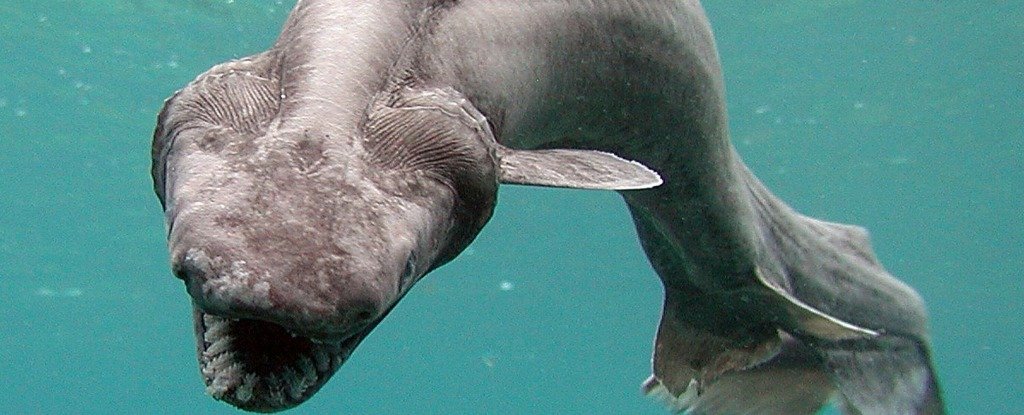
Add (Awashima Marine Park)caption

Deep-sea fishermen recently spotted the snake-like shark (Chlamydoselachus anguineus) in a pile of fish that unintentionally caught, known as bycatch, while they were fishing off the coast of Portugal. The shark died, but the fishermen handed it over to a research vessel, where scientists could study it, according to Boy Genius Report (BGR), a news site.

The examination gave scientists a close-up look at the shark's roughly 300 three-pointed teeth, which it uses to grab and kill prey, including fish, squid and other sharks.

Margarida Castro, a fishery science researcher at the University of the Algarve, in Portugal, told Sic Noticias, a Portuguese news outlet, said that these strange teeth, arranged in a frill-like pattern, inspired the shark's name. The teeth look like backward needles, and its jaw can snatch prey more than half its size.

#Portugal—rare #FrilledShark (Chlamydoselachus anguineus) netted at depth of 700m (2.3k ft)—1.5m (5 ft) snake-like #sharkw/300 teeth—“living fossil” from 80 million years ago http://www.bbc.com/news/blogs-news-from-elsewhere-41928537 …

The roughly 5-foot-long (1.5 meters) shark has barely changed in the past 80 million years, earning it a "living fossil" title. The fishermen reported catching the C. anguineus at 2,300 feet (700 m) under water — about half as deep as it can swim, as the species is known to range from about 65 feet to 4,900 feet (20 to 1,500 m) underwater, according to the International Union for Conservation of Nature (IUCN).


Monday, 2 February 2015

“Horrific” pre-historic shark makes a rare appearance in Australia

January 30, 2015

John Hopton for redOrbit.com – Your Universe Online

A fishing crew in Australia had a surprise guest in their catch recently, after snaring a rarely seen shark with 300 teeth and a terrifying, pre-historic appearance that was enough to make even Australian fisherman go all sissy. 

The 6-foot long frilled shark more closely resembles a crazed eel, but has the tail of a shark. Referred to as a ‘living fossil,’ Its ancestry goes back at least 80 million years. With 300 teeth in dozens of rows its diet consists of creatures more half its size, including squid and octopus.

Although the shark is known to science, they are very hard to find, even if we wanted to. Simon Boag from Australia’s South East Trawl Fishing Association said it was the first time in living memory that anyone had laid eyes on one. “We couldn’t find a fisherman who had ever seen one before,” he told ABC News.

Fuel for nightmares
Looking about as angry as you would expect for something that had pretty much been left alone for 80 million years and suddenly dragged onto a fishing boat, the frilled shark struck fear into the hearts of the fisherman who had mistakenly dragged it up.

Skipper David Guillot told Australian Fairfax radio that: “The head on it was like something out of a horror movie. It was quite horrific looking. … It was quite scary actually.”


Thursday, 22 January 2015

Frilled shark: Australian fishermen capture terrifying shark from the deep

Local fishermen were left scratching their heads at the sight of the two metre long creature

A rare and terrifying frilled shark has been pulled from the water by fishermen near Lakes Entrance in Victoria, Australia.

Also known as the "living fossil", the frilled shark is named for its six pairs of frill-like gills. The shark’s origin dates back 80 million years, and is one of two species that is still alive from this period.

South East Trawl Fishing Association (SETFA) chief executive Simon Boag told ABC that this is the first sighting of the species alive by humans.

Monday, 17 June 2013

Fishing ban proposed near Rockall after rare scientific finds

Fishing is expected to be banned near the Atlantic islet of Rockall after a rare methane gas vent in the seabed and two new shellfish species were discovered by British scientists.

The methane, which leaks through a so-called "cold seep" vent in the ocean floor, was found last year by scientists working with the government agency Marine Scotland. It is the first of its kind to be found near UK waters and only the third in the north-east Atlantic.

It was detected after Marine Scotland's Scotia survey ship trawled up two new species of deep-water clam that have a "chemosynthetic" relationship with the methane: the clams' food source is a bacteria that harvests the gas. That implies there may be a complex ecosystem around the mouth of the vent.

Francis Neat, the Marine Scotland scientist who oversaw the survey, said the site roughly four miles west of Rockall island was comparable to the complex habitats that build up around often exceptionally hot mineral-rich hydrothermal vents found on mid-ocean ridges.

The clams were "packed full" of polychaete worms that are also expected to be new to science, he said.

The International Convention on the Exploration of the Seas, an intergovernmental agency which polices fish stocks in the North Atlantic, has now recommended a fishing ban for the site (pdf), which is international waters, to protect it from highly damaging bottom trawling.

It has also requested additional fishing bans – adding to several already in place - at three other sites around Rockall to protect rare cold-water coral, sea sponge colonies, and sea fans or gorgonians which are being harmed by bottom-trawling.

The agency's surveys around Rockall also caught a frilled shark, an ancient "living fossil" species of shark that dates back at least 90m years and is rarely seen in northern waters. They found unusually large adult cod – known as "buffaloes" by fishermen, and large ling, saithe and haddock, suggesting Rockall's waters were very rich in food.

Two large areas around Rockall, the remote islet 230 miles west of the Outer Hebrides that adventurer Nick Hancock unsuccessfully tried to occupy this month, are already closed to fishing.


Related Posts with Thumbnails

ShareThis