Showing posts with label brown bears. Show all posts

Thursday, 19 April 2018

Potential explanation for declines in brown bear populations


Date:  April 5, 2018
Source:  Wiley

Animals may fall into what are called evolutionary and ecological traps when they make poor decisions using seemingly reliable environmental cues. For example, animals may select habitats to occupy based on food availability, but mortality may be highest in habitats with the highest food availability. A new Mammal Review article examines how the brown (grizzly) bear can fall into such traps in human-modified landscapes, which may contribute to decreases in brown bear populations.


Monday, 12 March 2018

Scientists use forensic technology to genetically document infanticide in brown bears


Modern open-source software helped the researchers identify the male that killed a female and her two cubs

Date:  February 27, 2018
Source:  Pensoft Publishers

Summary:
Scientists used a technology designed for human forensics, to provide the first genetically documented observation of infanticide in brown bears, following the murder of a female and her cubs in Italy, where a small population has been genetically monitored for already 20 years. Despite being a common reproductive strategy in social mammals, infanticide could threaten the long-term conservation of fragile populations and even species.


Friday, 28 April 2017

Brown bears found to leave scent signals by twisting feet into the ground

April 28, 2017 by Bob Yirka

(Phys.org)—A team of researchers from Poland, Spain and Austria has discovered that brown bears living in Poland have glands in their paws that produce chemicals that the bears use to communicate with other bears. In their paper published in Scientific Reports, the team describes their study of multiple bears in the wild and what they observed.

As the researchers note, many animals both on land and in the sea use chemical signaling as a way to communicate with one another. Such chemicals when dispersed into the environment can be used by others of the same species to learn about the animal that left them by simply sniffing them.

Prior research has shown that brown bears are typically loners who establish large territories. Such a lifestyle would seem to suggest the need for long range communications—to let other bears know of territory borders, occupant age, gender, etc. Also, there would be a need for females to signal males when they are ready for mating. To learn more about possible chemical signaling in brown bears, the researchers began by examining skin samples from two bears—one in the wild and one from a zoo. They found that the bears had glands in their feet that secreted chemicals that could be released when the feet were twisted on the ground. Upon examining the secreted chemicals, the researchers found 20 compounds suitable for use in communicating information such as gender, readiness for mating, etc.

To better understand how the bears might use chemical signaling, the researchers watched and filmed wild bears living in the mountains of southern Poland from 2014 to 2016. They also filmed bears living in the mountains in Spain over the course of a three-year period.

In looking at the film the researchers report that they observed bears intentionally twisting their feet on the ground as they walked in certain instances—a move that would likely release the secreted chemicals to the ground. They also found that many of the bears would retrace steps they had taken before, carefully placing their feet into the prints they had left behind—perhaps updating their profile. In some cases, multiple twistings over time had led to bare patches of ground that presumably would serve as listening posts for other bears who happened upon them. They also report that males appeared to engage in feet twisting more than females.

Read more at:

Sunday, 19 February 2017

Wolfing it down: Brown bears reduce wolf kill rates says usu ecologist


Contrary to popular assumptions, researchers on two continents find wolves kill less often in the presence of brown bears

Date: February 8, 2017
Source: Utah State University

If you've ever been elbowed out of the way at the dinner table by older, stronger siblings, you'll identify with wolves competing with larger bears for food. A study by Utah State University ecologist Aimee Tallian and colleagues reveals wolves might be at more of a disadvantage than previously thought.

Tallian is lead author of a paper examining competition between wolves and brown bears on two continents published Feb. 8, 2017, in Proceedings of the Royal Society B [DOI: 10.1098/rspb.2016.2368].

"Wolves and brown bears coexist across most of their range," says Tallian, who completed a doctoral degree from USU in 2017. "Although competition between predators such as these is widespread in nature, we know little about how brown bears affect wolf predation."

With colleagues in Scandinavia and North America, Tallian examined how brown bears affected wolf kill rates at study sites in northern Europe and Yellowstone National Park.

"We found an unexpected pattern," she says. "Wolves killed less often in the presence of brown bears, which is contrary to the common assumption that wolves kill prey more often to compensate for loss of food to bears."

Tallian says the consistency in results between the systems on different continents suggests brown bear presence actually reduces wolf kill rate, but the researchers aren't sure why.

They surmise wolves, unlike lynx and mountain lion, may not be quickly abandoning their kills, as bears move in take advantage of the spoils.

"The wolves may be hanging around longer, waiting their turn to gain access to food," Tallian says.

She and her colleagues also wonder if wolves kill less frequently because it takes them longer to find prey.

"We think this may be the case, in the spring, when newborn ungulates make easy pickings for bears," Tallian says. "It may simply take more time for wolves to find calves, when there are fewer of them."


Wednesday, 12 October 2016

Romania bans trophy hunting of brown bears, wolves, lynx and wild cats


Unexpected move reverses a trend that has seen increasing numbers of large carnivores shot by hunters each year since Romania’s accession to the European Union
 
Wednesday 5 October 2016 16.08 BST Last modified on Thursday 6 October 2016 10.14 BST

Romania has banned all trophy hunting of brown bears, wolves, lynx and wild cats in a surprise decision that gives Europe’s largest population of large carnivores a reprieve from its most severe and immediate threat.

The move on Tuesday reverses a trend which has seen the number of large carnivores being shot by hunters grow year on year since Romania’s accession into the European Union in 2007. In 2016, the largest hunting quotas yet gave hunters the mandate to shoot 550 bears, 600 wolves and 500 big cats over 12 months. 

Over the last decade, hunting has grown into a multimillion-euro industry in Romania, with hunters from all over the world paying up to €10,000 (£8,800) to claim a ‘trophy’ – hunting parlance for the carcass of a hunted animal – from the Carpathian mountains. 

The government has claimed that in order to exist, the industry relies on a loophole in European law which allows for the culling of wild animals that have been proven to be a danger to humans. Under the habitats directive, all large carnivores are protected in European Union member states, yet the state can order the killing of specific animals if shown to have attacked a person or damaged private property.

“Hunting for money was already illegal, but it was given a green light anyway,” environment minster, Cristiana Pasca-Palmer, told the Guardian. ‘The damages [clause in the habitats directive] acted as a cover for trophy hunting.”

Tuesday, 26 November 2013

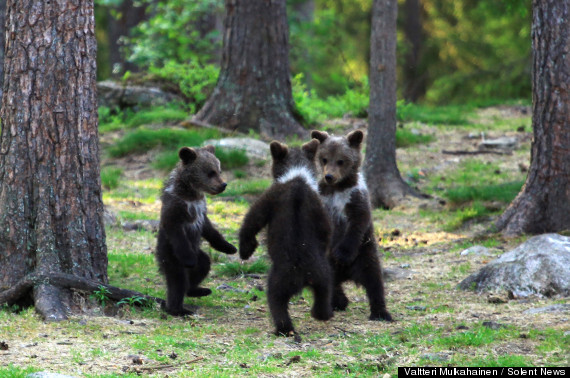
Bear Cubs Play 'Ring Around The Rosie,' And We All Fall Down From Cuteness Overload (PHOTOS)

bears2This family of baby brown bears is making our wildest fairytale dreams come true. Just look. These three siblings -- two little guys and their sister -- were photographed playing a game of "Ring Around The Rosie."

Valtteri Mulkahainen, a 52-year-old PE teacher, spotted the bears while traveling in Finland, according to Solent News. He watched the cubs hold each others' hands and dance around in a circle, while Mama bear chaperoned from just a few feet away.

Friday, 27 September 2013

European law could be unbearable for Croatia's brown bears

Croatia joined the European Union on 1 July and conservation scientists fear that EU rules could cause problems for its brown bear population.

The country has been managing its brown bears as game animals, meaning they can be hunted; but under EU legislation, bears are a protected species and can only be shot if they are deemed to be problem animals.

This might seem to be a positive outcome for the bears. However, it could lead to reduced tolerance for bears among local people, because the local economy will lose valuable revenue from hunting, according to a study by researchers from Imperial College London and Zagreb University. They argue that a system involving hunting ensures local support for bears in Croatia, which is vital in ensuring the animals’ long-term survival. It was a lack of local support for large carnivores, such as wolves and bears, that led to these animals disappearing from much of Europe in previous centuries. 

Under the Croatian hunting system, 10 to 15 per cent of the total bear population can be killed each year, and individual hunting organisations receive the right to hunt a portion of this quota. These organisations sell the rights to shoot bears for trophies to hunters, which enables them to provide employment to local people, and to compensate farmers quickly for any bear damage. Under this system, the local economy has benefited and the bear population has remained stable.

Sunday, 19 May 2013

The bears who like to get high: Russian animals are so addicted to aviation fuel they sniff it until they pass out


· Photographer Igor Shpilenok spent seven months observing the bears 

· The brown bears live at the Kronotsky Nature Reserve in Russia's far east 


PUBLISHED: 14:46, 17 March 2013 | UPDATED: 07:59, 18 March 2013 

These brown bears are keen to play with discarded barrels - because they have developed a nose for aviation fuel. 

The creatures sniff kerosene and gasoline from containers left in the Kronotsky Nature Reserve in the far east of Russia. 

They take deep breaths for minutes at a time before digging a shallow hole and lying in a 'nirvana' position. 

The fuel is used to power generators and helicopters used by nature reserve workers. 

Photographer Igor Shpilenok, 52, spent seven months with the community of bears. 

He said some of the addicted predators even stalked helicopters, waiting for take off and drops of fuel to leak onto the hard soil for them to hoover up. 

He added: 'In another case a helicopter brought a few barrels of gasoline. 

Tuesday, 26 March 2013

DNA study clarifies how Polar bears and brown bears are related


"In retrospect, I think we were wrong about the directionality of the gene flow between polar bears and Irish brown bears," she said.

March 2013. At the end of the last ice age, a population of polar bears was stranded by the receding ice on a few islands in south-eastern Alaska. Male brown bears swam across to the islands from the Alaskan mainland and mated with female polar bears, eventually transforming the polar bear population into brown bears.

Evidence for this surprising scenario emerged from a new genetic study of polar bears and brown bears led by researchers at the University of California, Santa Cruz. The findings, published March 14 in PLOS Genetics, upend prevailing ideas about the evolutionary history of the two species, which are closely related and known to produce fertile hybrids.
Limited hybridisation

Previous studies suggested that past hybridization had resulted in all polar bears having genes that came from brown bears. But the new study indicates that episodes of gene flow between the two species occurred only in isolated populations and did not affect the larger polar bear population, which remains free of brown bear genes.

At the centre of the confusion is a population of brown bears that live on Alaska's Admiralty, Baranof and Chicagof Islands, known as the ABC Islands. These bears--clearly brown bears in appearance and behaviour--have striking genetic similarities to polar bears.

"This population of brown bears stood out as being really weird genetically, and there's been a long controversy about their relationship to polar bears. We can now explain it, and instead of the convoluted history some have proposed, it's a very simple story," said co-author Beth Shapiro, associate professor of ecology and evolutionary biology at UC Santa Cruz.

Shapiro and her colleagues analysed genome-wide DNA sequence data from seven polar bears, an ABC Islands brown bear, a mainland Alaskan brown bear, and a black bear. The study also included genetic data from other bears that was recently published by other researchers. Shapiro's team found that polar bears are a remarkably homogeneous species with no evidence of brown bear ancestry, whereas the ABC Islands brown bears show clear evidence of polar bear ancestry.


Related Posts with Thumbnails

ShareThis