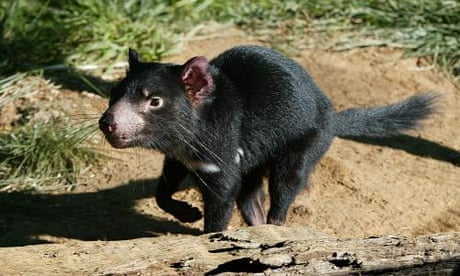
Showing posts with label facial tumours. Show all posts

Wednesday, 17 April 2019

Tasmanian devils 'adapting to coexist with cancer'


By Beth Timmins BBC News
30 March 2019
There's fresh hope for the survival of endangered Tasmanian devils after large numbers were killed off by facial tumours.
The world's largest carnivorous marsupials have been battling Devil Facial Tumour Disease (DFTD) for over 20 years.
But researchers have found the animals' immune system to be modifying to combat the assault.
And according to an international team of scientists from Australia, UK, US and France, the future for the devils is now looking brighter.
"In the past, we were managing devil populations to avoid extinction. Now, we are progressively moving to an adaptive management strategy, enhancing those selective adaptations for the evolution of devil/DFTD coexistence," explains Dr Rodrigo Hamede, from the University of Tasmania.
First discovered in north-eastern Tasmania in 1996, the disease has since spread across 95% of the species' range, with local population losses of over 90%.
Dr Hamede's team has been collecting epidemiological evidence over the past 10 years. The group has plotted scenarios based on current infection rates in the wild, and in their forecast for the next 100 years, 57% of scenarios see DFTD fading out and 22% predict coexistence.


Friday, 13 April 2018

Human drugs could help treat transmissible cancers in Tasmanian devils


April 9, 2018, University of Cambridge

Transmissible cancers are incredibly rare in nature, yet have arisen in Tasmanian devils on at least two separate occasions. New research from the University of Cambridge identifies key anti-cancer drugs which could be trialled as a treatment for these diseases, which are threatening Tasmanian devils with extinction.

The research also found that the two Tasmanian devil transmissible cancers are very similar to each other, and likely both arose due to susceptibilities inherent to the devils themselves.

Tasmanian devils are marsupial carnivores endemic to the Australian island of Tasmania. The species is considered endangered due to devil facial tumour 1 (DFT1), a cancer that is passed between animals through the transfer of living cancer cells when the animals bite each other. DFT1 causes grotesque and disfiguring facial tumours, which usually kill affected individuals.

The DFT1 cancer first arose in a single individual devil several decades ago, but rather than dying together with this devil, the cancer survived by 'metastasising' into different devils. Therefore, the DNA of the devils' tumour cells is not their own DNA, but rather belongs to the individual devil that first gave rise to DFT1 all those years ago. Remarkably, DFT1 cells can escape the devils' immune systems despite being in essence a foreign body.

The DFT1 cancer was first observed in north-east Tasmania in 1996, but has subsequently spread widely throughout the island, causing significant declines in devil populations.

Thursday, 3 September 2015

Tasmanian devils thrown a lifeline by facial tumour that threatens them

Researchers say deadly tumour that has wiped out 80% of the marsupials will evolve to ensure its survival – and devils will do the same


Thursday 3 September 2015 05.55 BSTLast modified on Thursday 3 September 201506.42 BST

The deadly facial tumour disease that has killed large numbers of Tasmanian devils is evolving to increase infection rates but is unlikely to wipe out the species completely, according to new research.

A study of devils in north-western Tasmania by Australian and British scientists found that the facial tumour disease has been evolving to allow the devils to live for longer, thereby increasing the spread of the infection.

The facial tumours are spread by contact between devils, which often fight and clash heads when competing over food. The disease, first identified in 1996, is estimated to have wiped out 80% of the of the feisty marsupial’s population, based on sightings of the animal in Tasmania.

However, the findings of a 10-year project by the University of Tasmania, University of Cambridge and the Tasmanian government found that this evolution in the tumours meant that the threat of extinction was dwindling.

“The tumour is subject to changes – for its own benefit rather than the devil’s benefit,” said Dr Rodrigo Hamede, of the University of Tasmania’s school of biological sciences. “The tumour is a living organism and wants to do whatever is best for it.

“The tumour used to allow devils to survive longer and the population to sustain itself. Then the diploid strain arrived and out-competed the more benign tumour strain, and has caused a severe population decline.

“The diploid tumour at this site is the older and most common tumour type which is spread over most of Tasmania.”

Wednesday, 19 November 2014

Tasmanian Devil Facial Tumor is a Transmissible Cancer

By Greg Woods, University of Tasmania | November 18, 2014 05:54pm ET

This article was originally published on The Conversation. The publication contributed this article to Live Science's Expert Voices: Op-Ed & Insights.

On Monday this week The Conversation published a story under the headline “What’s killing Tassie devils if it isn’t contagious cancer?” The article suggested evidence that the Tasmanian devil facial tumor disease (DFTD) is a transmissible cancer is inconclusive and instead, environmental chemicals could be to blame. This misrepresents the state of the science.

All the latest research points to the fact that the deadly DFTD is a transmissible cancer that originated in a female Tasmanian devil. A single cell in this devil (patient zero) developed into a cancer cell.

Related Posts with Thumbnails

ShareThis