Showing posts with label iowa. Show all posts

Friday, 28 October 2016

Iowa panel advances restrictions on turtle trapping = via Herp Digest


For first time, Iowans will be subject to limits on number of turtles they trap.

10/15/16 AP DES MOINES — An Iowa Department of Natural Resources
commission has advanced restrictions on the state’s turtle trapping.

The rules approved Thursday by the commission would limit trappers to catching six or fewer turtles a day and bar trapping during a six-week period in late spring. The rules now will go through a series of public hearings and administrative steps. If approved along the way, they are expected to be in place by early February.

Lawmakers passed a measure earlier this year requiring the department to set a trapping season and daily catch limit. The newly proposed rule would restrict trappers to catching four snapping turtles, one painted turtle and one softshell or spiny softshell turtle per day. The process has proved controversial for turtle trappers, because the rule threatens their jobs.

“I believe the DNR doesn’t like to see people making a living from harvesting wild animals and I think this bag limit is a way for them to have their cake and eat it too,” said trapper Matt O’Hearn.
mid-article-wrapper

Members of conservation groups have expressed dissatisfaction, saying the proposal will not protect the state’s turtle population.
“This rule has no scientific basis and is simply, apparently, the whim of the governor based on pressure from the turtle harvesters,” said Wally Taylor, chairman of the Iowa chapter of the Sierra Club.

Iowa is one of a small number of states allowing trappers to take unlimited numbers of certain turtles throughout the year.


Sunday, 29 June 2014

US company in Iowa churns out 100 cloned cows a year

In the meadow, four white-haired Shorthorn heifers peel off from the others, raising their heads at the same time in the same direction. Unsettling, when you know they are clones.

From their ears dangle yellow tags marked with the same number: 434P. Only the numbers that follow are different: 2, 3, 4 and 6.

The tag also bears the name of the company that bred them and is holding them temporarily in a field at its headquarters in Sioux Center, Iowa: Trans Ova Genetics, the only large US company selling cloned cows.

A few miles away, four Trans Ova scientists in white lab jackets bend over high-tech microscopes in the company's laboratories. They are meticulously working with the minute elements of life to create, in Petri dishes, genetically identical copies of existing animals.

Each year, the company gives birth, using the cloning technique, to about 100 calves. It also clones pigs and horses.


Tuesday, 13 May 2014

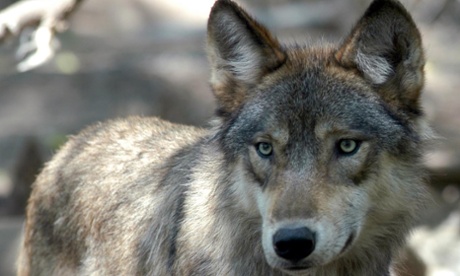
Grey wolf appears in Iowa for first time in 89 years – and is shot dead

Hunter mistook animal for a coyote and escapes being cited despite wolves being a protected species in the state, reports Mongabay

Jeremy Hance for Mongabay, part of the Guardian Environment Network

theguardian.com, Monday 12 May 2014 15.52 BST

DNA testing has confirmed that an animal shot in February in Iowa's Buchanan County was in fact a wolf, according to the Iowa Department of Natural Resources. This is the first confirmed grey wolf (Canis lupus) in the US state since 1925. 

Experts believe the wolf likely travelled south from Wisconsin or Minnesota, the latter of which has the largest wolf population in the lower 48. 

The Iowa wolf, which was a 65-70 pound healthy female, was shot and killed in February of this year by a hunter who mistook it for a coyote. Although wolves remain a protected species in Iowa, the hunter was not cited, because he believed the animal to be a coyote and has cooperated with authorities, including bringing the wolf to them in the first place. 

"I was surprised but not that surprised," DNA specialist Vince Evelsizer told the Gazette. "Large animals can cover great distances, and state lines mean nothing to them." 


Sunday, 22 December 2013

Officials seek sanctuary for Iowa alligator

WATERLOO, Iowa (AP) — Animal control officials in the Iowa city of Waterloo are seeking a new home for a baby alligator named Chompey.
In this Dec. 5, 2013 photo provided by Pawsitive Pet Care is a baby alligator at their veterinary center in Waterloo, Iowa. Animal control officials say a resident bought the alligator after spotting an online advertisement but later learned Iowa law doesn't allow people to keep alligators or other exotic animals. The alligator acquired the name Chompey during a short stay at a pet care center before being quarantined in Des Moines while officials seek a permanent home at a sanctuary in a warmer climate. (AP Photo/Pawsitive Pet Care)
A resident of the eastern Iowa city of about 68,000 people bought the alligator after spotting an online advertisement, but he later learned state law does not allow people to keep alligators or other exotic animals, The Waterloo-Cedar Falls Courier reported (http://bit.ly/J7SVtu ) Monday.

The resident turned the gator in to animal control officials, who kept the creature in an aquarium while figuring out what to do with it. Then the gator started snapping and making noises.

"He was really kind of cute, but he was also kind of naughty," said Maria Tiller, Waterloo's code enforcement forewoman. "I didn't want him in my office anymore."

The alligator was moved to the Pawsitive Pet Care, a veterinary center, where staffed dubbed the animal "Chompey." The alligator then was sent to a herpetologist in Des Moines, where the animal's being held in quarantine while staff seek a sanctuary in a warmer climate for Chompey.

Thursday, 3 October 2013

Raccoon survives month at sea by eating cardboard

A stowaway raccoon is thought to have survived a month at sea by eating cardboard.

Curious Meeko got in a container in Davenport, Iowa, US, that was sent by rail to Halifax in Canada and shipped to Liverpool.

The cargo was driven to Ebbw Vale in South Wales, where workers found a furry extra in their machine parts order.

‘She was really thin when she arrived but is starting to put some weight on,’ said Jan Garen, who has given Meeko a home at Wales Ape and Monkey sanctuary, in Abercrave.

‘She is getting used to us but she has had a rough ride. She was locked in that container for four weeks and somehow survived by drinking condensation and eating cardboard.

‘It’s obvious that she wasn’t a pet, she’s a wild animal so she has to be handled very carefully.’

Her new parents now plan to build a permanent home for the cheeky critter, who is slowly returning to full health, at the Welsh sanctuary.


Friday, 23 August 2013

Butter-Cow Prank Does Nothing to Help the Cause of Animals (Op-Ed)

Wayne Pacelle is the president and chief executive officer of The Humane Society of the United States (HSUS). This Op-Ed first appeared on the blog A Humane Nation, where it ran before appearing in LiveScience's Expert Voices: Op-Ed & Insights.

If you care about farm animals in Iowa, there is unfortunately no shortage of high-profile, high-impact matters that would benefit from citizen activism there.

For example, with Congress in recess and lawmakers back home in their districts, The HSUS is working to defeat the amendment from Rep. Steve King (R-Iowa) to nullify important state laws — statutes that impose conditions or standards on the agriculture industry to protect animals, workers, public health and the environment. There is great value in organizing folks in King's district to defend Iowa's laws and remind King that his constituents don't support the amendment's attack on states' rights.


Wednesday, 31 July 2013

Prairie butterfly sliding towards extinction

Rarer than a Panda! Researchers working to save endangered butterfly
July 2013. Researchers from both Canada and the United States are rushing to figure out why a small, brown and orange winged butterfly is dying out quickly.
 (Courtesy Erik Runquist/Minnesota Zoo)


Massive population crash
Listed as an endangered species in Manitoba in 2012 and listed nationally as threatened, the Poweshiek skipperling butterfly population has dropped dramatically throughout North America. In Canada, it is known to only inhabit 17 fields in south-eastern Manitoba, primarily on the Nature Conservancy of Canada's Tall Grass Prairie Natural Area. In the United States, the closest population appears only in a handful of sites in Iowa and North Dakota.

Researchers from the University of Winnipeg, Minnesota Zoo and University of Michigan are now just outside of Winnipeg performing valuable research on this declining species. Since the adult butterfly is active for only two to three weeks, researchers are using this critical time to collect information on the Poweshiek skipperling's genetics and genetic diversity to save this important butterfly from extinction.

Wednesday, 3 October 2012

Officials urge horse owners to vaccinate against West Nile virus


DES MOINES, Iowa (AP) — Iowa agriculture and health officials are warning that mosquitoes are still active in the state and are urging horse owners to have the animals vaccinated against West Nile virus.

The Iowa Department of Agriculture and Land Stewardship and Iowa Department of Public Health said in a joint statement that mosquitoes can carry West Nile virus until the first hard freeze.

Officials say surveillance has shown a larger number of horses have been infected with West Nile virus this year, with more than 20 confirmed cases. Last year, Iowa only had one confirmed case in a horse.

West Nile virus is transmitted through the bite of a mosquito that has picked up the virus from an infected bird. The virus has flu-like symptoms.

Wednesday, 8 August 2012

Thousands of fish die as Midwest streams heat up


LINCOLN, Neb. (AP) — Thousands of fish are dying in the Midwest as the hot, dry summer dries up rivers and causes water temperatures to climb in some spots to nearly 100 degrees.
About 40,000 shovelnose sturgeon were killed in Iowa last week as water temperatures reached 97 degrees. Nebraska fishery officials said they've seen thousands of dead sturgeon, catfish, carp, and other species in the Lower Platte River, including the endangered pallid sturgeon. And biologists in Illinois said the hot weather has killed tens of thousands of large- and smallmouth bass and channel catfish and is threatening the population of the greater redhorse fish, a state-endangered species.
So many fish died in one Illinois lake that the carcasses clogged an intake screen near a power plant, lowering water levels to the point that the station had to shut down one of its generators.
"It's something I've never seen in my career, and I've been here for more than 17 years," said Mark Flammang, a fisheries biologist with the Iowa Department of Natural Resources. "I think what we're mainly dealing with here are the extremely low flows and this unparalleled heat."
The fish are victims of one of the driest and warmest summers in history. The federal U.S. Drought Monitor shows nearly two-thirds of the lower 48 states are experiencing some form of drought, and the Department of Agriculture has declared more than half of the nation's counties — nearly 1,600 in 32 states — as natural disaster areas. More than 3,000 heat records were broken over the last month.
Iowa DNR officials said the sturgeon found dead in the Des Moines River were worth nearly $10 million, a high value based in part on their highly sought eggs, which are used for caviar. The fish are valued at more than $110 a pound.
Gavin Gibbons, a spokesman for the National Fisheries Institute, said the sturgeon kills don't appear to have reduced the supply enough to hurt regional caviar suppliers.

Thursday, 8 December 2011

Hungry goats improve habitat for rare native species in Iowa project

The following is from the Leopold Center for Sustainable Agriculture at Iowa State University:

MAXWELL, Iowa — At the Chichaqua Bottoms Greenbelt in Polk County, researchers have developed a novel tool for restoring biodiversity to a landscape choked by invasive species: Set loose a herd of hungry goats.

The project began in 2008 when the Leopold Center for Sustainable Agriculture awarded a competitive grant to Iowa Heartland Resource Conservation and Development to study the benefits of incorporating livestock onto conservation lands. By dining on unwanted buckthorn, goats helped restore a rare swamp white oak savannah and created habitat for a wide array of native species, including Blanding’s turtles, listed as threatened in Iowa.

Loren Lown, natural resource specialist for the Polk County Conservation Board, leads the project. Lown asked Deb and Eric Finch of State Center, Iowa, to let their herd of 30-plus goats browse at Chichaqua Bottoms, a 7,300-acre greenbelt along the Skunk River. The partnership allowed the Finches to raise healthy goats and rest their home pastures while Lown cleaned up the ecosystem.

The goats, rotated through a 10-acre area divided into three paddocks, munched on invasive buckthorn and other unwanted plants. Goats prefer to eat twigs, leaves and woody species first, leaving the herbaceous layer alone. Lown described them as “little buckthorn bombs.”

Read more here ...

Friday, 28 May 2010

Mystery surrounds Iowa armadillo

Published: May 19, 2010 at 4:09 PM

WEVER, Iowa, May 19 (UPI) -- Experts said an armadillo found dead at the side of a southeastern Iowa road may have been part of an early species range expansion.

Ron Andrews, a biologist with the Iowa Department of Natural Resources, said armadillos are commonly found in the south central and southeastern United States, Mexico and South America, but one of the animals was found Saturday at the side of the road by a rural couple near Wever, The (Burlington, Iowa) Hawk Eye, reported Wednesday.

He said the animal may have been part of an early species range expansion.

"In southeast Iowa, the chances are a little rarer than in southwest Iowa because the rascals have been moving up from the more southwesterly side (of the region.) But I do know this, nothing is impossible anymore in this day and age. You never want to say never," Andrews said.

He said the armadillo may have also been captured somewhere else and released in the area or it may have stowed away on a truck or a train.

"We have no way to know for sure," Andrews said. "It's one of those quirky things we're going to have to really watch as the next year unfolds to see if more show up."

http://www.upi.com/Odd_News/2010/05/19/Mystery-surrounds-Iowa-armadillo/UPI-52941274299762/
(Submitted by Chad Arment)

Saturday, 15 May 2010

Cougar suspected of attack on horse near Sidney, Iowa (Via Paul Cropper)

Cougar suspected of attack on horse near Sidney, Iowa ; DNR officials are examining the mare after a possible mountain lion sighting
11 May 2010
Omaha World-Herald
Iowa

SIDNEY, Iowa -- Iowa Department of Natural Resources officials are investigating reports that a cougar attacked a 2-year-old quarter horse mare west of Sidney recently. The horse, owned by Jim and Donna Glenn of rural Sidney, was found with scrapes and cuts. Jim Glenn said he has eight horses in a pasture he rents from Lynn Benson about a couple miles west of Sidney High School.

"Lynn came by Saturday morning and said he saw a cougar," Glenn said. "He suggested I check on my horses."
Glenn found the mare limping badly in a cornfield about 100 feet from the pasture. Benson said he was heading from his pasture to his house early Saturday when he saw what appeared to be a cougar. "It was close to 100 yards away, but I had a good view of it," Benson said. "The size, the way he was running, the color -- I don't think it was anything else."

Benson contacted his neighbors who have livestock.

Glenn initially thought the horse had been spooked through a fence and had cut itself. Later, he said, he and his wife found claw marks. "I thought they were fence marks, but Donna noticed scrapes," Glenn said. "There were claw marks all the way down her left shoulder and a wound to her left shoulder. The claw marks went across her whole body diagonally."

Marlow Wilson, with the Department of Natural Resources, took photos of the horse and looked for evidence of a cougar. Wilson said he's not convinced it was a cougar and said the horse could have been injured running through a fence. "I can be talked into either way, to be honest with you," Wilson said. "It seems the scratches are a little close together for barbed wire and they're pretty high on the horse's body, but there's also a wound on the front leg that looks like a fence post or something tore it up."

Wilson said the scratches are roughly an inch apart and lead down one side of the body. There are four or five scratches leading into the skin tear on the shoulder of the horse. The scratches go down the entire side of the horse, Wilson said. He said if the horse had gone through a fence, she would have had more scratches across her chest. "The front of the animal is where I would expect to see the most (scratches) from the barbed wire," Wilson said.

Last week, veterinarian Eric Laumann checked on the horse. "I've been on about five of these that were suspected (cougar attacks) and I'd say this is the only one that has any merit," Laumann said. "The scratches were all along the left side of the horse, and they're about an inch apart." Laumann said the scratches would be about four inches apart if they were from barbed wire. "There's definitely a chance of it being from a mountain lion," Laumann said. "The marks start at the front left shoulder, there's a fairly good piece of skin missing there, and then the scratches continue all the way down the side, back to the rump."

"The wound over the shoulder is a fairly decent skin wound, but the horse should make a full recovery," Laumann said. State wildlife biologist Carl Priebe isn't sure it was a cougar. "Photos were sent in to get a more expert opinion." Priebe said. There have been several unconfirmed reports of cougars in the area, the biologist said, including another sighting near Sidney a couple of weeks ago.

"What we've learned is that these moving cougars are young males, which average about 60 miles a week and never really stop," Priebe said. "Two sightings, two weeks apart is a little bit different than what we know to be occurring with most of those animals. It's different from what research has shown."
Related Posts with Thumbnails

ShareThis