Showing posts with label Portugal. Show all posts

Sunday, 20 January 2019

The first case of a Portuguese beetle living exclusively in groundwater


January 8, 2019, Pensoft Publishers
A diving beetle demonstrating various adaptations to the life underground, including depigmentation and evolutionary loss of eyes, was discovered at the bottom of a clay pound in the cave Soprador do Carvalho, Portugal. The species turned out to be the very first in the whole order of beetles (Coleoptera) to be known exclusively from the underground waters of the country.
Despite not being able to find any other specimens during their study—save for the single female, the team of Dr. Ignacio Ribera, Institute of Evolutionary Biology (Spain) and Prof Ana Sofia P. S. Reboleira, University of Copenhagen (Denmark) identified the beetle as new to science, thanks to its unambiguous morphology in combination with molecular data.
Aptly named Iberoporus pluto in reference to the ruler of the underworld in Greek mythology Pluto, the species was recently described in the open-access journal ZooKeys.
With a uniformly pale orange body measuring 2.8 mm in length and 1.1 mm in its widest part, the beetle is larger than the rest species known in its genus, and its appendages are longer and more slender. While blindness and depigmentation are clear adaptation to life away from sunlight, the elongated limbs and antennae reflect poor swimming abilities needed in a subterranean habitat. Going for 4 km in horizontal direction, Soprador do Carvalho is the largest in the Dueça cave system, located in the north-eastern part of the Sicó karst area in central Portugal. In recent years, the cave is being explored for tourism.
"The knowledge of the subterranean fauna from Portugal has significantly increased over the last decade, with the description of a high number of obligate subterranean species (tripling their number) and the establishment of new biogeographic patterns," explain the authors of the study. "A high number of these species are stygobiont (i.e. confined to groundwater), mostly from wells in the north of the country, where evapotranspiration is higher."

Wednesday, 15 November 2017

Dinosaur-Age Shark with 300 'Frilled' Teeth Caught in Deep Sea


By Laura Geggel, Senior Writer | November 13, 2017 02:28pm ET

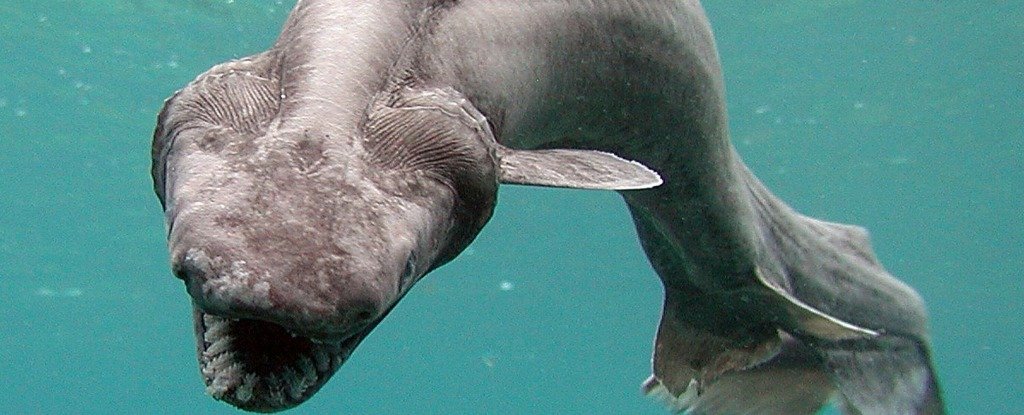
Forget about the minuscule odds of spotting Ahab's white whale: Sightings of the frilled shark, a so-called "living fossil" that has elusively swum around Earth's deep waters since the age of the dinosaurs, may been an even rarer find.
Add (Awashima Marine Park)caption

Deep-sea fishermen recently spotted the snake-like shark (Chlamydoselachus anguineus) in a pile of fish that unintentionally caught, known as bycatch, while they were fishing off the coast of Portugal. The shark died, but the fishermen handed it over to a research vessel, where scientists could study it, according to Boy Genius Report (BGR), a news site.

The examination gave scientists a close-up look at the shark's roughly 300 three-pointed teeth, which it uses to grab and kill prey, including fish, squid and other sharks.

Margarida Castro, a fishery science researcher at the University of the Algarve, in Portugal, told Sic Noticias, a Portuguese news outlet, said that these strange teeth, arranged in a frill-like pattern, inspired the shark's name. The teeth look like backward needles, and its jaw can snatch prey more than half its size.

#Portugal—rare #FrilledShark (Chlamydoselachus anguineus) netted at depth of 700m (2.3k ft)—1.5m (5 ft) snake-like #sharkw/300 teeth—“living fossil” from 80 million years ago http://www.bbc.com/news/blogs-news-from-elsewhere-41928537 …

The roughly 5-foot-long (1.5 meters) shark has barely changed in the past 80 million years, earning it a "living fossil" title. The fishermen reported catching the C. anguineus at 2,300 feet (700 m) under water — about half as deep as it can swim, as the species is known to range from about 65 feet to 4,900 feet (20 to 1,500 m) underwater, according to the International Union for Conservation of Nature (IUCN).


Thursday, 23 March 2017

Virus lethal to amphibians is spreading across Portugal


Date: March 13, 2017
Source: Plataforma SINC

A new strain of ranavirus is currently causing mass mortality in several species of amphibian in the Serra da Estrela, the highest mountain range in continental Portugal. This infectious agent is hypervirulent and also affects fish and reptiles, which complicates the situation, according to a study boasting the collaboration of the National Museum of Natural Sciences in Madrid.

An emerging virus is affecting amphibian populations in Portugal, but this is not the first time amphibians have been a source of worry in the country. In 2009, hundreds of midwife toads (Alytes obstetricans) were found dead in Serra da Estrela Natural Park.

A research study published in the journal Scientific Reports raises a new alert on this genus of virus, which has also been discovered in Spain and elsewhere in Europe. As Jaime Bosch, a researcher at the National Museum of Natural Sciences and co-author of the study, explains: "Ranaviruses have been known about for a long time, although in recent years globalisation is setting off mass mortalities throughout the world, and new strains also keep appearing, probably from Asia."

The fact that these viruses also affect fish and reptiles complicates the situation enormously, firstly because they can spread easily and also because of their persistence in the environment, even after amphibians disappear.

"They have probably been infecting amphibian populations in Spain for several decades. In 1992 we discovered what turned out to be the first known case in our country, although at the time we didn't even know exactly which organism caused the problem," the scientist adds.

In autumn 2011, another curious episode of mortality arose in the Serra da Estrela, which not only affected midwife toads but also other species of amphibians in the park. The episode was in contrast to all mortality patterns previously associated with chytridiomycosis on the Iberian Peninsula and Europe.

Thursday, 2 February 2017

New moth in Europe: A southern hemisphere species now resident in Portugal


January 25, 2017 

As travelling in the 21st century is easier than ever, so is for species to make their way to new areas, sometimes increasing their distributional range, or even establishing whole new habitats. On the other hand, when they leave their natural predators and competitors behind, and find abundance of suitable resources somewhere else, they are running the risk of becoming invasive. 

Nevertheless, such is not the case of a small, darkish brown moth from the southern hemisphere that is now resident in central Portugal. There, the species do not exhibit invasive behaviour, and so far has been only observed in very low numbers. The discovery is published in the open access journal Nota Lepidopterologica by an international research team, led by Martin Corley, CIBIO-InBIO, Portugal.

In 2012, Jorge Rosete, one of the co-authors of the study, spotted a female specimen that he could not identify near his house. When Martin took a look at it, he placed it in the concealer moth family (Oecophoridae), but was unable to recognise neither its species, nor its genus. It did not took long before a few more specimens were found, including males.

Initially, Martin thought the moth might originate from Australia, given the abundance of eucalyptus plantations in the area where it was found, and the fact that there are more concealer moth species in Australia than on any other continent. However, despite their efforts and contacts with other researchers, they failed to find an Australian species to match the Portuguese specimens. As a result, the mystery remained for the next four years, until a molecular study into moth DNA pulled the curtains.

A fragment of DNA, also called DNA barcode, matched three other genetically identical unnamed specimens, originally collected from South Africa, in the DNA database BOLD. Further collaboration with Alexander Lvovsky, Russian Academy of Sciences, allowed the assignation of the specimens to a species name: Borkhausenia intumescens, known from South Africa. However, it did not end there. Further research into museum collections showed that in fact this species had been previously described from Argentina as Borkhausenia crimnodes, and therefore should be named as such.

Friday, 29 April 2016

Campaigners urge Elton John to boycott music festival in Portugal

In an open letter, environmentalists say locating Marés Vivas event near a nature reserve threatens nesting birds and wildlife

Elton John is due to play at the Marés Vivas festival alongside British singers James Bay and Tom Odell. Photograph: Daniel Leal-Olivas/PA


Friday 29 April 2016 17.24 BSTLast modified on Friday 29 April 201618.06 BST

Campaigners have sent an open letter to Elton John asking him to boycott a Portuguese music festival due to concerns it will be an environmental disaster to a nearby nature reserve.

Marés Vivas festival, which takes place every July in Gaia, Porto, has been moved for the first time to an area of land just 100m from the nature reserve of the Douro River Estuary.

The 150-acre reserve, which is protected under Portuguese law, is home to more than 220 species of birds, including eagles, kingfishers and cormorants, and is one of Europe’s most popular sites for birdwatching.

Local campaigners have written to John, who will headline Marés Vivas alongside other British singers James Bay and Tom Odell, asking him to take a stand against the “environmental damage”.

”More than your business and your art, please consider the environmental importance of the area. The reserve is very delicate, special and vulnerable... the area is very special to some species of birds for stopover and for nesting,” says the letter, which is signed by figures such as biologist Serafim Riem, Lucília Guedes, vice president of the Fund for the Protection of Wild Animals, and João Branco, director of Portuguese environmental group Quercus.

About 30,000 visitors a day are expected at the music festival, which was moved from its previous site after a dispute with the owners. Campaigners are concerned that crowds, noise and lights so close to the estuary will have a lasting impact on the nesting birds and wildlife.

The letter says “damaging” preparations for the festival had begun, including bulldozing and cutting down trees. It says the site of the show was home to the protected Iberian emerald lizard and that if the festival goes ahead “the whole area, including the nature park, is going to lose its state as a protected area”.


Thursday, 11 June 2015

Saving the Iberian lynx from extinction, one cat at a time

Paul Ames, GlobalPost1:06 p.m. EDT June 2, 2015

SILVES, Portugal — The world's most endangered cat? If you're guessing tiger or snow leopard, think again. The Iberian lynx is officially the feline at greatest risk of extinction.

Decades of habitat destruction, hunting and rabbit epidemics that wiped out food supplies mean there are barely 350 still alive in the shrinking wildernesses of Spain and Portugal.

The World Wildlife Fund has long warned these elegant, bobcat-sized creatures could become the first cat species to disappear in at least 2,000 years.

Help, however, is at hand.

In a high-security compound, hidden deep in the hills above this medieval town in southern Portugal, a dedicated band of humans is helping the lynx make a comeback.

"We've had 11 cubs this year," animal behavior specialist Andreia Grancho said. "They are at the stage where they play a lot and are learning to hunt."

On cue, a tufty-eared bundle of cuteness appears on one of six computer screens monitored 24-7 by Grancho and her team of colleagues at Portugal's Iberian Lynx Breeding Center.

Tuesday, 24 March 2015

'Monster salamanders' found in fossilised mass grave

By Jonathan Webb
Science reporter, BBC News

24 March 2015 

Scientists have discovered a new species of massive, toothy amphibian dating from 220 million years ago.

Hundreds of the creatures probably died when a lake dried up, leaving a huge jumble of bones which is now being excavated in southern Portugal.

Although related to modern salamanders, the two-metre beast probably lived more like a crocodile, snapping up fish and scrapping with rivals on the shore.

The find is reported in the Journal of Vertebrate Paleontology.

Nobody's pet
"It's basically a salamander that's the size of a car," said Dr Steve Brusatte, a palaeontologist at the University of Edinburgh who led the research.

"It's one of those creatures from the distant past that looks like an alien - but it actually has quite a lot of relevance. These kind of big amphibians were the ancestral stock that modern frogs, salamanders and newts came from."

Related Posts with Thumbnails

ShareThis