Showing posts with label new and rediscovered. Show all posts

Thursday, 2 July 2020

Shining like a diamond: A new species of diamond frog from northern Madagascar


Date: June 16, 2020
Source: Pensoft Publishers
Despite the active ongoing taxonomic progress on Madagascar's frogs, the amphibian inventory of this hyper-diverse island is still very far from being complete. The known diversity of the diamond frog genus Rhombophryne in Madagascar has increased significantly (more than doubled!) over the last 10 years, but still there are several undescribed candidate species awaiting description. New species are constantly being discovered in Madagascar, often even within already well-studied areas. One such place is the Montagne d'Ambre National Park in northern Madagascar.
Montagne d'Ambre National Park is widely known for its endemic flora and fauna, waterfalls and crater lakes, and considered to be a relatively well-studied area. Yet, only two studies have been published so far on the reptiles and amphibians of the Park.
Serving the pursuit of knowledge of the herpetofauna in the region, Germany-based herpetologist Dr. Mark D. Scherz (Bavarian State Collection of Zoology, Technical University of Braunschweig, University of Konstanz) published a description of a new diamond frog species: Rhombophryne ellae, in the open-access journal Zoosystematics and Evolution.
"As soon as I saw this frog, I knew it was a new species," shares Dr. Scherz, "The orange flash-markings on the legs and the large black spots on the hip made it immediately obvious to me. During my Master's and PhD research, I studied this genus and described several species, and there are no described species with such orange legs, and only few species have these black markings on the hip. It's rare that we find a frog and are immediately able to recognise that it is a new species without having to wait for the DNA sequence results to come back, so this was elating."

Sunday, 29 March 2020

Ancestor of all animals identified in Australian fossils

A wormlike creature that lived more than 555 million years ago is the earliest bilaterian

Date: March 23, 2020
Source: University of California - Riverside

A team led by UC Riverside geologists has discovered the first ancestor on the family tree that contains most familiar animals today, including humans.

The tiny, wormlike creature, named Ikaria wariootia, is the earliest bilaterian, or organism with a front and back, two symmetrical sides, and openings at either end connected by a gut. The paper is published today in Proceedings of the National Academy of Sciences.

The earliest multicellular organisms, such as sponges and algal mats, had variable shapes. Collectively known as the Ediacaran Biota, this group contains the oldest fossils of complex, multicellular organisms. However, most of these are not directly related to animals around today, including lily pad-shaped creatures known as Dickinsonia that lack basic features of most animals, such as a mouth or gut.

The development of bilateral symmetry was a critical step in the evolution of animal life, giving organisms the ability to move purposefully and a common, yet successful way to organize their bodies. A multitude of animals, from worms to insects to dinosaurs to humans, are organized around this same basic bilaterian body plan.

Evolutionary biologists studying the genetics of modern animals predicted the oldest ancestor of all bilaterians would have been simple and small, with rudimentary sensory organs. Preserving and identifying the fossilized remains of such an animal was thought to be difficult, if not impossible.

For 15 years, scientists agreed that fossilized burrows found in 555 million-year-old Ediacaran Period deposits in Nilpena, South Australia, were made by bilaterians. But there was no sign of the creature that made the burrows, leaving scientists with nothing but speculation.

Thursday, 26 March 2020

Here be dragons: Analysis reveals new species in Smaug lizard group


MARCH 25, 2020


Smaug, the deadly dragon in J.R.R Tolkien's "The Hobbit," has a few living relatives. With dense, alligator-like armor, these small, real-life dragon lizards are rock-crevice recluses mostly confined to mountaintops in southern Africa.

Now, herpetologists Michael Bates, a curator at South Africa's National Museum in Bloemfontein, and Edward Stanley of the Florida Museum of Natural History have discovered a ninth species of dragon lizard in the genus Smaug, previously mistaken for a similar-looking species, S. barbertonensis.

The new species, a heavily plated dark brown lizard with pale yellow bands, has been named Smaug swazicus, or the Swazi dragon lizard, in honor of the country of Eswatini, where most of the species' range is located. Up to 13 inches from snout to tail tip, S. swazicus is an unusually big lizard for the region.

"In terms of bulk and actual recorded total length, Smaug swazicus may be the largest southern African lizard species described since the western giant plated lizard, Matobosaurus maltzahni, 82 years ago," Bates said.

Sunday, 22 March 2020

We've just discovered two new shark species

MARCH 20, 2020

Finding a species that's entirely new to science is always exciting, and so we were delighted to be a part of the discovery of two new sixgill sawsharks (called Pliotrema kajae and Pliotrema annae) off the coast of East Africa.

We know very little about sawsharks. Until now, only one sixgill species (Pliotrema warreni) was recognised. But we know sawsharks are carnivores, living on a diet of fish, crustaceans and squid. They use their serrated snouts to kill their prey and, with quick side-to-side slashes, break them up into bite-sized chunks.

Sawsharks look similar to sawfish (which are actually rays), but they are much smaller. Sawsharks grow to around 1.5 meters in length, compared to 7 meters for a sawfish and they also have barbels (fish "whiskers"), which sawfish lack. Sawsharks have gills on the side of their heads, whereas sawfish have them on the underside of their bodies.

Together with our colleagues, we discovered these two new sawsharks while researching small-scale fisheries that were operating off the coasts of Madagascar and Zanzibar. While the discovery of these extraordinary and interesting sharks is a wonder in itself, it also highlights how much is still unknown about biodiversity in coastal waters around the world, and how vulnerable it may be to poorly monitored and managed fisheries.

Friday, 13 March 2020

Researchers discover the Sulawesi hairy-tailed shrew

MARCH 11, 2020

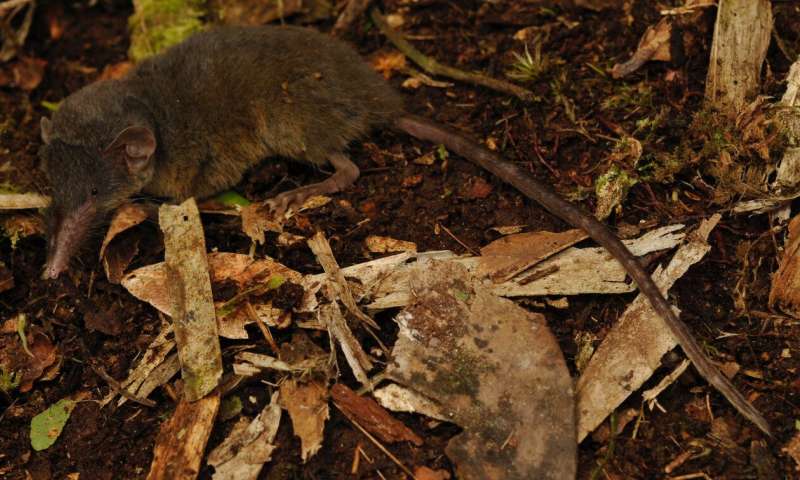
Researchers at Louisiana State University discovered this new species, the Sulawesi hairy-tailed shrew, in Indonesia. Credit: Kevin Rowe, Museums Victoria.

Researchers at Louisiana State University have discovered a new species of shrew, which they have named the hairy-tailed shrew, or Crocidura caudipilosa.

"There was no doubt that this was a new species," said LSU Museum of Natural Science Mammal Curator Jake Esselstyn whose work on Sulawesi Island in Indonesia led to the discovery published in the Journal of Mammalogy. "There isn't another species on the island that has as much hair on its tail, in terms of shrews."

The newly discovered shrew is slender with gray-brown fur on its back and silver-gray fur on its belly. Its tail is slightly longer than the combined length of its head and body and is covered with long bristles and hair, which make the distinctive tail very hirsute. In fact, no other shrew species in Indonesia, Malaysia or the Philippines is known to have such thick, long hair on its tail; however, some shrew species in Africa have very hairy tails. The scientists were also surprised to discover that this shrew climbs trees whereas most shrews live primarily on the ground, as far as anyone knows.

The Sulawesi hairy-tailed shrew was found on nine mountains across Sulawesi at various elevations from 1,500 feet to 4,800 feet.

"Tropical diversity is still not well documented even for mammals with a wide distribution on this island. This discovery shows how little we still know about mammal diversity," Esselstyn said.

Wednesday, 11 March 2020

Rainbow Snake Spotted in Central Florida County for 1st Time in Over 50 Year - viaia Herp Digest

Rainbow snakes are highly aquatic, according to state officials, and spend most of their lives hidden in vegetation such as lakes and marshes

Officials made quite the discover in a Central Florida county this week when a rainbow snake was spotted in the area for the first time in over half a century. The four-foot reptile was spotted by a person that was hiking in the Ocala National Forest, officials from the Florida Fish and Wildlife Conservation Commission told NBC affiliate WESH-TV. 

It’s the first confirmed sighting of that type of snake in the area since 1969.  Rainbow snakes are highly aquatic, according to state officials, and spend most of their lives hidden in vegetation such as lakes and marshes. Biologists speculate that a recently drawn out reservoir had this reptile looking for a new home.

Monday, 9 March 2020

Palaeontologists Identify New Prehistoric Amphibian: A Salamander Named Egoria - via Herp Digest

TOPICS:Amphibians Evolution Paleontology By ST. PETERSBURG STATE UNIVERSITY FEBRUARY 21, 2020

A group of Russian and German paleontologists have described a previously unknown genus and species of prehistoric salamanders. The new amphibian is named Egoria malashichevi — in honor of Yegor Malashichev a talented scientist and associate professor of the Department of Vertebrate Zoology at St Petersburg University, who passed away at the end of 2018. Credit: Vadim Glinskiy 

They lived on the Earth about 166-168 million years ago, in the Middle Jurassic. The paleontologists found the remains of the ancient amphibian at the Berezovsky quarry, a fossil locality in the Krasnoyarsk Krai near the town of Sharypovo. Fossils of ancient fish, various reptiles, mammals, herbivorous and predatory dinosaurs have been previously found there. The research materials were collected on field expeditions in the mid-2010s. In these expeditions the scientists from St Petersburg University worked alongside experts from the University of Bonn (Germany), the Tomsk State University, the Zoological Institute of the Russian Academy of Sciences, and the Sharypovo Museum of Local History and Nature. 

Four vertebrate fossils enabled the scientists to declare the finding of a new genus and species. These were: three trunk vertebrae and the atlas — the first and, in the case of the salamander, the only cervical vertebra. Since the atlas is a highly specialized vertebra, providing for attachment and rotation movements of the skull, it has a rather complex structure, the scientists explain. It is therefore most suitable for describing a new species as it provides much information for analysis. The amphibian proved to have belonged to the geologically oldest stem salamanders. 

It was not the first time that remains of ancient salamanders had been found at the Berezovsky quarry. One of them — a basal stem salamander Urupia monstrosa, named after the nearby Uryup River — was about 50-60 centimeters long. Another one — Kiyatriton krasnolutskii — was named after a local historian Sergei Krasnolutskii, the discoverer of the fossil locality Berezovsky quarry. By contrast, this one was quite small in size (about 10-15 centimeters) and looked more like modern Hynobiidae. The newly discovered salamander, judging by the size of the vertebrae, was of medium length (about 20 centimeters). 

‘Salamanders first appear in the fossil records in the Middle Jurassic, including representatives of both the present-day salamander families and the most primitive ones,’ said Pavel Skutschas, associate professor of St Petersburg University, doctor of biology, expert in Mesozoic vertebrates. ‘When they had just appeared, salamanders made efforts to occupy different ecological niches. Thus, the stem salamanders filled the niche of large water bodies; while those close to the present-day salamanders found their niche in small water bodies. As for the newly discovered salamander, it occupied a middle position, although morphologically, it is closer to the primitive.’ 

The scientists not only described the external characteristics of the specimens, but were able to look inside the fossils. In this, they were assisted by the experts from the ‘Centre of X-ray diffraction studies’ at the Research Park of St Petersburg University, where the specimens were scanned on up-to-date microtomography scanners. Based on the obtained data, the paleontologists created 3D reconstructions of the vertebrae and described their internal structure. As expected, it proved to be very similar to that of the large stem salamanders. The ancient amphibian received the name Egoria malashichevi — in honor of Yegor Malashichev, associate professor of the Department of Vertebrate Zoology at St Petersburg University, who, among other things, studied the morphology of caudate amphibians. ‘Yegor Malashichev was a wonderful person and a very talented scientist. 

He supported aspiring palaeontologists and did everything to help them to stay in scientific research,’ remarked Pavel Skutschas. Additionally, Malashichev studied the phenomenon of lateralization (body asymmetries associated with the functioning of the nervous system), as well as other asymmetries in motor performance and visual perception. Yegor Malashichev’s professional career was almost exclusively connected with St Petersburg University. In 1996, he graduated from the Faculty of Biology and Soil Science. In 2000, he began to teach there, and in 2003, he defended his dissertation and was awarded a PhD in biology. Sadly, in late 2018, he passed away unexpectedly. The next step for the paleontologists is to compare the bones of the ‘Berezovsky’ salamanders with the fossils from Great Britain: the ‘Kirtlington’ salamanders which were found at the Kirtlington quarry in Oxfordshire. The Siberian and British faunas of the mid-Jurassic time were very similar. Besides, the paleontologists are aware of similar amphibians that lived in the territory of present-day England. 

‘They may be representatives of the same genera. However, to ascertain this, a detailed comparison of the palaeontological collections is required. In the coming spring, our colleagues from England will come to St Petersburg to study our research materials. We may discover that Urupia and Egoria used to have a very wide habitat, extending across Europe and Asia,’ mused Pavel Skutschas. 

Reference: “A new small-sized stem salamander from the Middle Jurassic of Western Siberia, Russia” by Pavel Skutschas, Veniamin Kolchanov, Sergey Krasnolutskii, Alexander Averianov, Rico Schellhorn, Julia Schultz and Thomas Martin, 19 February 2020, PLOS ONE. DOI: 10.1371/journal.pone.0228610A

Thursday, 5 March 2020

Himalayan butterfly found in Fujairah - via Mark Raines

Published Sunday, March 01, 2020

Another new butterfly species has been added to the UAE list by locally-based naturalist Binish Roobas – this time a Himalayan species, the Indian Fritillary (Argynnis hyperbius). It was found in the wild in Wadi Wurayah National Park, WWNP, in Fujairah earlier this month.

This latest discovery brings the UAE butterfly total to 58 species. The record may also be a first for Arabia.

The Indian Fritillary is common in the Himalayan regions of Northern India, Afghanistan, Pakistan and Nepal, and it has also been found in southern Iran. Now a small number have made their way to Wadi Wurayah, where Roobas was able to photograph both a male and female of the species.

The butterfly was discovered during a visit to update earlier surveys of plant and insect diversity in Wadi Wurayah, following the exceptional fall and winter rains. Joining Roobas in the field were Gary Feulner, Chairman of the Dubai Natural History Group, Sami Ullah Majeed, WWNP Park Ranger, and Nuri Asmita, a WWNP biologist.

The new species is an opportunistic migrant that probably arrived to take advantage of the favourable conditions created by abundant rainfall from October until January. It is unlikely that they will remain for the UAE summer.

Monday, 2 March 2020

Four new butterfly varieties seen in Salem forest division

Senthil Kumaran | TN ..

SALEM: Four new varieties of butterflies and a new bird species were spotted in the Salem forest division during the three-day census that was carried out jointly by the forest department and Salem Nature Society (SNS) recently. 

In total, they have recorded 214 varieties of birds and 136 species of butterflies in the forest division. V Gokul, president, SNS, said, “The bird and butterfly survey was carried out by 135 specialists from various states for three days from Friday to Sunday (February 14-16).” The survey covered all the nine forest ranges in the Salem forest division. According to N Murugesan, secretary, SNS, three of the four new butterfly varieties - common tinsel, pale four-line blue and transparent sixline blue - were spotted in the Yercaud forest range and the remaining one - chocolate albatross - in the Danishpet forest range. 

They were spotted by butterfly experts A Pavendhan, S Soundararaj, T Nagaraj, R Krishnamoorthy and K K Nilesh. Pointing out that common tinsel was usually seen only in the Western Ghats and Northeast India, he said this was probably the first time the butterfly variety was seen in Eastern Ghats of Tamil Nadu. The butterfly is small in size and comes with silver edged bands, grey-brown lower body and blue upper body. 

Thursday, 6 February 2020

Rare Bolivian "Glass" Frogs Rediscovered After 18 Years - via Herp Digest

By Carlos Dela Vega (staff@latinpost.com) 1/3020 Jan 30, 2020

Bolivian Cochran frogs that were originally found in South American countries, have not been seen for nearly two decades, according to a published report in Remezcla.

This species is known for translucent skin and are more commonly known as "glass frogs" because of their vitreous bellies reveal their internal organs. Luckily, after nearly two decades, this rare species was spotted once again in the Carrasco National Park, near the central city of Cochabamba, on January 8.

A group of conservationists were on an expedition to rescue vulnerable animals like reptiles and amphibians that are facing an increased risk of endangerment due to an ongoing hydroelectric project in the area.

Researchers told the AFP News agency, "The rediscovery of this species fills us with a ray of hope for the future of the glass frogs - one of the most charismatic amphibians in the world - but also for other species." 

This extremely rare species is called "ranas de cristal" in Spanish, and is very recognizable. You can also see the heart of this frog beating as if it were on display behind their skin.

The Bolivian Cochran frogs weigh between 70 to 80 grams and measure 19 to 24 millimeters. Meanwhile, Cochran frogs found in Carrasco National Park were reported to have a white chest. Male Cochran frogs are described to have dark green bones and vocal sacs.

Part of the team who discovered this rare species was Rodrigo Aguayo and Oliver Quinteros, from the Natural History Museum "Alcide d'Orbigny," and Rene Carpio of the San Simon University in Cochabamba.  

Latin America and Bolivia are generally known to hold some of the richest ecosystems on the planet. Meanwhile, Bolivia is one of the top 15 most-diverse countries in the world and 24 new species have been discovered since 2014, according to the Convention on Biological Diversity.

Bolivia adopted The Law of Mother Earth in 2010, the law requires every citizen in the country to uphold and respect the rights of Mother Earth and this includes the Bolivian Cochran frog that is currently threatened by degradation and habitat destruction.

The Latin American Wildlife Trafficking Coordinator for the Wildlife Conservation Society, Adrian Reuter, said that the expansion of commercial agriculture is a particular threat. He also said that amphibians like the Cochran frogs have to contend with an infectious fungal disease and this has been linked to the drastic decline of some species of amphibians. 

Moreover, the re-discovered Bolivian Cochran frogs have been taken to the K'ayra Amphibian Conservation Center along with Aguayo, Quinteros, and Carpio's frogs at Alcide d'Orbigny museum. The newly found amphibian will join the two other frogs, Romeo and Juliet. 

There have been efforts made to breed Romeo and Juliet, but until now they have not yet successfully produced offspring. This is done to preserve the endangered species, and help Mother Earth continue to balance the natural habitats of animals. 

It is still unknown whether the frogs will continue to procreate, but seeing as how they were rediscovered after 18 years, it's safe to say that they can take care of themselves. Nevertheless, conservationists and others will be sure to assist these magnificent beings along the way.

Thursday, 5 December 2019

The Romer’s tree frog: green group and scientists thrilled by endangered amphibian’s surprise appearance in Tai Po wetlands survey - via Herp Digest


Once feared extinct, frog found only in Hong Kong is now breeding in more areas

Sha Lo Tung wetlands have shrunk, but ongoing survey records numerous animals
by Zoe Low, South China Morning Post, 11/11/19

An endangered frog native to Hong Kong has been spotted in an ecologically rich wetland region in rural Tai Po, in the New Territories, for the first time by a local green group.

“The Romer’s tree frog is a precious species only found in Hong Kong, so this is an encouraging find,” said Elaine Yuen Yan-ling, assistant education and conservation manager of local non-profit Green Power.

Scientists who have been tracking the tiny frog since the 1950s, and feared at one time that it was extinct, are excited to learn it is breeding in more areas today.

The group first spotted the rare amphibian while doing an ecological survey in Sha Lo Tung in June last year, as part of a management agreement with the government. The survey began in April last year and will continue for two years.

Presenting the preliminary findings of the survey on October 31, Green Power said it had so far found 128 butterflies, 56 dragonflies, 36 amphibians and reptiles, 13 freshwater fish, 11 mammals and 151 plants.

Aside from the Romer’s tree frog, it also spotted several rare animals including the crab-eating mongoose and Ryukyu Dusk-hawker dragonfly.

Wednesday, 13 November 2019

Mouse deer species not seen for nearly 30 years is found alive in Vietnam

Silver-backed chevrotain caught on camera after it was feared lost to science

A distinctly two-tone mouse deer that was feared lost to science has been captured on film foraging for food by camera traps set up in a Vietnamese forest.
Two silver-backed chevrotains
Photograph: Global Widlife Conservation

The pictures of the rabbit-sized animal, also known as the silver-backed chevrotain, are the first to be taken in the wild and come nearly 30 years after the last confirmed sighting.

“We had no idea what to expect, so I was surprised and overjoyed when we checked the camera traps and saw photographs of a chevrotain with silver flanks,” said An Nguyen, a scientist and expedition team leader at Global Wildlife Conservation (GWC).

“Discovering that it is, indeed, still out there is the first step in ensuring we don’t lose it again, and we’re moving quickly now to figure out how best to protect it,” he said.

The silver-backed chevrotain is a half-painted beast. Behind the russet head, neck and front legs lies a silver-grey body and hind legs rounded off by a white, grizzled bottom. Though probably preyed on by leopards, wild dogs and pythons, scientists fear that snares laid by hunters have pushed the species to the brink of extinction. Despite the name, they are neither mice nor deer, but the world’s smallest ungulate, or hoofed animal.

Sunday, 13 October 2019

New species of tapir discovered in south-west Amazon


Tapirus kabomani was hidden from science but known to local indigenous tribes in Brazil and Colombia

Jeremy Hance for Mongabay, part of the Guardian Environment Network

Tue 17 Dec 2013 16.30 GMTFirst published on Tue 17 Dec 2013 16.30 GMT

In what will likely be considered one of the biggest (literally) zoological discoveries of the 21st century, scientists today announced they have discovered a new species of tapir in Brazil and Colombia. The new mammal, hidden from science but known to local indigenous tribes, is actually one of the biggest animals on the continent, although it's still the smallest living tapir. Described in the Journal of Mammology, the scientists have named the new tapir Tapirus kabomani after the name for "tapir" in the local Paumari language: "Arabo kabomani."

Tapirus kabomani, or the Kobomani tapir, is the fifth tapir found in the world and the first to be discovered since 1865. It is also the first mammal in the order Perissodactyla (which includes tapirs, rhinos, and horses) found in over a hundred years. Moreover, this is the largest land mammal to be uncovered in decades: in 1992 scientists discovered the saola in Vietnam and Cambodia, a rainforest bovine that is about the same size as the new tapir.

Found inhabiting open grasslands and forests in the southwest Amazon (the Brazilian states of Rondônia and Amazonas, as well as the Colombian department of Amazonas), the new species is regularly hunted by the Karitiana tribe who call it the "little black tapir." The new species is most similar to the Brazilian tapir (Tapirus terrestris), but sports darker hair and is significantly smaller: while a Brazilian tapir can weigh up to 320 kilograms (710 pounds), the Kabomani weighs-in around 110 kilograms (240 pounds). Given its relatively small size it likely won't be long till conservationists christen it the pygmy or dwarf tapir. It also has shorter legs, a distinctly-shaped skull, and a less prominent crest.

Monday, 30 September 2019

Bee biodiversity barometer on Fiji


New species described as environment changes
Date:  September 23, 2019
Source:  Flinders University
The biodiversity buzz is alive and well in Fiji, but climate change, noxious weeds and multiple human activities are making possible extinction a counter buzzword.
Just as Australian researchers are finding colourful new bee species, some of them are already showing signs of exposure to environmental changes.
Flinders University PhD candidate James Dorey -- whose macrophotography has captured some of Fiji's newest bee species -- says the naming of nine new species gives researchers an opportunity to highlight the risks.
"Homalictus terminalis is named so to indicate that, like many Fijian bees, it is nearing its limit and is at risk of climate-related extinction," he says.
"Found only on Mount Batilamu near the city of Nadi, where many tourists launch their holidays, H. terminalis has only been found within 95 metres of the mountain peak."
South Australian university students on the Australian Government's New Colombo overseas study program have gone to Fiji in the south-west Pacific for several years, naming nine new species in one of their latest research publications in Zootaxa.
The impressive black Homalictus achrostus, featuring unusual large mandibles, is one of the most interesting endemic bee species on Fiji.
But, like many Fijian bee species, H. achrostus has only ever found on a single mountain top.

Sunday, 22 September 2019

New Zealand insect named after hobbit Frodo Baggins from Lord of the Rings

The newly classified species Psylla Frodobaggins is found on the South Island, where the Tolkein movies were filmed

Angela Cuming in Dunedin

Fri 20 Sep 2019 02.51 BSTLast modified on Fri 20 Sep 2019 03.38 BST

New Zealand researchers have named an insect after JRR Tolkein’s famous hobbit character Frodo Baggins. Like the famous literary character, the insect is smaller than its relations and is found in New Zealand’s South Island, the location where the Lord of the Rings and Hobbit movies were filmed.

The Psylla frodobagginsi was identified by Francesco Martoni and Karen Armstrong, who examined the psyllid insects during research for Martoni’s PhD, with the New Zealand’s Bio-Protection Research Centre.

It is not the first time Kiwi insects have been named after hobbits. In 2013 scientists discovered a new species of wasp that were small, short and stout and named them after Bilbo, Frodo, Merry, Pippin and Sam.

During their research, the pair also solved an 87-year-old mystery about why there was so much variation in what is called the kōwhai psyllid. There are in fact two different varieties of psyllid: the Psylla apicalis and the slightly smaller Psylla frodobagginsi.

For his PhD research, Martoni examined psyllids collected from kōwhai trees in 21 South Island locations and described consistent differences between two types, which allowed them to be classified as two distinct species.

“Psylla frodobagginsi can be identified most easily by its small dimension, light colours, and uniformly spotted wings,” the authors wrote in their paper outlining the research.

“Psylla frodobagginsi is smaller than P. apicalis, with males as small as 1.24 mm, compared to the 1.65mm of P. apicalis, and females as small as 1.56 mm, against the 2.03 mm of P. Apicalis.”

The name is likely to be seen as an improvement on the psyllids’ more common name of jumping plant lice.

Wednesday, 18 September 2019

World's biggest amphibian 'discovered' in museum

By Helen Briggs BBC News

17 September 2019

A newly-identified amphibian is possibly the largest on the planet, according to DNA from museum specimens.

Reaching nearly two metres in length, the South China giant salamander is critically endangered in the wild.

Scientists say renewed conservation efforts are needed if the animal is to be saved from extinction.

Harvesting for the luxury food trade has led to a collapse in numbers across China.

Previously considered a single species, analysis of specimens, living and dead, suggests there are in fact three species found in different parts of China.

The South China salamander is the largest of the three, which researchers suspect it is the largest amphibian alive today.

"We hope that this new understanding of their species diversity has arrived in time to support their successful conservation, but urgent measures are required to protect any viable giant salamander populations that might remain," he said.

Co-researcher, Melissa Marr, of the Natural History Museum London, said measures must be put in place that preserve the genetic integrity of each distinct species.

"These findings come at a time where urgent interventions are required to save Chinese giant salamanders in the wild," she said.

Thursday, 12 September 2019

Nightmare Creature Had Egg-Shaped Eyes, Swiss Army Knife Head and a Butt Shield

The animal was no bigger than a human thumb, but it was a deadly predator.

A spiky, armor-plated "walking tank" with bulging eyes, a shield on its butt and a head like a Swiss army knife scuttled along the seafloor more than 500 million years ago, snapping up prey with a deadly pair of mouth pincers called chelicerae.

Researchers discovered astoundingly well-preserved fossils of these thumb-size predators in 2012, and a new study recently described the creatures, determined to be a previously unknown species now dubbed Mollisonia plenovenatrix. Scientists have found dozens of fossils of this species in recent years that include preserved soft tissue of the mouthparts, along with the animals' multiple legs and bulbous eyes.

The mouth pincers, in particular, caught scientists' attention. Chelicerae are found in a diverse group of animals called chelicerates; the group includes more than 115,000 species alive today, among them spiders, scorpions and horseshoe crabs. These fossils provided the oldest evidence to date of these mouth appendages. But these robust pincers may have originated in an unknown species that is even older, the study said.

Wednesday, 11 September 2019

Electric eel produces highest voltage discharge of any known animal


Date: September 10, 2019
Source: Smithsonian


South American rivers are home to at least three different species of electric eels, including a newly identified species capable of generating a greater electrical discharge than any other known animal, according to a new analysis of 107 fish collected in Brazil, French Guiana, Guyana and Suriname in recent years.

Scientists have known for more than 250 years that electric eels, which send electricity pulsing through the water to stun their prey, live in the Amazon basin. They are widely distributed in swamps, streams, creeks, and rivers across northern South America, and have long been thought to belong to a single species. With modern genetic and ecological analyses, however, researchers at the Smithsonian's National Museum of Natural History have discovered that electric eels in the Amazon basin belong to three different species that evolved from a shared ancestor millions of years ago. The findings are reported Sept. 10 in the journal Nature Communications.

The identification of two new species of electric eel highlights how much remains to be discovered within the Amazon rainforest -- one of Earth's biodiversity hotspots -- as well as the importance of protecting and preserving this threatened environment, says study leader C. David de Santana, a research associate in the museum's division of fishes. "These fish grow to be seven to eight feet long. They're really conspicuous," he says. "If you can discover a new eight-foot-long fish after 250 years of scientific exploration, can you imagine what remains to be discovered in that region?"

Thursday, 5 September 2019

These albino lizards are the world's first gene-edited reptiles


Date: August 27, 2019
Source: Cell Press


Meet the world's first gene-edited reptiles: albino lizards roughly the size of your index finger. Researchers used CRISPR-Cas9 to make the lizards, providing a technique for gene editing outside of major animal models. In their study, publishing August 27 in the journal Cell Reports, the researchers also show that the lizards can successfully pass gene-edited alleles for albinism to their offspring.

"For quite some time we've been wrestling with how to modify reptile genomes and manipulate genes in reptiles, but we've been stuck in the mode of how gene editing is being done in the major model systems," says corresponding author Doug Menke, an associate professor at the University of Georgia. "We wanted to explore anole lizards to study the evolution of gene regulation, since they've experienced a series of speciation events on Caribbean islands, much like Darwin's finches of the Galapagos."

The way gene editing is performed in most model systems is to inject CRISPR-Cas9 gene-editing reagents into freshly fertilized eggs or single-cell zygotes. But this technique cannot be used in reptiles, Menke says, because lizards have internal fertilization and the time of fertilization cannot be predicted. An isolated single-cell embryo from a female lizard also cannot be easily transferred, making it almost impossible to manipulate outside of the lizard

New whale species discovered along the coast of Hokkaido


Date:  September 3, 2019
Source: Hokkaido University

A new beaked whale species Berardius minimus, which has been long postulated by local whalers in Hokkaido, Japan, has been confirmed.

In a collaboration between the National Museum of Nature and Science, Hokkaido University, Iwate University, and the United States National Museum of Natural History, a beaked whale species which has long been called Kurotsuchikujira (black Baird's beaked whale) by local Hokkaido whalers has been confirmed as the new cetacean species Berardius minimus (B. minimus).

Beaked whales prefer deep ocean waters and have a long diving capacity, making them hard to see and inadequately understood. The Stranding Network Hokkaido, a research group founded and managed by Professor Takashi F. Matsuishi of Hokkaido University, collected six stranded un-identified beaked whales along the coasts of the Okhotsk Sea.

The whales shared characteristics of B. bairdii (Baird's beaked whale) and were classified as belonging to the same genus Berardius. However, a number of distinguishable external characteristics, such as body proportions and color, led the researchers to investigate whether these beaked whales belong to a currently unclassified species.


Related Posts with Thumbnails

ShareThis