Showing posts with label Vietnam. Show all posts

Wednesday, 13 November 2019

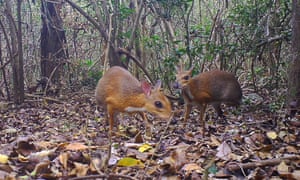
Mouse deer species not seen for nearly 30 years is found alive in Vietnam

Silver-backed chevrotain caught on camera after it was feared lost to science

A distinctly two-tone mouse deer that was feared lost to science has been captured on film foraging for food by camera traps set up in a Vietnamese forest.
Two silver-backed chevrotains
Photograph: Global Widlife Conservation

The pictures of the rabbit-sized animal, also known as the silver-backed chevrotain, are the first to be taken in the wild and come nearly 30 years after the last confirmed sighting.

“We had no idea what to expect, so I was surprised and overjoyed when we checked the camera traps and saw photographs of a chevrotain with silver flanks,” said An Nguyen, a scientist and expedition team leader at Global Wildlife Conservation (GWC).

“Discovering that it is, indeed, still out there is the first step in ensuring we don’t lose it again, and we’re moving quickly now to figure out how best to protect it,” he said.

The silver-backed chevrotain is a half-painted beast. Behind the russet head, neck and front legs lies a silver-grey body and hind legs rounded off by a white, grizzled bottom. Though probably preyed on by leopards, wild dogs and pythons, scientists fear that snares laid by hunters have pushed the species to the brink of extinction. Despite the name, they are neither mice nor deer, but the world’s smallest ungulate, or hoofed animal.

Sunday, 14 April 2019

Tiger geckos in Vietnam could be the next species sold into extinction


Date:  April 1, 2019
Source:  Pensoft Publishers
While proper information about the conservation status of tiger gecko species is largely missing, these Asian lizards are already particularly vulnerable to extinction, as most of them have extremely restricted distribution. Furthermore, they have been facing severe declines over the last two decades, mostly due to overcollection for the international exotic pet market. Such is the case of the Cat Ba Tiger Gecko, whose tiny populations can only be found on Cat Ba Island and a few islands in the Ha Long Bay (Vietnam).
In their study, a Vietnamese-German research team, led by PhD candidate Hai Ngoc Ngo of the Vietnam National Museum of Nature in Hanoi, provide an overview of the evidence for domestic and international trade in tiger gecko species and update the information about the abundance and threats impacting the subpopulations of the Vietnamese Cat Ba Tiger Gecko in Ha Long Bay. By presenting both direct and online observations, interviews and existing knowledge, the scientists point out that strict conservation measures and regulations are urgently needed for the protection and monitoring of all tiger geckos. The research article is published in the open-access journal Nature Conservation.

Sunday, 3 March 2019

New Species Of Turtle Discovered - And It's Already Critically Endangered (Potted Softshell- Pelodiscus variegatus) – via Herp Digest


FEMALE SPECIMEN OF THE NEWLY DESCRIBED TURTLE (PELODISCUS VARIEGATUS) SERVING AS A PARATYPE OF THE NEW SPECIES. THOMAS ZIEGLER
By Tom Hall, 2/13/19, IFLScience
A new species of turtle, complete with a pig-like snoot and a spotted squishy shell, has been identified in the swampy waters of central Vietnam and Hainan Island in China. Unfortunately, the new species is already listed as "critically endangered" – nice one, humans.
It was long assumed that the Chinese Softshell Turtles all belonged to the same species, however, over the past few decades, scientists realized that these creatures were actually numerous different species.
Now, they've identified yet another. Reporting in the journal ZooKeys, an international team of researchers has carried out tests that identify a fifth species in the genus, the Spotted Softshell Turtle (Pelodiscus variegatus), noted for its unique spots on the underside of its belly. Crucially, DNA analysis showed the individuals were genetically distinct enough to be defined as a new species.
"Some years ago we started to investigate whether all ‘Chinese softshells’ are indeed the same species, and during the course of our research it turned out that there are several unrecognized species,” lead author Professor Uwe Fritz of the Senckenberg Natural History Collections in Dresden told IFLScience.
“The new one is the most beautiful one with its nice spots.” 
Fritz suspects that further analysis of Chinese softshell turtles will reveal even more new species hidden in the genus. "More new species to come!" he said.
As the name suggests, softshell turtles have a flexible shell covered with leathery skin rather than a horn-covered shell like you see most turtles and tortoises. They have an extremely long nose (known as a proboscis) with nostrils at the tips that can act like a little snorkel.
The new species is already listed as a vulnerable to extinction, much like the other members of its genus. Softshell turtles are eaten as a delicacy in Vietnam and China, often served up in a stew with chili sauce and bamboo shoots. People also like to chew on bits of their shells, "a bit like chewing gum," Fritz says. This taste for turtle has led to large-scale turtle farming in China and neighboring countries, which has only raised further problems for the turtles.
"For breeding, softshells are transferred across Asia and large farms are established, some outside the native distribution range," Fritz explains. "There is evidence that another species has been brought to Vietnam by this trade, and this new species (originally from China) is now in the wild, occurring in northern Vietnam in the same rivers as the native species.”
“We cannot predict how this will develop but there is the serious risk that the introduced species will outcompete the native one – think of the Grey Squirrel and the Red Squirrel in Britain,” he said. 
The team hopes that asserting the Spotted Softshell Turtle as a new species will allow researchers to raise more awareness and develop better conservation efforts for P. variegatus. Perhaps all is not quite lost for this very strange beast. 

Friday, 1 June 2018

First record of large-antlered muntjac in Vietnam


New hope for the survival of this species

Date: May 22, 2018
Source: Forschungsverbund Berlin

In November 2017 -- under a biodiversity monitoring and assessment activity supported by the US Agency for International Development (USAID) -- scientists and conservationists of the Leibniz Institute for Zoo and Wildlife Research (Leibniz-IZW) and WWF-Vietnam captured photographs of one of the rarest and most threatened mammal species of Southeast Asia, the large-antlered muntjac (Muntiacus vuquangensis), in Quang Nam province, central Vietnam. Prior to this milestone, this species had only been camera trapped in three protected areas in all of Vietnam since the year 2000. The new records from Quang Nam -- which include photographs of both a male and a female -- provide new hope for the continued survival of a species that is on the brink of extinction.

"It is amazing news," said Phan Tuan, Director of the Forest Protection Department of Quang Nam in Vietnam "The two individuals are both mature and of reproductive age. These images prove that the species still survives in Quang Nam province and give us hope that there might even be a breeding population."


Wednesday, 26 July 2017

Three tonnes of ivory seized in Vietnam


July 9, 2017

The global trade in elephant ivory, with rare exceptions, has been outlawed since 1989 after populations of the African giants dropped from millions in the mid-20th century to around 600,000 by the end of the 1980s

Vietnamese authorities have seized nearly three tonnes of ivory hidden among boxes of fruit, officials said Sunday, the latest haul to spotlight the country's key role in the global wildlife smuggling trade.

Police in the central province of Thanh Hoa found 2.7 tonnes of tusks inside cartons on the back of a truck that was on its way to Hanoi, according to a report on their website.

"This is the largest seizure of smuggled ivory ever in Thanh Hoa province," the report said.

State media said the elephant tusks originated from South Africa.

The truck driver claimed he was unaware of what he was transporting, according to a report in state-controlled Tuoi Tre newspaper.

Police declined to comment further when contacted by AFP on Sunday.

The global trade in elephant ivory, with rare exceptions, has been outlawed since 1989 after populations of the African giants dropped from millions in the mid-20th century to around 600,000 by the end of the 1980s.
There are now believed to be some 4
5,000, with 30,000 illegally killed each year.

Thursday, 1 June 2017

Herpetologists describe an elf frog from the elfin forests in southern Vietnam - via Herp Digest


Date: May 19, 2017
Source: Pensoft Publishers

Deep in the foggy, moss-covered forests of Southern Vietnam, herpetologists uncovered one of the smallest species of horned mountain toads.

The name of the new amphibian (Ophryophryne elfina) derives from European mythology and translates to "elfish eyebrow toad." Despite being recently discovered, the new species is already considered to be endangered. Having remained hidden in the highlands of Langbian Plateau, it is now described in the open access journal ZooKeys.
The unique species name "elfina" derives from the English word "elf." In German and Celtic folklore, elves are described as small, supernatural creatures usually dwelling deep in the forests of magical hills. The frogs were named after them primarily because of their small size of around 3 cm, which makes them the smallest known species of the genus -- as well as their fascinating appearance -- they have small horn-like projections above their eyes.

The unique habitat of the amphibians also inspired their species name. The Elfin mountain toad lives in the highland wet subtropical evergreen forest. There it can only be found on mountain summits higher than 1800 m, or on the slopes of the eastern side of Langbian Plateau, where the rainfall is high because of the sea nearby. Both the rocks and the dwarf curbed trees are covered with a heavy layer of moss, whilst a thick misty fog is constantly lingering amongst the trees. This is why such wet mountain ecosystems are known as elfin forests.

The Elfin mountain toad is one of the three known species in the genus Ophryophryne that inhabit Langbian Plateau. Curiously, all three of them share the same habitat, but can be easily distinguished by their advertisement calls resembling whistling birds.

Story Source:
Materials provided by Pensoft Publishers. Note: Content may be edited for style and length.

Journal Reference:
1 Nikolay A. Poyarkov Jr., Tang Van Duong, Nikolai L. Orlov, Svetlana S. Gogoleva, Anna B. Vassilieva, Luan Thanh Nguyen, Vu Dang Hoang Nguyen, Sang Ngoc Nguyen, Jing Che, Stephen Mahony. Molecular, morphological and acoustic assessment of the genus Ophryophryne (Anura, Megophryidae) from Langbian Plateau, southern Vietnam, with description of a new species. ZooKeys, 2017; 672: 49 DOI: 10.3897/zookeys.672.10624

Pensoft Publishers. "Herpetologists describe an elf frog from the elfin forests in southern Vietnam." ScienceDaily. ScienceDaily, 19 May 2017. <www.sciencedaily.com/releases/2017/05/170519100435.htm>.

Thursday, 4 May 2017

In search of the elusive saola - via Richard Freeman

Bill Robichaud fights to save one of the world’s rarest creatures

by Catherine Capellaro

April 6, 2017

When one the most important zoological discoveries of the century was announced in 1992, field biologist Bill Robichaud happened to be sitting in a noodle shop in Vientiane, Laos, reading the Bangkok Post. The article had an inset map showing the location of a Vietnamese village where a set of long, tapered horns — unlike any known to science — were found in a hunter’s shack. “I thought, that thing’s in Laos, for sure,” says Robichaud. “Three days later I was down on a bus to that part of Laos.” By now, we have a name for the mysterious cloven-hoofed creature, the saola (pronounced sow-LAH).

The importance of that discovery still animates Robichaud, who studied zoology at UW-Madison and now lives outside Barneveld. It turns out the saola is the only surviving line of a genus of bovid, a grazing animal related to cattle, bison, goats and antelopes. “This wasn’t a new species of something else; this was an entirely new type of mammal that doesn’t look like anything else, and it had gone undetected,” says Robichaud. “Even the Vietnamese biologists in Hanoi didn’t know about it. And villagers didn’t know it was anything special. I think it was, without doubt, the most surprising zoological find of the 20th century.”

Robichaud assumed some superstar biologists would latch onto the project and make the saola their life’s work. A natural candidate would be George Schaller, who had studied tigers, mountain gorillas, jaguars and giant pandas. The subject of Peter Matthiessen’s adventure tale The Snow Leopard had been a mentor and colleague of Robichaud’s at the Bronx Zoo Wildlife Conservation Society. “I just said, ‘George, you’ve defined your career by being the first guy to do the first-ever field study of large, unknown mammals. Why aren’t you settling down in Laos and making saola your retirement project?’” Schaller’s reply: “How can you study an animal you can’t even see?” So Robichaud seized the opportunity to study the rare and elusive creature. “I just kept waiting for someone to take this over, and nobody did, so I just did it by default.” Robichaud now coordinates a massive international effort to save the saola from imminent extinction.


Continued

Wednesday, 27 April 2016

Vietnam investigates mass fish deaths

Authorities are looking into whether pollution is to blame for a spate of mysterious mass fish deaths along the country’s central coast

Agence France-Presse 

Thursday 21 April 201611.16 BST 

Vietnam said on Thursday it was investigating whether pollution is to blame for a spate of mysterious mass fish deaths along the country’s central coast after huge amounts of marine life washed ashore in recent days.

Tonnes of fish, including rare species which live far offshore and in the deep, have been discovered on beaches along the country’s central coastal provinces of Ha Tinh, Quang Tri, Quang Binh and Hue.

“We have never seen anything like it,” aquaculture official Nhu Van Can told AFP on Thursday.

The strange situation first came to light when farmed fish in the area began dying in great numbers, he said, with locals later discovering huge numbers of dead fish on beaches.

Local fishermen told state-run media that they are burying hundreds of kilograms of fish everyday.

“If you sail just three miles offshore, you can see dead fish all over the ocean floor,” the state-run Tuoi Tre quoted local fishermen as saying.

Signs point to the fish having been poisoned by “unidentified substances,” Tran Dinh Du, deputy director of agriculture in Quang Binh province, said, according to the report.

“We have asked people not to eat the fish and not use the fish as food for their livestock,” Du added.


Wednesday, 27 January 2016

The Turtle Survival Alliance has confirmed that one of the world’s four known remaining Yangtze Giant Softshell Turtles (Rafetus swinhoei), has died in Vietnam. - via Herp Digest

This turtle – believed to be a male - was highly revered in Vietnam and was a long-time occupant of Hoan Kiem Lake in the heart of downtown Hanoi. Sightings of the turtle attracted large crowds, as well as visitors from around the world. This turtle made global news back in 2011 when health concerns prompted officials to capture the turtle for medical treatment and mount a massive cleanup effort for the polluted lake.
The death of this Rafetus reduces the known number of living animals to three: one in a protected lake in Vietnam and a pair at the Suzhou Zoo in China. Since 2008, this pair has been the subject of intensive efforts to encourage them to reproduce in captivity as a last ditch effort to save the species, currently recognized as the most endangered turtle in the world.

Saturday, 28 March 2015

Bio-diversity hotspot in Vietnam saved as part of Forests of Hope programme

The future of one of South-East Asia’s richest biodiversity hotspots has been made more secure thanks to an innovative new agreement that aims to see such forests protected.

A 30-year environmental lease on 768 ha of lowland broadleaved evergreen forest at Dong Chau in north-central Vietnam, was signed by members of the Viet Nature Conservation Centre (an independent NGO), local Vietnamese authorities and environmental officials.

It is the first partnership agreement of its kind in Vietnam and was part of Birdlife International’s Forests of Hope programme, aimed at achieving large-scale forest conservation and restoration for the benefit of people and nature.

The announcement of the lease may have come just in time for Khe Nuoc Trong Forest.

Tuesday, 10 March 2015

Dermacentor limbooliati: New tick species from Malaysia, Vietnam

Date:
March 10, 2015

Source:
Entomological Society of America

Summary:
A new tick species found in Malaysia and Vietnam was recently discovered in the United States National Tick Collection by researchers in Georgia.


Sunday, 8 March 2015

Vietnam: Officials try to trace 'mystery amphibian'

5 March 2015 Last updated at 12:14
By News from Elsewhere......as found by BBC Monitoring


Officials in Vietnam are on the hunt for a mystery amphibian which was apparently captured and then sold in the north of the country, it's reported.

Vietnamese environment officials are trying to
 trace the animal after images were widely
 shared on social media

Photos of the metre-long animal were posted on Facebook by a man who says he pulled it from a pond near his home in the Vinh Phuc region,Thanh Nien News website reports. But local environment officials don't know what it is, despite searching records of native species. While it bears some resemblance to a giant salamander, native to neighbouring China, officials say even if it's a related species there is no explanation for how it came to be found hundreds of miles away in northern Vietnam. And tracking it down now could prove tricky - the man who uploaded the images told Thanh Nien News that he has sold it, and won't give any more details.

Monday, 16 February 2015

Rescued pangolins sold to restaurants


Rescued pangolins sold to restaurantsWhen police from the northern province of Vietnam intercepted poachers and rescued 42 pangolins it might be safe to assume that eventually those pangolins would be released back into the wild. However once the pangolins were handed over to forest officials the officials decided to sell them to local restaurants.

Conservationists from Education for Nature-Vietnam have been angered by the decision of the forestry department and accuse the officials of effectively supporting the trade in endangered animals. Even if, as claimed by officials, the pangolins were in such a poor condition they would likely die, selling them to restaurants should not have been contemplated.

Nguyen Thi Phuong Dung, deputy director of Education for Nature-Vietnam, called the decision a failure to deter the wildlife trade and that the pangolins should not have been treated purely as evidence and then traded commercially.

Bac Ninh’s Forest Management Department head, Le Van Minh, said that everything was done within the law. The animals were not in a fit condition to be released back into the wild and the law allows authorities and registered traders to undertake commercial activities with pangolins.

Tuesday, 25 November 2014

Vietnam seizes over 1,000 dead endangered sea turtles

Tuesday 25 November 2014 10.33 GMT

Vietnam’s environmental police have seized a record haul of over 1,000 endangered sea turtles which were being prepared for illegal export to China, an official said on Tuesday.

“The turtles were all dead,” said Le Hong Thai, an official of the Ministry of public security’s environmental police department.

“They were meant to be processed into handicrafts for export to China,” he added.

The raids were made on Wednesday last week in the resort town of Nha Trang on Vietnam’s south-central coast.

“The case is under investigation, so we cannot reveal the number of detainees or any other details,” Thai said.

Thursday, 16 October 2014

Rhino horn demand down in Vietnam

Demand for rhinoceros horn in Vietnam has dropped by almost 40 percent since the launch of a public education and awareness campaign in August 2013.

news/2010_jan/rhino-horn-demand-declines-in-VietnamThe campaign was jointly implemented by the Humane Society International (HIS) and the Vietnam Convention on International Trade in Endangered Species of Wild Fauna and Flora (CITES)
The year-long campaign focused on targeting people in Vietnam’s capital city, Ha Noi, by engaging stakeholder groups to help spread messages against the use of rhino horns.

These included the 800,000-member Ha Noi Women’s Association, the business community, university students, the scientific community, leading health experts and school children,. Who all received copies of HSI’s book I’m A Little Rhino as part of their curriculum.

Saturday, 2 August 2014

Black bear sighting in Vietnam indicates conservation success

A rare Asiatic black bear has been recorded by WWF camera traps in Quang Nam Province in central Vietnam.

Due to its white patch on its chest the Asian black bear (Ursus thibetanus),is also known as the moon bear or white-chested bear, and is classed by the IUCN as a vulnerable species.

The sighting is an important indicator of the success of the conservation efforts by WWF and the Vietnamese government to improve the quality of the area’s forests and preserve the unique species diversity.

The framework of the Carbon and Biodiversity Programme (CarBi) covers an area of more than 200,000ha of forest, along a vital mountain range that links Laos and Vietnam in Southeast Asia.

Monday, 16 June 2014

Vietnamese ivory smugglers go on package holiday

Posted by: Kevin Heath / 1 day ago

A new modus operandi could be coming into force as Hong Kong customs intercepted 15 Vietnamese passengers on the same flight who were carrying ivory in cabin luggage. By using lots of ‘mules’ carrying small quantities of ivory in ‘carry-on’ bags smugglers may be hoping to reduce the risk of discovery.

In total the 15 passengers, who were agreed between 20 to 54, were carrying 790kg of ivory and tusks. The travel plans of the passengers involved flights from Angola via Ethiopia in to Hong Kong. The smugglers were then to fly from Hong Kong to Cambodia via South Korea.

The ivory was discovered after passengers luggage were put through routine inspections. Customs officers revealed that some of the tusks were still blood-stained from being hacked away fromelephants and that there was a bad smell when many of the cases were opened.

“The Hong Kong authorities are to be congratulated for their diligence in detecting this sizeable quantity of ivory, but the case throws up many questions and could be harbinger of new criminal tactics emerging in the illicit ivory trade,” said Tom Milliken, TRAFFIC’s ivory trade expert.

Tuesday, 27 May 2014

Vietnam seizes over 1 tonne of ivory


Vietnam has made a major seizure of ivory as it entered the country yesterday. Over 1 tonne of elephant tusks were hidden in a container marked as charcoal. It is thought that the ivory made its way to Hai Phong via Hong Kong.

The tusks arrived at the port in a 40 foot container that had been certified as containing 15 tonnes of charcoal. When the shipment was inspected customs officers found the tusks, which had been sliced up into piece, hidden in the bags of charcoal.

Hai Phong customs officials are investigating the shipment which had been declared as belonging to Du Huong Commercial and Construction in Mong Cai City.

Ivory trading has been banned in Vietnam since 1992.

Sunday, 13 April 2014

New pink and yellow frog discovered

April 2014: Biologist Jodi Rowley, an expert on Southeast Asian amphibians from the Australian Museum Research Institute in Sydney, recently found this striking pink and yellow frog in the remote Mount Ngoc Linh region of Vietnam.

The 5cm long frog lives in forests above 1,800m where the terrain is steep and rocky, and lacking in the standing water that might be expected to sustain frogs, but the research team found they thrived in water-filled hollows in the trees. The males have skin covered in keratin spines, which increase in size during the mating season and are thought to help females to identify males. The species has been named thorny tree frogs (Gracixalus lumarius).


Tuesday, 8 April 2014

Vietnamese Bear Bile Farmer Joins Growing Movement as He Turns His Back on Cruel Trade


Founder and CEO, Animals Asia
Posted: 04/03/2014 4:09 pm EDT Updated: 04/03/2014 4:59 pm EDT

Just recently we celebrated the rescue of another "bile farmed" bear who had spent 14 years of his life caged and extracted of his bile. Ti Map, (or Chubby Mouse), was the last farmed bear in the province of Binh Thuan in southern Vietnam and was rather remarkably offered into our care by the farmer himself, who announced he no longer wanted to be part of the trade.

Known in the area by virtue of an advertising sign outside of his house, that boasted the healing effects of bear bile (while ignoring the mutilation of the bear), the farmer suddenly announced that he and his wife wanted to give the bear up, but not to another farm. Apologizing to the local Forest Protection Department, for violating Vietnam's laws, the farmer also said that the couple did not want the bear to be abused any more, they wanted him to see no more suffering.

Just this week, because this farmer had the moral integrity to admit the truth of an industry in which he was engaged, Ti Map arrived on site at Animals Asia's expansive Vietnam sanctuary after our team escorted him virtually from one end of the country to the other. Now settling into his new life, and being spoiled with food he could only have dreamed of before, Ti Map is hopefully putting the misery of his caged and farmed suffering well and truly behind.

Related Posts with Thumbnails

ShareThis