Showing posts with label Norfolk. Show all posts

Monday, 14 October 2019

Norfolk RSPCA centre saves 50th seal with injuries from rubbish


11 October 2019

A grey seal rescued on the North Sea coast has become the 50th to be treated by a wildlife centre for injuries caused by discarded man-made rubbish.

The animal, a male named Scylla, was found with an infected wound caused by a fishing net embedded around his neck.

The RSPCA centre in Norfolk said 2019 could be a record year for seal rescues "for all the wrong reasons".

"It's hard to describe how much pain and distress this can cause a seal," said manager Alison Charles.

"They are weighed down by this huge mass of netting, which must make it hard for them to swim, and then the net starts to cut and embed into their neck too.

"The injuries are horrendous, sometimes inches deep, and all the while the seal is becoming weaker and weaker and cannot feed so their suffering continues and they slowly starve to death.

"It is just horrific."

Wednesday, 29 August 2018

Project to save rare species in unique Brecks landscape


PUBLISHED: 14:20 15 August 2018 | UPDATED: 14:20 15 August 2018

Straddling the Norfolk and Suffolk border, The Brecks is one of the most unusual lowland landscapes in the UK and one of its most important areas for wildlife.

The unique landscape that developed from an ancient landscape of sandy, chalky soils, shallow rivers, open heaths, sheep walks and medieval rabbit warrens covers 1,000 sq km and is home to more than 12,800 species.

Comprising conifer plantations and large fields edged with lines of crooked pines, rare species include birds such as the nightjar and woodlark as well as 65% of the UK’s stone curlews.

Now a new ambitious project that aims to help restore and protect its at-risk wildlife and habitats will be launched this weekend at Brandon Country Park.

Shifting Sands is one of 19 projects around the country under the umbrella of the collaborative Back from the Brink programme which aims to save some of the nation’s rarest wildlife.

It will work with volunteers and partner organisations in Norfolk and Suffolk to restore more than 15 areas of grass heath recreating the open, sparsely vegetated conditions required by many birds, reptiles, plants and insects that live or breed there.

Natural England’s project officer for Shifting Sands, Phoebe Miles, said: “The Brecks is a very special landscape that is home to over a quarter of the UK’s rare and declining species, but it needs our help. Over 75% of its grass heaths have been lost in the past century.”

The project will directly benefit 14 vulnerable and endangered species including woodlark, the wormwood moonshiner beetle, its food plant Breckland wormwood and prostrate perennial knawel - a small plant that exists nowhere else in the world.

Ms Miles said heaths for hundreds of years were home to rabbits that proved great habitat managers, but they are now in sharp decline.

“We aim to boost rabbit populations on these heaths so that rare plants and their associated insects can re-colonise the more open, rabbit-disturbed ground,” she said.

Read on http://www.edp24.co.uk/news/environment/project-launches-to-save-rare-species-in-unique-brecks-landscape-1-5652955

Sunday, 13 May 2018

Seal avoids 'slow and painful death' by air vent filter


3 May 2018

A young seal is having to be taught to swim upright, after it became used to swimming on its back because of a plastic ring stuck around its neck.

It was spotted off the Norfolk coast with a deep wound caused by part of an air vent filter cutting into his flesh. After treatment, staff at Sea Life Hunstanton named him Relashio, after a Harry Potter spell.

It is now being taught to mimic other seals and swim in an upright position so it can be released. The juvenile grey seal was spotted struggling at Burnham Overy Staithe beach on the north Norfolk coast with a "waste air vent... dangerously trapped around his neck" which would have led to "a slow and painful death" had he not been treated.

Read on 

Wednesday, 24 January 2018

Giant new safari park could be created on Norfolk quarry site


PUBLISHED: 17:02 21 January 2018 | UPDATED: 19:01 21 January 2018

A £7.5m safari park complete with wildebeeste, flamingo and a host of wild animals could be created in Norfolk, bringing hundreds of jobs to the county.

The visionary behind the new Watlington Safari Park, near King’s Lynn, believes it would be the first of its kind of the United Kingdom, bringing £3.57m per year to West Norfolk’s economy and providing a popular attraction for residents and visitors alike.

In a brochure sent to villagers Edward Pope, the man behind the idea, said: “I am passionate about the conservation of endangered animals and birds.

“For several years I have been provided a refuge and breeding programme for deer and antelope at my home in Norfolk.

“Now I want to build on that work by expanding this refuge to create an inspirational centre for education, a visitor experience that people can enjoy and a site for extraordinary wildlife encounters.”

Sunday, 30 October 2016

Rare fin whale stranding in Norfolk puzzles scientists


Experts say fin whales are normally found on south or west coasts of UK, not on east coast
Staff and agencies

Friday 21 October 2016 16.37 BST Last modified on Monday 24 October 2016 18.00 BST 

Mystery surrounds how a rare 12-metre (40ft) fin whale came to be washed up on a beach in Norfolk.

The enormous creature was already dead when it was washed up on Holkham beach on the north Norfolk coast on Thursday afternoon. 

Evolutionary biologist Dr Ben Garrod from Anglia Ruskin University in Cambridge said it was very unusual for a fin whale to be found on the east coast of Britain.

Fin whales sometimes seen in North Sea
“It should not be in those waters,” he told the BBC. “We see fin whales occasionally on the southern coast or more the west coast of the UK, so Ireland, right up to Scotland. But you never get them in the North Sea, so what it was doing there, we have no idea at the moment.”

It was not clear why the whale died, he added.

A postmortem is expected to be carried out by the Cetacean Strandings Investigation Programme.

The death comes after a spate of whale strandings along the Norfolk region’s coastline this year, with dozens having died in other parts of the North Sea.

A spokeswoman for the Holkham Estate said the picturesque beach remained open and added: “Plans are in place to remove the whale from the beach. Holkham beach remains open, but we advise the public not to venture close to the carcass and to keep dogs on leads.”


Tuesday, 15 March 2016

Rare wildlife discovered in biggest nature survey along Britain's coast

 Wildlife ‘firsts’ include Norfolk’s only sighting of a Balearic shearwater and a beetle not seen in Northern Ireland for more than 100 years


Friday 11 March 2016 06.01 GMTLast modified on Friday 11 March 201606.05 GMT

The biggest survey to date of nature along Britain’s coastline has uncovered a host of “wildlife firsts”.

More than 3,400 species were recorded at 25 National Trust locations along the coastline of England, Wales and Northern Ireland in the charity’s largest ever wildlife survey. A handful have either been seen in a new habitat for the first time or “rediscovered” after going unseen for many years. 

Results included the first ever recorded sighting of the Balearic shearwater (Puffinus mauretanicus) at Blakeney on the Norfolk coast. This bird is normally seen far out to sea off the coast of Cornwall, Devon, Dorset and west Wales, but a sighting off the east coast is more unusual, rangers said.

At Freshwater West in Pembrokeshire, west Wales, a slow worm (Anguis fragilis), was found for the first time since 1966 and a rare forest cockchafer beetle (Melolontha hippocastani), was found in the dunes of White Park Bay, Co Antrim for the first time in Northern Ireland in more than a century.

Four thousand nature lovers and expert volunteers helped survey 25 National Trust coastal properties. Photograph: Zoe Frank/National Trust

Over six months last year, 4,000 people took part in “bio blitz” surveys, with the aim of recording as many species as possible over either 12 or 24 hours. 

Some 53 species “red listed” by the IUCNwere recorded, including the Dartford warbler, spotted on Brownsea Island in Dorset for only the second time since the 1980s. The surveys also recorded 95 of the UK’s most threatened species – among them water vole, found at Dunwich Heath on the Suffolk coast for only the second time in more than 40 years, and the red-shanked carder bee (Bombus ruderarius), seen at Birling Gap in East Sussex for the first time.

Dr David Bullock, the trust’s head of conservation, said the results would help provide the trust with a greater understanding of the species that live along Britain’s coastline.


Friday, 11 March 2016

Norfolk grey seal twin pups R2-D2 and C-3PO 'a world first'

7 March 2016

Two seal pups, which were believed to be the first wild grey seal twins born in the UK, are the first to be recorded in the world, it has been confirmed.

The pups were abandoned by their mother after being born at Horsey Gap in Norfolk in November.

The seals and blood-soaked sand from the birth site were tested and revealed they have the same mother.

Anne Kirstine Frie, of the Institute of Marine Research in Norway, said: "It is so rare. It is very exciting."

The female and male are being cared for at the RSPCA Wildlife Hospital at East Winch, near King's Lynn, where they were named R2-D2 and C-3PO.

Experts had hoped they were twins and were unaware of any grey seal twins recorded in the UK. The Institute of Marine Research, which carried out the tests, confirmed it was the first record of wild grey seal twins in the world.

Ms Frie said: "It's very unusual.

They were born on 28 November and rescued after their mother stopped feeding them for 24 hours

"I have never experienced it myself, and my British colleagues who do a lot of fieldwork have never observed it.

"It must happen in the wild from time to time, but we have never had knowledge of wild grey seal twins.

"In the wild they very rarely survive, the both of them, but these are both in good health."


Tuesday, 16 February 2016

Female shark due for ‘virgin birth’ at Great Yarmouth Sea Life Centre


She has been the only member of her species at the centre and has had no contact with male sharks

Wednesday 10 February 2016

A female shark could be set to give birth to two babies despite not having had contact with males for more than two years.

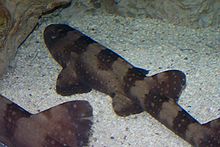
Experts at the Great Yarmouth Sea Life Centre have said that the white spotted bamboo shark has produced two fertile eggs which could hatch at any time after 15 weeks. 

Chiloscyllium plagiosum newport.jpgThe so-called virgin birth is known as parthenogenesis - a process which does not involve input from a male. It was recorded for the first time in sharks in 2001, and has since been seen in the bamboo, bonnethead, blacktip and zebra species.

Darren Gook, a marine biologist and shark expert, said: “Females somehow manage to add an extra set of chromosomes to their eggs to produce off-spring which are either clones or half-clones of themselves."

Read on ...

Tuesday, 9 February 2016

Whale feared to be in trouble off Norfolk coast

Latest report comes after a bull died at Hunstanton, Norfolk, and the discovery of four dead whales washed up on the Lincolnshire coast.

By Agency

11:42AM GMT 09 Feb 2016

Another whale may be in trouble in shallow waters off the British coast, rescuers have said.

The latest report comes after a bull died at Hunstanton, Norfolk, on Thursday. This was the 30th sperm whale death in the North Sea this year.

British Divers Marine Life Rescue (BDMLR) said on Tuesday that it was investigating the latest sighting off north Norfolk.

A spokeswoman said the sighting had been referred to them but there were no further details on precise location or species

Last week's whale death followed the discovery of four dead whales washed up on the Lincolnshire coast and another at Hunstanton last month.

Others have been found in France, the Netherlands and Germany.

The Cetacean Strandings Investigation Programme, which examines all whale, dolphin and porpoise strandings in the UK, is working to establish why the whales came ashore and how they died.

This could help establish what the whales, thought to have come from the same bachelor pod normally living off the west coast of Norway, were doing in the North Sea.

One theory is that the male whales could have taken a wrong turn while heading south to find females or been lured by food.

Sunday, 24 January 2016

Eel fisherman quits amid plunging eel numbers

Britain's last eel catcher will bring a 3,000 year old tradition to an end as he says he can’t find a successor or make the job pay

By Agency
1:50PM GMT 19 Jan 2016

Britain’s last eel catcher will bring a 3,000-year-old tradition to an end as he says he can’t find a successor or “live on empty pockets”.

Peter Carter, 50, has been trapping eels using the same methods that have been employed on the Fens in eastern England for a staggering 3,000 years.

But now devastated Mr Carter is hanging up his nets amid plunging eel stocks.

Peter's own family has traced its eel fishing connections back to at least 1475. But archaeologists have found clear evidence of the same cottage industry arcing back many more centuries than that to the Bronze Age.

Mr Carter, of Outwell, west Norfolk wrote in an statement posted online: "It breaks my heart but I can't live on empty pockets.


Saturday, 2 January 2016

Blakeney seal pup drop is 'good news' for reserve

1 January 2016 

The number of seals born at England's largest colony has dropped for the first time after nine years of growth.

The National Trust counted 2,342 pups born this season at Blakeney in Norfolk - about 80 fewer than last year.

Ajay Tegala, National Trust ranger, said: "This is good news as the seals were spreading at such a rate over such a big area that it makes it easier to protect them."

The Trust said the lower birth rate meant the colony had "stabilised".

After grey seals began colonising the spit on the north Norfolk coast, the Trust said there was anecdotal evidence of two pups being born in 1987 or 1988 and a first "official" record of five pups in 1999.

A more accurate standardised method of counting pups began in 2006 when 213 were recorded.

Tuesday, 15 December 2015

Wounded Norfolk seal faces wait for treatment on neck

11 December 2015 

A seal thought to have been wounded by netting might have to wait for weeks before being treated, a charity said.

The bull seal, who is surrounded by females on the Norfolk coast, has a deep neck wound but vets do not want to approach him during breeding season.

The RSPCA said he did not appear to be in "imminent" danger, but they hoped to remove what was believed to be the embedded netting in January.

It said it did not want to disturb the mothers while they nursed their pups.

The public beach at Horsey, about 12 miles (19km) from Great Yarmouth, has had breeding grey seal colonies since 2003, according to the Friends of Horsey Seals.

Peter Ansell, chairman of the group, which patrols the beach to try to prevent people disturbing the animals, said: "The poor old boy does look pretty gruesome.

"At this time of year, all the bulls want to do is dominate their competitors and mate, so he's among the ladies and full of testosterone.

"You could never catch him and if you tranquilised him with a dart there's a risk he could bolt into the sea, lose consciousness and drown."

He said the breeding season would not finish until mid-January.

An RSPCA spokeswoman said they wanted to remove any netting, but the bull still seemed "strong and mobile".

Sunday, 15 November 2015

Three-eared 'Captain Kirk' cat found in Norfolk

12 November 2015

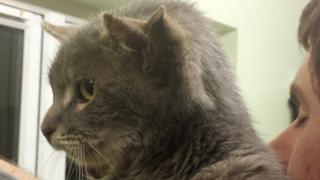
A three-eared cat - who rescuers almost dubbed Captain Kirk due to his "final front-ear" - has been found abandoned near a garage.

The stray stunned staff at Feline Care Cat Rescue, in East Harling, Norfolk, with the "peculiar" birth defect.

Manager Molly Farrar said the centre's vet had not seen a cat with an extra ear in 30 years of practice.

Staff at the centre floated a number of names but settled on Brian, the Eastern Daily Press first reported.

The cat was named after the owner of the garage where he was found.

"It's obviously a really rare thing as our vet hasn't seen it as well," Ms Farrar told the BBC.

Brian the three-eared cat"We see plenty of cats with no tails, some tails, only a little bit of tail missing, cats with three legs, one eye, cats with all kinds of disabilities, but this is something quite special."

Brian, who is thought to be between four and eight years old, almost ended up with a more outlandish moniker, Ms Farrar said.

"We have had suggestions of Spock or Captain Kirk because he's got a left ear, a right ear and a final front-ear," she said.

Brian was discovered on Monday near the remote cat sanctuary, which is on the edge of an industrial estate, and it is thought he may have been dumped or ended up on the back of a lorry.

If Brian's owner cannot be found, he will be re-homed, Ms Farrar said.


Sunday, 21 June 2015

David Attenborough opens new stretch of Norfolk reserve and education centre at Cley

A new footpath across a recently connected 8km swathe of continuous Norfolk coast welcomed its first visitors last Friday, 12 June 2015.

President Emeritus of The Wildlife Trusts, Sir David Attenborough, and two young naturalists, Connor Lonergan and Sasha Carter-Lonergan took the first steps along the path as it officially opened to the public.

Norfolk Wildlife Trust (NWT) purchased the missing stretch of land in 8km of protected coastal sites in 2012, thanks to a £900,000 public appeal and a grant of over £1.5m from Heritage Lottery Fund (HLF). 

The land - 143 acres - sits between its nature reserve at Salthouse Marshes, and NWT’s flagship reserve, Cley Marshes. Cley Marshes is one of the world’s leading bird-watching destinations and is a historic jewel in The Wildlife Trusts’ crown – it was The Trusts’ first ever nature reserve when it was acquired in 1926.

Over the past three years the new land has been transformed from its former use as land for commercial shooting.

Wednesday, 1 April 2015

New mushroom species found in Norfolk (don't eat it)

Scientists say a fungi with a strange, manlike appearance found in Cockley Cley 15 years ago was in fact a new species


6:57PM BST 29 Mar 2015

A new type of mushroom shaped like a fisherman has been discovered in Norfolk – just don't try to eat it.

The fungi, first spotted in the remote Cockley Cley, almost 15 years ago has been confirmed by scientists as a completely new species.

Its appearance has been compared to a fisherman because it has a little round head that could be a seafaring hat and two protrusions that look somewhat like arms inside a Mackintosh.

The fungi have been given the name Geastrum britannicum, recognising that, so far, they have only been found in Britain.

Tony Leech, fungi recorder for Norfolk, said: "For us, it's like a bird watcher spotting a rare bird and this is not just a new species of fungus for Norfolk or for Britain, it is new to science."

The fungus was first spotted by on a roadside verge under some pine trees in 2000 by Jonathan Revett, one of Mr Leech's fellow members at the Norfolk and Norwich Naturalist’s Society.

At the time, experts at Kew Gardens and in Holland thought it was merely a variant of the extremely rare Rayed Earthstar, which is only slightly different in appearance.

Monday, 9 March 2015

Lynx to be reintroduced into wild in Britain after a 1,300-year absence

The predators eat deer, rabbits and hares among other animals but are not considered a risk to people


Lynx are to be reintroduced into the wild in Britain after a 1,300-year absence, under an ambitious “rewilding” plan drawn up by a conservation charity.

The Lynx UK Trust would release up to 18 of the cats onto private estates in Aberdeenshire, Cumbria and Norfolk if the idea is given the go-ahead by Natural England and Scottish Natural Heritage.

The predators eat deer, rabbits and hares among other animals but are not considered a risk to people as they tend to stay away from humans.

Dr Paul O’Donoghue, who advises the trust, told The Sunday Times: “The lynx is one of the most enigmatic, beautiful cats on the planet. The British countryside is dying, and lynx will bring it back to life.”

Monday, 19 January 2015

Pup numbers boom at English seal colony

Blakeney Point becomes the biggest breeding site for grey seals in England thanks to remote, sheltered beach

Press Association

Monday 19 January 2015 10.01 GMT

A grey seal colony has seen the number of pups born each year increase a hundred-fold in just 14 years to become the biggest breeding site for the animals in England.

North Norfolk’s Blakeney Point, managed by the National Trust, saw 2,426 seals born this year, almost double the number born there two years ago.

National Trust experts put the success of the colony, which has grown exponentially since the first 25 pups were born there 14 years ago, down to the remote, sheltered beach which is safe from predators and other disturbances.

To prevent walkers disturbing the seals, which can increase the chance of fighting among the adults and lead to the pups being crushed, National Trust rangers and volunteers have fenced off part of the beach and dunes and introduced viewing areas.

National Trust rangers monitor the colony, tracking and recording seal pups born throughout the winter from November. The young seals are expected to be on Blakeney Point until the end of January.

Related Posts with Thumbnails

ShareThis