Showing posts with label stranding. Show all posts

Sunday, 30 October 2016

Rare fin whale stranding in Norfolk puzzles scientists


Experts say fin whales are normally found on south or west coasts of UK, not on east coast
Staff and agencies

Friday 21 October 2016 16.37 BST Last modified on Monday 24 October 2016 18.00 BST 

Mystery surrounds how a rare 12-metre (40ft) fin whale came to be washed up on a beach in Norfolk.

The enormous creature was already dead when it was washed up on Holkham beach on the north Norfolk coast on Thursday afternoon. 

Evolutionary biologist Dr Ben Garrod from Anglia Ruskin University in Cambridge said it was very unusual for a fin whale to be found on the east coast of Britain.

Fin whales sometimes seen in North Sea
“It should not be in those waters,” he told the BBC. “We see fin whales occasionally on the southern coast or more the west coast of the UK, so Ireland, right up to Scotland. But you never get them in the North Sea, so what it was doing there, we have no idea at the moment.”

It was not clear why the whale died, he added.

A postmortem is expected to be carried out by the Cetacean Strandings Investigation Programme.

The death comes after a spate of whale strandings along the Norfolk region’s coastline this year, with dozens having died in other parts of the North Sea.

A spokeswoman for the Holkham Estate said the picturesque beach remained open and added: “Plans are in place to remove the whale from the beach. Holkham beach remains open, but we advise the public not to venture close to the carcass and to keep dogs on leads.”


Monday, 20 June 2016

Eight pilot whales dead in mass stranding in Indonesia

Hundreds of fishermen and officials rescued 24 of the whales after their pod swam ashore in Probolinggo, East Java

Agence France-Presse
Thursday 16 June 201611.02 BST
  

Eight pilot whales have died after a mass stranding on the coast of Indonesia’s main island of Java that sparked a major rescue operation, an official said Thursday.

Thirty-two of the short-finned pilot whales came ashore during high tide early Wednesday in Probolinggo, East Java province.

“At first there were just one or two whales swimming near the shore, and the nature of whales is that if they are sick they will come near the shore,” Dedy Isfandi, the head of the local maritime and fisheries office, told AFP.

“But whales have such high social interaction – when one fell ill, they approached the sick one to swim back to sea ... when the tide fell all of them were trapped,” Isfandi added.

Hundreds of local fishermen and government officials tried to take them back out to sea overnight, but in the morning eight whales had returned to shore and died, Isfandi said.

About 23 others were already out at sea while one disoriented whale was accompanied by rescuers to make sure it did not return to shore.

Rescuers used tarps to wrap around the beached whales and pull them out to sea, while swimmers plunged into the water to drive others out of the area.

Vets and scientists conducted autopsies on the dead whales to find out why they were stranded. Fishery officials said it could be due to turbulent waters in the Indian Ocean or that they had eaten something poisonous.

Over the last decade or so, whale sharks and orcas have also been found stranded in the area, Isfandi said.


Friday, 29 January 2016

Fifth dead whale found on English beach

Experts investigate possible causes of worst stranding on the English coast since records began in 1913, while people flock to sites to take photos

Josh Halliday, north of England correspondent, and Patrick Barkham

Monday 25 January 2016 19.03 GMTLast modified on Tuesday 26 January 201611.28 GMT

A fifth dead whale has been found washed up on the Lincolnshire coast, several miles from four other members of the same pod, marking the worst sperm whale stranding off the English coast since records began in 1913.

The fifth whale was discovered by a member of the public on Monday afternoon on a former weapons range in Lincolnshire where the second world war Dambusters squadron practised bombing runs.
Onlookers have been told to stay away from the land, which was sold by the Ministry of Defence six years ago, and it remains inaccessible to scientists amid warnings that it may be strewn with unexploded bombs.

The male sperm whale was found five miles down the coast from where three others were found in Skegness at the weekend and across the shallow waters of the Wash from where another whale was found on Hunstanton beach in Norfolk.

Scientists believe that the whales, all members of the same pod, were hungry and dehydrated but alive when they were stranded in shallow waters during their search for food. Sperm whales are deep sea creatures and can easily become disoriented if they get into shallow water.

One of the Skegness whale bodies “exploded” when pathologists cut it open, and Rob Deaville, project manager at the UK Cetacean Strandings Investigation Programme, a Defra-funded group that investigates whale deaths, said the quickly decomposing state of the carcasses made it “much harder to gain any pathologically useful information”.

According to Deaville, their investigations found little in the whales’ intestines apart from “some squid beaks and some little fragments of plastic”. He said this suggested the whales died when the weight of their own bodies caused their internal organs to collapse.

 “This is an unusual event and the question hanging is why they were in the North Sea in the first place,” said Deaville. With a lack of food and shallow, disorientating waters for a deep sea animal, “they were always up against it unless they could find their way out through the big open end between Norway and Scotland.”

Thousands of people have flocked to the tourist resort of Skegness to see the whales since Sunday, with onlookers taking selfies in front of the huge carcasses as marine biologists cut away chunks of flesh and bone.


Tuesday, 14 July 2015

Beachgoers help rescue stranded great white shark

Shark kept wet by beachgoers
UPDATED 11:53 PM EDT Jul 13, 2015

CHATHAM, Mass. —A great white shark that became stranded on a Chatham beach was kept wet by beachgoers until it could be pulled back into the water by officials Monday.

The shark, a 7-foot juvenile male, beached itself trying to get a seagull near the barrier breach on South Beach, a witness said.

"Last year we know that sharks were in that area, and that it got shallow and it was hard for them to get out," Cynthia Wigren, of the Atlantic White Shark Conservancy said. "It was hard for them to get out, but for a shark to be beached, is a big deal."

"There was no way for the shark to get to where it could swim, so it just kept flapping and moving over," witness Kelly Skanell said.

The shark was kept wet by beachgoers until it was pulled back into the water by officials who attached a line to its rear caudal fin.

"What we did once it was completely beached is throw buckets of water, because we though that would sort of help keep it alive," Isabel Hegland said.

It took about an hour to slowly tow the shark back out to sea. The shark was tagged by Marine Fisheries officials and returned to the sea.

Tuesday, 2 June 2015

Five whales die in Isle of Skye stranding

Rescuers refloat several pilot whales pod at Brogaig Bay on Staffin Island but 11 are still stranded and five others have died

Staff and agencies

Tuesday 2 June 2015 12.40 BSTLast modified on Tuesday 2 June 201513.00 BST

Five whales have died and 11 others are stranded off the Isle of Skye after becoming stuck on rocks on Staffin Island off the northern coast earlier on Tuesday.

A team from the British Divers Marine Life Rescue (BDMLR) is tending to the stranded mammals and giving first aid to them.

A spokesman said: “They are not in an easy position as they have stranded awkwardly on rocks, meaning it is difficult to relieve the pressure on their bodies.”

The BDMLR was alerted to a pod of 21 pilot whales that had become stranded at Brogaig Bay on Skye at about 4am.

Rescuers said 18 were refloated before 16 became stranded again on Staffin Island. Two whales died and a pregnant female who was not expected to survive was euthanised, the BDMLR said.

Wednesday, 15 April 2015

Walker rescues octopus stranded on misty North Devon beach

By NDJDuncan | Posted: April 15, 2015

A WALKER has rescued an octopus which he found stranded on a misty North Devon beach.

Dave Browne was walking his dog in Instow this morning when he noticed a “white ball” on the sand.

“I gently nudged it with my foot and it started to move,” he said.

“I then realised it was a living octopus which had been washed up on the shore.


Wednesday, 26 November 2014

Rare whale successfully rescued after stranding on Welsh beach

A stranded young six-foot Pygmy Sperm Whale has been successfully been refloated off a beach at Anglesey, North Wales and last seen heading towards the Irish Sea.

Sea Watch volunteer and BDMLR marine medic Ben Murcott, was the first to arrive at the Newborough beach on Anglesey after the alarm was raised. He and other trained volunteers assessed its condition and kept it comfortable until they were satisfied it could cope with being refloated. It was then carried out to the sea on a stretcher and allowed to reacclimatise to the water before being released to swim away.

The Pygmy Sperm Whale is one of two species of theKogia Whale, the other of which is a Dwarf, and sightings of either is unusual in UK waters.


Thursday, 20 November 2014

Rescuers try to guide pod of whales off Essex coast into deeper water


Pilot whales spotted a mile offshore in area where there are several mud and sand flats

A group of pilot whales spotted off the Essex coast are being herded out into deeper water to stop them from stranding.

The 40-strong pod have been spotted just a mile offshore and have been sheltering near the Blackwater Estuary.

Boats are being used by British Divers Marine Life Rescue and Essex police’s marine unit to try to herd the whales further out to sea as the estuary has a number of mud and sand flats.

This could lead to the pod, which was initially spotted off the Norfolk coast, becoming stranded when the tide goes out.

Members of the public have been asked to keep their distance to stop the animals from becoming upset.

Tuesday, 21 January 2014

Well, This Is One Way To Remove A Dead Whale From The Beach

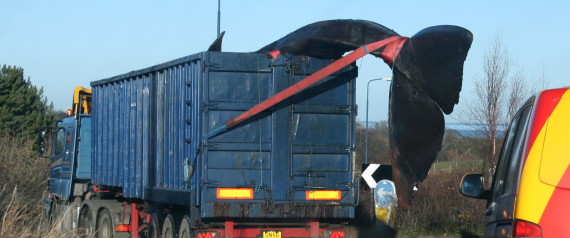
A massive sperm whale was laid to rest in a landfill recently after being transported from its stranding site in the bed of a tractor-trailer -- an odd sight for any Scottish drivers on the road at the time.
dead whale scotlandThe whale stranded on Portobello Beach in Edingburgh, Scotland last weekend. Because this monstrous cetacean was so big -- weighing 28 tons and measuring 45 feet long -- it was logistically difficult to bury and necropsy on site, and had to be transported away.

Original reports attributed this whale's death to boat strikes, but there was "no evidence" of this, Dr. Andrew Brownlow, the Scottish Marine Animal Stranding Scheme's Veterinary Investigation Officer, said in an email to The Huffington Post. "The 'cuts' previously identified by others were in fact normal anatomical grooves which had abraded so they looked like traumatic lesions," he said. Toxicology, DNA and diet analysis samples taken at the necropsy lent no evidence of "anthropogenic trauma" or disease.

Tuesday, 7 January 2014

Stranded whales on Farewell Spit unable to be saved

Thirty-nine pilot whales are unable to saved after stranding on Farewell Spit overnight.

Golden Bay Conservation Services Manager John Mason said 27 of the whales were still alive this morning but DOC staff had made the difficult decision to euthanise them when it became clear an attempt to refloat them would be unlikely to succeed.

‘We carefully weighed up the likelihood of being able to refloat them and get them safely back out to sea. But our staff, who have extensive experience in dealing with mass whale strandings in Golden Bay, determined that due to various factors it was unlikely they could be rescued.

Friday, 6 December 2013

Workers try again to save whales in Everglades

EVERGLADES NATIONAL PARK, Fla. (AP) - Wildlife workers are returning to Everglades National Park in Florida on Thursday to try leading 41 pilot whales out of dangerously shallow waters and back to the ocean where they belong.

"We're going to be cautiously optimistic on our way out," said Liz Stratton, assistant stranding coordinator for the National Oceanic and Atmospheric Administration. "We don't know what we're going to find."

For now, the death count stands at 10. Six whales were found dead in the remote area on the park's western edge, and four had to be euthanized. The whales were first spotted on Tuesday about 20 miles east of where they normally live. It takes more than an hour to reach the spot from the nearest boat ramp and there is no cellphone service, complicating rescue efforts.

Tuesday, 5 November 2013

Dead sperm whale found near Hunting Island

By MATT McNAB — mmcnab@beaufortgazette.com

A dying whale was found off the shores of Hunting Island Sunday, the second whale in more than a week found on the Beaufort County coast, a National Oceanic and Atmospheric Administration marine biologist said.

A pygmy sperm whale was spotted in a marsh area near the coast of Hunting Island stuck on an oyster bed Sunday morning, marine biologist Jessica Conway said.

The whale was alive when it got stuck, but died naturally once the tide had fallen, Conway said. Conway said she performed a necropsy at the site and took samples from the whale for testing, but no cause of death was immediately available.


Monday, 15 July 2013

Pod of Killer whales rescued after stranding in Australia


Killer whales swim free after rescue
July 2013. Five killer whales that stranded on sandbanks off the western side of Fraser Island, off Queensland in Australia, have swum free on the following high tide; sadly two more orca died on a separate beach nearby, believed to be a mother and calf.

Queensland Parks and Wildlife Service Acting Regional Director Sunshine and Fraser Coast Peter Wright said the whales - 4 adults and a juvenile - were found stranded early in the morning at Sheridan Flats in Great Sandy Strait, near the southern tip of Fraser Island.

Four more orca waited at sea
Mr Wright said "Four more killer whales were seen swimming in the area, and a further two killer whales were found dead at nearby Bookar Island. The live stranded whales were kept in good condition, and around 5pm were seen heading south, swimming well and in the company of the four whales which seem to have been waiting all day for them. It's hoped they will make it out to the open sea on the tide.

Water and shade to keep them cool
"After being alerted this morning, Queensland Parks and Wildlife Service rangers and Queensland Boating and Fisheries officers went to Sheridan Flats to care for the whales. Six rangers and two Boating and Fisheries officers kept the whales comfortable with water and shade, monitoring the whales' breathing and other vital signs while waiting for the tide to rise.

"Weather conditions were difficult, with winds 20 to 25 knots. It was a great effort from all concerned to keep these whales in good condition. It is not known how long the whales were stranded, nor do we know why they stranded. The Humpback whale migration is currently at its peak, and we know killer whales follow the Humpbacks," Mr Wright said.

Friday, 12 July 2013

Rescuers Try to Free Whale Stuck in Shallow Water

A Southern right whale was stranded in shallow water near Lakes Entrance, a tourist resort and fishing port located in the southeast of Australia's Victoria state, on Saturday (July 6), local media said. The whale drew a crowd of onlookers after local media reported the incident. Rescue workers sprayed water over the 12-metre whale in order reduce the effect of sun exposure, local media said. The whale has been stranded since Friday (July 5).

Friday, 30 November 2012

Mysterious stranding on Irish beach involved up to 50,000 starfish


By: Pete Thomas, GrindTV.com

http://www.grindtv.com/outdoor/blog/41673/mysterious+stranding+on+irish+beach+involved+up+to+50000+starfish/

It was a surreal and somewhat ghostly sight: that of perhaps 50,000 starfish that somehow had come ashore overnight, en masse, and perished on a secluded beach in Ireland. The Belfast Telegraph reports that harsh weather might have been responsible for last week's peculiar and mysterious event, on Lissadell Beach.

Bill Crowe, a marine biologist at Sligo Institute of Technology, theorized that the starfish (also called sea stars) might have been lifted ashore while feeding on mussel beds in the nearshore tidal zone. They were spread over nearly 500 feet of coastline.

"The most likely explanation is that they were feeding on mussels, but it is a little strange that none of them were attached to mussels when they were washed in," Crowe said.

A toxic algae bloom would seem another possible explanation, but no other type of marine life was affected. Only starfish, mostly adult size, were found on the beach.

Equally mysterious is that virtually all of the starfish were dead, meaning they had succumbed surprisingly quickly after coming or being delivered ashore.

Other experts agreed that the most likely explanation is stormy weather, and perhaps high surf that deposited the starfish on the beach.

"They turned up almost certainly as a result of an exceptional storm event," said Tim Roderick, an officer with Ireland's National Parks and Wildlife Service. "A storm hit the seabed where these sub-tidal animals were and lifted them up and washed them ashore."

The bizarre incident, like a smaller-scale die-off that occurred earlier this year on another beach in Ireland, remains under investigation.

Starfish, which can live up to 35 years in the wild, are among the most interesting critters in the world oceans. They possess no brains, and no blood. According to National Geographic: "Their nervous system is spread through their arms and their 'blood' is actually filtered sea water."

They're carnivorous and feed largely on clams, mussels and oysters.

"Using tiny, suction-cupped tube feet, they pry open clams or oysters, and their sack-like cardiac stomach emerges from their mouth and oozes inside the shell," National Geographic explains. "The stomach then envelops the prey to digest it, and finally withdraws back into the body."

It remains unclear who collected the 50,000 dead specimens on Lissadell Beach, and what became of them.
Related Posts with Thumbnails

ShareThis