Showing posts with label sperm whale. Show all posts

Sunday, 2 February 2020

Sperm whale stuck in Thames Estuary off Whitstable dies

1 February 2020

A sperm whale which became stuck in the Thames Estuary has died.

The mammal was spotted about 100m (328ft) off the coast of Whitstable, Kent, on Thursday.

Medics monitored its progress and behaviour over the past two days and said it appeared to be distressed and confused.

A spokesman for British Divers Marine Life Rescue (BDMLR) said the whale had since died and was currently at Elmley marshes.

At first the whale was thought to be a minke or possibly a humpback, but when photos emerged from a member of public the BDMLR team said it "became clear that it was more likely to be a sperm whale".

They are not usually found around the UK but it is not the first time a whale has swum into its waters.

Benny the beluga became a minor celebrity when it appeared in the River Thames at Gravesend in September 2018. It is believed the whale made its way back out of the estuary in January 2019.

Sunday, 13 January 2019

No sign of 'distressed sperm whale' in loch


4 January 2019
A search of a Highlands loch has found no sign of a sperm whale believed to be in difficulty earlier this week.
The animal, which has been estimated to be up to 9m (30ft) long, was reported to have been tangled in rope in Loch Eriboll, near Durness, Sutherland.
Coastguard and British Divers Marine Life Rescue (BDMLR) volunteers and Scottish SPCA officers have been monitoring the whale.
The whale was reported to the coastguard on Wednesday.
BDMLR said it had been unable to confirm if the animal was caught in rope, adding that the it might have been ill or injured.
'Lost its course'
A team from the organisation had hoped to get to Loch Eriboll on Thursday with specialist equipment, but it was delayed.
A search of the loch for the whale began at first light on Friday and continued until late afternoon. The BDMLR team will remain on standby over the weekend.


Thursday, 29 November 2018

Indonesia: dead whale had 1,000 pieces of plastic in stomach


Sperm whale washed up in Sulawesi had flip-flops, bottles, bags and 115 drinking cups in its stomach
Associated Press in Jakarta
Tue 20 Nov 2018 10.27 GMTLast modified on Tue 20 Nov 2018 10.42 GMT
A dead whale that washed ashore in eastern Indonesia had a large lump of plastic waste in its stomach, including flip-flops and 115 drinking cups, a park official has said, causing concern among environmentalists and government officials in one of the world’s largest plastic polluting countries.
Rescuers from Wakatobi national park found the rotting carcass of the 9.5 metre (31ft) sperm whale on Monday near the park in Southeast Sulawesi province after receiving a report from environmentalists that villagers had surrounded the dead whale and were beginning to butcher the rotting carcass, park chief Heri Santoso said.
Santoso said researchers from wildlife conservation group WWF and the park’s conservation academy found about 5.9kg (13lbs) of plastic waste in the animal’s stomach containing 115 plastic cups, four plastic bottles, 25 plastic bags, two flip-flops, a nylon sack and more than 1,000 other assorted pieces of plastic.
“Although we have not been able to deduce the cause of death, the facts that we see are truly awful,” said Dwi Suprapti, a marine species conservation coordinator at WWF Indonesia.
She said it was not possible to determine if the plastic had caused the whale’s death because of the animal’s advanced state of decay.
Indonesia, an archipelago of 260 million people, is the world’s second-largest plastic polluter after China, according to a study published in the journal Science in January. It produces 3.2 million tons of mismanaged plastic waste a year, of which 1.29m tons ends up in the ocean, the study said.
Luhut Binsar Pandjaitan, Indonesia’s coordinating minister of maritime affairs, said the whale’s discovery should raise public awareness about the need to reduce plastic use, and had spurred the government to take tougher measures to protect the ocean.

Friday, 4 August 2017

'Tail-Standing' Sperm Whales Snooze in Stunning Photo


By Mindy Weisberger, Senior Writer | July 24, 2017 06:12am ET

Sleeping dogs lie, but sleeping whales … "stand" on their tails? That was the scene recently glimpsed by a diver in the Caribbean, at least, when the photographer encountered a group of sperm whales napping together, all of them suspended tails-down in the water.

Photographer Franco Banfi was free diving — underwater diving without a breathing apparatus — on Jan. 28 off the coast of Dominica, an island in the Caribbean Sea between Martinique and Guadalupe, when he spied six still and silent sperm whales drifting in their upright postures at a depth of around 65 feet (20 meters).

Researchers first saw this unusual sleep behavior in sperm whales in 2008, describing it in a study published in January of that year in the journal Current Biology. The scientists in that study found that sperm whales dozed in this upright drifting posture for about 10 to 15 minutes at a time, and the whales did not breathe or move at all during their naps, the study authors reported. 


Friday, 29 January 2016

Fifth dead whale found on English beach

Experts investigate possible causes of worst stranding on the English coast since records began in 1913, while people flock to sites to take photos

Josh Halliday, north of England correspondent, and Patrick Barkham

Monday 25 January 2016 19.03 GMTLast modified on Tuesday 26 January 201611.28 GMT

A fifth dead whale has been found washed up on the Lincolnshire coast, several miles from four other members of the same pod, marking the worst sperm whale stranding off the English coast since records began in 1913.

The fifth whale was discovered by a member of the public on Monday afternoon on a former weapons range in Lincolnshire where the second world war Dambusters squadron practised bombing runs.
Onlookers have been told to stay away from the land, which was sold by the Ministry of Defence six years ago, and it remains inaccessible to scientists amid warnings that it may be strewn with unexploded bombs.

The male sperm whale was found five miles down the coast from where three others were found in Skegness at the weekend and across the shallow waters of the Wash from where another whale was found on Hunstanton beach in Norfolk.

Scientists believe that the whales, all members of the same pod, were hungry and dehydrated but alive when they were stranded in shallow waters during their search for food. Sperm whales are deep sea creatures and can easily become disoriented if they get into shallow water.

One of the Skegness whale bodies “exploded” when pathologists cut it open, and Rob Deaville, project manager at the UK Cetacean Strandings Investigation Programme, a Defra-funded group that investigates whale deaths, said the quickly decomposing state of the carcasses made it “much harder to gain any pathologically useful information”.

According to Deaville, their investigations found little in the whales’ intestines apart from “some squid beaks and some little fragments of plastic”. He said this suggested the whales died when the weight of their own bodies caused their internal organs to collapse.

 “This is an unusual event and the question hanging is why they were in the North Sea in the first place,” said Deaville. With a lack of food and shallow, disorientating waters for a deep sea animal, “they were always up against it unless they could find their way out through the big open end between Norway and Scotland.”

Thousands of people have flocked to the tourist resort of Skegness to see the whales since Sunday, with onlookers taking selfies in front of the huge carcasses as marine biologists cut away chunks of flesh and bone.


Monday, 14 December 2015

White fossil was 'Moby Dick' of the ancient sea

By Jane O'BrienBBC News, Washington

9 December 2015 

In Hollywood's version of the events that inspired the classic novel Moby Dick, a giant sperm whale terrorises the crew of a whaling ship and eventually destroys the vessel.

Based on the true story of the sinking of the Essex in 1820, the film, In the Heart of the Sea, portrays the whale as a merciless monster that pushes its shipwrecked victims to the brink of madness.

Did such a terrifying creature ever exist? Scientists at the Smithsonian Institution say it probably did - but 15 million years ago.

They've identified an ancient genus of sperm whale that, unlike its modern cousins, had enormous teeth.

"Modern sperm whales only have teeth in their lower jaw, partly because their main food source is squid," says Alex Boersma, lead author of the new research published in the open access journal PLoS One.

"To see a fossil sperm whale like ours that has these big prominent teeth in both the lower and upper jaws suggests they were feeding on something very different - possibly other marine animals."

The fossil was part of a collection amassed in the 1920s by Remington Kellogg, a palaeontologist who helped introduce protections for whales and became the first chairman of the International Whaling Commission.

The specimen was placed in the vast stores of the Smithsonian's National Museum of Natural History in Washington where staff noticed that the label was incorrect. It said the bones belonged to an extinct walrus instead of a sperm whale.

Friday, 20 November 2015

Huge white pointer shark circles a dead whale off Australian shore

Parks Victoria worker Mike Irvine was shocked to see a large shark stalking a whale carcass while taking his daughter for a walk along Salmon Rocks

By Sally Biddall

11:07AM GMT 17 Nov 2015

A large shark was spotted on the Australian coast, causing the state parks authority to warn swimmers to stay out of the water.

The shark was circling an 11-metre dead sperm whale which was washed up on the shore on far east Gippsland in Victoria, Australia.

According to the Parks Victoria worker Mike Irvine, he was shocked to make the discovery whilst walking along the beach with his daughter.

“We were the only ones down there and we had a pretty good look at it,” he told ABC Gippsland.

“We started walking back along the beach towards the carpark and I noticed a big shark in the shore break heading towards the whale.”

"It was in knee deep, waist deep water...(it was) a decent sized shark splashing around every time it got in the shallows. It was pretty spectacular to watch, but it sent a few shivers up my spine seeing a large shark that close," he added.

Realising that his daughter could be in danger, he made sure to keep her at a safe distance.

Sunday, 6 April 2014

Tracking sperm whales' ecology through stomach contents

Date:
April 4, 2014

Source:
University of Massachusetts at Amherst

Summary:
While studying pygmy and dwarf sperm whales, a researcher involved in a new project stated that "understanding what resources support populations of these incredibly rare animals is important to conservation. If there are changes in the environment or their prey, we can now hope to better anticipate the potential impacts. There had been quite a knowledge gap about these animals, but this work gives us an idea of their ecological niche and requirements in the current environment."


Sunday, 9 March 2014

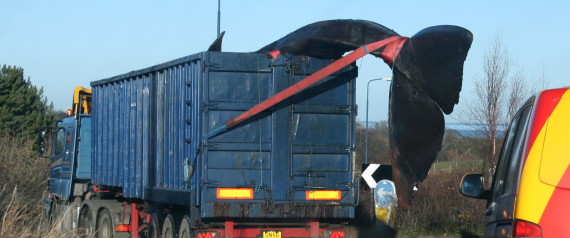
Stunned motorists see rotting 50ft whale driven down A2 on lorry

A sheet of tarpaulin was draped over the body but failed to hide the dead animals from passing motorists

By Rishma Dosani | Yahoo News – Fri, Feb 28, 2014


Motorists were left stunned by the sight of a rotting 50ft whale being driven along a busy dual carriageway.

The sperm whale died more than a week ago after it became stranded near Seasalter, on the Kent coast.

Its rotting body was left unattended for five days before it was finally loaded onto the back of a lorry to be taken to a landfill site.

The corpse was strapped to the truck with part of the mammal hanging off the back.

Tuesday, 21 January 2014

Well, This Is One Way To Remove A Dead Whale From The Beach

A massive sperm whale was laid to rest in a landfill recently after being transported from its stranding site in the bed of a tractor-trailer -- an odd sight for any Scottish drivers on the road at the time.
dead whale scotlandThe whale stranded on Portobello Beach in Edingburgh, Scotland last weekend. Because this monstrous cetacean was so big -- weighing 28 tons and measuring 45 feet long -- it was logistically difficult to bury and necropsy on site, and had to be transported away.

Original reports attributed this whale's death to boat strikes, but there was "no evidence" of this, Dr. Andrew Brownlow, the Scottish Marine Animal Stranding Scheme's Veterinary Investigation Officer, said in an email to The Huffington Post. "The 'cuts' previously identified by others were in fact normal anatomical grooves which had abraded so they looked like traumatic lesions," he said. Toxicology, DNA and diet analysis samples taken at the necropsy lent no evidence of "anthropogenic trauma" or disease.

Saturday, 8 June 2013

Four dead whales baffle expert - via Tony Lucas

Online Reporter

Scientists are baffled at what might have killed four whales which washed up over two days on a certain section of a West Coast beach.

All four whales were dead when they washed up at the weekend, and all belonged to different species.

The first was a 6-metre long Cuvier's beaked whale which washed up on Saturday morning at Greymouth's Cobden Beach. It is on the list of threatened species.

Later that day, a huge 15-metre long Sperm whale washed up on the beach at the end of Serpentine Rd, just 14 km south of where the Cuvier's beaked whale was discovered.

On Sunday, a 2-metre long juvenile long-finned pilot whale was discovered on Westport's North Beach, followed by a 3-metre long pigmy sperm whale in the same area.

Department of Conservation marine mammal scientist Don Neale says a quadruple dead-stranding within 48 hours is something he's never heard of before.

Read more:

Wednesday, 20 March 2013

Spanish Sperm whale killed by plastic debris


10 metre long male Sperm whale had more than 8 kilograms of plastic in gut
- Our thanks to Renaud de Stephanis of the Spanish Cetacean Society
March 2013. Marine debris has been found in marine animals since the early 20th century, but little is known about the impacts of the ingestion of debris in large marine mammals. In 2012, a dead Sperm whale was found on a beach in southern Spain. The whale weighed around 4500 kg, and seemed to be in a state of advanced emaciation. There was no evidence of entanglement scars or other injuries. 

Large mass of compacted plastics
During inspection of the abdominal cavity, squid beaks were found on the exterior portion of the small intestine, and inside the stomach compartments. A large mass of compacted plastics could be seen protruding through a rupture in the first stomach compartment. No fresh remains of squids were recovered. The intestines were empty. Cause of death was presumed to be gastric rupture following impaction with debris, which added to a previous problem of starvation. All of the plastic pieces and other debris were recovered. The matching of the sperm whale's fluke revealed that the animal had not been photographically matched before in the Mediterranean Sea.

Saturday, 22 December 2012

Were People Trying to Ride This Sick Sperm Whale?


Officials in Florida are investigating a report that swimmers might have been trying to ride a sickly sperm whale before it died off the coast of an Atlantic beach.

The 35-foot (10.6-meter) creature was spotted yesterday (Dec. 16) morning just off Pompano Beach and never quite stranded. As it floated close to the shore, a woman from a nearby condo snapped a picture that allegedly shows two people paddling out to the whale and one getting on top of it. That witness told local NBC station WTVJ-TV she saw the swimmers approach the whale twice, adding that she believed the creature was still alive at the time, since she saw its tail flapping.

Her testimony could land those beachgoers in hot water, as close encounters of this kind are illegal under the Marine Mammal Protection Act, Blair Mase, NOAA's southeast marine mammal stranding coordinator, explained to LiveScience.

Sunday, 18 March 2012

Giant squid eyes are sperm whale defence

The world's biggest squid species have developed huge eyes to give early warning of approaching sperm whales.
Colossal and giant squid both have eyes that can measure 27cm (11in) across - much bigger than any fish.
Scientists found that huge eyes offer no advantages in the murky ocean depths other than making it easier to spot enormous shapes - such as sperm whales.
Writing in current Biology journal, they say this could explain the equally huge eyes of fossil ichthyosaurs.
Lead scientist Dan Nilsson from Lund University in Sweden was present at the unique dissection of a colossal squid performed four years ago in New Zealand.
There, he examined and handled the eyes - in particular, the hard parts of the lens.

Monday, 5 March 2012

Sperm whale washes ashore at Skegness Beach

A DEAD sperm whale, 35 feet in length, weighing an estimated 30 tonnes, washed ashore at Skegness Beach.

The massive sea mammal was first spotted near the bottom of Skegness Pier in the early hours of Saturday morning.

News of the rare occurrence soon spread, prompting crowds to gather, hoping to take a glimpse at the fascinating yet sombre spectacle

Julie Hamilton who was visiting Butlins from Leicester was saddened to see such a macabre site.

“We came down to have a look because it’s a once in a lifetime experience to see such a rare thing but it’s really sad, I love animals and it’s always awful when you see any wildlife destroyed,” she said.

And Skegness resident Ivan Frost was amazed by the sheer enormity of the whale.

He said: “It’s unbelievable - I’ve never seen anything so large washed up on the beach before.”

Large gashes along its spine indicate the majestic creature died from a collision with a boat and could have been dead for several days before finally washing ashore.

Male sperm whales undertake vast migratory journeys and are abundant in nearly all of the earth’s oceans, though they prefer deep waters to hunt their predominate prey - the deep sea squid.

They rarely venture into shallow waters as naturalist Tony Burgess who visited Skegness to witness the spectacle explained: “If they get into shallow waters the weight of their bodies on their lungs makes it difficult for them to breathe.

“It’s always so sad when you see a great creature like that dead.”

East Lindsey District Council has employed the services of local waste disposal firm Sid Dennis and Sons to remove the creature.

When the tide retreats this evening it is expected to haul the whale inland and bury it, before disposing of it fully on Monday morning.

The last recorded whales to be spotted on Skegness Beach were in 2006, when two bottled nosed whales washed ashore prompting a rescue mission which ultimately proved unsuccessful.

http://www.skegnessstandard.co.uk/news/environment/sperm-whale-washes-ashore-at-skegness-beach-1-3587848

Friday, 30 December 2011

Monster from the deep... on the Norfolk coast: 40ft sperm whale washes up on Christmas Eve

It is believed the mammal was dead before it was washed up on the beach


The sand around its tail did not appear disturbed, suggesting the creature was dead before the tide carried it onto the sands at Old Hunstanton, Norfolk.


Large crowds gathered to see the whale, which is near the high tide mark.

A spokesman for the British Divers Marine Life Rescue said it may have been the same whale which had been seen dead on the RAF’s bombing range on the other side of the estuary, at Holbeach, some weeks ago.

Scientists from the Zooological Society have already taken samples from the animal, which will be left to be carried away by the tide to decompose naturally.

A number of whales have been washed up on the North Sea coast in the past year.


They have been especially prevalent around the Humber Estuary.

Conservationists believe the increase in the number of strandings could be explained by a change in sea currents bringing colder streams of Arctic water into the North Sea and with them whales that would not normally pass so close to the UK shoreline.

At the end of September a 33ft mammal, thought to be a Sei whale, was discovered in marshes on the north bank of the River Humber near the village of Skeffling.

Earlier the same month, a young Fin whale - a relative of the Sei - was stranded at Immingham, North East Lincolnshire, and subsequently washed up dead near Spurn Point.

The Yorkshire Wildlife Trust has noted a rise in whale sightings generally in 2011 but no-one is sure why there may be an increase in the mammals in the North Sea.

Over the summer, a pod of up to 10 Minke whales were spotted regularly off the North Yorkshire coast between Whitby and Scarborough.

Whale experts admit they do not know why there has been an upsurge in sightings and strandings.

Read more: http://www.dailymail.co.uk/news/article-2079389/Monster-deep--Norfolk-coast-40ft-sperm-whale-washes-East-Anglian-beach-Christmas-Eve.html?ito=feeds-newsxml

Friday, 14 October 2011

Hopes growing for Orkney whale

A SPERM whale that was thought to be in a poor condition has moved away from a harbour and back into deeper water.

The whale, a male measuring 40-50ft long, was first sighted in Kirkwall Bay, Orkney, at around 7am yesterday by the crew of a passing vessel.

There were growing concerns that the whale had come into Kirkwall harbour because it was ill or injured.

Shipping had been warned to stay clear of the animal.

The whale was around 30ft from the harbour pier and was barely moving in shallow water.

However, just after 1pm, the whale moved away from the harbour, travelling north into deeper water.
Mike Lynch, local inspector for the Scottish SPCA, was at the scene all morning and said it was unusual that the animal came so close to shore.

He said: “The whale has disappeared. It moved off pretty quickly after managing to get into deeper water. It’s heading north and hopefully will be OK.”

However, he said the young adult male whale was clearly ill or injured.

“It’s got scars on its nose and its body condition is poor,” he said. “It’s very thin and immobile and has never really submerged fully.

“Normally they’ll go underwater for 20 minutes and can pop up a mile away.”

At one point the whale came within a few metres of the busy pier. Its plight attracted crowds of onlookers.

The whale was closely monitored while it was in the harbour, with contingency plans drawn up to deal with the animal’s carcass, had it died in the bay. But it swam back into deeper water north of the harbour and vanished.

“It’s a happy ending, for now,” said Mr Lynch. “It’s the first time I’ve seen a sperm whale here that wasn’t stranded.”

http://www.scotsman.com/news/environment/hopes_growing_for_orkney_whale_1_1905895

Monday, 11 July 2011

Sperm whales: the 12-metre-long babysitters

Underwater mammals in the waters of Azores solve their childcare issues in a spirit of mutual cooperation

Sperm whales may be the biggest predators that ever lived, but they have childcare issues too. The solution? A very big babysitter.


Here in the Azores, where I've spent the past two weeks diving with sperm whales off the island of Pico, a resident population of these remarkable mammals search for their main source of food: squid.

While the sperm whale is a natural submarine, able to dive a mile in depth for up to two hours, young calves still suckling their mother's milk (which is 60% fat, with the consistency of cottage cheese) cannot undertake such deep plunges. So while their mothers hunt for food, calves are cared for communally in what amounts to a cetacean creche. This accompanying image, taken by the accomplished underwater photographer Andrew Sutton, shows whale altruism in action. Only one of the four juveniles with this large female is hers; she may not even be genetically connected to the others.

João Quaresma of Espaco Talassa, our Azorean skipper, told me that to see four young with one female is unusual. "Calves start to feed themselves at around three or four years," he says, "but they've found whales up to the age of nine still suckling." Studies by scientists such as Dr Hal Whitehead of Nova Scotia University have shown that sperm whales organise themselves in highly complex societies, communicating in discrete dialects of sonar clicks, passing on culture learned matrilineally. Such behaviour reinforces what we are beginning to discover about the intelligence of these whales, which possess the largest brain of any animal.

Operating under special licence from the Azorean government which determines strict care for the whales' welfare, Andrew and I snorkelled with this group, watching them silently twisting and turning around one another in a physical expression of social solidarity. It was a salutary moment. In the 20th century, our species came close to driving the great whales to extinction. This week, the International Whaling Commission meets in Jersey to decide the fate of cetaceans around the world. Conservationists hope that they'll make the right decisions. Sometimes whales need more than a babysitter to help them – even when she's 12 metres long.

Philip Hoare

guardian.co.uk,


http://www.guardian.co.uk/theguardian/2011/jul/10/azores-whales-cooperative-childcare

Thursday, 2 June 2011

Beached 44ft whale dies on Redcar beach

The mammal died despite hopes it would survive until the tide went out
31 May 2011

A 44ft (13m) long whale has died three hours after becoming stranded on a beach on Teesside.

Police alerted the RNLI after spotting the 20 tonne stricken mammal on Redcar Beach, just after 0620 BST.

A rescue bid started which involved trying to keep the adult sperm whale wet until high tide but it died.

Richard Ilderton, of British Divers Marine Life Rescue, said the North Sea was not a suitable environment for such a large creature.

RSPCA officers were involved in the rescue attempt, along with those from the Coastguard and Cleveland Fire Brigade, while RSPCA vets assessed the mammal's condition.

An RNLI spokesman said: "We don't know the reasons but usually when they get to this situation the conclusion is that they don't survive.

"A post mortem will be carried out on the whale and then it will be up to the local council to dispose of it."

'Becomes malnourished'

Crowds went to the beach to see the whale.

Redcar and Cleveland Council said cordons had been put up around the whale, which is due to remain on the beach overnight, watched by security guards.

Mr Ilderton said: "While we have whales in the North Sea, it is not a suitable environment for a sperm whale because the food supply is not there.

"It doesn't eat, it becomes malnourished, it becomes dehydrated because whales do not drink - they get their liquid from their food.

"It can cause all sorts of health problems and ultimately results in something like this happening."

He said the whale's death might actually have been the best outcome.

"If we were able to put the animal back out to sea, all we would be doing is putting it back out to starve, which is massively cruel and against what we want to do," he said.

Robbie Marsland, UK Director of International Fund for Animal Welfare, said whales stranded for a variety of reasons.

He said: "While it is not possible to pinpoint the cause in every case, we do know that human activity in the seas is increasing the threats to these highly intelligent and complex marine mammals.

"Manmade ocean noise, from shipping, oil and gas excavation and naval sonar, makes it ever harder for whales to navigate, communicate, find food or mates and avoid prey."

http://www.bbc.co.uk/news/uk-england-tees-13601654
(Submitted by Liz R)

Friday, 4 March 2011

Huge sperm whale washes up on Kent beach

3 March 2011 Last updated at 21:48

A 45ft (13.7m) sperm whale has died after becoming stranded on a beach in Kent.

Coastguards were alerted to the beached whale at Pegwell Bay, between Ramsgate and Sandwich, at about 0730 GMT.

Claudia Sermbezis reports.

See video at: http://www.bbc.co.uk/news/science-environment-12642695
(Submitted by Dawn Holloway)
Related Posts with Thumbnails

ShareThis