Showing posts with label polar bear. Show all posts

Thursday, 4 July 2019

Study reveals new genomic roots of ecological adaptation in polar bear evolution


How natural selection shaped gene copy numbers
Date:  June 17, 2019
Source:  University of Massachusetts at Amherst
Scientists from the University of Massachusetts Amherst, Vanderbilt University and Clark University have shed new light on the genomic foundation of the polar bear's ecological adaption by pinpointing rapid changes in the bear's gene copy numbers in response to a diet shifting from vegetation to meat.
In a paper published Monday, June 17 in the Proceedings of the National Academy of Sciences and chosen for the cover of PNASVol. 116, issue 27, John G. Gibbons and Ph.D. student Shu Zhao of UMass Amherst, David C. Rinker of Vanderbilt and Natalya K. Specian of Clark discuss the first population-level study to characterize genome-wide patterns of copy number variation (CNV) in the polar bear and brown bear.
CNV refers to differences among individuals in the number of copies of a particular portion of the genome, and the study's results suggest this variation played an important role in the adaptation of polar bears to the Arctic.
"This research addresses a big-picture evolutionary question of how diet shapes the genome," explains Gibbons, assistant professor of food science.
Since the brown or grizzly bear (Ursus arctos) and polar bear (Ursus maritimus) diverged less than 500,000 years ago, the polar bear has evolved unique traits to adapt to the Arctic climate and ecology, such as a camouflaging coat of pigment-free fur. Previous population genomic studies of polar bears and brown bears analyzed single-nucleotide polymorphisms, or changes in a single base pair in a DNA sequence.
"CNVs were traditionally harder to detect so they weren't always analyzed," Gibbons says. "With recent advances in DNA sequencing technologies over the last 15 years or so, computational approaches to detect and quantify CNVs from genomic data have been developed. The polar bear data gave us a nice opportunity to fill in the gap."

Monday, 22 May 2017

Sweating the Details: Polar Bear Hits the Treadmill for Science


By Mindy Weisberger, Senior Writer | May 17, 2017 04:00pm ET 

A polar bear at the San Diego Zoo named Tatqiq recently went the extra mile to help scientific research by steadily plodding along on a treadmill at the zoo's Institute for Conservation Research.

Five months of training prepared the 16-year-old bear for her 10-minute walk, zoo officials said in a statement. With every step the bear took in the enclosed treadmill, biologists tracked her movements and activity levels, so they could better understand how polar bears expend their energy.

Polar bears hunt on sea ice, which is rapidly diminishing in a warming Arctic; more and more frequently, they must swim or walk long distances between meals. Data from Tatqiq's treadmill traipsing could help researchers forecast how polar bears will fare in the future, as sea ice in their polar habitat continues to shrink.

"Little information exists on the number of seals polar bears need to eat in the wild," Anthony Pagano, a wildlife biologist with the U.S. Geological Survey (USGS) polar bear research program, said in the statement.

"The data we're collecting from Tatqiq will allow us to quantify the impacts of declines in Arctic sea ice on polar bear energy demands," Pagan said.

Video footage of Tatqiq on the treadmill shows her moving at a slow and steady pace, wearing a bulky collar that holds an accelerometer — a sensor that detects movement and speed. Her readings, which represent the oxygen consumption of a healthy bear, can be used to estimate the stamina of wild bears, and to predict how they might be affected by having to work harder to find and catch their prey.

"The ice sheets where they hunt are vanishing," Nate Wagner, a senior keeper at the zoo, said in a statement.

"Polar bears can swim 30 miles in open ocean, but because of climate change, the resting places they go to after that long swim may not exist anymore. They need to find other resources," Wagner said.


Thursday, 27 August 2015

Knut polar bear death riddle solved

By Jonathan Amos
BBC Science Correspondent

Scientists say they can now explain what happened to Knut, the famous polar bear that drowned at Berlin Zoo in 2011.

A new investigation has shown that he had a type of autoimmune inflammation of the brain that is also recognised in humans.

Researchers hope this knowledge can help both human and animal sufferers.

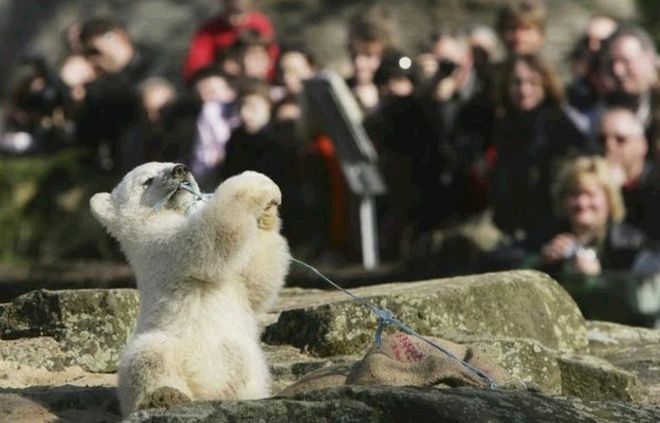
Knut became an international celebrity, after being abandoned by his mother and then hand-raised by a zookeeper.

For a while, he was the most recognisable bear on the planet, with his face featuring regularly on TV and in newspapers, and even on the front cover of an edition of Vanity Fair magazine.

His death was as public as his life. Knut experienced a seizure and collapsed into his enclosure's moat - right in front of the many zoo visitors who had come to see him - and never regained consciousness.

The necropsy established he had encephalitis, a brain inflammation, but the investigating scientists could find no reason for it.

They suspected some kind of infection, however all pathogen screening drew a blank.

Tuesday, 27 January 2015

Giant polar bear shocks travellers on Tube


27 January 2015, 11:01


Passengers on the London Underground were stunned to see an eight foot polar bear climb aboard a train.

The giant bear, created by Hollwood special effects experts FX, was spotted at Charing Cross tube station, as well as Hampstead Heath and the South Bank of the Thames.

The huge puppet was made by a team of 19 prop specialists and made from more than 60 different materials including 90 sq ft of white fur.

It was controlled by two puppeteers who spent weeks studying footage of real polar bears in the wild before spending five days rehearsing with the device.

Thursday, 15 May 2014

Canadian Polar Bear Hunt Continues, Despite Extinction Threat (Op-Ed)

Zak Smith, Natural Resources Defense Council (NRDC) | May 14, 2014 01:28am ET

Zak Smith is an attorney for the Marine Mammal Protection Project at NRDC. This Op-Ed is adapted from one that first appeared on the NRDC blogSwitchboard. Smith contributed this article to Live Science's Expert Voices: Op-Ed & Insights.

Most people don't know that Canada is the only country where polar bears are still hunted and killed to supply the world trade in polar bear skins and other parts (teeth, claws, skulls, etc.). But Canada's practice of allowing polar bears to be killed for profit when their very existence is threatened by climate change is now going to be scrutinized by the international community, which is expressing concern that such trade is not sustainable.

This critical issue came into focus at a meeting I recently attended in Veracruz, Mexico, of the Convention on International Trade in Endangered Species (CITES) — the international organization tasked with managing trade in endangered species.

Wednesday, 23 April 2014

Polar Bears on Thin Ice, Arctic Expedition Finds

By Tanya Lewis, Staff Writer | April 22, 2014 10:07am ET

An expedition to the islands of Svalbard, Norway, to study how rising temperatures and melting sea ice are affecting polar bears concluded Monday (April 21).

Over the 10-day trek, researchers outfitted female bears with satellite tracking collars that will send back data, giving researchers a picture of how shrinking sea ice may be affecting the polar bears' movements and denning patterns.

"The bear denning habitats appear to be shifting further north," Geoff York, one of the expedition leaders, told Live Science via satellite phone from the team's ship in Svalbard Thursday (April 17). The team had so far deployed 11 of their 20 collars, York said.

Sunday, 5 January 2014

Knut the Polar Bear's Medical Legacy

Jan. 3, 2014 — Keeping wild animals is an important component of the mission of zoos to educate the public and preserve endangered species. When animals die, tracking the potential cause becomes an investigation of pathogens from around the world. This is because zoo animals are not only potentially exposed to pathogens occurring where the zoo is located, but also to those pathogens harbored by other zoo animals. In other words: the diagnostic challenge is enormous.

Monday, 23 December 2013

Canadian woman attacked by 400-pound polar bear

A woman in Canada was attacked by a 400-pound polar bear and lived to tell the tale. She and her friends were just crossing a street when they spotted the polar bear.

ERIN GREENE: "Within seconds of seeing him, he was already on my head and just kind of scratching at me and biting my head and pulling." (Via KUTV)

The bear apparently chose Greene out of the group. She said: "My friends started running, but the bear was so quick, and it was so close to us. I knew that it was going to get us. And it was very focused on me. Its eyes were locked on mine, so I was his target." (Via New York Daily News)

Her injuries were extensive.

Wednesday, 6 November 2013

Beagle Sniffs Out Polar Bear Pregnancies

When other pregnancy tests fall short, a poop-sniffing beagle named Elvis could reveal whether or not a polar bear has one on the way.

At least that's what keepers at the Denver Zoo are hoping. The zoo's 11-year-old female Cranbeary may be expecting, but progesterone monitoring, ultrasound examination and other traditional methods cannot effectively detect pregnancy in polar bears. Keepers think Cranbeary's feces, however, could hold faint clues imperceptible to humans.

A sample of Cranbeary's poop has been sent to the Cincinnati Zoo, where researchers are working with a professional dog trainer to see if the canine nose is sensitive enough to detect polar bear pregnancies. 

Tuesday, 3 September 2013

Polar bear drags Maine man from tent

Canadian park officials say they will never know whether an electric fence failed when a polar bear entered a campsite and dragged a Maine man from his tent in northern Labrador. The bear in Torngat Mountains National Park destroyed the fence, so officials cannot determine if it was working, said Peter Deering, manager of resource conservation for Parks Canada in western Newfoundland and Labrador. Matt Dyer, of Turner, Maine, was saved when a member of his party fired a flare, startling the bear and causing it to drop him early on July 24. He is recovering from his injuries. Officials in the remote park recommend that visitors hire an armed Inuit guide.

Monday, 2 September 2013

Central Park Zoo’s last remaining polar bear, Gus, dead at age 27

He’s gone to that giant iceberg in the sky.

The Central Park Zoo’s last remaining polar bear, Gus, died at the age of 27, the zoo announced yesterday.

Gus, once nicknamed the “bipolar bear” after he was diagnosed with depression, spent 25 years entertaining New York’s children and animal lovers.

“Gus was an icon at the Central Park Zoo and a great source of joy for our visitors and staff,” said Jim Breheny, a vice president of the Wildlife Conservation Society, which runs the zoo.

“He was an important ambassador for his species, bringing attention to the problems these bears face in the wild due to a changing environment,” he said.

The bear had recently fallen ill, losing his appetite and having trouble swallowing his food.

Veterinarians checked Gus out Monday and found a large, inoperable tumor near his thyroid.

He was euthanized while still under anesthesia, zoo officials said.

Gus came to the Central Park Zoo as a cub from the Toledo Zoo in 1988 and wowed zoo-goers for more than two decades.

Visitors yesterday were heartbroken by the news.

Monday, 12 August 2013

Is this starved polar bear which died as ‘skin and bones’ the 'categorical proof' that climate change is wiping out the species?

  • Experts found the carcass of a polar bear in Svalbard in the Arctic Ocean
  • Lack of sea ice and seals forced the bear to search further afield for food
  • Scientists claim climate change has reduced sea ice to record lows and is to blame for the death of this animal
  • But some experts add that commercial trade in Canada is also to blame for falling polar bear numbers

The skin and bones of a male polar bear, that is believed to have starved to death, has been discovered washed up in Svalbard, in the Arctic Ocean. 

Experts claim low sea ice levels caused by climate change meant the bear couldn't hunt seals and this caused the bear to unsuccessfully search more than 150 miles for food. 

Climate change is said to have reduced sea ice in the Arctic region to record lows and is 'absolutely, categorically and without question' the reason why polar bears are dying out, according to one wildlife expert.

Dr Ian Stirling from Polar Bears International has studied polar bears in the region for the past 40 years. 

He told The Guardian that the way the bear was found, lying on its stomach, suggests that it starved to death and just dropped to the ground when it died.

Monday, 5 August 2013

Polar Bear's Collar Cam to Reveal Species' Secrets

A polar bear named Tasul at the Oregon Zoo has been wearing a collar cam that shows what the world looks like through the Arctic animal's eyes. Eventually, researchers will use data collected from Tasul's everyday movements to study the behavior of polar bears in their increasingly threatened and hard-to-reach habitats in the wild.

Tasul, 
Credit: Michael Durham/Oregon Zoo
As part of a research project for the U.S, Geological Survey (USGS), the captive female bear's collar is also equipped with an accelerometer, a device similar to the one that lets a smartphone know when it's being flipped sideways or upside-down.

A polar bear named Tasul at the Oregon Zoo has been wearing a collar cam that shows what the world looks like through the Arctic animal's eyes. Eventually, researchers will use data collected from Tasul's everyday movements to study the behavior of polar bears in their increasingly threatened and hard-to-reach habitats in the wild.

As part of a research project for the U.S. Geological Survey (USGS), the captive female bear's collar is also equipped with an accelerometer, a device similar to the one that lets a smartphone know when it's being flipped sideways or upside-down.


Wednesday, 17 July 2013

New Retroviruses Found in Polar Bear 'Knut' and Panda 'Bao Bao'

July 15, 2013 — Endogenous retroviruses (ERVs) are viruses that at some point in the past inserted themselves into the nuclear genome of a host's germ cell. Once integrated in a germ cell the virus would be passed on from one generation to the next and the endogenous retroviral genome would therefore be inherited to new species that evolve from the original host. 'ERV sequences and fragments make up about eight per cent of the human genome,' explains Professor Jens Mayer from the Department of Human Genetics at Saarland University. Endogenous retroviruses are found not only in humans, but also in other mammals such as horses, cattle, apes, koalas and, as has now been shown, in polar bears and giant pandas.

Working in collaboration with Professor Alex D Greenwood and Kyriakos Tsangaras from the Leibniz Institute for Zoo and Wildlife Research in Berlin, Jens Mayer has been taking a closer look at the DNA sequences from polar bears and great pandas. 'We have characterised endogenous retroviral sequences in both bear species and found a strong similarity between the two, which indicates that these two virus species are closely related,' says human geneticist Mayer. The researchers also identified ERV sequences in other bear species such as the brown bear, the black bear and the spectacled bear. 'Using molecular dating methods we have now been able to show that the retrovirus became integrated into the genetic material of an ancestor of today's bear species around 45 million years ago,' explains Greenwood. The research team also showed that the original retrovirus was closely related to those found in the genomes of bats and cattle. Interestingly, the viruses found in bears exhibit strong similarity with several endogenous retroviruses found in the human genome. 'Some of these sequences are suspected of playing a role in the occurrence of cancer, neurodegenerative or autoimmune diseases,' says Mayer.


Sunday, 30 December 2012

Zoo polar bear dies during heatwave


The last polar bear at the Buenos Aires zoo has died amid a heat wave.

Zoo officials said Winner became nervous and irritated amid the scorching heat of South America's summer and the noise from fireworks during Christmas Eve celebrations.

This affected his ability to control his body temperature and he apparently died of hyperthermia.

The zoo is widely visited in the Argentinian capital and has traditionally showcased polar bears.

Officials said the animals used to live in a 2.5-meter-in-diameter pool but their cage was improved in 1993 when a 145,000-litre pool was built along with a site for birthing and three security rings.

The zoo said in a statement that the site had been visited by experts and met all international regulations to house polar bears.

Saturday, 20 October 2012

Duluth polar bear improving after surgery


ST. PAUL, Minn. - A Duluth polar bear who briefly escaped from her exhibit during June flooding is improving after surgery in St. Paul.
Berlin underwent surgery Saturday at the University of Minnesota Veterinary Medical Center.
Lake Superior Zoo veterinarian Louise Beyea says the polar bear had been acting lethargic and vomiting in its new home at Como Park Zoo.

Tuesday, 21 August 2012

Zebra virus kills polar bear in German zoo


Zoos should be on the alert for viruses that can jump from one animal to another, threatening endangered species, say researchers.
The cause of an infection that killed a polar bear at a German zoo has been traced back to the zebra house, scientists report in Current Biology.
Viruses spreading to unexpected hosts may threaten the conservation mission of zoos, they warn.
Most pathogens are adapted to one host but some can leap the species barrier.
Flu, for example, is thought to have moved between pigs, birds and humans during its evolution.
Mystery illness
An international team of researchers carried out some DNA detective work after two polar bears at the Zoological Gardens in Wuppertal, Germany, were struck down by a mystery illness.
Two bears contracted the brain infection encephalitis, suffering seizures and frothing at the mouth.
One - a 20-year-old female, Jerka, died after little more than a week.

Saturday, 21 July 2012

Polar bear that thrived at Detroit Zoo after rescue from circus dies


A 27-year-old female polar bear that thrived at the Detroit Zoo after being rescued from a circus 10 years ago was euthanized today after she was found to be suffering from terminal cancer, zoo officials said.

Bärle (pronounced BEAR-la) was found to have extensive tumors in her abdominal cavity during a physical examination, a zoo press release said.

“We are very saddened by this loss,” said Scott Carter, Detroit Zoological Society Chief Life Sciences Officer. “Since her rescue a decade ago, Bärle has been a favorite of our staff and visitors,” Carter said in the release.

Zookeepers reported changes in Bärle’s behavior over the past five days, including a drop in appetite. Although she was given favorite foods of cooked sweet potatoes and chicken, she did not respond. During a veterinary exam this morning to assess her condition, multiple tumors were discovered and the decision was made to humanely end her life, the release said.

Thursday, 14 June 2012

Newfoundland man charged with killing polar bear


A central Newfoundland man is facing charges after shooting a polar bear to death near Coachman's Cove in April.
Terry Fitzgerald killed the animal with one shot as it ambled toward his community on the Baie Verte Peninsula.
Now he's facing three charges: firing a rifle too close to a home; shooting a polar bear out of season; and shooting a bear without a licence.
Fitzgerald defended his decision to kill the bear, saying he believed he was protecting his children.
"We were just after getting our kids ready for school," he said. "The kids went out waiting for the school bus, and I went out on the back deck. I saw a polar bear coming out of the salt water. From there, I just took off. I went to my father’s house and grabbed a rifle and went to shoot it."
He believes the charges are unfair, arguing that no one else was charged for killing any of the other bears that were shot when they came ashore in Newfoundland and Labrador this year.
"A wildlife officer shot one, and a police officer, and neither of them were charged,” he said.
Fitzgerald is scheduled to appear in court in late June.
Several bears were seen in Newfoundland and Labrador communities this past winter. Four of the animals were shot dead — the one Fitzgerald shot, one in near St. Anthony, one in Greenspond and another in St. Lewis, Labrador.
There were reports of polar bears in other parts of the province where sea ice drifted near shore this spring.
Bears travel on the pack ice that moves close to coastal areas depending on the direction of winds. The large mammals hunt for seals on the ice and sometimes come ashore.
Wildlife officials say anyone who encounters a polar bear should:
  • Remain calm.
  • Give the bear(s) space.
  • Back away, get out of the situation, never run.
  • If you must speak, do so calmly and firmly.
  • Avoid direct eye contact with the bear(s).
Last November, the federal government classified polar bears a species of special concern — one level below "threatened" and two levels below "endangered" — under the Species at Risk Act.
The "species of special concern" classification requires that a plan must be devised within three years to prevent the species from becoming endangered or threatened.
Ottawa's move comes almost three years after the Committee on the Status of Endangered Wildlife in Canada, an arm's-length scientific advisory body, recommended the special-concern listing for the polar bear.
The United States listed the polar bear as a threatened species in 2008, citing shrinking sea ice due to climate change.

Saturday, 21 April 2012

Dawn of Polar Bears Far Earlier Than Thought


Polar bears have been chilling on the ice far longer than is generally thought, new research suggests, and they probably interbred with brown bears at one point after the two species separated.

The new German study contradicts data from a study published last July in the journal Current Biology that suggested polar bears separated from brown bears 150,000 years ago. The new study analyzed the bears' mitochondrial DNA, a special "additional genome" that lives in the cell's energy factories and is passed down only from the mother. The new study concludes that the bears became separate species closer to 600,000 years ago.

If the polar bears were only 150,000 years old, as suggested by the previous study, they would have had to evolve many specialized traits in a curiously brief time, the German researchers said.
"I've been long puzzled by the suggestion that the polar bears would have been such a miraculous and rapidly evolving species," Frank Hailer of the Senckenberg Nature Research Society in Frankfurt told LiveScience. "I had this lingering question: Is it really true?"

Related Posts with Thumbnails

ShareThis