Showing posts with label python. Show all posts

Friday, 29 November 2019

An 18-foot, 4-inch python becomes one of largest ever captured in Florida – via Herp Digest


10/6/19 NEW YORK DAILY NEWS

This massive snake was caught by the Python Action Team of the Florida Fish and Wildlife Conservation Commission last month. (Florida Fish and Wildlife Conservation Commission)

That’s a big snake.

Wildlife conservation officials in Florida caught a massive Burmese python that measures in at a whopping 18 feet and 4 inches.

The serpent, which weighs 98 pounds, was captured on Sept. 22 by the Python Action Team of the Florida Fish and Wildlife Conservation Commission (FWC), the organization said in an announcement.

The adult female was caught in the Big Cypress National Preserve.

The snake is the biggest of the 900 Burmese pythons that have been removed from the wild by the FWC, and the biggest to be captured in Big Cypress, the organization said.
the animal, illustrating just how big it is.

"Removing 900 pythons is a great milestone for our Python Action Team!” said Eric Sutton, the group’s executive director. “These snakes coupled with the thousands removed by our partners at the National Park Service and the South Florida Water Management District make a significant impact to protect Florida’s native wildlife.”

The organization says it is important to remove such animals from nature because adult females can be responsible for an additional 30 to 60 hatchlings, which pose a threat to other animals.

The more-than-18-foot python captured last month is the second largest to be caught in Florida. The biggest was only 4 inches larger, the FWC said.

Thursday, 10 January 2019

Desperately Horny Australian Cane Toads Ride Snake Train to Sex Town – via Herp Digest


Tom McKay, Gizmodo, 12/31/18


Are these invasive cane toads waterlogged, or just really, really thirsty? The below photo, captured by one Andrew Mock of Kununurra in northern Australia, shows 10 cane toads riding out a storm that dumped nearly 70mm of rain by hitching themselves to the back of an approximately 3.5-meter python, the Guardian reported on Monday, though it seems as though their primary motivation may have been humping it.

68mm just fell in the last hour at Kununurra.  Flushed all the cane toads out of my brothers dam.  Some of them took the easy way out - hitching a ride on the back of a 3.5m python.

The paper wrote that the bizarre scene was originally discovered by Andrew Mock’s brother, Paul Mock, after which they quickly took a photo of the reptilian-amphibian Bang Bus:

Worried the dam and spillway might break its banks, Paul Mock ventured outside in the middle of the lightning and rain.

“The lake was so full it had filled the cane toad burrows around the bank and they were all sitting on top of the grass – thousands of them,” he told Guardian Australia.

“[The snake] was in the middle of the lawn, making for higher ground... He was literally moving across the grass at full speed with the frogs hanging on.”

According to Jodi Rowley, the curator of Amphibian & Reptile Conservation Biology at the Australian Museum, the cane toads in question may have been less interested in escaping the rainfall than desperately trying to bang the snake.

Cane toads are not native to Australia, and were introduced to the country in the 1930s in a misguided attempt to eliminate beetle infestations of sugar cane crops. That didn’t work, but the toads breed quickly and are highly adaptable, and every stage of their life cycle from eggs to adulthood are brimming with a potent venom that “can cause rapid heartbeat, excessive salivation, convulsions and paralysis and can result in death for many native animals,” according to the Australian government’s Department of the Environment and Energy. (The toxin even persists after death, meaning their corpses can poison carrion-eating animals or perhaps even ponds and puddles.)

There’s no way to know for sure, but per the BBC, the number of the toads across the country is estimated to have perhaps crossed into the billions:

“They probably have moved about halfway through that tropical region of Western Australia,” explained Rick Shine, a professor in biology at the University of Sydney. “They are in very inaccessible country now in the Kimberley. It is very hard to get detailed information on exactly where the front is but it seems to be moving at 50 to 60km (31 to 37 miles) per annum.”

The warty amphibians move only during the wet season. Although tracking studies have shown many hop less than 10 metres a day, those at the front line have grown bigger and faster.

Efforts to control the toad’s spread have included government-backed elimination campaigns (though funding was cut in 2014 as they outpaced the program) as well as air-dropping sausages of toad meat laced with a nauseating substance in an attempt to train predators not to eat the toxic toads. According to the Conversation, researchers recently sequenced the species’ genome, which could give conservation authorities better tools to finally crack down on their invasion of the continent.

Wednesday, 31 January 2018

Alligator fighting Giant Python on Golf Course in Florida. - via Herp Digest


Go to see more photos and other examples of gators encountering pythons. http://cbsn.ws/2Dna6Uk (pythons seem to be loosing)

NAPLES, Fla. CBS.Com 1/18/17-- A group of Florida golfers found a new kind of adversary on the green in Naples over the weekend, CBS Miami reports: A large alligator and a large Burmese python entangled on the course. Richard Nadler posted the pictures on his Facebook account while trying to play through the 10th hole at the Golf Club at Fiddler's Creek.

“Wild” day on the 10th hole today! That’s a an alligator and a Burmese python entwined. The alligator seems to have the upper hand.


Sunday, 30 July 2017

Viral video of child with 12ft snake sparks online debate – via Herp Digest


Video at

The Scottsman, July 10, 2017

An online video on a Harry Potter fan page involving a young girl wrapped in a large snake has sparked an online debate.

The video, titled “Raising a young Slytherin” shows a girl sitting as a snake perches just above her on the couch.

The Harry Potter fan site is clearly linking video to Parseltongue, the language of serpents linked to Slytherin House in Harry Potter.

In the video, as the girl says “do it” the snake opens its mouth in apparent yawn.

However, the post has sparked an online debate over the safety of the child.

Some users have expressed concern while others have praised the parents for making sure the child feels comfortable with snakes

User Emily Parvin wrote: “It’s an albino python. They will stop eating when sizing something up so no need to worry as long as it’s eating the food on offer to it.

“If it stops eating, then you should be concerned. As for not being dangerous, of course it’s dangerous, but so can any animal be. I love snakes though. But I’ll stick to cats for pets.”

Shannon Kerr posted: “Having a snake is just like having a dog or anything else like that, yeh it’s quite unlikely but if it wanted to the dog could snap and bite a child just like a snake could wrap itself around you but honestly, most PET snakes I’ve met are pretty chill.”

Dorothy Locke Mancinelli wrote: “Well this is a news story waiting to happen. I get of it were a little corn snake or something but this is just stupid. Haven’t we seen the stories of snakes that were “gentle” or “harmless” that have strangled kids or the family dog or cat? Stupid stupid stupid!”

A debate has been sparked over the safety concerns with Jordan Pemble writing: “Yeah, no freakin way. That snake is sizing that child up to eat.”


The video has been viewed more than 319,000 times on the page alone.

Monday, 27 October 2014

World’s largest snake species has 'virgin birth'

A 20-foot python from a zoo in America has given birth without the help of a mate.

Thelma, an 11-year-old reticulated python - the longest species of snake in the world - laid 61 eggs in the summer of 2012. This is despite having had no contact with a male in her four years at Louisville Zoo in Kentucky, USA.

After six months of extensive tests on the shed skins of the mother and her daughters, a study published in July this year in the Biological Journal of the Linnean Society confirmed that Thelma was the sole parent, in the first recorded example of virgin birth in the species.

Bill McMahan, Curator of Ectotherms at Louisville Zoo, told National Geographic: “We didn’t know what we were seeing. We had attributed it to stored sperm. I guess sometimes truth is stranger than fiction."

The research revealed that offspring were in fact the result of terminal fusion automixis, a process whereby cells known as polar bodies fuse with the egg to trigger cell division, effectively acting as sperm.

Friday, 15 August 2014

Residents blame 9-foot python for disappearance of pets in Oviedo

Posted: 7:27 a.m. Wednesday, Aug. 6, 2014

SEMINOLE COUNTY, Fla. — 


Residents in a Seminole County neighborhood said they are on the lookout for a 9-foot Burmese python.

They told WFTV several pets have disappeared from Michael Drive in Oviedo.

Residents said they believe a Burmese python is to blame.

Several people have seen the snake, and now, the search is on to find it.

Neighbors WFTV spoke with said they want wildlife officials to trap it.

"Is someone else going to spot it in their back yard and is it going to eat their dog?" asked one resident.

WFTV spoke with a local trapper, who said he is not 100 percent convinced the offending snake is a Burmese python.

Monday, 7 July 2014

Floridians trap 12-foot python in barbecue grill

Florida residents used a barbecue grill to trap a 12-foot Burmese python Thursday night in Florida City, police said.

The snake was initially spotted in the middle of the road in a gated community before residents were able to wrangle it, according to Bay News 9.

"We managed to get it in the barbecue and under the cover of the barbecue," Juan Rivero Sr. told Bay News 9. "The owner of the house brought us a pillow case, and eventually the tail just went in the pillowcase, so we had to use the barbecue cover to get it into it."

Miami-Dade Fire Rescue's venom team responded and captured the python at 10 p.m., according to team spokesman Arnold Piedrahita Jr..

Monday, 23 June 2014

Fashion's Love of Python Comes at a Price - via Herp Digest

The $1 billion python trade raises concerns about sustainability, illegality and animal welfare issues. The fashion industry is finally starting to confront these concerns -- but is it enough?


Jun 2, 2014

WARNING: This story shows the reality of the animal skin trade and includes graphic content.- 


Luxury fashion is nothing without its snake.

Whether it materializes as bags, boots, belts, heels, clutches or luggage tags, python has a trending role in couture: Narcisco Rodriguez’s Python-Print Two-Tone Pumps. Saint Laurent’s Python Medium Betty Bag. Chloe’s Python Susan Studded Ankle Boot. Reece Hudson’s Python Siren Backpack. And Fendi’s Multicolored Python Patchwork Collarless Jacket, priced at, oh, just $11,500. (Of course, that’s pennies compared to last year’s must-lust exotic-skin item: Hermes’s crocodile t-shirt, which clocked in at no fewer than $91,000.)

The popularity of exotic skins like python, alligator and crocodile has ebbed and flowed over their many years in the fashion industry, but currently there’s a cozy embrace as luxury brands, appealing to an ever-richer and more global customer, try to appear even more luxurious.

According to Marshal Cohen, chief industry analyst at NPD Group, buyers of exotics are women between the ages of 35 and 60, who are very affluent, cosmopolitan and “mostly suburban to metro.” Cohen further explains that although these exotic items sell to only about 1 percent of the population, “they represent 3-4 percent of the luxury market. It might not sound like a lot – it’s not big in terms of size. But it brings in a lot of money.”

And a whole lot of controversy. The python trade raises concerns about wildlife conservation, sustainability, illegality along the trade chain and animal welfare issues. But a recently released study on the trade by fashion giant Kering suggests the industry is finally starting to confront these concerns -- an effort that many agree is a splendid idea, if not entirely overdue.

An Introduction to the Python Trade
There are five kinds of python heavily traded for their skins out of Southeast Asia, where most of the python in the fashion world is sourced: The Reticulated python, the Burmese python and three species of short-tailed python. According to “The Trade in South-East Asian Python Skins,” a 2012 seminal report by the International Trade Centre (ITC), International Union for Conservation of Nature (IUCN) and Traffic International, about 500,000 python skins are exported annually from Southeast Asia, with the overwhelming majority of those skins ending up in the European fashion industry. Luxury brands cited in the report are as high profile as Prada, Gucci, Hermes, Dior, Burberry, Giorgio Armani and Chanel.

“It’s enormous,” says Chris Shepherd, Regional Director of Traffic in Southeast Asia. “The fashion industry involves fewer species than, say, the pet trade. But it’s in very large quantities.” (Ninety-six percent of the value of the trade chain is captured by the European fashion industry; the trade altogether is worth at least $1 billion annually.) The top source countries for python are Indonesia and Malaysia, but Laos, Vietnam and Singapore are also in the trade mix. Pythons enter the trade after either being caught in the wild or bred in captivity.

The Illegal Trade
Despite the fact that a half-million python are exported annually, according to the ITC report, the skin of wild-caught snakes has particular qualities that make it resilient despite substantial harvesting. The snakes have fast growth rates as well as high reproductive outputs -- and because they’re nocturnal, they’re less likely to be caught from the wild in massive numbers. 

For those who are conservation minded, this is good news. The bad news, however, is that data used to make determinations about the sustainability of the python trade is scarce. “There is a paucity of information available to determine whether current harvest levels are sustainable or not,” the report reads. Limited data from Indonesia, for example, shows sizable quantities of python are slaughtered before they reach breeding age, so “it is possible that this reduction in the number of mature, breeding adults (particularly females), may have impacts upon the ability of populations to remain at stable levels.” 

Similarly, according to the 2012 report, there’s an information gap as it pertains to the captive breeding industry. “Countries claiming to be ranching these facilities – that claim to be breeding the python – need to be monitored,” Chris Shepherd explains. “What we find is that, while some are indeed breeding species, many of them are not. And they are just taking the wild caught python and laundering them.” If the numbers are being manipulated, this means that more python are conceivably being taken from the wild than the data indicates and the quotas allow. 

Daniel Natusch is an IUCN/SSC Boa and Python Specialist Group (BPSG) member who contributed to the ITC report. He says there are approximately 1,100 legal farms in Asia that sell skins to the domestic and international fashion industry, but he believes there’s a compelling reason why snakes are being taken from the wild: poverty. “Because poor people make a living from this trade, it is unreasonable to assume they are going to stop harvesting. This results in more snakes being taken than quotas allow.” Natusch continues, “All reasons for illegal trade result because people still want to sell the excess skins they have been collecting. If quotas were raised or, more appropriately, abolished in favor of sound management and monitoring programs, then there would no longer be incentives to trade illegally.” 

Generally, the illegal trade in exotic skins – like all wildlife -- is a “high profit, low risk” endeavor. Simply put: You can make money without worrying too much about being caught. Beyond the issue of whether the python is captive-bred or wild-caught, there are other ways to dodge the legal system. For example, in the export process, the snake skins can easily be concealed within shipments of other legally exported products, permits can be falsified, or the documents that state whether a python has been captive bred or caught in the wild can be forged. “This form of fraud,” says Shepherd, “is one of the most common forms of wildlife smuggling.” 

The illegal trade in python can exist anywhere in the trade chain. A FOIA request from the U.S. Fish and Wildlife Service (FWS) asking for import data from the years 2010-2013 (until November 1), shows that, during those three years, approximately 656,000 pairs of python shoes were imported into the U.S. by the fashion industry. And every year, a very small percentage of these shoes are “seized” -- meaning that “in some way, the shipment is in violation of the law,” explains Bruce Weissgold, senior CITES policy specialist at FWS (CITES is the Convention on International Trade in Endangered Species of Wild Fauna and Flora). “A confiscation of imported wildlife in the United States may occur for a variety of reasons, including violations of CITES requirements, foreign wildlife protection laws -- which are enforced through the Lacey Act -- or other legal requirements. Most confiscations relate to some sort of permit irregularity, such as more items in a shipment than is allowed on a permit, or the absence of a permit. Of course, the absence of a permit may be linked to an outright smuggling attempt or it may or it may be a slip-up by a company in managing their shipments.” From 2010-13, a number of well-known luxury fashion houses had shipments seized.

The Fashion Industry Investigates
Enter Kering -- home to a multitude of luxury brands like Gucci, Balenciaga, Alexander McQueen, Stella McCartney and Saint Laurent. In late March, it released a sizable report called “Assessment of Python Breeding Farms Supplying the International High-end Leather Industry” (ITC’s Daniel Natucsch is a co-author). The report, which was funded by Gucci, is the product of the recently formed “Python Conservation Partnership” – a joint venture between Kering, the International Trade Center (ITC) and the Boa and Python Specialist Group of IUCN. The goal of the partnership is to focus on “research and recommendations around improving sustainability, transparency, animal welfare and local livelihoods for the python skin trade.” 

The Kering report is something of a Part II of the 2012 ITC report – although in this case, it is specifically focused on the captive breeding aspect of the python trade. Many questions posited in the 2012 report are still yet to be answered, but Natusch says the Kering report “provides a more thorough understanding of the issues, and shows that some of the concerns raised by the first report… are not valid.” (The report may be downloaded here.) Nearly 40 python captive breeding farms in China, Thailand and Vietnam were reportedly visited for the study.

According to the report, captive breeding of python is sustainable: “It is biologically feasible to breed and raise pythons to the sizes, and within the time frames required by trade.” Thus, it summarizes, captive breeding is “an economically viable business model.” However, the survey emphasizes that various systems must be put into place for this to happen so that captive breeding doesn’t negatively impact wild python numbers or create a venue for illegal trade. The report also recommends that python farming shouldn’t be promoted exclusively, but that a complementary relationship between captive breeding and “robust wild harvest systems is needed to ultimately achieve the social, economic and conservation benefits made possible by this trade.” 

Kering maintains that this report is the first of many, and there will be forthcoming studies on the livelihood of python farmers, the management of wild snakes and welfare concerns. Altogether, research about the trade will be an 18-month long endeavor, and by 2015 there should be some clear recommendations in place. 

Developing a Traceability System
Kering isn’t the only group working on the trade within the fashion industry. Another group looking for answers is RESP, short for the Responsible Ecosystems Sourcing Platform. RESP mainly focuses on creating a global traceability system for the python trade -- a way to connect the dots from source to consumer. Ralph Arbeid is an advisor for RESP, and has been working in the leather trade since 1973 (he is also a co-author of the 2012 ITC report). Arbeid explains that RESP is currently pursuing the research for “a modern technology that allows the tracing of python skins throughout the various stages of the production process -- from the moment that the skin enters the market up, to the moment the consumer takes possession of the end product.” (Yes, like those shoes in your closet.)

Eduardo Escobedo, director of RESP, explains a main catalyst for RESP’s formation with the reptile skins industry was a graphic undercover video on the python trade produced by Karl Amman, called “The Medan Connection.” Amman’s documentary portrays a gruesome, dirty industry, in which snakes are bludgeoned on soupy, bloody floors, hung on hooks and skinned alive; with those skins eventually being stretched tight and nailed onto planks of wood. There’s an aesthetic canyon between these images and the glitzy bags, boots and clutches for sale, and the documentary incited “a public outrage in Switzerland, where a lot of the skins are manufactured,” says Escobedo. When companies were approached for a response, “they realized they had no answer. They didn’t have a clear understanding of what was going on in their supply. And because they didn’t have a clear response to the video, they realized that some important questions needed responses. This is why traceability of the python has become one of the biggest priorities.”

Escobedo elaborates on the traceability system the organization is striving to implement. “RESP has begun the work for the development and testing of the four components of the system: the identification device, the application device, the tracking technology and the global database.” In order for the system to work, he says, “the global database must be comparable from country to country. Secondly, the data itself must be comprehensive, credible and externally audited.” Finally, Escobedo points out, “It is crucial to employ the latest technology that is also user-friendly and tamper-free.” For example, RESP is looking at chips or barcodes to trace the skin to its origin, and “we are looking at opportunities to take these technologies a step further to make them unnoticeable to the naked eye and make them compatible with mobile phone applications so that consumers can access useful information about the material, the species, and their habitats.” Arbeid says that RESP is engaging with all stakeholders in the trade, including fashion houses, and that ideas will soon be submitted to software developers. “This process is in full swing,” says Arbeid, “and we hope that by the end of this year, we will be able to start testing the system live.”

The Real Issue: Animal Treatment
For some consumers, these efforts for reform might be well and good – tackling sustainability and traceability and the illegal chain. But for others, it’s all just gobbledygook. Because to them, it means absolutely nothing compared to the issue of animal welfare. 

There are three main methods of slaughter for a python in the trade: Decapitation, brain destruction (blow to the head using a hammer or mallet) and asphyxiation, which is explicitly described in the 2012 ITC report: “ The research team observed at one slaughter house [in Vietnam] that the live snakes have their mouths and anus sealed with rubber bands. An air compressor is then used to fill the animal’s alimentary canal with air which has the same effect as filling the animal with water, only the animal is still alive, not having had its head cut off or its brain crushed first. Post inflation, a rubber band was also tied around the heart to cause cardiac arrest.” According to the report, “the team observed that the animal continued to move for around 15-30 minutes after inflation. Whether these movements were the result of conscious writhing or post-mortem spasm is unknown.” 

Unsurprisingly, the animal welfare organization PETA has been campaigning to stop the trade in python for years (a video on PETA’s website narrated by Joaquin Phoenix can be viewed here). “From the start, we have seen the exotic skin trade as being a problem,” says Ashley Byrne, Campaign Specialist at PETA. Byrne states that the campaign to abolish fur from wardrobes has by and large been a success, and so now, a more aggressive turn toward reptile skins makes sense. “In recent years, we have started prioritizing the issue more because so many people see fur as cruel and as something they want nothing to do with. Young people have rejected fur in large numbers. So we have started making exotic skins a priority.”

For the first time, in 2013, PETA protested the python trade at that year’s New York Fashion Week, with Byrne and others hitting Lincoln Center body-painted like green snakes. The organization also continues to call out celebrities for wearing python: Beyonce, Kim Kardashian, Reese Witherspoon, Kylie Minogue and Ashley Olsen have all been cited. But PETA is also quick to give credit when a company decides to go exotic-skin free. According to Byrne, Topshop, H&M, Ann Taylor, Victoria’s Secret, Cole Haan, Nike, Overstock.com and Adidas are all on board.

But these brands are not in the domain of luxury fashion. The most recognized high-end designer who shuns animal skins is Stella McCartney. Another is New York-based South African designer Marc Bouwer, who has dressed a many top celebrities including Angelina Jolie, Charlize Theron, Sarah Jessica Parker and Halle Berry. Bouwer says the technology now available to make alternative-to-python fabrics is very high: “They are actually superior and last much longer; I think a lot of people are wearing fake skin already and don’t even know it.” 

When asked if he is ostracized by the more formidable luxury fashion houses for not using exotics, he replies, “I still am. The very la-dee-da fashion stylists are so brand conscious, and they think if it’s not leather, it’s not good. It’s a stupid mentality and needs to change. It’s absolute bullshit.” Of all the cultural arenas that exalt the use of exotics, Bouwer says, “The music industry is the worst.” He understands, however, there is less sympathy toward reptiles than other mammals. “I think snakes and crocodiles… a lot of people find those creatures disgusting. But they have a right to live and when they are bred and captured – especially bred – they do terrible things to preserve that skin. It’s horrible, what they go through.”

NPD’s Cohen says he is seeing a rise in using alternatives to python, but ironically, he says that the lean toward faux exotics is simultaneously spawning a surge for the authentic version. “There’s plenty of people who wouldn’t know the difference between the two,” Cohen remarks, “but it seems like the faux growth has spawned the desire for the consumer to have ‘the real thing.’” Why? “It’s in the DNA of the brand. It’s what separates brands from everything else... In their eyes, the world doesn’t need another imitation.” 

Traffic's Chris Shepherd acknowledges that, in the end, buying or not buying that Python Medium Betty Bag or Susan Studded Ankle Boot is up to the consumer. But what does that 35-60 year old metropolitan, cosmopolitan, maybe suburban woman do if she’s lusting after said product, but wracked with images of bludgeoned snakeheads, with no clear answers still to the trade’s dysfunctions? “That’s the hard part,” he says. “Ultimately, consumers should demand a product coming from a sustainable and legal source. Consumers have a lot of power. And they should demand that the companies prove it. And if the companies can’t prove it... don’t buy it.” 

“At the end of the day,” Shepherd reminds, “this is a fashion item. It’s not a need.”


Wednesday, 16 April 2014

Kering and Boa & Python Specialist Group of IUCN announce first ’Python Conservation Partnership’ Report on Captive Breeding - via Herp Digest

Python conservation could benefit from captive breeding

Gland/Paris, March 31, 2014 - The first report under the ‘Python Conservation Partnership’, a collaboration between Kering, the International Trade Centre (ITC) and the Boa and Python Specialist Group of the International Union for Conservation of Nature, has been presented today.

The “Assessment of Python Breeding Farms Supplying the International High-end Leather Industry” is a study evaluating the economic feasibility and viability of captive breeding of pythons as a possible element of sustainable use and conservation of the species. Its aim is to provide guidance to those involved in the python trade to adopt sustainable practices when sourcing skins.

According to the report, python farming could help reduce pressure on wild python populations in Asia. The practice, however, should be viewed only as part of a holistic approach to python conservation and additional research on python farming and trade is required to determine its conservation benefits and impacts on livelihoods. The report also found that greater emphasis on the conservation of python species in the wild is needed.

“It is encouraging to finally have some concrete information about the feasibility and role of farming pythons for skins, particularly given the previous concerns raised about whether it was possible or not,” said Daniel Natusch, one of the authors of the report and member of the IUCN SSC Boa and Python Specialist Group. “Captive breeding is only part of a possible solution for a sustainable python skin trade. We shouldn’t lose sight of overall conservation goals and the greater potential of wild harvest systems to encourage conservation of wild pythons and their habitats.”

Key recommendations from the report include putting in place systems to ensure that python farming is well documented and that any trade is sustainable, legal and does not encourage trafficking from the wild under the guise of farmed animals. The study also highlights the urgent need to develop techniques to differentiate between captive-bred and wild-caught skins. The Python Conservation Partnership is currently addressing this issue by working with Viet Nam to research innovative ways to determine whether skins are derived from captive-bred or wild sources.

“Our drive and commitment to sustainable business includes going deep into sustainability across our supply chains, right to our sources,” said Marie-Claire Daveu, Chief Sustainability Officer and Head of international institutional affairs of Kering. “This first report and the continued work we are doing in the Python Conservation Partnership to enhance traceable, sustainable sourcing and the conservation of pythons will assist our sector and move the industry towards more informed decisions in python sourcing. We will be proactive in addressing these recommendations, and in particular developing best practice guidelines in the PCP for captive breeding farms and training the suppliers we work with."

Python skins are traded primarily to meet demands from the fashion industry to make luxury leather products, with Italy, Germany and France being the biggest importers. Skins are also used for traditional Chinese musical instruments. Indonesia, Malaysia and Viet Nam are the main source of python skins, with China, Thailand and Viet Nam all producing python skins through farming.

Southeast Asia’s pythons, the Reticulated Python (Python reticulatus) and the Burmese Python (Python molurus bivittatus) - which are two of the world’s largest snakes - have been harvested from the wild for their skins for almost eight decades. Within the last 20 years, the scale of trade in python skins has increased significantly with nearly 500,000 skins exported from Southeast Asian countries per year. Continued increase in demand is likely to put significant pressure on wild stocks, according to the study.

“This report offers a possible alternative solution to the sourcing of python skins for which demand is escalating. However, there is still some way to go towards more transparent, better managed python farming,” said Jean-Christophe Vié, Deputy Director of IUCN’s Global Species Programme. “We must make sure that attention is not diverted from the urgent need to preserve wild pythons and their habitats through direct site conservation and action against illegal trade.”

The report will be presented at the Animals Committee  of the upcoming Convention on International Trade in Endangered Species of Wild Fauna and Flora (CITES) meeting in May 2014 to contribute to the discussion on international snake trade.

"CITES is seeking to improve the legality, sustainability and traceability of international trade in pythons. It has called for further research to help the CITES Animals and Standing Committees determine what guidance should be provided and additional steps taken to ensure the ongoing sustainability and legality of this trade,” said John E. Scanlon, Secretary-General Convention on International Trade in Endangered Species of Wild Fauna and Flora (CITES). “This effort is bringing the relevant players together across all sectors to find pragmatic and innovative solutions. The “Assessment of Python Breeding Farms Supplying the High-end Leather Industry”, delivered under the Python Conservation Partnership, is making a highly valuable contribution towards this collective undertaking.”

For Full Report 

Tuesday, 4 March 2014

Australia: Snake eats crocodile after battle

A snake has won a lengthy battle with a crocodile in northern Queensland, wrestling it, constricting it and then finally eating it.

The incident at Lake Moondarra, near Mount Isa, was captured on camera by local residents on Sunday.

The snake curls itself around the crocodile at Lake Moondarra on 2 March 2014The 10-ft snake, thought to be a python, coiled itself around the crocodile and the two struggled in the water.

The snake later brought the dead crocodile onto land and ate it.

Friday, 3 January 2014

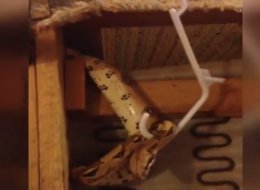
Holly Wright Finds Python In Secondhand Sofa


Now here's a story guaranteed to make you squirm.

A woman in Michigan recently got the surprise of her life when she discovered a large reptile coiled in the folds of her couch.

According to ABC News, Grand Rapids resident Holly Wright made the shocking find over the weekend, when she spotted a large snake slithering around in a secondhand couch she had picked up.

"I picked this couch up off the street and it's been in my bedroom for a couple months, and today we found a python inside the couch," Holly Wright said in a video obtained by ABC News' Grand Rapids affiliate WZZM-TV.


Saturday, 28 December 2013

Python strangles security guard at luxury hotel in Bali, Indonesia

A python strangled a security guard near a luxury hotel on Indonesia's resort island of Bali on Friday, and then escaped into nearby bushes following the deadly attack, police and a hotel employee who witnessed the incident said.

The incident happened around 3 a.m. local time (2 p.m. ET Thursday) as the 15-foot-long python was slithering across a road near the Bali Hyatt hotel, said Agung Bawa, an assistant security manager at the hotel, which is closed for renovations until 2015.

Thursday, 5 December 2013

WHAT DID THIS PYTHON EAT? Shocking photo sparks rumour snake ate human

The image appears to show a GIGANTIC PYTHON that has just consumed a suspiciously human-shaped meal.
Giant python, snake, eats man, python, india, man eaten by snake, picture, fake, hoax, It is unknown exactly where the photo originated but whatever the python ate it was MASSIVE.

One story doing the rounds is that the monster snake ATE a man who had gotten drunk and passed out on the street in India.

Another popular tale is that the photo was taken last year in South Africa when the deadly snake devoured a woman.

While some sites claim the photo is entirely fake, others appear to suggest the photo is real but it is unknown what the snake ate to get so bloated.


It's a reticulated python from tropical Asia not an African rock python. Both types have scoffed people on occasion.  - Richard Freeman

Thursday, 15 August 2013

BIG TABLOID STORY OF WEEK. 2 BOYS KILLED BY PYTHON. - via Herp Digest

5a) Python kills two boys in their sleep at New Brunswick sleepover 

GLOBE AND MAIL (Toronto, Ontario) 8/5/13 by Jane Taber

Two young boys in northern New Brunswick are dead after a python snake is believed to have escaped from an exotic animal store, slithered through ventilation ducts into an upstairs apartment and strangled them while they were sleeping, according to Campbellton, New Brunswick RCMP.

It is believed that the boys, five and seven-years-old, were brothers. The RCMP will not confirm this. An RCMP spokeswoman said, however, that the two did not live in the upstairs apartment but were on a sleepover.

The snake, which is in RCMP possession, is believed to have come from Reptile Ocean, an establishment in Campbellton that has exotic fish and reptiles. The establishment has three employees and has been in operation for at least 16 years.

The police were called to the apartment early in the morning where the boys were found dead, said the spokeswoman. Autopsies are being performed on the boys bodies.

Nearby residents said that police had been around the store since early in the morning. A 75-year-old resident, who refused to give her name, said there was quite a “commotion” around the store.

A 1996 report on zoos in the Maritimes for Zoocheck Canada Inc. and World Society for the Protection of Animals written by Dr. John Gripper, a veterinarian, gave a good review of Reptile Ocean. Dr. Gripper reported that the reptiles appeared to be in good health and the water in their tanks was clean. The collection of reptiles had only been opened a few months before his inspection.

He wrote that the owner, Jean-Claude Savoie “is a young, enthusiastic amateur collector who has only recently embarked on this commercial venture.” “In my opinion, it is only likely to be financially viable if he can obtain a national reputation as a successful and knowledgeable breeder of reptiles,” wrote Dr. Gripper.

However, there was an online petition calling for Reptile Ocean to be shut down. The person who started the petition complained about the humidity in the store and the condition of some animals.

________________________________________________________________

5b) N.B. python attack shines spotlight on 'patchwork' of exotic animal rules-Why did a python kill 2 boys in N.B.? Experts explain 'extremely rare' attack

Aug. 5, 2013. (CP)

"We recognize that this has touched the hearts of people across the world and that people want to know how this could have happened. Our investigators are looking at all aspects of this tragic incident, and that will take some time."

Police said a 15-foot African rock python escaped its enclosure in an apartment where the boys were sleeping over, slithered through a ventilation system and fell through a ceiling into the living room.


The boys' bodies were discovered by the owner of the apartment, Jean-Claude Savoie, early Monday morning.

Savoie also owns an exotic animal store, Reptile Ocean, located below the apartment.

The snake has since been euthanized. The RCMP said a necropsy showed that the python was in overall good health, but investigators are still waiting on the final report.

Meanwhile, a vigil is planned for the brothers on Wednesday evening.

"It won't be a closure, but it's something that people in this close-knit community have wanted to do," Campbellton deputy mayor Ian Comeau told CTV's Canada AM. "Share some stories, and their grief, and their sadness.”

The vigil will take place in a park featuring a giant salmon – a trademark of Campbellton – approximately a block away from where the two brothers died.

Family members are expected to be present at the vigil. Officials are asking people to keep a respectable distance from the family to allow them to grieve.

The boys’ deaths have shocked the northern New Brunswick community, where friends and family have described the brothers as having a love for life.

During a news conference Tuesday, Tremblay would not comment on whether Savoie had the right to keep such a snake, saying the investigation is still in the early stages.

However, a spokesperson with the provincial government said Savoie did not have the permit required to house the python, adding that the snake is generally only allowed in accredited zoos.

Comeau noted that there's some anger in Campbellton toward Savoie, but he stressed that people should refrain from rushing to judgement.

"He's grieving," Comeau said. "He's got a son that lost two good friends and it’s important we let the people out there know to let him grieve."

Paul Goulet, owner of Little Ray's Reptile Zoo in Ottawa, said it's very rare for a snake to strangle humans, as they’re not considered a food source.

The brothers were at a farm before the python attack, according a relative, and they were handling animals.

"That would be an explanation of how the snake could potentially mistake (the boys) for a food item," Goulet said.

"They rely heavily on their sense of smell and they have an unbelievably sensitive sense of smell," he said. "They would smell a goat or some other animals and not recognize that this isn't a food source."

Goulet said snakes have the ability to constrict their prey within seconds.

"I hate to think about what happened that night, but if those children were asleep, by the time they even woke up and realized what was happening and tried to scream, it would potentially be too late.

A funeral for the two brothers has been planned for Saturday at 3 p.m. ET at St. Thomas Aquinas church. The boys will be buried together in one casket.

The brothers’ mother told CTV Atlantic that they lived every moment together and so she wanted them to go to their final resting place together.

With a report from CTV’s Atlantic bureau chief Todd Battis

_____________________________________________________________

5c) ‘Very, very strange’: Snake handlers, experts baffled by New Brunswick python attack

8/6/13 by Sarah Boesveld, Global News 

The deaths of two young brothers apparently killed by an African rock python as they slept early Monday has left a New Brunswick town in mourning, and snake handlers questioning how such a rare incident could have happened.

Snakes are master escape artists and this 100 lb, 14-16 foot creature was no different, having slithered up the wall of its glass enclosure and through a ceiling vent in a second-floor Campbellton, N.B., apartment, police told reporters Tuesday.

The python then made its way through the ventilation shaft and spilled out into the living room where Noah Barthe, 4, and Connor Barthe, 6 were sleeping, having stayed overnight at the home of family friend Jean-Claude Savoie, who ran exotic pet shop Reptile Ocean on the floor below.

What happened next has been described as a fatal “attack” or a “strangling,” though the coroner reports on both the boys and the snake — which has since been euthanized and was not a legal pet in the province — were not yet available by press time on Tuesday.

“We appreciate the outpouring of sympathy that’s been shown,” Dave Rose, the boys’ uncle, told a news conference in Campbellton. Local residents had started a small memorial across the street from the scene of the tragedy.

‘It’s like a bad dream’: Family, friends in shock over death of N.B. boys believed strangled by python

African rock python euthanized, N.B. police scour ‘crime scene’ where brothers were killed at sleepover

Adding to the pile of unanswered questions, herpetologists, snake breeders and those who own snakes as pets are unconvinced by claims that the snake hunted the boys down.

“I’m totally skeptical,” said Johan Marais, who has written multiple books on these snakes and runs the African Snakebite Institute.


“It just sounds very, very strange. The fact that we don’t know if there was evidence of one kid being bitten, it’s puzzling that the two would be bitten,” he said Tuesday from Pretoria, South Africa.

African rock snakes, found in evergreen forests and open savannahs from Côte d’Ivoire to Ethiopia, do not just constrict their prey — first, they bite in order to anchor the animal they’re hunting down (anything from rats to antelopes, and they could easily fell an adult). Then, they begin to constrict, coiling around the body, damaging muscles, squeezing the air out of the lungs, causing cardiac arrest and then death, Mr. Marais said. Then, they eat their prey head first.

But they don’t eat very often — just a few times a year — and snakes held in captivity, like this one, are typically “overfed,” he said.

“Snakes don’t kill for fun,” Mr. Marais said. “It takes far too much energy.”

Jay Brewer describes the African rock python as among the most “misunderstood” constrictors he’s ever encountered. The president of Prehistoric Pets, a large pet store in Fountain Valley, Ca., has about 10 to 20 of these snakes in stock, but it’s not the first choice of many snake owners — even those who like large constrictors.

“A lot of people consider them to be really mean, but to be honest they’re mostly misunderstood, they’re just real frightened, real scared snakes,” he said. Rock pythons will strike at a perceived threat to try to scare it off rather than lunge and bite, Mr. Brewer said.

“I’m not going to sit here and tell you it’s impossible, but it’s really out of character for a snake not to bite and constrict and it’s really out of character for two victims and not just one.”

The snake would have also had to wrap its body around horizontally lying children, if they were sleeping during an attack — another unlikelihood, he said, considering a snake bite from a constrictor would elicit blood-curdling screams, waking anyone sleeping nearby.

But African rock pythons have claimed the lives of small children in the past — albeit not by striking, biting and squeezing as it would its prey.

Robert & Melissa Altom of Centralia, Ill., were acquitted of child endangerment in 2000 after their 3-year-old son was smothered by a 7 1/2 foot African rock python while he slept. Judge Harold Pennock said prosecutors failed to prove the parents knew the snake was “practically certain” to pose a threat to their son.

Snakes longer than three feet are prohibited pets in most provinces and municipalities in Canada, which automatically excludes large constrictors such as the African rock python. Legal reptiles are supposed to be kept in heavy glassed-in enclosures with locks.

“If someone were to phone me up and say ‘I want an African rock python’ that would be like saying ’I want a pit bull for dog fighting,’” said Corey Woods, a snake breeder in Guelph, Ont., who primarily breeds ball pythons, the most common snake of this type held in captivity in Canada. The ball python earned its name for the way it coils up into a ball when it’s scared, he said.

What happened in New Brunswick is “tragic,” he said, adding he, too, is skeptical of how these children could have been killed by a snake in their sleep if all 100 lbs of it tumbled from a ceiling vent (“that’s like a sack full of bowling balls,” he said).

“Everybody’s going to be calling to ban all pythons and that’s like saying ‘Somebody got bit by a dog so we should ban all dogs,’” he said. “We really need to find out exactly what happened — was the python really responsible for this?”

Snakes have had a bad reputation since the beginning of time, Mr. Marais points out.

“Snakes have had bad press from the day Adam and Eve came along,” he said. “It’s never got better for them.”

The local RCMP are treating the case as a criminal investigation and are also concerned about the pet shop owner’s safety due to community backlash. No charges have been laid.

_________________________________________________________________5d) N.B. boys who died after python attack were asphyxiated: autopsy

CTVNews.ca Staff, August 7, 2013

Preliminary results from autopsies performed on two young New Brunswick brothers believed to have been killed by a large python show the boys died of asphyxiation, the RCMP said Wednesday.

A pathologist has concluded that Noah Barthe, 4, and Connor Barthe, 6, were asphyxiated, police said.

"While we now have some preliminary information, investigators still have to wait for other test results to come back and for the final report," Sgt. Alain Tremblay of the New Brunswick RCMP said in a statement.

Related Stories

Snake that killed N.B. brothers was kept in apartment where they slept: RCMP

________________________________________________________________
5e) Python's strangling of 2 boys in Canada probed

ROB GILLIES, AP, Wed Aug 7, 2013

TORONTO — A 100-pound (45-kilogram) python blamed in the strangling deaths of two Canadian boys apparently escaped from its enclosure, slithered through a ventilation system and fell through the ceiling into the room where the young brothers were sleeping, authorities said Tuesday.

A snake expert said it was possible that the python was spooked and simply clung to whatever it landed on. Police are treating the deaths in Campbellton, New Brunswick, as a criminal investigation.

Autopsies on Noah Barthe, 4 and his brother Connor Barthe, 6, were performed Tuesday.

The brothers had been visiting the apartment of a friend whose father owned an exotic pet store on the floor below, Royal Canadian Mounted Police Sgt. Alain Tremblay said at a news conference in Campbellton. Tremblay said the African rock python was being kept inside the second floor apartment, not inside the pet store as authorities had previously stated.

Steve Benteau, a spokesman for the provincial Natural Resources Department, said no permit was issued for an African rock python and provincial authorities weren't aware it was being kept at the apartment. The department said the snake is generally only permitted in accredited zoos, unless there is a special permit.

Tremblay said the snake was housed in a large glass enclosure that reached the ceiling of the apartment and escaped through a small hole in the ceiling connected to the ventilation system. He said the snake made its way through the ventilation system and moved toward the living room, where the boys were sleeping. The pipe collapsed and the snake fell.

The friend of the boys was sleeping in another room and was unharmed.

The pet store owner, Jean-Claude Savoie, told the Global News television station that he didn't hear a sound and discovered the "horrific scene" when he went into his living room on Monday morning.

"I can't believe this is real," Savoie said.

He said the boys were the children of his best friend and were often at his apartment to visit his son. Savoie said the python, which he has had for at least 10 years, had been kept alone in its enclosure and was not handled by anyone else.

Police said the snake was killed by a veterinarian. It was sent for a necropsy to confirm the type of snake and help understand what may have caused it to attack.

Family spokesman Dave Rose, the boys' great-uncle, said the brothers had spent Monday at Savoie's family farm and played with different animals before staying over at the apartment. Rose thanked the community for their support and asked for privacy.

The snake was about 4.3 meters (14 feet) long, Tremblay said. He said police were looking at whether the store followed the province's regulations on exotic animals.

"It's a criminal investigation," Tremblay said. "We're going to look at all avenues."

The RCMP's Major Crime Unit is continuing the investigation, with the assistance of a reptile expert from the Magnetic Hill Zoo in Moncton, New Brunswick.

"I guess we can assume that given the size of the snake that certain things occurred, but the pathologist will be identifying the cause of death," Tremblay said.

Tremblay said police spoke to the store owner briefly and will meet with him again.

Reptile expert Bry Loyst, curator of the Indian River Reptile Zoo in Ontario, said police have been seeking his advice. He said he was told by police that it wasn't the first time that the python had escaped its enclosure. Police were not available to confirm that late Tuesday.

Loyst noted the boys had been playing with other animals hours earlier and he believes their scent might have attracted the snake.

Paul Goulet, founder and co-owner of Little Ray's Reptile Zoo in Ottawa, said snakes don't recognize humans as a source of food, but if the children smelled like animals, it could explain an attack.

"If a snake sees an animal moving, giving off heat and smells like a goat, what is it? It's a goat," Goulet said. "The reasonable explanation of how this has happened is that they had been playing with farm animals, they did smell like their prey items and the snake sadly enough mistook them as a food item when they weren't."

Rose said the kids had played with llamas, goats, horses and dogs and cats just a few hours earlier.

The town's deputy mayor, Ian Comeau, said the Reptile Ocean shop was licensed to operate and "everything was according to our bylaws, to the provincial guidelines." He said he saw alligators, crocodiles and snakes when he toured the shop with the fire department about two years ago.

Snake expert John Kendrick, a manager at the Reptile Store in Hamilton, Ontario, said it sounds like the python was not enclosed properly and might have been spooked. He called the strangling deaths "very unusual" but said African rock pythons tend to be a little more high-strung.

"It's very odd that one would go out and seek out a person. They don't recognize us as food," he said.

Pythons can sense heat, and if they are startled they can grab something, Kendrick said. He said snakes are very long and their muscles run lengthwise through their body, so they are not very stable unless they are holding on to something.

"A snake that size that was just trying to hold on securely enough to make sure he felt like he wasn't falling or going anywhere; he has enough muscle power to cut off circulation," he said.

It's possible that the python was just holding on to what it landed on, Kendrick said.

"Once they are in constricting mode, any part of their body that is touching something that moves, they'll wrap it," he said. "I've seen snakes with two different prey items at the same time, one with the back of the body and one with the front. It could have been an incident like that."

______________________________________________________________

5f) New Brunswick python owner got animals from Environment Canada

By Nick Logan Global News 8/8/13

Jean-Claude Savoie, the owner of the python that the RCMP says killed two boys in northern New Brunswick earlier this week, did government officials a favour by taking in the animal and several others, a former employee told Global News.

According to Marc Doiron, officials routinely brought seized reptiles to Savoie’s store, Reptile Ocean, when they were unable to facilitate care for them.

Doiron said he worked at Reptile Ocean for six months in total, in 2001 and 2002.

He told Global News that officials also brought a Cuban crocodile to Reptile Ocean sometime in 2001 or 2002.

It’s believed that’s one of the 16 animals that Department of Natural Resources officials are preparing to remove from the Campbellton exotic pet store.

Now a snake breeder, Doiron said the crocodile was seized at Moncton airport and officials brought it to Reptile Ocean because it was the only facility capable of taking care of it.

“All kinds of government had to get [involved] because of the rarity and endangered status of this animal,” he explained.

He said Savoie was more or less “babysitting” the animals for the government because they didn’t have the proper means to manage them.

Doiron said Savoie is now being “hung out to dry” and being blamed for having the deadly snake on his property.

Global News contacted Environment Canada for comment on Doiron’s statement.

Environment Canada spokesperson Mark Johnson confirmed in an email Thursday evening that the agency seized the crocodile in 2002 following an investigation that took place in N.B. and Alberta.

“The crocodile was placed with Reptile Ocean in June 2002 as it was operating as a zoo in the province of New Brunswick. Environment Canada places seized live animals in facilities for care under long-term loan agreements,” Johnson said.

He did not provide details about the long-term loan agreements.

Johnson also confirmed to Global News on Wednesday that Environment Canada officials brought the African rock python to Savoie in 2002, after it was dropped off anonymously at the local SPCA.

RCMP believe the 45-kilogram snake escaped from a glass enclosure in Savoie’s apartment, above the store, asphyxiating six-year-old Connor Barthe and his four-year-old brother Noah while they slept in the living room.

“You have to understand than a man does not come across these animals just because he wants them,” Doiron said. “The government was in step every step of the way with him.”

He said Savoie often took in animals that no one else wanted or were considered a danger to public safety.

“No one can look at me with a straight face and say they didn’t know he had what he had. It can’t be done,” Doiron said.

“We have to stop looking at him as this guy who owns too many snakes. We have to look at him as a guy who provided an amazing public service,” he added.

RCMP investigators are still trying to determining whether they will lay charges in the case.

A funeral service for the boys is scheduled for Saturday.

Meanwhile, the manager of a New Brunswick zoo says officials are preparing to remove more than a dozen animals from the building housing Savoie’s store and apartment.

Bruce Dougan, the manager of the Magnetic Hill Zoo in Moncton, N.B., says it could take two days to safely remove 16 animals and put them into crates.

Dougan, who has been inside Reptile Ocean, said there are four large American alligators, six crocodiles, some tortoises, turtles and snakes in the shop.

He said the tortoises will be going to his zoo, while the rest of the animals seized will be taken to the Indian River Reptile Zoo in Indian River, Ont.

But as of late afternoon Thursday, officials had not yet begun removing any of the animals. Dougan said it would likely take the rest of Thursday and most of Friday before the reptiles could be completely removed from the premises.

The snake was seized by RCMP on Monday and destroyed.


Related Posts with Thumbnails

ShareThis