Showing posts with label Paris. Show all posts

Monday, 3 February 2020

They survived fire and toxic fumes. So what happened next to Notre Dame's bees?

Hives that survived catastrophic Paris cathedral blaze are healthier than ever, says beekeeper

Kim Willsher in Paris

Fri 31 Jan 2020 06.00 GMTLast modified on Fri 31 Jan 2020 13.35 GMT

It is a crisp winter morning and the area around Notre Dame is sealed off as it has been since the fire last April that devastated the cathedral.

Those in the know, however, especially those with the keenest of eyes, might spot some small movement high up to the south of the stricken and blackened structure.

The bees of Notre Dame, whose escape from the inferno seemed almost miraculous, are thriving and conserving their energy ready to produce honey this summer, just as they have every year since they took up residence on the sacristy roof in 2013.

Nearly 10 months after the Paris cathedral was ravaged by fire, the three colonies are healthier than ever, according to their beekeeper.

Sibyle Moulin, who looks after the hives, spoke to the Guardian after she visited them for the first time in six months. Access to the site is restricted because the severely damaged 13th-century stone structure is still unstable and there is a risk from lead particles from the roof that was turned into dust in the blaze.

Moulin, who had to undergo a health and safety course to resume visits to the honey bees, said the 30-45,000 insects in the three hives are absolutely fine.

“There’s nothing wrong with them at all. The behaviour of the colonies is perfectly normal,” she said. “They’re not very active at this time of the year, but that’s how it should be. They seem fine.”

Monday, 4 June 2018

Dolphin 'happiness' measured by scientists in France


By Victoria GillScience correspondent, BBC News
28 May 2018

Scientists working with dolphins at a marine park near Paris have attempted to measure how the animals feel about aspects of their lives in captivity.

In what researchers say is the first project to examine captivity "from the animals' perspective", the team assessed what activities dolphins looked forward to most.

They found that the marine mammals most keenly anticipated interacting with a familiar human.

The results, they say, show that "better human-animal bonds equals better welfare".

The study, published in the journal Applied Animal Behaviour Science, was part of a three-year project to measure dolphin welfare in a captive setting.

Lead researcher Dr Isabella Clegg worked at Parc Astérix, a theme park with one of France's largest dolphinariums.

With colleagues at the University of Paris animal behaviour lab, she designed experiments to decode dolphin behaviour - essentially looking for physical postures that indicate how the animals were feeling.

"We wanted to find out what activities in captivity they like most," Dr Clegg told the BBC.


Wednesday, 8 March 2017

Poachers break into Paris zoo, shoot rhino dead and steal its horn

Four-year-old rhinoceros named Vince found with three bullets to head at Thoiry Zoo 

Katie Forster

A rhinoceros at a zoo near Paris was shot three times in the head on Monday night by poachers who then cut off its horn with a chainsaw.

The four-year-old rhinoceros, named Vince, was found dead by keepers at Thoiry Zoo, to the west of the French capital.

One or more poachers are believed to have broken in to the zoo and forced their way into an enclosure where three rhinos lived, reported Le Parisien. 


The white rhinoceros's second horn had also been partially hacked off, indicating the perpetrators had run out of time or their equipment had failed.

They may have also planned to steal the horns of the two other white rhinos, five-year-old Bruno and 37-year-old Gracie. Both animals are said to be safe and healthy.

Vince was born on in September 2012 at Burgers' Zoo in the Netherlands. He arrived in Paris in March 2015 with Bruno.

Rhinoceros horns can be sold on the black market for around £30,000 each and are particularly sought after in China, where they are believed to have aphrodisiac qualities.


Continued


4 years old.  You callous, cowardly bastards.  Shame on you and those who pay you your blood money.  Just remember that karma has no menu; you get served what you deserve.

Tuesday, 16 June 2015

France makes biggest ivory bust in a decade


French customs have announced they have seized 12 elephant tusks at Charles de Gaulle Airport in Paris making it the biggest single seizure in a decade. The tusks had been cut down to 37 individual pieces and hidden under aluminium plates in cases to try an avoid detection.

The ivory was on route to Vietnam and the original flight of the plane was from the DR Congo.

“This is a sadly typical case,” said airport customs official Sebastien Tiran. “There’s one thing that never goes out of fashion and that’s ivory,”

The total weight of the ivory was 136 kilos and makes it the largest single seizure since December 2006 when 600 kilos of ivory were intercepted.

Thursday, 13 November 2014

'Paris tiger': Big cat loose near French capital - report

13th November 2014 

Police, fire officials and a specially-trained hunting dog are searching for a big cat - believed to be a tiger - seen in a town outside Paris.

A woman alerted officials after spotting the animal in a supermarket car park in Montevrain, east of the French capital.

Officers armed with tranquiliser guns have been combing countryside outside the town, helped by a helicopter.

Residents of Montevrain and two other towns have been told to stay indoors.

As darkness fell, the Montevrain council said on its Facebook page that the search had been called off for the night but local schools would be secured by 08:00 on Friday.

During the day, children were kept in schools and collected by their parents by car.

It was unclear where the animal came from, though there is a big cat park near Montevrain.

Tuesday, 7 January 2014

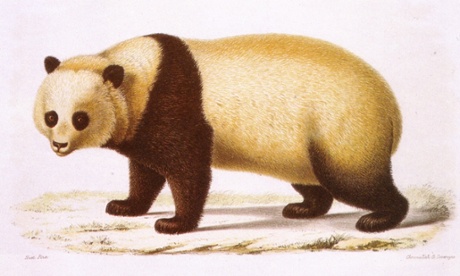
The ‘first’ giant panda and how it ended up in Paris

Engraving of the giant pandaPandas are such a common sight in today’s busy world (cute pandas,sneezing pandas, Kung Fu pandas, humans dressed as pandas) that it’s hard to imagine a time when this beast was not known. Yet as recently as 150 years ago, this was the case for all but a handful of people.

The first westerner to clap eyes on a panda is thought to have been a French priest and naturalist known as Armand David. He’d been posted to China in 1862 to spread the Christian word, but was a keen naturalist too (“all science is dedicated to the study of God’s works and glorifies the Author”) and went on several collecting trips over the course of his stay, sending specimens back to the Muséum National d’Histoire Naturelle in Paris.

Friday, 6 September 2013

Testicle-eating fish could be headed to UK after being found in Paris

The ‘ball-cutter’ fish, which reportedly bites human testicles, could be on its way to the UK after being found in France.

Male swimmers in Britain could soon have to wear extra protection down below after the pacu was caught worryingly close to these shores in Paris’s Seine river.

Police in the French capital took a photo of the Amazon based fish and said it measured 1ft.

It can grow as large as 35in (90cm) and weigh up to 55lb (25kg).

The pacu, which has reportedly caused men to bleed to death after biting their testicles, had previously turned up in Sweden.

‘The pacu is not normally dangerous to people but it has quite a serious bite,’ said fish expert Henrik Carl.

‘There have been incidents in other countries, such as Papua New Guinea where some men have had their testicles bitten off.

‘They bite because they’re hungry, and testicles sit nicely in their mouth.’

Wednesday, 10 April 2013

King Louis XIV's pet elephant attacked with chainsaw

More than 300 years after its death, a pet elephant that once belonged to King Louis XIV has been attacked by a would-be ivory poacher.

By Henry Samuel, Paris
10:53PM BST 31 Mar 2013

A 20-year-old man allegedly broke into the Museum of Natural History in Paris on Friday night and attacked the elephant’s skeleton with a chainsaw, hacking off its left tusk. He has been detained but not identified.


Neighbours alerted police after being roused by the sound of a chainsaw at 3am. The museum’s alarm also went off after the thief had climbed railings and smashed a thick window to enter.

Within minutes, officers caught a man carrying the tusk over his shoulder. He had a fractured ankle apparently after jumping from a wall. They found the chainsaw still whirring in the museum.

The African elephant, whose skeleton stands in the anatomy gallery of the museum in the Jardin des Plantes was given to the Sun King by the king of Portugal in 1668. It lived in the zoo of Versailles Palace until its death in 1681.

Related Posts with Thumbnails

ShareThis