Sunday, 4 July 2021

Out of place animals in Wales

 The raccoon dog, panthers, wallaby and other creatures that made a run for it in Wales

From mystical big cats to captured raccoon dogs, there's always a chance that ... A big cat consultant and expert, Danny Nineham, said at the time: "It's ..

Friday, 2 July 2021

Wild Justice #67


Contact photo

Message Body

Image
 
 
Good morning,
 
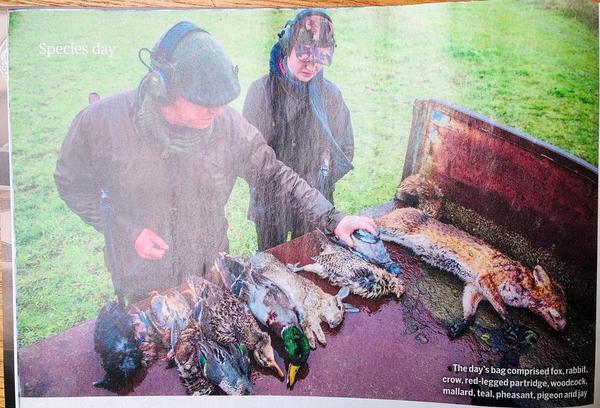
Near the end of May we sent out newsletter 62 which decribed what we believed was a breach of the general licences (we also published an account on our blog). The events which we reported to DEFRA were published in the Shooting Times on 10 February in an article which purported to describe a day's shooting where a regular columnist describes going out into the countryside in late January to see how many species of mammal and bird he could shoot. He was delighted to shoot 10 species in the day including a Carrion Crow and a Jay (see image above from the article). Those species are only lawfully killed under certain circumstances and with certain conditions. We believed that the shooting of those two birds was potentially unlawful. Today we can provide an update on that matter in this newsletter and on our blog (see here).  
 
At DEFRA's request, we sent the legal and biological dossiers that we had sent to them to Essex Police who investigated. Essex Police have recently told us that they cannot take the case any further as the Shooting Times columnist denies having shot either a Jay or a Carrion Crow despite having described the shots that led to the deaths of these two birds in some detail in his published article.
 
Essex Police tell us that 'With regards to the Carrion Crow and Jay he has stated that, he did not shoot these birds on this day and has a number of frozen/prop birds that he uses in his articles, if he needs to and bases the events on previous incidents or other incidents which have similarities.'.
 
So, assuming, as we will, that this statement is true, the article was not true.  If it had been true then perhaps the court would have been asked to rule on the legality of the action - an action that we would state is unlawful (but since it did not happen in this particular case that is the end of this matter).
 
We intend to ask DEFRA for their view on these matters in general, in case such circumstances arise in future. We have also written to the Shooting Times stating that we regard their publication of a false and misleading article as a breach of the IPSO Editors' Code and seeking a retraction and clarification (see here).
 
We are grateful to Essex Police for their investigation of this matter.
 
Wild Justice has maintained since we first sprang into action in 2019, that much of the killing of birds under the different general licences which exist in the four UK nations amounts to casual killing, too much of which is unlawful. We have made progress in tightening up the general licences, getting some species removed from them, and highlighting the issues that they raise. The article in Shooting Times, now admitted to be false by its author, is a further example of how some shooters appear to believe that the laws work. There is more work to be done by Wild Justice in making sure that the general licences in place fully reflect the requirements of the law.  In that regard, we see that DAERA in Northern Ireland yesterday issued a consultation on their general licences. Wild Justice has been in correspondence with the Northern Ireland authorities about their general licences, which we regard as shockingly bad and unlawful, and that may well be why this consultation is now taking place.  We will update you on Northern Ireland general licences next week.
 
If you like what we are doing then please consider making a donation through PayPal, bank transfer or a cheque in the post - see details here. 
 
That's it for now - have a good weekend.
 
Wild Justice (Directors: Mark Avery, Chris Packham and Ruth Tingay)

Thursday, 1 July 2021

BBC: Covid common in cats and dogs, study finds


 Covid is common in pet cats and dogs whose owners have the disease, research suggests.

Swabs were taken from 310 pets in 196 households where a human infection had been detected.

Six cats and seven dogs returned a positive PCR result, while 54 animals tested positive for virus antibodies.

"If you have Covid, you should avoid contact with your cat or dog, just as you would do with other people," Dr Els Broens, from Utrecht University, said.

"The main concern is not the animals' health but the potential risk that pets could act as a reservoir of the virus and reintroduce it into the human population."


Read on…


BBC: leucistic puffin


IMAGE COPYRIGHTDORA HAMILTON
image captionThe bird's lack of pigmentation is caused by a genetic condition called leucism

A rare white puffin has been spotted on a small island off the Sutherland coast in the Highlands.

The Scottish Wildlife Trust (SWT) said the bird was first seen on Handa Island in mid-June by seabird fieldworker Dora Hamilton.

The young puffin has only a few black feathers and its bill is largely orange. 

SWT said the bird's lack of pigmentation was caused by a genetic condition called leucism.

The trust manages the island as a wildlife reserve


Read on… 


Saving the Siamese crocodile


Siamese crocodile hatchling being held by conservationist

The timeless reptiles running out of time

They are living dinosaurs. 

Siamese crocodiles are truly ancient - one of the final living connections we have to our planet’s long-lost past. For millennia, they have kept themselves to themselves and thrived in peaceful isolation.

But their time is almost up.

There are now just a few hundred left.

In an evolutionary blink of an eye these captivating creatures have been systematically slaughtered for their skin and wiped out from 99% of their former range.

They are now one of the world’s rarest reptiles, thought to be extinct until they were rediscovered in Cambodia in 2000.

And despite this terrifying decline, their struggle for survival is scarcely-known.

Siamese crocodiles are skilled natural predators, though their size means that they rarely tackle prey larger than small snakes, frogs and fish. Sadly, instead of being admired for their extraordinary agility and hunting prowess in the same way that we view species like lions and bears, crocodiles are often demonised and misunderstood.

They have faded from public view and been driven to the brink of extinction.

Unless they get help, they won't survive this crisis. Their ancient history will end now - with us - as a damning example of how humanity valued fancy leather over an entire living species. 

But through your donations, we can change that. We can give them a chance.

Through your support we’re carrying out a crucial captive breeding programme in Cambodia and releasing hundreds of Siamese crocodiles into the wild - aiming to double the wild population over the next few years.

We are working closely with local communities to carry out vital research and monitoring, as well as advocating for stricter controls over crocodile farming and trade. Many local communities in Cambodia adore and admire these charismatic creatures, considering them sacred. Now we need to value them too. 

That way, we can save Siamese crocodiles before it’s too late. We can stop these so-called living fossils from going the way of the dinosaurs.


Please help save Siamese crocodiles. If everyone reading this donates just £3, you could help fund our crucial captive breeding programme - helping these incredible creatures to thrive in the wild once again. Thank you.

Related Posts with Thumbnails

ShareThis