Showing posts with label rare whales. Show all posts

Tuesday, 17 May 2016

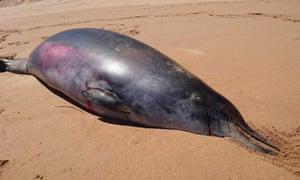
Rare whale found on Australian beach believed to be evolutionary throwback

South Australian Museum researchers confounded by mysterious teeth previously unseen in beaked whales


Photograph: South Australian Museum
Snday 15 May 201604.08 BSTLast modified on Sunday 15 May 201605.22 BST

Sientists believe they have an uncovered an evolutionary throwback in a rare deep ocean whale that washed ashore on a South Australian beach.

The beaked whale, found dead on Waitpinga beach in February, confounded examiners from the South Australian Museum who discovered two mysterious teeth previously unseen in that family of deep diving mammals.

Appeals to museum colleagues across the world, including at the renowned Smithsonian Institute in the US, have yielded no answers on the vestigial fangs, which are small and pointy.


South Australian Museum senior researcher Catherine Kemper told the ABC that the teeth, which defied the known norm in female whales by erupting above the jawline, were “very odd … something I had never seen before”.

“My mind was thinking, ‘Do we have something new here?’,” Kemper said.

Researcher Catherine Kemper told the ABC that the teeth, which defied the known norm in female whales by erupting above the jawline, were ‘very odd’. Photograph: South Australian Museum

After the whale skull was stripped clean, the museum’s collections manager, David Stemmer, yanked the tooth and was surprised to find the larger tooth of a Hector’s beaked whale underneath.

Wednesday, 18 July 2012

Shipping lanes shifted to protect rare whales


Shippers say the project, spurred by an uptick in propeller accidents, benefits them, too.

By JASON DEAREN The Associated Press
SAN FRANCISCO - Scientists studying the carcass of a 47-foot fin whale that washed up on a beach in the Point Reyes National Seashore last month found the creature's spine and ribs severed, likely from the propeller of one of the huge cargo ships that sail those waters.
There have been many victims of such accidents in recent years as migrating blue, fin and humpback whales have been lured close to California's shore by plentiful krill, the shrimplike organisms they eat. All three species are endangered.
Now, after a two-year effort spurred by the uptick in accidents, federal maritime officials have approved a plan to protect whales in and around San Francisco Bay. It includes rerouting shipping traffic and establishing better ways to track whale locations.
The changes crafted by the National Oceanic and Atmospheric Administration, shipping industry representatives, whale researchers and the Coast Guard will likely take effect next year, after a final review by the United Nations International Maritime Organization.
"In 2010, it really struck home when a female blue whale carrying a calf was found dead on the beach," said Maria Brown, NOAA's superintendent for the Gulf of the Farallones National Marine Sanctuary. "And blue whales' numbers are so small -- to lose a female and a new whale coming into the population really sent home the message that we needed to look at the whale strike issue."


Related Posts with Thumbnails

ShareThis
