
A dancing goat has become something of a local celebrity in a Chinese village.
Owner Zhao Huaiyun, of Gao'an village, Mianzhu, southwest China's Sichuan province, says his goat loves to dance.
He has been offered a small fortune for the eight-month-old animal but is refusing to sell it.
"It's like a kid, always following me everywhere I go," he said.
People were coming from all over the area to see it peform, Zhao added.
"Whenever it has a bit of free time, it will stand up and dance in a circle and even shake hands with visitors," he said.
http://web.orange.co.uk/article/quirkies/Dancing_goat
Showing posts with label unusual talents. Show all posts
Showing posts with label unusual talents. Show all posts
Saturday, 30 July 2011


Wednesday, 30 March 2011
Cat with thunderous purr makes record attempt in UK
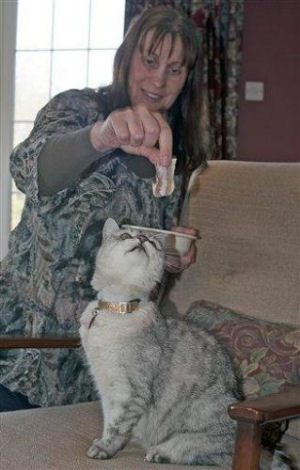 |
| In this handout photo released by Northampton College, Smokey, a gray and white tabby cat prepares to receive a treat from owner Ruth Adams, in Northampton , England. A British community college says it has a recorded a house cat whose lawnmower-like purr hit 73 decibels, 16 times louder than the average feline. Northampton College in central England said Wednesday, March 30, 2011, that it had dispatched a music team with specialist sound equipment to record 12-year-old Smokey. The recording has been submitted to the Guinness World Records. (AP Photo, Alisdair Tait, Northampton College) |
LONDON (AP) -- A British community college has recorded a house cat named Smokey whose lawnmower-like purr hit 73 decibels, which is 16 times louder than the average feline.
Northampton College in central England said Wednesday it received a request from Smokey's owner, Ruth Adams, to provide the equipment needed to file a world record application.
The college agreed, dispatching a team with specialist sound equipment to record Smokey purring in the comfort of Adams' home in the nearby village of Pitsford, about 70 miles (110 kilometers) northwest of London.
The recording has now been submitted to Guinness World Records for vetting.
The 12-year-old gray-and-white tabby has already made several media appearances, with journalists comparing the purr to the sound of a Boeing 747 from a mile away. A video posted to the cat's website made it sound more like the cooing of an angry dove.
"Sometimes she purrs so loudly it makes her cough and splutter," the site said. "She even manages to purr while she eats."
Smokey is camera-shy, according to Adams, who said in a statement that the recording session had to be kept quiet and low key to keep the cat from getting upset.
All the attention may have made the Adams household media-shy as well.
"Oh God," said a man who answered the phone at the Adams' home Wednesday. "You're not the only caller." He then hung up.
Guinness World Records spokeswoman Amarilis Whitty said that she was "anxiously waiting" for the recording to see if it meets the group's standards.
http://newsok.com/cat-with-thunderous-purr-makes-record-attempt-in-uk/article/3553850
Wednesday, 9 March 2011
Elephants know how to co-operate
Monday, 7 March 2011
By Victoria Gill
Science and nature reporter, BBC News
Footage of an oversized experiment has revealed that elephants understand when they need help from a partner.
In the test, two animals had to work together - each pulling on a rope in order to tug a platform towards them.
Elephants' apparent grasp of the need to co-operate shows, scientists say, that they belong in an "elite group" of intelligent, socially complex animals.
Researchers from the University of Cambridge built the apparatus, which was originally designed for chimps.
The team published their findings in Proceedings of the National Academy of Sciences.
Study leader Dr Joshua Plotnik from the University of Cambridge said it was exciting to find a way to study elephant behaviour in such detail.
"It's so hard to work with elephants because of their size," he said.
"We see them doing amazing things in the wild, but we can see from this that they're definitely co-operating."
Helping trunk
The Asian elephants (Elephas maximus) involved in the study had already been taught that pulling on a rope brought a platform towards them, and a food reward on that platform within reach.
But this apparatus, set up at the Thai Elephant Conservation Center in Lampang province, presented them with a new twist on that simple task.
One rope was threaded all the way around a platform - like a belt through belt loops - so if one end was tugged, the rope simply slipped out and the platform did not budge.
But if two elephants each took an end of the rope and pulled, the platform moved and that could claim their treats.
"When we released one elephant before the other, they quickly learned to wait for their partner before they pulled the rope," Dr Plotnik told BBC News.
"They learnt that rule [to wait for the other elephant to arrive] quicker than chimps doing the same task.
And one elephant - the youngest in the study - quickly learned that it did not have to do any pulling to get a treat.
"She could just put her foot on the rope, so her partner had to do all the work," said Dr Plotnik.
Many scientists, photographers and film-makers have documented remarkable behaviour by wild elephants, including "targeted helping" of other elephants that become stuck in mud.
There have even been reports of elephants appearing to mourn their dead.
"As humans, we like to show that we're unique," said Dr Plotnik, "but we're repeatedly shot down.
"One thing that remains is our language. But amazingly complex behaviours - culture, tool use, social interaction - we see all of this in the animal kingdom."
Dr Karen McComb from the University of Sussex, who studies animal behaviour, agreed that the study enhanced "our understanding of the cognitive abilities of this intensely social animal".
Dr Plotnik also hopes that his findings will help with the conservation of these endangered animals.
"The more we can understand about their intelligence, the better we can develop solutions to things like human-elephant conflict," he explained.
"So when the animals are raiding crops, we need to think of solutions that are based on the reasons why, and that benefit elephants as well as people."
Tina Dow from US-based Elephant Research International said the findings could also "have positive effects on captive elephants, allowing keepers and mahouts to develop better enrichment tools that can stimulate both mental and physical health".
"Elephants are caring, sentient beings," she added.
See video at: http://news.bbc.co.uk/earth/hi/earth_news/newsid_9417000/9417308.stm
(Submitted by Dawn Holloway)
By Victoria Gill
Science and nature reporter, BBC News
Footage of an oversized experiment has revealed that elephants understand when they need help from a partner.
In the test, two animals had to work together - each pulling on a rope in order to tug a platform towards them.
Elephants' apparent grasp of the need to co-operate shows, scientists say, that they belong in an "elite group" of intelligent, socially complex animals.
Researchers from the University of Cambridge built the apparatus, which was originally designed for chimps.
The team published their findings in Proceedings of the National Academy of Sciences.
Study leader Dr Joshua Plotnik from the University of Cambridge said it was exciting to find a way to study elephant behaviour in such detail.
"It's so hard to work with elephants because of their size," he said.
"We see them doing amazing things in the wild, but we can see from this that they're definitely co-operating."
Helping trunk
The Asian elephants (Elephas maximus) involved in the study had already been taught that pulling on a rope brought a platform towards them, and a food reward on that platform within reach.
But this apparatus, set up at the Thai Elephant Conservation Center in Lampang province, presented them with a new twist on that simple task.
One rope was threaded all the way around a platform - like a belt through belt loops - so if one end was tugged, the rope simply slipped out and the platform did not budge.
But if two elephants each took an end of the rope and pulled, the platform moved and that could claim their treats.
"When we released one elephant before the other, they quickly learned to wait for their partner before they pulled the rope," Dr Plotnik told BBC News.
"They learnt that rule [to wait for the other elephant to arrive] quicker than chimps doing the same task.
And one elephant - the youngest in the study - quickly learned that it did not have to do any pulling to get a treat.
"She could just put her foot on the rope, so her partner had to do all the work," said Dr Plotnik.
Many scientists, photographers and film-makers have documented remarkable behaviour by wild elephants, including "targeted helping" of other elephants that become stuck in mud.
There have even been reports of elephants appearing to mourn their dead.
"As humans, we like to show that we're unique," said Dr Plotnik, "but we're repeatedly shot down.
"One thing that remains is our language. But amazingly complex behaviours - culture, tool use, social interaction - we see all of this in the animal kingdom."
Dr Karen McComb from the University of Sussex, who studies animal behaviour, agreed that the study enhanced "our understanding of the cognitive abilities of this intensely social animal".
Dr Plotnik also hopes that his findings will help with the conservation of these endangered animals.
"The more we can understand about their intelligence, the better we can develop solutions to things like human-elephant conflict," he explained.
"So when the animals are raiding crops, we need to think of solutions that are based on the reasons why, and that benefit elephants as well as people."
Tina Dow from US-based Elephant Research International said the findings could also "have positive effects on captive elephants, allowing keepers and mahouts to develop better enrichment tools that can stimulate both mental and physical health".
"Elephants are caring, sentient beings," she added.
See video at: http://news.bbc.co.uk/earth/hi/earth_news/newsid_9417000/9417308.stm
(Submitted by Dawn Holloway)
Sunday, 13 February 2011
Remember the psychic octopus? No? Well here comes a psychic opossum anyways

Feb 13, 2011, 1:30 PM EST
Ah, the Germans. Never one to let a once-cute idea die, they’ve revived World Cup sensation Paul the Psychic Octopus (in spirit anyways) by introducing their newest ESP-laden animal– Heidi, a cross-eyed opossum. You can’t make this stuff up.
Heidi’s task? Picking the Oscars, a seemingly tougher task than Paul’s since he had a 50/50 chance on every match and she’ll have to pick a winner out of multiple choice. Nevertheless, Heidi isn’t nervous. Mainly because she’s an opossum.
I’m not exactly sure how an opossum gets cross-eyed (probably from staring at its laptop too long) but it’s admirable that Heidi hasn’t let this disability stop her from chasing her dreams of being a famous psychic marsupial, like so many before her.
In the meantime, let me submit my services a psychic blogger– Toy Story 3 wins Best Animated Film. Now where’s my check?
***
Germany’s cross-eyed opossum to pick Oscar winners [Associated Press]
Heidi’s task? Picking the Oscars, a seemingly tougher task than Paul’s since he had a 50/50 chance on every match and she’ll have to pick a winner out of multiple choice. Nevertheless, Heidi isn’t nervous. Mainly because she’s an opossum.
Leipzig Zoo Director Joerg Junghold told Germany’s RTL television on Friday that Heidi will be appearing on the “Jimmy Kimmel Show” alongside the Oscars on Feb. 27.What, Conan wasn’t available?
I’m not exactly sure how an opossum gets cross-eyed (probably from staring at its laptop too long) but it’s admirable that Heidi hasn’t let this disability stop her from chasing her dreams of being a famous psychic marsupial, like so many before her.
In the meantime, let me submit my services a psychic blogger– Toy Story 3 wins Best Animated Film. Now where’s my check?
***
Germany’s cross-eyed opossum to pick Oscar winners [Associated Press]
http://offthebench.nbcsports.com/2011/02/13/remember-the-psychic-octopus-no-well-here-comes-a-psychic-opossum-anyways/
Tuesday, 8 February 2011
How 'Chimpus Commercialus' Went From Ad Star to Endangered Species
Pressure From Animal-Rights Groups Has Agencies Pledging Not to Use Great Apes for Ad Entertainment
By Brian Steinberg
Published: February 06, 2011
NEW YORK (AdAge.com) -- They were once stars. After a rough start in life -- taken from their mothers during infancy -- they found themselves on the national stage, making millions laugh during the Super Bowl. Their careers were short, two or three years at most, and now they've been shunted aside. But they're the lucky ones. Sent to finish out their lives in Florida, the four chimpanzees from the original CareerBuilder Super Bowl ads share a home with Michael Jackson's former pet, Bubbles, at the Center for Great Apes in Wauchula. They could have ended up in cages in roadside attractions, or on the nightly news, put down after going on a rampage.
Before this year's Super Bowl, it had likely been years since most Americans had seen a national TV spot featuring an ape. That's because chimpus commercialus and its kin, thanks to pressure put on marketers and ad agencies by animal-rights groups, are on the verge of extinction.
But there are still reminders. After moving away from the use of chimpanzees in its Big Game commercials, CareerBuilder has sparked a minor controversy by reviving interest in the animals that have long been a staple of big-budget TV advertising. CareerBuilder ads in last night's game returned to the theme from the company's memorable efforts in 2005 and 2006: chimpanzees as obstinate, time-wasting cubicle-mates who demonstrate the need for CareerBuilder's online job listings.
Last night's spot could mark the last for this close relative of the monkey that has ridden on Madison Avenue's back for decades.
Eighteen different ad agencies have agreed in the last few years to stop using great apes in the commercials they produce, the result of an ongoing effort started in 2008 by People for the Ethical Treatment of Animals.
Among the big firms involved are Omnicom Group's BBDO, GSD&M and Merkley & Partners; Interpublic Group of Cos.' McCann Erickson, DraftFCB and RPA; Havas' Arnold and Euro RSCG; WPP's Grey Group, Ogilvy & Mather, Young & Rubicam and JWT; and Publicis Groupe's Saatchi & Saatchi and Leo Burnett.
"The list is only going to grow," said Julia Galluci, a primatologist with PETA who studies the use of apes in commercials.
Indeed, Omnicom's DDB and TBWA/Chiat/Day, two agencies that work for marketers that have made memorable ads with chimps in the past -- Anheuser-Busch InBev and PepsiCo -- are not yet on the list.
PETA also successfully lobbied several major advertisers to modify or pull ads in 2010 when apes were featured. Pfizer edited out an orangutan used in a commercial crafted by Grey Group for its Robitussin, and decided instead to incorporate a digital image of a chimp. Dodge, AT&T and Travelers Insurance made similar moves after PETA's approach.
For its part, CareerBuilder, which created its ad in-house, said it has treated the animals involved in this year's Super Bowl plans well. "During the production of our ad, we followed the strictest guidelines to ensure our chimpanzee stars were treated well and not harmed in any way. We hired top trainers known to provide the highest standard of care for their animals. We also had a member of an animal rights group, the American Humane Association, on set during the entire filming to ensure the chimpanzees were treated with respect," the company said in a statement. "This was very important to us."
But it's not the treatment of the animals on set that is the main concern from animal-rights groups. Rather, it's the procurement and disposal of apes for acting.
Apes in the wild stay with their mothers for nearly the first decade of life, and typically nurse for the first five or six years, said Patti Ragan, founder and director of the Center for Great Apes, the private sanctuary that hosts those four CareerBuilder chimps as well as Bubbles. But to work on an ad, movie or TV program, a chimp or orangutan needs to be under the age of 8. When they pass that age, she said, "they are too dangerous and strong to work around humans" and are therefore retired. Caring for the animals after they can no longer work on shoots can require something in the neighborhood of $20,000 a year, she estimated.
Heartstring-plucking details such as these are likely not immediately clear to the consumers who thrill to monkeyshines in TV pitches. And even those who protect the chimps admit that there has been no consumer outrage. If it did, the animals wouldn't show up year after year in the Super Bowl, the nation's broadest advertising showcase.
Great apes have appeared in 10 different ads tailored for the Big Game since 2000, according to research from students of Chuck Tomkovick, a professor of marketing at University of Wisconsin-Eau Claire, who has studied Super Bowl ads for years. There's good reason: Mr. Tomkovick's recent research suggests that placing any sort of an animal in an ad increases its likability.
The ad industry's eagerness to distance itself from chimps and their cousins comes even though capturing consumer attention with TV ads has become increasingly difficult. And it arrives despite the fact consumers are more likely to stop and notice chimps and apes when spotted on the TV screen. Chimps and apes have particular appeal, said Barbara J. King, an anthropology professor at the College of William and Mary, who has studied apes and monkeys in the wild and in U.S. zoos for 30 years.
"They are like us, but they're not like us," she said. "It's exactly that strange paradox that grabs people."
Further, when it comes to convincing consumers that apes need protecting, there is a perception problem. "It looks to me like these commercials are making these animals seem cute and perfectly well-cared for," said Ms. King, the anthropology professor. "It's not clear to me from the surface of it why consumers would necessarily be concerned unless someone tells them the back story."
And PETA has been relaying that story to ad-agency executives to some effect. "The cruelty of separating baby apes from their mothers, the brutal training, and the tragic 'retirement' provide a real incentive not to use them," said Andrew Robertson, president-CEO of BBDO Worldwide.
"They are cute. They behave like humans. They are cuddly," said Tony Granger, global chief creative officer at Young & Rubicam. "But what really does it for me is understanding that the apes are taken away from their mothers. We honestly didn't know any of this."
PETA expects to press its case, Ms. Galluci said. The organization is in early talks with BBDO to create an ad campaign aimed at ad-industry employees and make them aware of the problems with using live apes in ad shoots. "It's the agencies that are writing the stories, writing the scripts for these ads," she said. Once agency executives hear the details about the simians, she added, "they are really quick to agree" not to use them any longer. Whether the entire industry apes the move remains to be seen.
http://adage.com/superbowl/article?article_id=148714
By Brian Steinberg
Published: February 06, 2011
NEW YORK (AdAge.com) -- They were once stars. After a rough start in life -- taken from their mothers during infancy -- they found themselves on the national stage, making millions laugh during the Super Bowl. Their careers were short, two or three years at most, and now they've been shunted aside. But they're the lucky ones. Sent to finish out their lives in Florida, the four chimpanzees from the original CareerBuilder Super Bowl ads share a home with Michael Jackson's former pet, Bubbles, at the Center for Great Apes in Wauchula. They could have ended up in cages in roadside attractions, or on the nightly news, put down after going on a rampage.
Before this year's Super Bowl, it had likely been years since most Americans had seen a national TV spot featuring an ape. That's because chimpus commercialus and its kin, thanks to pressure put on marketers and ad agencies by animal-rights groups, are on the verge of extinction.
But there are still reminders. After moving away from the use of chimpanzees in its Big Game commercials, CareerBuilder has sparked a minor controversy by reviving interest in the animals that have long been a staple of big-budget TV advertising. CareerBuilder ads in last night's game returned to the theme from the company's memorable efforts in 2005 and 2006: chimpanzees as obstinate, time-wasting cubicle-mates who demonstrate the need for CareerBuilder's online job listings.
Last night's spot could mark the last for this close relative of the monkey that has ridden on Madison Avenue's back for decades.
Eighteen different ad agencies have agreed in the last few years to stop using great apes in the commercials they produce, the result of an ongoing effort started in 2008 by People for the Ethical Treatment of Animals.
Among the big firms involved are Omnicom Group's BBDO, GSD&M and Merkley & Partners; Interpublic Group of Cos.' McCann Erickson, DraftFCB and RPA; Havas' Arnold and Euro RSCG; WPP's Grey Group, Ogilvy & Mather, Young & Rubicam and JWT; and Publicis Groupe's Saatchi & Saatchi and Leo Burnett.
"The list is only going to grow," said Julia Galluci, a primatologist with PETA who studies the use of apes in commercials.
Indeed, Omnicom's DDB and TBWA/Chiat/Day, two agencies that work for marketers that have made memorable ads with chimps in the past -- Anheuser-Busch InBev and PepsiCo -- are not yet on the list.
PETA also successfully lobbied several major advertisers to modify or pull ads in 2010 when apes were featured. Pfizer edited out an orangutan used in a commercial crafted by Grey Group for its Robitussin, and decided instead to incorporate a digital image of a chimp. Dodge, AT&T and Travelers Insurance made similar moves after PETA's approach.
For its part, CareerBuilder, which created its ad in-house, said it has treated the animals involved in this year's Super Bowl plans well. "During the production of our ad, we followed the strictest guidelines to ensure our chimpanzee stars were treated well and not harmed in any way. We hired top trainers known to provide the highest standard of care for their animals. We also had a member of an animal rights group, the American Humane Association, on set during the entire filming to ensure the chimpanzees were treated with respect," the company said in a statement. "This was very important to us."
But it's not the treatment of the animals on set that is the main concern from animal-rights groups. Rather, it's the procurement and disposal of apes for acting.
Apes in the wild stay with their mothers for nearly the first decade of life, and typically nurse for the first five or six years, said Patti Ragan, founder and director of the Center for Great Apes, the private sanctuary that hosts those four CareerBuilder chimps as well as Bubbles. But to work on an ad, movie or TV program, a chimp or orangutan needs to be under the age of 8. When they pass that age, she said, "they are too dangerous and strong to work around humans" and are therefore retired. Caring for the animals after they can no longer work on shoots can require something in the neighborhood of $20,000 a year, she estimated.
Heartstring-plucking details such as these are likely not immediately clear to the consumers who thrill to monkeyshines in TV pitches. And even those who protect the chimps admit that there has been no consumer outrage. If it did, the animals wouldn't show up year after year in the Super Bowl, the nation's broadest advertising showcase.
Great apes have appeared in 10 different ads tailored for the Big Game since 2000, according to research from students of Chuck Tomkovick, a professor of marketing at University of Wisconsin-Eau Claire, who has studied Super Bowl ads for years. There's good reason: Mr. Tomkovick's recent research suggests that placing any sort of an animal in an ad increases its likability.
The ad industry's eagerness to distance itself from chimps and their cousins comes even though capturing consumer attention with TV ads has become increasingly difficult. And it arrives despite the fact consumers are more likely to stop and notice chimps and apes when spotted on the TV screen. Chimps and apes have particular appeal, said Barbara J. King, an anthropology professor at the College of William and Mary, who has studied apes and monkeys in the wild and in U.S. zoos for 30 years.
"They are like us, but they're not like us," she said. "It's exactly that strange paradox that grabs people."
Further, when it comes to convincing consumers that apes need protecting, there is a perception problem. "It looks to me like these commercials are making these animals seem cute and perfectly well-cared for," said Ms. King, the anthropology professor. "It's not clear to me from the surface of it why consumers would necessarily be concerned unless someone tells them the back story."
And PETA has been relaying that story to ad-agency executives to some effect. "The cruelty of separating baby apes from their mothers, the brutal training, and the tragic 'retirement' provide a real incentive not to use them," said Andrew Robertson, president-CEO of BBDO Worldwide.
"They are cute. They behave like humans. They are cuddly," said Tony Granger, global chief creative officer at Young & Rubicam. "But what really does it for me is understanding that the apes are taken away from their mothers. We honestly didn't know any of this."
PETA expects to press its case, Ms. Galluci said. The organization is in early talks with BBDO to create an ad campaign aimed at ad-industry employees and make them aware of the problems with using live apes in ad shoots. "It's the agencies that are writing the stories, writing the scripts for these ads," she said. Once agency executives hear the details about the simians, she added, "they are really quick to agree" not to use them any longer. Whether the entire industry apes the move remains to be seen.
http://adage.com/superbowl/article?article_id=148714
Wednesday, 26 January 2011
Bats Use Carnivorous Pitcher Plant as Living Toilet

posted: 25 January 2011 07:11 pm ET
Birds may bomb cars with airborne droppings, but apparently bats use living toilets made of carnivorous plants, gracing them with their fecal matter, scientists find.
Pitcher plants get their name from the long jug-like structures they form from rolled-up leaves. These pitchers serve as pitfall traps, with digestive fluids to liquefy any hapless victims (typically insects) that fall in.
Scientists recently discovered that small mammals known as tree shrews on the Southeast Asian island of Borneo don't end up as doomed victims of the carnivorous plant — instead, they sit on the rims of one such pitcher plant Nepenthes lowii and then poop inside.
As ignoble as this might seem, this is a win-win situation for both the pitchers and tree shrews. The plants cover the pitcher lids with nectar that the critters readily lick for nourishment, while the excrement serves as much-needed fertilizer. (This is why carnivorous plants normally trap insects — to get valuable nutrients.)
Now it turns out pitcher plants are not exclusive bathrooms. Scientists have discovered the small woolly bat Kerivoula hardwickii uses a different type of pitcher in Borneo, Nepenthes rafflesiana elongata, as a lavatory and home as well.
Bat roosts
Tropical ecologist Ulmar Grafe at the University of Brunei Darussalam in Brunei first started working on the island of Borneo investigating how tadpoles can survive within the fluid of pitcher plants.
"It was a hot and humid day in the peat swamp forest and a student calls out, 'Ulmar, have a look at this — there's a bat in this pitcher,'" Grafe recalled. "We squeezed it out the top, and it was alive and well, obviously using the pitcher as a daytime roost."
Other people had seen bats roosting in the pitchers but they put it off as coincidental. "We were seeing it too often, however," Grafe said.
The pitchers of N. rafflesiana elongata are actually poor insect traps, capturing up to seven times fewer insects than typical varieties and possessing relatively little in the way of insect-attracting scents and digestive fluid. As such, "maybe the pitchers are modified in a way that attracts bats," Grafe said. "Bat roosting may not be coincidental." [Pitcher Plant Eats Rodents]
To learn more about the relationship between the small woolly bats and the plants, the researchers stuck radio transmitters onto 17 bats they found in pitchers.
"We had to use the lightest, custom-made transmitters possible, weighing only 0.4 grams, probably the smallest ones used to track animals so far, to minimize any effect of transmitter weight on bat behavior — the bats weigh 4 grams on average," Grafe said.
Not only was it tricky gluing transmitters onto the bats, "one of my students was in the peat swamp one day checking the roosts with her mother of all people, and she calls me all excited saying that she doesn't dare check one of the pitchers because a pit viper is perched beside it," Grafe said. "I told her not to worry and in just over an hour I arrived at the site and removed the viper, not wanting to be responsible for any mishap. I took the viper home as a pet, to the enjoyment of my two young kids."
Also, "my students from Germany were living with local hosts nearby who mentioned that bats were quite tasty and also healthy for pregnant women," he added. "Needless to say, we did not let them know where 'our' bats were to be found."
After their hard work, the scientists found these bats exclusively used pitchers of N. rafflesiana elongata as their daytime roosts. During the course of a roughly six-week period in 2009, they saw that 64 plants out of 223 they monitored harbored at least one bat in one of its pitchers.
The pitchers lent ample space for the bats to roost above the digestive fluid — the pitchers of N. rafflesiana elongata are up to four times longer than typical varieties of pitcher plant. Indeed, on two separate occasions, young bats shared the same pitchers with their mothers.
The scientists also compared pitchers of N. rafflesiana elongata that served as roosts and ones that were never occupied, which the researchers had monitored since they opened. They found leaves of roost pitchers had significantly higher levels of the vital nutrient nitrogen, with which excrement is loaded.
Mutually beneficial
As is the case with tree shrews and N. lowii, the bat and N. rafflesiana elongata mutually benefit from their relationship. The pitchers get excrement as fertilizer, while the bats gain valuable shelter. Indeed, these pitchers taper distinctly in their lower halves — the bats can thus rest inside by just wedging in their heads instead of trying to cling to the slippery pitcher walls.
It seems likely these different cases of poop-scooping are independent evolutionary events. N. lowii grows in areas where there seem to be low numbers of insects, so they need to get nitrogen from somewhere, and tree shrews turned up as the answer. In the case of N. rafflesiana elongata, small forest bats often find it difficult to find appropriate roosts, and coincidental use of pitchers may have evolved into a regular practice if the pitchers responded by making them more attractive as roosts.
"We believe our study is the most conclusive case to date of a mutualistic association between a carnivorous plant and a mammal," Grafe said. "I hope that more people will become fascinated by the extraordinary biology of pitcher plants. We are still learning so much about these plants and their ecology."
The scientists detailed their findings online Jan. 26 in the journal Biology Letters.
Friday, 21 January 2011
Paul the Octopus gets memorialized
Tentacled tipster immortalized by aquarium
Thursday, 20 Jan 2011, 6:11 PM EST
BERLIN (AP) - Paul the celebrated octopus has finally got his tentacles wrapped around a soccer ball.
The Sea Life aquarium in Oberhausen on Thursday unveiled an outsized memorial to the World Cup's most unlikely star: A 6 1/2-foot (2-meter) tall plastic replica of Paul clutching a ball in his eight arms.
Aquarium spokeswoman Tanja Munzig says Paul's cremated ashes were placed in a gold-leaf-covered urn inside the ball. Paul died three months ago and Munzig says fans around the world had asked for a memorial.
Paul correctly tipped the outcome of all seven of Germany's games at last year's World Cup plus the Spain-Netherlands final. He made his predictions by opening the lid of one of two boxes, each containing a mussel and bearing a team flag.
http://www.myndytv.com/dpps/strange_news/strange/paul-the-octopus-gets-memorialilzed-wd11-tvw_3701711
Thursday, 20 Jan 2011, 6:11 PM EST
BERLIN (AP) - Paul the celebrated octopus has finally got his tentacles wrapped around a soccer ball.
The Sea Life aquarium in Oberhausen on Thursday unveiled an outsized memorial to the World Cup's most unlikely star: A 6 1/2-foot (2-meter) tall plastic replica of Paul clutching a ball in his eight arms.
Aquarium spokeswoman Tanja Munzig says Paul's cremated ashes were placed in a gold-leaf-covered urn inside the ball. Paul died three months ago and Munzig says fans around the world had asked for a memorial.
Paul correctly tipped the outcome of all seven of Germany's games at last year's World Cup plus the Spain-Netherlands final. He made his predictions by opening the lid of one of two boxes, each containing a mussel and bearing a team flag.
http://www.myndytv.com/dpps/strange_news/strange/paul-the-octopus-gets-memorialilzed-wd11-tvw_3701711
Wednesday, 19 January 2011
Fox shoots man
Thursday, January 13 07:47 pm
A wounded fox shot its would be killer in Belarus by pulling the trigger on the hunter's gun as the pair scuffled after the man tried to finish the animal off with the butt of the rifle, media said Thursday. Skip related content
The unnamed hunter, who had approached the fox after wounding it from a distance, was in hospital with a leg wound, while the fox made its escape, media said, citing prosecutors from the Grodno region.
"The animal fiercely resisted and in the struggle accidentally pulled the trigger with its paw," one prosecutor was quoted as saying.
Fox-hunting is popular in the picturesque farming region of northwestern Belarus which borders Poland.
(Reporting by Amie Ferris-Rotman; Editing by Matthew Jones)
http://uk.news.yahoo.com/22/20110113/tod-oukoe-uk-belarus-fox-cb1d00a.html
(Submitted by Marije Tintin)
A wounded fox shot its would be killer in Belarus by pulling the trigger on the hunter's gun as the pair scuffled after the man tried to finish the animal off with the butt of the rifle, media said Thursday. Skip related content
The unnamed hunter, who had approached the fox after wounding it from a distance, was in hospital with a leg wound, while the fox made its escape, media said, citing prosecutors from the Grodno region.
"The animal fiercely resisted and in the struggle accidentally pulled the trigger with its paw," one prosecutor was quoted as saying.
Fox-hunting is popular in the picturesque farming region of northwestern Belarus which borders Poland.
(Reporting by Amie Ferris-Rotman; Editing by Matthew Jones)
http://uk.news.yahoo.com/22/20110113/tod-oukoe-uk-belarus-fox-cb1d00a.html
(Submitted by Marije Tintin)
Saturday, 8 January 2011
Nazi fury at Hitler the paw-raising dog
German ministries considered prosecuting dog's Finnish owner or ruining his business for insulting Hitler, wartime records reveal
Associated Press
guardian.co.uk, Friday 7 January 2011 12.48 GMT
Germany's Nazi government was so angry about a dog trained to imitate Hitler that it started an obsessive campaign against its Finnish owner, according to newly discovered documents.
In the middle of the second world war, the foreign office in Berlin commanded its diplomats in Nazi-friendly Finland to gather evidence on the dog, and even came up with plans to destroy the pharmaceutical wholesale company of the dog's owner.
Historians had not been aware of the strange footnote to the Nazi period before some 30 files containing parts of the correspondence and diplomatic cables were recently found by a researcher in the political archives of the German foreign office.
Klaus Hillenbrand, who has written several books on the Nazi period, was contacted by the historian and examined all of the documents for an article to be published tomorrow in the daily newspaper Die Tageszeitung.
Hillenbrand called the episode "completely bizarre". "Just months before the Nazis launched their attack on the Soviet Union, they had nothing better to do than to obsess about this dog," he said.
The dog, Jackie, was owned by Tor Borg, a businessman from Tampere. Borg's wife, Josefine, a German citizen known for her anti-Nazi sentiments, dubbed the dog Hitler because of the strange way it raised its paw high in the air like Germans greeting the Führer with a cry of "Heil Hitler!"
On 29 January 1941, the German vice-consul in Helsinki, Willy Erkelenz, wrote that "a witness, who does not want to be named, said ... he saw and heard how Borg's dog reacted to the command 'Hitler' by raising its paw".
Borg was ordered to the German embassy in Helsinki and questioned about his dog's unusual trick. He denied ever calling the dog by the German dictator's name, but admitted that his wife called the dog Hitler.
He tried to play down the accusations, saying the paw-raising had only happened a few times in 1933 – shortly after Hitler came to power – and assured the Nazi diplomats that he never did anything "that could be seen as an insult against the German Reich".
The zealous diplomats in Helsinki did not believe him and wrote back to Berlin that "Borg, even though he claims otherwise, is not telling the truth".
The different ministries involved in the dog scandal – the foreign office, the economy ministry and even Hitler's chancellory – meticulously reported their findings about the canine.
The economy ministry announced that the German chemical conglomerate IG Farben, which had supplied Borg's wholesale trade with pharmaceuticals, offered to eliminate his company by ending their cooperation with him.
The foreign office looked for ways to bring Borg to trial for insulting Hitler, but none of the potential witnesses were willing to repeat their accusations in front of a judge.
On 21 March 1941, the foreign office asked the chancellory whether to press charges against Borg and five days later the chancellory answered that "considering that the circumstances could not be solved completely, it is not necessary to press charges".
There is no evidence that Hitler was told of the case, Hillenbrand said.
Tor Borg died at 60 in 1959. His company Tampereen Rohdoskauppa Oy eventually became Tamro Group, the leading wholesale company for pharmaceuticals in the Nordic region.
A spokeswoman for Tamro Group, Margit Nieminen, said the company had not been aware of the story of Borg's dog until the recent archive discovery.
http://www.guardian.co.uk/world/2011/jan/07/nazi-fury-hitler-dog
Associated Press
guardian.co.uk, Friday 7 January 2011 12.48 GMT
Germany's Nazi government was so angry about a dog trained to imitate Hitler that it started an obsessive campaign against its Finnish owner, according to newly discovered documents.
In the middle of the second world war, the foreign office in Berlin commanded its diplomats in Nazi-friendly Finland to gather evidence on the dog, and even came up with plans to destroy the pharmaceutical wholesale company of the dog's owner.
Historians had not been aware of the strange footnote to the Nazi period before some 30 files containing parts of the correspondence and diplomatic cables were recently found by a researcher in the political archives of the German foreign office.
Klaus Hillenbrand, who has written several books on the Nazi period, was contacted by the historian and examined all of the documents for an article to be published tomorrow in the daily newspaper Die Tageszeitung.
Hillenbrand called the episode "completely bizarre". "Just months before the Nazis launched their attack on the Soviet Union, they had nothing better to do than to obsess about this dog," he said.
The dog, Jackie, was owned by Tor Borg, a businessman from Tampere. Borg's wife, Josefine, a German citizen known for her anti-Nazi sentiments, dubbed the dog Hitler because of the strange way it raised its paw high in the air like Germans greeting the Führer with a cry of "Heil Hitler!"
On 29 January 1941, the German vice-consul in Helsinki, Willy Erkelenz, wrote that "a witness, who does not want to be named, said ... he saw and heard how Borg's dog reacted to the command 'Hitler' by raising its paw".
Borg was ordered to the German embassy in Helsinki and questioned about his dog's unusual trick. He denied ever calling the dog by the German dictator's name, but admitted that his wife called the dog Hitler.
He tried to play down the accusations, saying the paw-raising had only happened a few times in 1933 – shortly after Hitler came to power – and assured the Nazi diplomats that he never did anything "that could be seen as an insult against the German Reich".
The zealous diplomats in Helsinki did not believe him and wrote back to Berlin that "Borg, even though he claims otherwise, is not telling the truth".
The different ministries involved in the dog scandal – the foreign office, the economy ministry and even Hitler's chancellory – meticulously reported their findings about the canine.
The economy ministry announced that the German chemical conglomerate IG Farben, which had supplied Borg's wholesale trade with pharmaceuticals, offered to eliminate his company by ending their cooperation with him.
The foreign office looked for ways to bring Borg to trial for insulting Hitler, but none of the potential witnesses were willing to repeat their accusations in front of a judge.
On 21 March 1941, the foreign office asked the chancellory whether to press charges against Borg and five days later the chancellory answered that "considering that the circumstances could not be solved completely, it is not necessary to press charges".
There is no evidence that Hitler was told of the case, Hillenbrand said.
Tor Borg died at 60 in 1959. His company Tampereen Rohdoskauppa Oy eventually became Tamro Group, the leading wholesale company for pharmaceuticals in the Nordic region.
A spokeswoman for Tamro Group, Margit Nieminen, said the company had not been aware of the story of Borg's dog until the recent archive discovery.
http://www.guardian.co.uk/world/2011/jan/07/nazi-fury-hitler-dog
Sunday, 10 October 2010
Chimp Charlie dies at 52 despite smoking habit
6 October 2010
A chimpanzee famous for smoking cigarettes has died at a South African zoo, aged 52.
Charlie the chimp started smoking when some visitors to Mangaung zoo, in Bloemfontein, threw him lit cigarettes.
Zoo spokesman Qondile Khedama said Charlie had become an institution, entertaining thousands of visitors every year with his antics.
An autopsy is being conducted to determine the cause of death.
For years, zookeepers had been trying to get the chimp to kick the habit, and they discouraged visitors from giving him cigarettes.
But Mr Khedama said he did not believe the addiction had ended Charlie's life prematurely, as he had lived around 10 years longer than the average chimp.
"He was on serious medications and in and out of the vet," he said.
"Even though he has been receiving special care, and a special diet including protein shakes, vitamin and mineral supplements, he succumbed to old age."
Charlie is not the only chimp to have picked up human bad habits.
In February, it was reported a Russian chimpanzee was being sent to rehab after he started pestering visitors for alcohol and cigarettes.
Mr Khedama said the zoo hopes to find a new companion for its female chimp, Judy.
But he said: "We realise it will be almost impossible to replace a character like Charlie."
http://www.bbc.co.uk/news/11484057
A chimpanzee famous for smoking cigarettes has died at a South African zoo, aged 52.
Charlie the chimp started smoking when some visitors to Mangaung zoo, in Bloemfontein, threw him lit cigarettes.
Zoo spokesman Qondile Khedama said Charlie had become an institution, entertaining thousands of visitors every year with his antics.
An autopsy is being conducted to determine the cause of death.
For years, zookeepers had been trying to get the chimp to kick the habit, and they discouraged visitors from giving him cigarettes.
But Mr Khedama said he did not believe the addiction had ended Charlie's life prematurely, as he had lived around 10 years longer than the average chimp.
"He was on serious medications and in and out of the vet," he said.
"Even though he has been receiving special care, and a special diet including protein shakes, vitamin and mineral supplements, he succumbed to old age."
Charlie is not the only chimp to have picked up human bad habits.
In February, it was reported a Russian chimpanzee was being sent to rehab after he started pestering visitors for alcohol and cigarettes.
Mr Khedama said the zoo hopes to find a new companion for its female chimp, Judy.
But he said: "We realise it will be almost impossible to replace a character like Charlie."
http://www.bbc.co.uk/news/11484057
Tuesday, 21 September 2010
'The Cezanne of the simians'

Roched Seba and Jimmy /PA21 September 2010, 8:30
A retired circus chimpanzee has become known as the "Cezanne of simians" after drawing crowds to watch him paint.
Jimmy, 26, has been producing paintings each day for three weeks at the Niteroi Zoo in Brazil.
And plans are now afoot for an exhibition of his works, reports the Daily Telegraph.
Roched Seba, the animal's trainer, said Jimmy had shown no interest in the toys and other diversions that chimpanzees typically enjoy.
In an effort to entertain the chimp, Mr Seba brought some paints to the enclosure three weeks ago - and Jimmy took to them straight away.
For at least 30 minutes a day, so long as he is not distracted by too many onlookers, Jimmy dips his brush into plastic paint containers and uses broad, bold strokes to create his art.
The chimp is not the first animal to wield a paintbrush. An African elephant called Brittany decorates canvases sold at the Milwaukee County Zoo's gift shop to raise revenue.
And three abstract paintings by a chimp named Congo in the 1950s sold for about £17,000 at a 2005 auction in London where works by Renoir and Warhol were unsold.
http://web.orange.co.uk/article/quirkies/The_Cezanne_of_the_simians
(Submitted by Rachel Carthy)
Friday, 27 August 2010
Chinese bear poses for pictures with tourists
 27 August 2010, 10:28
A bear has become a minor celebrity in a Chinese zoo by happily posing for pictures with tourists.
Tian Tian was forced to retire from his job in a circus - where he performed on the parallel bars and a bike - because he was too obese.
He is now paraded around Shendiao Mountain Zoo in Shandong, northern China, but because of his time interacting with humans at the circus, he relates to people better than other bears.
"I have to take her and wander around during the day time outside the bear pen," said Tian Tian's feeder Wang Qunfa.
When she first arrived at the zoo and tourists began to request pictures, officials decided to turn her into a full-time 'picture bear'.
She soon began to adopt special poses for photographs by putting on a casual look and leaning on a fence. In return, she stares at tourists' food until they give it to her. She has become particularly fond of beer.
http://web.orange.co.uk/article/quirkies/Chinese_bear_poses_for_pictures_with_tourists
Kayaker forced out of race by aerial fish
Tom Phillips - 27 August 2010
A favourite in a long-distance kayak race was forced to pull out of the competition after he was hit on the head by a flying carp.
Brad Pennington was competing in the annual Missouri River 340 endurance race, and was considered one of the favourites for the men's solo race.
But it all when wrong for Pennington when a 30-pound Asian silver carp leapt out of the river and struck him hard on the head.
'It felt like a brick hit me,' Pennington said Wednesday.
The fish hit forced him to withdraw just hours into the 340-mile race because of a 'pounding, pounding headache that kept getting worse.'
43-year-old Pennington was already having some problems with his kayak, which had been slightly damaged. It was as he was heading to shore to repaitr it that the jumpy fish caught him on the head. The carp are known to panic and jump in response to passing vessels.
'It's definitely a risk of being out on the river,' commented said Tracy Hill, a project leader for the U.S. Fish and Wildlife Service's local fisheries office. 'It's extremely serious. Those things can kill you.'
Hill says he was hit several times by flying carp a few days before while conducting tests on the river. He and his colleagues already wear construction hard hats while working, to protect themselves from the risks of airborne fish impact.
http://www.metro.co.uk/weird/839285-kayaker-forced-out-of-race-by-aerial-fish
A favourite in a long-distance kayak race was forced to pull out of the competition after he was hit on the head by a flying carp.
Brad Pennington was competing in the annual Missouri River 340 endurance race, and was considered one of the favourites for the men's solo race.
But it all when wrong for Pennington when a 30-pound Asian silver carp leapt out of the river and struck him hard on the head.
'It felt like a brick hit me,' Pennington said Wednesday.
The fish hit forced him to withdraw just hours into the 340-mile race because of a 'pounding, pounding headache that kept getting worse.'
43-year-old Pennington was already having some problems with his kayak, which had been slightly damaged. It was as he was heading to shore to repaitr it that the jumpy fish caught him on the head. The carp are known to panic and jump in response to passing vessels.
'It's definitely a risk of being out on the river,' commented said Tracy Hill, a project leader for the U.S. Fish and Wildlife Service's local fisheries office. 'It's extremely serious. Those things can kill you.'
Hill says he was hit several times by flying carp a few days before while conducting tests on the river. He and his colleagues already wear construction hard hats while working, to protect themselves from the risks of airborne fish impact.
http://www.metro.co.uk/weird/839285-kayaker-forced-out-of-race-by-aerial-fish
Wednesday, 25 August 2010
Lifedogs trained to rescue swimmers in Italy
August 24, 2010 5:00 PM
They many not look quite like Pamela Anderson in a red swimsuit, but dogs are being trained to work as lifeguards on Italian beaches.
Dozens of the pooches are currently undergoing training which will see them taught how to jump from helicopters or boats and save stranded swimmers.
In total the Italian Coast Guard uses 300 lifedogs - mostly golden retrievers and labradors - which each work with a human lifeguard.
Bosses say the dogs are great for taking inflatable rubber rings to swimmers who are in distress and act as an "intelligent lifebuoy".
The dogs are credited with saving the lives of some of the 3,000 people rescued each year -- not bad considering they can only swim doggie paddle.
http://newslite.tv/2010/08/24/lifedogs-trained-to-rescue-swi.html
They many not look quite like Pamela Anderson in a red swimsuit, but dogs are being trained to work as lifeguards on Italian beaches.
Dozens of the pooches are currently undergoing training which will see them taught how to jump from helicopters or boats and save stranded swimmers.
In total the Italian Coast Guard uses 300 lifedogs - mostly golden retrievers and labradors - which each work with a human lifeguard.
Bosses say the dogs are great for taking inflatable rubber rings to swimmers who are in distress and act as an "intelligent lifebuoy".
The dogs are credited with saving the lives of some of the 3,000 people rescued each year -- not bad considering they can only swim doggie paddle.
http://newslite.tv/2010/08/24/lifedogs-trained-to-rescue-swi.html
Pilots on alert for high-flying vulture
By Avril Ormsby
LONDON | Thu Aug 19, 2010 10:50am EDT
LONDON (Reuters) - Britain's air traffic controllers put pilots on alert this week after a vulture which can soar as high as 30,000 feet escaped from her handlers during a display.
Gandalf, a seven-year-old Ruppell's Vulture with a three-meter wingspan, has not been seen since she caught a warm thermal during a show at the World of Wings center in North Lanarkshire, Scotland, on Tuesday.
Nats, Britain's air traffic control company, said it had made pilots aware of the possibility of seeing the bird, while the aviation regulator, the Civil Aviation Authority, said bird strike is a constant threat to aviation.
"She caught a nice thermal and was gone," Alan Galloway, director at World of Wings, told Reuters.
"I had a mixture of feelings. She was like a ballerina in the sky, changing from this big lumbering bird on the ground."
Most airborne collisions involve birds flying into engines, forcing some aircraft into an emergency landing.
In January last year, a US Airways crew ditched their plane in the Hudson River in New York, with no human fatalities, after both engines were effectively disabled by a bird strike.
Gandalf, originally from Africa, can fly for long periods, and could reach the European continent.
Sightings by members of the public have been reported in Inverness, in northern Scotland, to Cornwall in southwest England, but none has been confirmed.
Galloway said he thought it unlikely the bird would pose a threat to aircraft as she would be hungry, flying low in search of food.
A demonstration bird, she has been at World of Wings for six years.
"She's clever and quite charming, but temperamental and not everybody's cup of tea," he added.
(Editing by Steve Addison)
http://www.reuters.com/article/idUSTRE67I23O20100819
LONDON | Thu Aug 19, 2010 10:50am EDT
LONDON (Reuters) - Britain's air traffic controllers put pilots on alert this week after a vulture which can soar as high as 30,000 feet escaped from her handlers during a display.
Gandalf, a seven-year-old Ruppell's Vulture with a three-meter wingspan, has not been seen since she caught a warm thermal during a show at the World of Wings center in North Lanarkshire, Scotland, on Tuesday.
Nats, Britain's air traffic control company, said it had made pilots aware of the possibility of seeing the bird, while the aviation regulator, the Civil Aviation Authority, said bird strike is a constant threat to aviation.
"She caught a nice thermal and was gone," Alan Galloway, director at World of Wings, told Reuters.
"I had a mixture of feelings. She was like a ballerina in the sky, changing from this big lumbering bird on the ground."
Most airborne collisions involve birds flying into engines, forcing some aircraft into an emergency landing.
In January last year, a US Airways crew ditched their plane in the Hudson River in New York, with no human fatalities, after both engines were effectively disabled by a bird strike.
Gandalf, originally from Africa, can fly for long periods, and could reach the European continent.
Sightings by members of the public have been reported in Inverness, in northern Scotland, to Cornwall in southwest England, but none has been confirmed.
Galloway said he thought it unlikely the bird would pose a threat to aircraft as she would be hungry, flying low in search of food.
A demonstration bird, she has been at World of Wings for six years.
"She's clever and quite charming, but temperamental and not everybody's cup of tea," he added.
(Editing by Steve Addison)
http://www.reuters.com/article/idUSTRE67I23O20100819
Thursday, 19 August 2010
'Psychic' croc predicts Gillard victory
By Jano Gibson and James Glenday
19 August 2010
An enormous saltwater crocodile named Harry has picked Julia Gillard as the winner of the federal election in a snap poll in Darwin this afternoon.
The 4.9 metre croc was given the choice of munching on one of two chicken carcasses - one tied to an image of the Prime Minister and the other attached to a picture of Opposition Leader Tony Abbott.
In front of a large crowd, the 720 kilogram beast, which last month correctly tipped Spain as the winner of the soccer World Cup, seemed at first disinterested in both options.
But after about five minutes, the croc opened its jaws and crunched down on the meat attached to Ms Gillard.
"He saw the future and I think he might have something going with Paul the octopus," the reptile's handler, Nigel Palmer, said, referring to the octopus that had eight correct tips during the World Cup.
Another crocodile at the enclosure, Bert, picked the winner of the Darwin Cup from a field of 12 horses earlier this month.
For decades, handlers have used the crocodiles to settle a range of issues, from who should do the chores to which lotto numbers to pick.
http://www.abc.net.au/news/stories/2010/08/19/2987787.htm
19 August 2010
An enormous saltwater crocodile named Harry has picked Julia Gillard as the winner of the federal election in a snap poll in Darwin this afternoon.
The 4.9 metre croc was given the choice of munching on one of two chicken carcasses - one tied to an image of the Prime Minister and the other attached to a picture of Opposition Leader Tony Abbott.
In front of a large crowd, the 720 kilogram beast, which last month correctly tipped Spain as the winner of the soccer World Cup, seemed at first disinterested in both options.
But after about five minutes, the croc opened its jaws and crunched down on the meat attached to Ms Gillard.
"He saw the future and I think he might have something going with Paul the octopus," the reptile's handler, Nigel Palmer, said, referring to the octopus that had eight correct tips during the World Cup.
Another crocodile at the enclosure, Bert, picked the winner of the Darwin Cup from a field of 12 horses earlier this month.
For decades, handlers have used the crocodiles to settle a range of issues, from who should do the chores to which lotto numbers to pick.
http://www.abc.net.au/news/stories/2010/08/19/2987787.htm
Monday, 12 July 2010
Oracle octopus gets own World Cup for winning streak
By Erik Kirschbaum
BERLIN | Mon Jul 12, 2010 2:04pm BST
BERLIN (Reuters) - Paul the oracle octopus was given a replica of the World Cup on Monday as a reward for his perfect eight-for-eight record in picking matches as worldwide collected their winnings based on his selections.
The two-year-old octopus with possible psychic powers turned into a worldwide celebrity for accurately predicting the winner of Germany's five World Cup wins as well as their two defeats. Paul also tipped Spain to beat Netherlands in Sunday's final.
"We've had a lot of offers for Paul but he will definitely be staying with us and returning to his old job -- making children smile," Sea Life spokeswoman Tanja Munzig in Oberhausen told Reuters after presenting Paul with the World Cup replica.
"There's no rational reason why he always got it right."
Bettors around the world made small fortunes based on Paul's uncanny picks, said Graham Sharpe, media relations director at William Hill in London.
"I've seen a lot of things in my lifetime but this is the first time I've ever seen people making their picks based on what an octopus tells them," Sharpe told Reuters.
"We had people coming in saying they didn't know how to place a bet but heard about this German octopus and wanted to bet with him. It's ludicrous. But he kept getting it right," said Sharpe. "It's one of the finest tipping feats ever."
Sharpe said that anyone who had placed a 10-pound accumulator bet on Paul's picks from the start of the World Cup would have won 3,000 pounds by the end of the tournament.
Paul's home at Sea Life aquarium in Oberhausen has been inundated with visitors and media from across Europe. Many networks broadcast his picks live. Hundreds were on hand to watch the World Cup replica lowered into his tank on Monday.
WINNING BETS
"Paul now wants to say good-bye to the whole world," Daniel Fey, a supervisor at Sea Life, told Reuters. "He really enjoyed all the media attention but now he's returning to his old job."
Yet interest in the 50-cm long octopus remained intense, especially after his last two picks on Friday were once again accurate. Germany won Saturday's match for third place and Spain won Sunday's final -- as Paul had called it on Friday.
Last week Germans were shocked and distraught when he picked Spain to beat Germany in the semi-final after tipping German wins over Argentina, England, Ghana and Australia.
And after Spain beat Germany, many wanted to publicly grill him. Sea Life installed extra security to protect their octopus.
"We have to remember he's quite old now -- 2-1/2 years is quite old for an octopus," Fey said.
Probability experts were quoted in media reports saying the likelihood of getting eight consecutive picks right is 1/256. Sharpe said the odds of getting eight straight right was over 1/300. Humbled professors were quoted saying Paul got lucky.
The octopus, considered by some to be the most intelligent of all invertebrates, had a choice of picking food from two different transparent containers lowered into his tank -- each with a national flag on it.
The container Paul opened first was regarded as his pick.
Sharpe at William Hill said he had at first been sceptical about the oracle octopus. But he became a believer.
"I suspect that Paul's predictions could have made about a half a million pounds," Sharpe said, adding he estimated William Hill paid out 100,000 pounds on his picks at its 2,300 outlets.
"We had people coming in asking who Paul had picked before they placed their bets," Sharpe said. "I'm sure there were a lot more people too who were too embarrassed to tell you they made their bet based on what the octopus said."
He said it was the first time in 30 years of work that he had seen "such widely orchestrated use of a non-human tipster."
Sharpe said he, unfortunately, did not follow Paul's advice. "It'd have been too embarrassing," he said. But Sharpe said he was going on holiday soon. "I'm going to the seaside and intend to eat as much octopus as I can cram down as revenge," he said.
(Editing by Paul Casciato)
http://uk.reuters.com/article/idUKTRE6673H820100712
BERLIN | Mon Jul 12, 2010 2:04pm BST
BERLIN (Reuters) - Paul the oracle octopus was given a replica of the World Cup on Monday as a reward for his perfect eight-for-eight record in picking matches as worldwide collected their winnings based on his selections.
The two-year-old octopus with possible psychic powers turned into a worldwide celebrity for accurately predicting the winner of Germany's five World Cup wins as well as their two defeats. Paul also tipped Spain to beat Netherlands in Sunday's final.
"We've had a lot of offers for Paul but he will definitely be staying with us and returning to his old job -- making children smile," Sea Life spokeswoman Tanja Munzig in Oberhausen told Reuters after presenting Paul with the World Cup replica.
"There's no rational reason why he always got it right."
Bettors around the world made small fortunes based on Paul's uncanny picks, said Graham Sharpe, media relations director at William Hill in London.
"I've seen a lot of things in my lifetime but this is the first time I've ever seen people making their picks based on what an octopus tells them," Sharpe told Reuters.
"We had people coming in saying they didn't know how to place a bet but heard about this German octopus and wanted to bet with him. It's ludicrous. But he kept getting it right," said Sharpe. "It's one of the finest tipping feats ever."
Sharpe said that anyone who had placed a 10-pound accumulator bet on Paul's picks from the start of the World Cup would have won 3,000 pounds by the end of the tournament.
Paul's home at Sea Life aquarium in Oberhausen has been inundated with visitors and media from across Europe. Many networks broadcast his picks live. Hundreds were on hand to watch the World Cup replica lowered into his tank on Monday.
WINNING BETS
"Paul now wants to say good-bye to the whole world," Daniel Fey, a supervisor at Sea Life, told Reuters. "He really enjoyed all the media attention but now he's returning to his old job."
Yet interest in the 50-cm long octopus remained intense, especially after his last two picks on Friday were once again accurate. Germany won Saturday's match for third place and Spain won Sunday's final -- as Paul had called it on Friday.
Last week Germans were shocked and distraught when he picked Spain to beat Germany in the semi-final after tipping German wins over Argentina, England, Ghana and Australia.
And after Spain beat Germany, many wanted to publicly grill him. Sea Life installed extra security to protect their octopus.
"We have to remember he's quite old now -- 2-1/2 years is quite old for an octopus," Fey said.
Probability experts were quoted in media reports saying the likelihood of getting eight consecutive picks right is 1/256. Sharpe said the odds of getting eight straight right was over 1/300. Humbled professors were quoted saying Paul got lucky.
The octopus, considered by some to be the most intelligent of all invertebrates, had a choice of picking food from two different transparent containers lowered into his tank -- each with a national flag on it.
The container Paul opened first was regarded as his pick.
Sharpe at William Hill said he had at first been sceptical about the oracle octopus. But he became a believer.
"I suspect that Paul's predictions could have made about a half a million pounds," Sharpe said, adding he estimated William Hill paid out 100,000 pounds on his picks at its 2,300 outlets.
"We had people coming in asking who Paul had picked before they placed their bets," Sharpe said. "I'm sure there were a lot more people too who were too embarrassed to tell you they made their bet based on what the octopus said."
He said it was the first time in 30 years of work that he had seen "such widely orchestrated use of a non-human tipster."
Sharpe said he, unfortunately, did not follow Paul's advice. "It'd have been too embarrassing," he said. But Sharpe said he was going on holiday soon. "I'm going to the seaside and intend to eat as much octopus as I can cram down as revenge," he said.
(Editing by Paul Casciato)
http://uk.reuters.com/article/idUKTRE6673H820100712
Tuesday, 6 July 2010
Psychic octopus predicts Spain to beat Germany
July 6, 2010 5:00 PM
A "psychic" octopus with an uncanny ability to predict the result of World Cup football matches has tipped Spain to beat Germany in the semi-final.
Paul the octopus, from he Sea Life Aquarium in Oberhausen, Germany has so far correctly predicted all the games involving the national team.
His predictions involve handlers at the attraction putting two boxes of tasty mussels into his tank, each with the flag of one team on the front.
The mussels he goes for first are then taken to be his "psychic" prediction and bookies claim many people even place bets on the back of them.
However, the creature has a less then perfect record when these two teams meet - during Euro 2008 he wrongly picked Germany as the victor against Spain. If he is right this time he could end up in a paella.
LINKS
SeaLife
http://newslite.tv/2010/07/06/psychic-octopus-predicts-spain.html
A "psychic" octopus with an uncanny ability to predict the result of World Cup football matches has tipped Spain to beat Germany in the semi-final.
Paul the octopus, from he Sea Life Aquarium in Oberhausen, Germany has so far correctly predicted all the games involving the national team.
His predictions involve handlers at the attraction putting two boxes of tasty mussels into his tank, each with the flag of one team on the front.
The mussels he goes for first are then taken to be his "psychic" prediction and bookies claim many people even place bets on the back of them.
However, the creature has a less then perfect record when these two teams meet - during Euro 2008 he wrongly picked Germany as the victor against Spain. If he is right this time he could end up in a paella.
LINKS
SeaLife
http://newslite.tv/2010/07/06/psychic-octopus-predicts-spain.html
Monday, 5 July 2010
Deep sea dog: Russian teaches dachshund to scuba
Jul 4, 12:47 PM EDT
MOSCOW (AP) -- Any dachshund owner knows the feisty breed rarely backs off from a challenge, but one in Russia is taking that reputation to new heights - or depths.
The dog named Boniface is learning how to scuba dive.
Owner Sergei Gorbunov, a professional diver in the Pacific Coast city of Vladivostok had a diving suit complete with helmet made for the dog and is teaching him the tricks of the trade.
In a recent demonstration, Boniface barked eagerly as Gorbunov readied the equipment and uncomplainingly endured being hung upside-down as Gorbunov fitted the suit on him.
Once underwater, he seemed to have a different outlook, emitting some high-pitched whines.
Gobunov says, "Underwater, I don't think he experiences any stress."
http://hosted.ap.org/dynamic/stories/E/EU_RUSSIA_DEEP_SEA_DACHSHUND
MOSCOW (AP) -- Any dachshund owner knows the feisty breed rarely backs off from a challenge, but one in Russia is taking that reputation to new heights - or depths.
The dog named Boniface is learning how to scuba dive.
Owner Sergei Gorbunov, a professional diver in the Pacific Coast city of Vladivostok had a diving suit complete with helmet made for the dog and is teaching him the tricks of the trade.
In a recent demonstration, Boniface barked eagerly as Gorbunov readied the equipment and uncomplainingly endured being hung upside-down as Gorbunov fitted the suit on him.
Once underwater, he seemed to have a different outlook, emitting some high-pitched whines.
Gobunov says, "Underwater, I don't think he experiences any stress."
http://hosted.ap.org/dynamic/stories/E/EU_RUSSIA_DEEP_SEA_DACHSHUND
Tuesday, 29 June 2010
Meet the 'radical rodent' surfing mice
 Fred Attewill - 28th June, 2010
Say aloha to the radical rodents – a mischievous bunch of fearless mice, who love nothing more than catching a wave and shooting a curl.
What’s more, the semi-amphibious crew’s pictures haven’t been digitally manipulated – they really are surfing on tiny handmade boards.
‘It’s a really stimulating way for them to live. Much more than just being stuck in a cage all their lives,’ said boat builder and surfing mouse breeder (yes, really) Shane Wilmott.
The 39-year-old Australian builds the mini-boards and begins the team’s training in his Gold Coast home.
He said: ‘I teach them how to do it in the bath at first, so they can get used to their custom made boards.
‘Once they’ve got some confidence we move out to my pool and tow them around with a remote controlled boat.’
But it’s when Peanut, Skidmark, Rocket and Banzai hit the beach that they get to show off the skills that pay the bills, shredding the surf and slotting in the tube just like the full-size pros – albeit on tiny wavelets in shallow water.
‘I only do it because I feel they are safe,’ said Mr Wilmott.
‘Gulls are a realistic threat so I have to stay close by to make sure my guys are safe. These guys aren’t just my pets, they’re my mates too – I care about them a lot.’
We may consider their natural environment to be round the bottom of food bins, but mice are naturally excellent swimmers.
‘So if they come off, they are fine and just paddle around until I collect them,’ said Mr Wilmott.
Since teaching his first mice to surf 25 years ago, eight-month-old Banzai and chums are the third generation of surf-mad antipodean cheese-munchers to receive his expert tutoring.
‘Me and a few mates were hanging out at the beach years ago, watching these perfect little waves form really close to the shore,’ he added.
‘I remember wishing I was tiny so that I could have a go on these perfect specimens... Then it hit me that a mouse on a tiny board could do it.’
More photos at: http://www.metro.co.uk/weird/833261-meet-the-radical-rodent-surfing-mice
Subscribe to:
Posts (Atom)


 Posts
Posts


