Showing posts with label wolf pack. Show all posts

Thursday, 20 April 2017

Two in the pack: No changes for Isle Royale wolves


Date: April 18, 2017
Source: Michigan Technological University


For the second year in a row, the Isle Royale wolf population remains a mere two. Researchers from Michigan Tech say that as the wolf population stays stagnant, the moose population will continue to grow at a rapid pace. And this could have a significant impact on the island's famed forests.

According to Rolf Peterson, a research professor at Michigan Tech and co-author of the report, the Isle Royale wolves are no longer serving their ecological function as the island's apex predator -- the creature at the top of the food chain. With only two wolves left on the island, the moose population has grown to an estimated 1,600.

Without wolf predation, says John Vucetich, a professor of ecology at Michigan Tech and report co-author, the moose population could double over the next three to four years. And more moose means more vegetation is eaten. The observations were reported in this year's Winter Study, which marks the 59th year of monitoring wolves and moose on Isle Royale, the longest running predator-prey study in the world.

Wolf Genetics
Where have all the island wolves gone? The answer lies in genetics. The population crash on Isle Royale is the result of inbreeding -- the remaining wolves are not only father and daughter, they are also half siblings who share the same mother.

Researchers believe the two have probably mated at least once in the past: in 2015, an approximately nine-month-old pup was spotted with the two adults. That pup, however, did not appear healthy. Researchers noted a visibly deformed tail, small stature and possibly abnormal posture. Peterson and Vucetich were not surprised when the pup failed to appear with the adults in 2016.
 

Tuesday, 25 August 2015

Wolf pack sighting could signal comeback in California

21 August 2015 
From the sectionUS & Canada

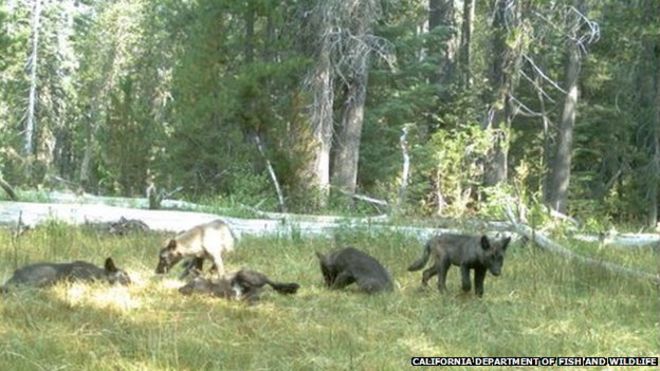
A pack of wolves has been spotted in Northern California for the first time in nearly 100 years.

The appearance of the five grey wolf pups and two adults could signal a return of the animals, which have not been found in the state since 1924.

California Department of Fish and Wildlife first discovered the pack this month in Siskiyou County near the Oregon border using a remote camera.

The wolves have been named the "Shasta Pack" after a nearby mountain.

"This news is exciting for California," Charlton Bonham of the California Department of Fish and Wildlife said on Thursday. "We knew wolves would eventually return home to the state and it appears now is the time."

State officials spotted a lone adult wolf earlier this year They believe the same wolf is associated with the newly spotted ones because of where it was photographed.

Another lone wolf made headlines in 2011 when the animal wandered into California from Oregon.

Friday, 5 October 2012

US Senator complains about wolf pack killing in his own state

Washington State eliminates wolf pack
September 2102. Washington State Senator Kevin Ranker, who is the chairman of the Washington State Senate committee that oversees The Department of Fish and Wildlife (WDFW), has issued a terse letter to the WDFW describing its recent decision to exterminate an entire wolf in Washington State as "a serious failure."

The Washington Department of Fish and Wildlife (WDFW) undertook the extermination of the pack of wolves in Northeast Washington and an agency marksman killed the pack's alpha male just south of the Canadian border. The alpha male wolf was shot from a helicopter; it was the last of the six of wolves from the Wedge Pack that were killed by the ‘Wildlife' Service, including the alpha female.

Ranker's letter outlines "deep concerns" over Fish and Wildlife's management of the Wedge Pack. He points out that state guidelines require ‘non-lethal methods of wolf management' be used first, something he said did not happen.


Read on: http://www.wildlifeextra.com/go/news/wedge-pack.html

Sunday, 8 July 2012

7th wolf pack confirmed in Washington State

Potentially 12 wolf packs now exist - More than 15 pairs will remove their protection
July 2012. The Washington Department of Fish and Wildlife (WDFW) has confirmed another wolf pack and a wolf attack on sheep in northeast Washington. Using remote video cameras, biologists documented at least five gray wolf pups this week in southern Stevens County, east of the town of Fruitland and north of the Spokane Indian Reservation. In reference to nearby Huckleberry Mountain, the pack has been named the Huckleberry pack. 

Potentially 12 packs

The new pack is Washington's seventh confirmed wolf pack, including the recently documented Nc'icn pack on the Colville Confederated Tribes reservation. An additional five packs are also suspected in the state.


Sheep kill
At about the same time the new wolf pack was documented, WDFW investigated an attack on domestic sheep in northwestern Spokane County, near Nine Mile Falls. Based on evidence at the scene, including wolf tracks and the trauma to the carcass, state wildlife officials confirmed that the attack was from a wolf. WDFW officials are working with the livestock producer on compensation for the sheep.
Wolf management plan
Washington's new wolf management plan, adopted last December, includes provisions to compensate ranchers who lose livestock to wolf predation, said Steve Pozzanghera, a regional WDFW director and wolf policy lead. In confirmed wolf depredation cases, livestock owners can be compensated for the full market value of lost animals.
"The primary goal of the new management plan is to protect gray wolves as they naturally re-establish themselves in Washington," Pozzanghera said. "But the plan also provides for compensation when landowners lose livestock to wolf depredation."
Listed as endangered
Wolves are currently listed by the state as endangered throughout Washington. The species remains federally listed as endangered in the western two-thirds of the state. The state's management plan calls for removing listed status protection for gray wolves when a total of 15 successful breeding pairs are sustained in three defined areas of the state for three consecutive years. The state can also delist wolves if a total of 18 successful breeding pairs are confirmed in those areas at any point in time.

Sunday, 7 August 2011

Washington’s fifth wolf pack confirmed

Another breeding population established

August 2011: Washington's fifth gray wolf pack has been confirmed in northeast Stevens County.

Washington Department of Fish and Wildlife (WDFW) biologists caught, tagged and then released a two-month-old wolf pup from the pack. Biologists have since been trying to capture one of the pack's breeding adult wolves to radio-collar it for monitoring. The effort to document the pack began after local ranchers reported observing three wolf pups and hearing howling in late June.

The pack is believed to include a breeding-age male and female and at least three pups. The group has been named the Smackout Pack, in reference to geographic features in the area.

'Wolves are re-establishing here on their own'
The Lookout Pack, confirmed in Okanogan and Chelan counties in 2008, was Washington's first documented resident gray wolf pack since a breeding population of wolves was extirpated from the state in the Thirties. Two more packs have been documented in Pend Oreille County - the Diamond Pack was confirmed in 2009 and the Salmo Pack a year later.

Just a couple of months ago, the state's fourth documented pack - dubbed the Teanaway Pack - was confirmed in Kittitas County. DNA analysis of that pack's adult female wolf indicated she is probably a recent descendant of the Lookout Pack.

The gray wolf is protected throughout Washington as a state endangered species. In the western two-thirds of Washington, the species is also federally protected under the Endangered Species Act (ESA), making it illegal to harm or harass them.

‘Wolves are re-establishing here on their own,' said Nate Pamplin, who heads WDFW's Wildlife Programme. ‘The confirmation of additional breeding wolf packs moves us closer to achieving a sustainable population, and also highlights the need to finalise a state wolf plan that sets recovery targets and management tools to address livestock and ungulate conflicts.'

http://www.wildlifeextra.com/go/news/wolves-washington.html
Related Posts with Thumbnails

ShareThis