Showing posts with label wolverine. Show all posts

Sunday, 17 June 2018

This Wily Wolverine Threw Scientists for a Loop


By Martin Robards and Tom Glass, Wildlife Conservation Society | June 8, 2018 07:39am ET

We were not expecting a familiar face as we cracked open the wooden box trap we'd carefully set on the remote north slope of Alaska. But there he was: a wolverine staring back at us, his face covered with the shredded remains of frozen caribou.

As conservationists in Beringia — an (at least historically) icy patch of land and sea that straddles the United States, Canada and Russia, hugging the Bering and Chukchi seas — we have spent a fair share of time considering this elusive carnivore, the wolverine (Gulo gulo).
The stout, canny predator, sometimes scavenger, can grow to be about 45 lbs. (20 kilograms) and is built to withstand the challenging, subzero-degree environment of the Arctic. With feet large enough to act like snowshoes, strong musculature and a honed set of teeth and claws, wolverines can take down an animal as large as a caribou in the middle of winter, but they'll also hunt small rodents, such as ground squirrels, when they're looking for a tasty morsel. Their thick, frost-shedding fur helps them survive at temperatures that, in the twilight of winter, can drop below minus 50 degrees Fahrenheit (minus 45 degrees Celsius). [Camera Trapped: Elusive Wildlife Caught in Photos]

Freezing temperatures are no match for the wolverine. These furry beasts will travel wide swaths of territory to find a mate or secure a meal. If they want to save a meal for later, wolverines have been known to cache it in the snow like a hidden trove of TV dinners. 

This particular wolverine staring back at us, however, recently threw us a curve ball: He had traveled great distances in order to enjoy a free meal from our box trap and, as a result, found himself caught in the name of science until we found and released him back into the wild.
To be clear, wolverines are generally thought of as reclusive animals, whose meals often consist of a carcass left behind by another predator. For our research, we use the scent of meat to lure and then trap them in a wooden box. Despite being safe, the trapped wolverines usually appear resigned at best and seem to avoid our traps once they're released. But this wolverine was different, having clearly thrown convention to the wind.  


Tuesday, 17 May 2016

'Killed this here critter': outrage after US rancher shoots rare wolverine

A North Dakota rancher shot and killed the first wolverine documented in the state for more than 150 years, allegedly saying it was a threat to his cows

Sam Levin in San Francisco

Friday 13 May 201621.20 BSTLast modified on Friday 13 May 201622.59 BST

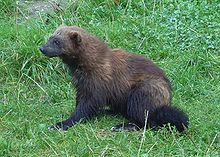
Gulo gulo 2.jpgA North Dakota rancher fatally shot the first wolverine documented in the state in more than 150 years, outraging wildlife advocates across the US who said the killing was cruel and unnecessary.

The rancher, who allegedly posted photos of the dead wolverine on Facebook, with the caption “killed this here critter out tormenting the cows”, was justified in shooting the animal, according to state wildlife officials, who said the wolverine had traveled in numerous states in the west.

“If there’s a situation where their livestock or property is in danger, they have the ability to take out the animal,” said Greg Link, chief of conservation and communication with the North Dakota game and fish department. “The statute says you can protect your personal property.”

Link said the state investigated the shooting, which happened last month but spread on social media this week, and determined that the killing complied with state laws.

Wildlife officials had originally placed a transmitter on the wolverine, identified as M-56, when the animal was located south of Yellowstone National Park in Wyoming in 2008, according to Link. The wolverine, a male who was eight or nine years old, was healthy when he was killed and had also previously traveled to Colorado, he said.

Because wolverines are not classified as endangered or threatened, ranchers are free under state law to kill them if they are a threat.

Even though federal officials believe the wolverine is not in danger of extinction in the “foreseeable future”, sightings of the species in North Dakota are unheard of. Link said the last formal documentation of a wolverine in the state was in the 1850s.

Ray Rafiti, a wildlife photographer based in Fort Collins, Colorado, said he took photos of M-56 when he spotted him in 2009 in Rocky Mountain National Park.

“After a couple weeks of wandering across Wyoming [the wolverine] found his way to Colorado,” Rafiti wrote on his Wild Faces Wild Places Photography Facebook page this week, after learning of the killing. “On that evening he walked right in our laps. I was fortunate to capture several photographs before he ran up the hillside and out of sight.”

Wednesday, 9 July 2014

Feds doubt climate change's impact on wolverines

By MATTHEW BROWN15 hours ago

BILLINGS, Mont. (AP) — A top federal wildlife official said there's too much uncertainty about climate change to prove it threatens the snow-loving wolverine — overruling agency scientists who warned of impending habitat loss for the "mountain devil."


There's no doubt the high-elevation range of wolverines is getting warmer, U.S. Fish and Wildlife Service Regional Director Noreen Walsh said. But any assumption about how that will change snowfall patterns is "speculation," she said.

Friday, 4 July 2014

Rare wolverine caught on camera in the US state of Utah

One of the camera trap images of the elusive wolverine

Wildlife biologists recently scanning photographs taken by a trail camera in the Uinta Mountains last winter, saw something never before captured in Utah: the first official photographs of a wolverine.

Kim Hersey, Mammals Conservation Coordinator for the Utah Division of Wildlife Resources (DWR), says biologists from the DWR and the US Forest Service set four stations — baited with road kill and monitored by trail cameras — along the north slope of the Uinta Mountains to capture images of any elusive forest-dwelling carnivores.

Having retrieved the cameras and viewed the hundreds of photos they came across their prize: the first wolverine verified in Utah since a wolverine carcass was found in 1979.

Wolverines are the largest terrestrial member of the weasel family.

Tuesday, 17 July 2012

Climate Change Could Melt Wolverines' Snowy 'Refrigerators'


Wolverines, bearlike members of the weasel family, seem to depend on spring snow cover, but it's not clear why.

Now, an international group of researchers has a new theory: Wolverines use snow like a refrigerator to preserve food during the lean, cold times after their young are born, they suggest.  

The animals live in the northern parts of North America, Asia and Europe where resources can be scarce. Their vulnerability to warming landed them as a "candidate for protection" in 2010 under the U.S. Endangered Species Act. As such, ever year the U.S. Fish and Wildlife Service will review the wolverines' status and work with others to implement voluntary measures.

After reviewing previous work on wolverine reproduction and food availability, the research team concluded that the wolverines live only within a "refrigeration zone," where spring snow and cold allow them to store the food they scavenge or kill. This strategy keeps insects, bacteria and other scavengers from consuming it.


Wolverines eat everything from moose and mountain goats to ground squirrels, birds' eggs and berries.


Continued:  http://www.livescience.com/21590-wolverines-refrigerators-climate.html


Tuesday, 6 March 2012

Wolverine caught on photo trap in Montana

Photos will help ID individual animals
February 2012. A baby bear on stilts, perhaps? No. Conservationists with the  Wildlife Conservation Society have released this camera-trap photo of a wolverine retrieving bait placed in a tree in Montana.
Unique markings
The frame upon which the animal climbs is designed so that the unique markings on the underside of the wolverine are revealed to the motion-sensing camera. Scientists use these markings to identify individual animals and document their distribution and range. WCS's eight-year study of wolverines in the Greater Yellowstone Ecosystem has led to a better understanding of wolverine ecology and will help inform conservation strategies so that this rare species can survive despite the 21st century conservation challenges it faces.
Just 250-300 in the Lower 48 States
An estimated 250-300 wolverines remain in the "lower 48," where they occupy about half of their former range in high alpine peaks of the western United States.

Wednesday, 14 December 2011

The wolverines that float on snow

Eight-year tracking programme reveals more about mysterious species

December 2011: Born during February in snow-caves at 9,000 feet on the north slope of craggy peaks in the Rocky Mountains, Yellowstone's wolverines are tough.

Now experts at the Wildlife Conservation Society (WCS) are revealing more about this mysterious and awe-inspiring species.

Eight years of capturing and radio-tracking the elusive wolverine revealed that adults live year-round in the high mountains, near the alpine tree-line, and inhabit some of the west's most remote and rugged terrain. Amazingly, the home range of an individual male can more than 500 square miles.

The winter endurance athletes of the animal world
‘Not only do they use an area even larger than a grizzly bear does,' said Kurt Alt, a coauthor with Montana Department of Fish, Wildlife and Parks, ‘they cover their territory on a fairly regular basis to scent mark it and defend it from other wolverines.'

The wolverine's capability for movement is stunning. Their large feet allow them to float on top of deep snow, and they were documented making winter traverses from one side of the massive Teton Range in Wyoming to the other in just a few hours.

‘They are the winter endurance athletes of the animal world,' said Steve Cain of the National Park Service. ‘We were impressed by their constant movements across large areas of snow-covered and incredibly rugged terrain.'

But covering this terrain comes with its risks, as two of the radio-collared wolverines were killed in avalanches.

One wolverine travelled more than 500 miles
Another wolverine travelled more than 500 miles from near Grand Teton National Park in northwest Wyoming to Rocky Mountain National Park in Colorado. This was the first documented wolverine in Colorado in almost a century. Other young wolverines regularly moved 100 miles or more searching for their own territory.

While bears are hibernating and most ungulates and their predators have moved to low elevation wintering ranges, the wolverine patrols a vast, frozen territory, looking for scraps of meat that they cache under boulders and snow.'

‘We learned that wolverines are adapted to eke out a living in very harsh conditions,' said Robert Inman, conservationist for the WCS. ‘As a result, they naturally exist in low numbers and reproduce slowly.'

The wolverine's reputation as a fierce competitor was also affirmed during the study. One individual challenged a bear probably ten times his size over an elk carcass.


http://www.wildlifeextra.com/go/news/wolverine-yellowstone.html

Monday, 24 October 2011

Island wolverine 'may still be around' (via Chad Arment)

Somewhere in the mountainous wilds of Vancouver Island there may be a few remaining wolverines belonging to a unique sub-species, a leading wildlife biologist believes.

Officially, the gulo gulo Vancouverensis - defined as the gluttonous glutton wolverine from Vancouver Island - almost disappeared in the 1960s and the last known sighting was in 1992, leading scientists to believe the species had been extirpated from the Island.

"But there may still be some around," said Montanabased Doug Chadwick, a National Geographic explorer and author of The Wolverine Way, who, hosted by the Sierra Club of B.C, was due to give a talk and slideshow Tuesday night at Fernwood Community Association.

Chadwick knows how elusive wolverines can be, despite their ferocious reputation, which is why no one knows how many remain in the U.S and Canada. For decades the animals were trapped, poisoned and shot without governments keeping count and now it is believed wolverines could be endangered.
It is not even known whether the Vancouver Island group is a true sub-species, said Chadwick, who is hoping someone has a few pelts stuffed away in their basement which could provide enough DNA for testing.

"Today we would be able to do genetic testing to give a much surer sense of the difference," he said.
After studying wolverines in Glacier National Park, Montana, where the animals often cross the border to B.C.'s Flathead River Valley, Chadwick is convinced that much of their fearsome reputation is a bad rap. "They are seen as Tasmanian devils on crack. They are if you corner them or are competing for a carcass," he said.

Although wolverines will take on grizzly bears or wolves, there is no record of attacks on humans, he said. But, there is no doubt wolverines have a bad-ass attitude, Chadwick said. "They are designed to intimidate so they can compete with grizzly bears," he said.


Read more: http://www.timescolonist.com/technology/Island+wolverine+still+around/5572593/story.html#ixzz1bhOcNHdZ


By Judith Lavoie, Times Colonist
http://www.timescolonist.com/technology/Island+wolverine+still+around/5572593/story.html

Sunday, 21 March 2010

Michigan's lone wild wolverine found dead

March 15. 2010 6:42PM
Karen Bouffard / Detroit News Lansing Bureau

Michigan's only known wild wolverine was found dead in a Sanilac County bog Saturday, according to state Department of Natural Resources and Environment officials.

The female wolverine, which was found in the Minden City State Game Area where it was discovered six years ago, is believed to have died of natural causes, spokeswoman Mary Dettloff said.

The brown furry mammal was spotted alive in late January by Deckerville High School teacher Jeff Ford, who was retrieving photos from a trail camera he'd mounted in the game area hoping for just such a shot.


"She came within 20 yards and circled around me," Ford said of the 28-pound creature. "Her claws were about an inch long and attached to a foot that's about the same size as a human hand.

"I was trying to stay still and be quiet but I was having a hard time because I was breathing heavily and shaking. When she got downwind of me she stopped ... and I got out of there as quick as I could."

It's been centuries since wolverines last made their home in the state, and DNR officials suspect this one may have been imported and released into the wild.

"The last one in Michigan in the wild was probably 200 years ago," Dettloff said. "We've long suspected that someone probably released it here. They do have them in Canada."

The animal's body was discovered by hikers. A necropsy will be performed at a DNRE lab at Michigan State University to confirm the cause of death, Dettloff said. The department plans to preserve the body for display at the Bay City State Game Area.

While Michigan's unofficial nickname is the "Wolverine State," historians aren't sure whether the animal ever inhabited Michigan.

According to the DNR's Web site, evidence shows if wolverines ever lived in Michigan, they would have been rare. The department offers theories for how the name was coined.

Some historians believe Ohioans came up with it as an insult around 1835. Apparently they believed Michiganians were as vicious and bloodthirsty as wolverines.

Another theory is the nickname was bestowed by Native Americans during the 1830s, for equally unpleasant reasons. According to that story, native tribesmen likened settlers' seizure of their lands to the gluttony of wolverines devouring their prey.

From The Detroit News: http://www.detnews.com/article/20100315/METRO/3150409/1361/Michigan-s-lone-wild-wolverine-found-dead#ixzz0ipZI6xZy
(Submitted by Chad Arment)

Thursday, 4 February 2010

Climate change causes wolverine decline across Canada

Wednesday, 3 February 2010

By Matt Walker
Editor, Earth News

The wolverine, a predator renowned for its strength and tenacious character, may be slowly melting away along with the snowpack upon which it lives.

Research shows wolverine numbers are falling across North America. Their decline has been linked to less snow settling as a result of climate change.

The study is the first to show a decline in the abundance of any land species due to vanishing snowpack.

Details of the wolverine's decline are published in Population Ecology.

The wolverine lives in boreal forest across Scandinavia, northern Russia, northern China, Mongolia and North America, where it ranges mostly across six provinces or territories of western Canada.

This largest member of the weasel family eats carrion and food it hunts itself, including hares, marmots, smaller rodents and young or weakened ungulates.

It has evolved for life on the snowpack, having thick fur and outsized feet that help it move across and hunt on snow.

Striking trend

Wildlife biologist Dr Jedediah Brodie of the University of Montana, in Missoula, US, wondered how climate change might be having an impact on snowpack levels, and on the animals that depend on it.

He had previously researched how declining levels of snow in the US Yellowstone National Park, caused by climate change, was changing the abundance of aspen trees and how elk feed on them.

Dr Brodie and his colleague, Professor Eric Post of Pennsylvania State University, at University Park, US, gathered data on snowpack levels across six provinces or territories of Canada: Alberta, British Columbia, Manitoba, the Northwest Territories, Saskatchewan and the Yukon Territory.

In all bar the Yukon, he found that snowpack depth declined significantly between 1968 and 2004.

Other studies have shown corresponding rising temperatures and declining precipitation across much of the western US.

"It occurred to me that a good first place to look for ecological impacts of that snowpack decline would be with a snow-adapted species like the wolverine," Dr Brodie told the BBC.

"Fortuitously, Canada has good records of both snowpack trends over time as well as trends in the harvest of all sorts of fur-bearing animals."

So Dr Brodie and Professor Post examined the records of wolverine numbers caught by fur trappers over the same period.

They found a striking correlation between declining snowpack and falling numbers of the predator.

"In provinces where winter snowpack levels are declining fastest, wolverine populations tend to be declining most rapidly," the researchers wrote in the journal article.

"Spring snowpack also appears to influence wolverine population dynamics."

The researchers found only one territory, the Northwest Territories, where wolverine numbers are increasing. There, snowpack levels are declining but they remain much higher and less variable than in most other provinces.

Food scarcity

Dr Brodie cannot be sure why wolverine numbers are falling, but he has his suspicions.

"Recent work shows that wolverines appear to use areas with deep snowpack for dispersal. So reduced snowpack could make dispersal more difficult or dangerous, potentially reducing the success rate with which individuals can establish new home ranges," he says.

"Reduced snowpack may also make it harder for wolverines to get food, for several reasons.

"First, harsh winters and deep snow are major causes of mortality for ungulates like elk, moose, deer and caribou.

"If milder winters mean that fewer of these animals die over the course of the winter, then there will be fewer carcasses for wolverines to feed on," he explains.

"Wolverines also hunt rodents, and this food source may be important for wolverine reproductive success in some areas.

"But shallower snowpack is bad for a lot of rodents because it provides less insulation from the cold.

"So if declining snowpack reduces rodent abundance, that could be bad for wolverines."

Dr Brodie believes that his is the first study to show a decline in species abundance due to a reducing snowpack - for any land animal, not just those in North America.

But he says there are interesting parallels in marine systems.

"For example, sea ice is critical for polar bear foraging."

Polar bear body condition, reproductive rates, and survival have declined significantly in Hudson Bay as sea ice breaks up earlier in the spring, he says.

"At the other end of the globe, Antarctic sea ice has increased over recent decades.

"This may have negative impacts on adelie penguin populations that depend on ice-free areas for breeding and foraging.

"But we don't have to just sit back and watch climate change drive animals extinct," he says.

"As climate change worsens, we should reduce trapping levels and also disturbance to boreal forest habitats.

"Reducing the impact of these anthropogenic stressors could help 'offset' the impacts of climate change on wolverines."

http://news.bbc.co.uk/earth/hi/earth_news/newsid_8494000/8494397.stm
(Submitted by Lindsay Selby)
Related Posts with Thumbnails

ShareThis