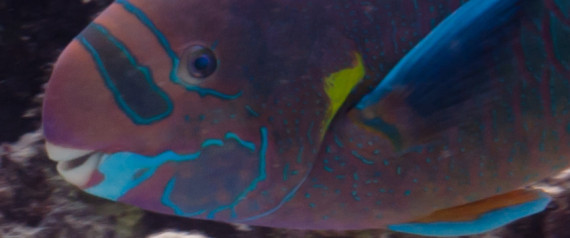
Showing posts with label parrotfish. Show all posts

Monday, 30 January 2017

Study finds parrotfish are critical to coral reef health

January 23, 2017

An analysis of fossilized parrotfish teeth and sea urchin spines by researchers at Scripps Institution of Oceanography at the University of California San Diego showed that when there are more algae-eating fish on a reef, it grows faster.

In the new study, published in the Jan. 23 issue of the journal Nature Communications, Scripps researchers Katie Cramer and Richard Norris developed a 3,000-year record of the abundance of parrotfish and urchins on reefs from the Caribbean side of Panama to help unravel the cause of the alarming modern-day shift from coral- to algae-dominated reefs occurring across the Caribbean.

"Our reconstruction of past and present reefs from fossils demonstrates that when overfishing wipes out parrotfish, reef health declines," said Cramer, a postdoctoral researcher at Scripps and lead author of the study.

Algae-eating parrotfish, like other herbivorous reef fish, play an important role in coral reef ecosystems by removing the algae that compete with corals. According to the study, the decline in herbivorous fish such as parrotfish over the last several decades from fishing is considered a main factor in the shift to more algae-dominated reefs in the Caribbean.

The Scripps researchers examined the amount and composition of fish, coral, and urchin fossils in 3 to 5-meter (10 to 33-feet) long sediment cores from three reef sites offshore of Bocas del Toro, Panama to understand the natural state of the reefs before humans began intensive fishing and land clearing, and to assess the role of these activities in recent reef declines. The analysis was aimed at determining if coral growth rates are affected by change in the population levels of parrotfish or urchins that eat algae.

Read more at: 

Friday, 4 July 2014

Corals need more parrotfish to survive

A decline in parrotfish and sea urchin numbers is a bigger cause of Caribbean coral loss than global warming, a new report suggests, and by increasing these populations the reefs have a chance of recovery.

The corals have declined by more than 50 per cent since the 1970s and only about one-sixth of their original coral cover remain.

These species are the area’s two main grazers and the loss of them breaks the delicate eco-balance of corals and allows algae, on which they feed, to smother the reefs.

“The rate at which the Caribbean corals have been declining is truly alarming,” says Carl Gustaf Lundin, Director of IUCN’s Global Marine and Polar Programme.

“But this study brings some very encouraging news: the fate of Caribbean corals is not beyond our control and there are some very concrete steps that we can take to help them recover.”

Tuesday, 1 April 2014

Hawaii's White Sand Beaches Are Made From Parrotfish Poop

Posted: 03/29/2014 4:32 am EDT Updated: 03/29/2014 4:59 am EDT


There are seven quintillion, five hundred quadrillion grains of sand in the world, according to math geniuses at the University of Hawaii. That’s more sand granules in Earth’s seas, lakes, and deserts than there are stars in the universe.

Where does it all come from? In Hawaii, where beaches are constantly ranked thebest in the world, a significant portion of that pristine, white, beautiful sand is actually poop.

Yep, poop.

Parrotfishes, or uhu in Hawaiian, are key players in regulating algae and reef life. Their parrot-like beaks and fused-together teeth are used for scraping and biting dead coral, while additional teeth in their throats help to break it all down into sand. Snorkelers can actually hear them chomping or see the bite marks they leave on rocks.

Friday, 1 November 2013

Young parrotfish explore, while adults stay at home

Young parrotfish rapidly expand their coral reef home range but only until they reach adulthood, scientists have found.

Researchers in Australia mapped the movements of individuals from very young juveniles to mature adults.

They found that small parrotfish quickly expanded their range as soon as they settled on a reef.

This expansion stopped when the fish matured, and their final home range was unrelated to adult body size.

The results are published in the journal Proceedings of the Royal Society B.

Most animals move within a home range; the size of which is driven by avoiding predators, finding food and reproducing.

"In many studies which look at coral reef fish movements, we see a significant relationship reported between body size and home range," explained lead researcher Justin Welsh from James Cook University, Australia.

The team identified 75 individual fish by size, colour markings and scars from three species of parrotfish.

Thursday, 14 June 2012

Violent Head-Butting Discovered in Giant Reef Fish


Scientists diving in the North Pacific were jarred when they heard mysterious sounds like spear guns being fired. The jolting noises turned out to be never-before-seen (or heard) head-butting bouts between some of the largest coral-reef fish, called parrotfish.

As they studied groups of the giant bumphead parrotfish (Bolbometopon muricatum), which can reach 4 feet (1.3 meters) long and 100 pounds (46 kg), the researchers were able to document the violent behavior with video and images.

The reef fish are named for their bulbous foreheads, which add to their eccentric, pouty lips and yellowish-to-pink faces. 

Related Posts with Thumbnails

ShareThis