
Press release from Orokonui Ecosanctuary and the University of Otago
15 December 2016
Modest
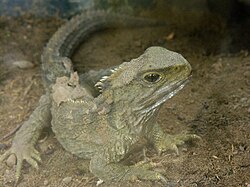
tuatara numbers will be boosted at Orokonui Ecosanctuary with the
release of 17 juvenile tuatara this Thursday, 15 December.
The
young tuatara, aged 3-4 years, have been reared at the University of
Otago. They join the population at Orokonui that was founded in 2012
when 87 adult and juvenile tuatara were released.
The
tuatara have their genetic origins in the population on Stephens Island
(Takapourewa) in Cook Strait, where they are recognised as a taonga and
under the kaitiakitanga (guardianship) of Ngāti Koata iwi.
Kāti
Huirapa Rūnaka ki Puketeraki will be present, alongside Ecosanctuary
staff, Department of Conservation staff and others to warm their arrival
and support any ceremonial duties.
Support
for the release of more tuatara at Orokonui was made possible following
positive results of monitoring last summer led by research assistant
Scott Jarvie and Associate Professor Alison Cree of the University’s
Department of Zoology.
“We
recaptured more than half of the tuatara that had been released about
three years earlier and they appeared healthy and well,” said Jarvie.
“We
are delighted to be able to provide a home for these additional
tuatara” said Chris Baillie, general manager of the ecosanctuary.
Orokonui
is the only fenced ecosanctuary in the South Island where tuatara roam
freely in the absence of predatory mammals such as cats and stoats.
Until a few hundred years ago tuatara lived throughout much of the
eastern South Island, but quickly disappeared following the arrival of
humans and other land mammals.
“We
see the establishment of a tuatara population at Orokonui as part of
our commitment to help tuatara survive the challenges of climate change”
says Associate Professor Cree. “Cooler, southern locations are likely
to become increasingly important to tuatara as sea levels rise and
conditions become hotter and perhaps drier on some northern islands.”
Members
of the public who see free-roaming tuatara in the ecosanctuary are
encouraged to take good-quality photographs without disturbing the
reptiles and to show these to Orokonui staff or University researchers.
Idiosyncracies of the spines or other body markings may enable
individual tuatara to be identified.
Background information
Tuatara, known to scientists as Sphenodon punctatus,
are the world’s only surviving rhynchocephalian reptiles.
Rhynchocephalians or beak-headed reptiles were common about 200 million
years ago. Tuatara are the closest living relatives of lizards and
snakes, although their common ancestry is distant in time.
Like
many other New Zealand reptiles, tuatara have “slow” life histories.
Their eggs take about a year or more to incubate in the ground,
hatchlings take about 15 years to reach maturity and females typically
produce only about nine eggs every 2-5 years. The life span of a wild
tuatara can reach about a hundred years.
Tuatara
once lived on the North and South Islands, but became extinct there and
on many offshore islands following the arrival of humans. Today they
survive naturally on about 32 islands in Cook Strait and off the North
Island coast. Since 1995, tuatara have been reintroduced to at least
nine islands and four North Island sanctuaries, in addition to Orokonui.




 Posts
Posts


