Showing posts with label porpoise. Show all posts

Monday, 17 October 2016

Dolphin pictured killing porpoise by flipping it into air


 11 October 2016


A bottlenose dolphin has been pictured flipping a porpoise into the air in a deadly attack. The rarely seen event was witnessed by gig rowers in Newlyn Harbour in Cornwall.

Dolphin attacks on porpoises accounted for about one death a year on average, said Cornwall Wildlife Trust (CWT).

It is unclear why dolphins attack porpoises but it could be an aggressive response to feeding competition or even "misdirected sexual aggression".

Image copyright Lizzie Warner Image caption No-one is quite sure why dolphins attack porpoises but it could be an aggressive response to feeding competition 

The pictures were captured by the Pendeen Pilot Gig Club in a training session.

CWT said: "We are unsure of why this happens and it is certainly not predation.

"Many theories have been put forward, including misdirected infanticide (bottlenoses will kill calves), misdirected sexual aggression or play behaviour and an aggressive response to feed competition are just some."

Marine Strandings Network said it found the carcass of the porpoise, which had "multiple severe injuries as a result of the attack".

"We do have a number of dead porpoise, and more unusually common dolphin, reported to us with injuries resulting from bottlenose dolphin aggression."

Tuesday, 17 May 2016

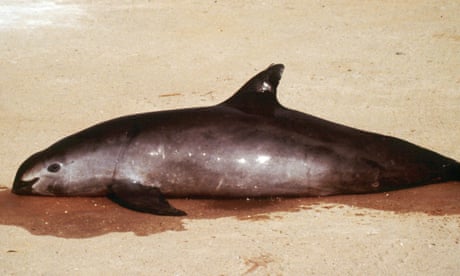
World's smallest porpoise 'at the edge of extinction' as illegal gillnets take toll

Now only 60 of Mexico’s vaquita marina left despite the navy enforcing a ban on the fishing net, latest study shows

Agence France-Presse

Saturday 14 May 201605.48 BST

Environmentalists warned on Friday that Mexico’s vaquita marina, the world’s smallest porpoise, was close to extinction as the government reported that only 60 were now left.

The population has dramatically dropped despite the arrival of navy reinforcements in the upper Gulf of California in April 2015 to enforce a ban on fishing gillnets blamed for the vaquita’s death.

The porpoise’s population had already fallen to fewer than 100 in 2014, down from 200 in 2012, according to the International Committee for the Recovery of the Vaquita (CIRVA), a global group of scientists.

Mexico’s environment ministry said in a statement a joint study with CIRVA between September and December estimated the latest population at “around 60”.

“The vaquita is at the edge of extinction,” the World Wildlife Fund said in a statement, warning that 20% more have probably died in nets since January.

The vaquita’s fate has been linked to another critically endangered sea creature, the totoaba, a fish that has been illegally caught for its swim bladder, which is dried and sold on the black market in China.

Poachers use illegal gillnets to catch the totoaba and the vaquita, a shy 1.5-metre-long (5ft) cetacean with dark rings around the eyes, is believed to be the victim of bycatch.

President Enrique Peña Nieto imposed a two-year ban on gillnets in April 2015 and increased the vaquita protection area tenfold to 13,000 square kilometres (5,000 square miles).

He deployed a navy patrol ship with a helipad, a dozen high-speed boats and two planes to enforce the prohibition.

Environment minister Rafael Pacchiano said three vaquitas had been found dead and that protective measures needed to be reinforced, but federal authorities are convinced the vaquita can still be saved.

He urged the local population to report illegal activities.

Friday, 5 April 2013

Fishermen help clear lobster 'carnage' on east coast


Wednesday, April 03, 2013
By Danny Longhorn

A TEAM of 25 fishermen has come to the rescue of about 450 lobsters washed up on an east coast beach.

East Yorkshire's coastal wildlife has taken a battering with the cold temperatures and strong easterly winds.

Thousands of shellfish, fish and even a porpoise were found washed up along a one-mile stretch between Barmston and Fraisthorpe – the majority of which had starved to death.
RSPB volunteers have also picked up 200 dead puffins in the last ten days and now fear the population could have decreased by 10 per cent.

Jo Ackes, secretary at the Independent Shell Fishermens' Cooperative in Bridlington, said more than 25 fishermen tried to save as many of the shellfish as possible.

She said: "It was carnage on the beach with thousands of different animals.

"There was everything from a variety of fish and crabs, lobsters and even seabirds and a porpoise.

"We tried to save as many as possible and take them to our tanks. It was mainly some of the lobsters that had survived as they are a bit stronger.

"The reason (for them being there) was a combination of factors with the sea being unseasonably cold and the lobsters being quite lethargic and not getting enough food. They have also been battered by the easterly winds and huge tides."

In the end, about 450 lobsters were released off the coast yesterday morning about six miles out to sea.

Jo said: "It is difficult to say what impact it will have.

Related Posts with Thumbnails

ShareThis