Showing posts with label rare colouration. Show all posts

Friday, 28 February 2020

Rare pink manta ray caught courting lady friend Down Under


The manta ray is named after Inspector Clouseau from "The Pink Panther" movies.

Photos of a bright pink manta ray have gone viral after the Pepto-Bismol-colored creature was spotted swimming near Australia’s Great Barrier Reef.

Photographer Kristian Laine, who snapped the photos while was freediving near Lady Elliot Island, initially thought that his camera was broken, National Geographic reported. Later, Laine learned that he had laid eyes on what may be the world's only pink manta ray — a fish comically named Inspector Clouseau, after the klutzy detective in the "The Pink Panther" movies.

Despite his stunning hue, the inspector has been seen fewer than 10 times since he was first spotted in 2015, National Geographic reported. (You can see a 2015 video of the inspector on The Guardian.)


Thursday, 6 October 2016

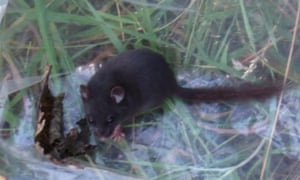
Black dormouse discovered in the UK for the first time


Rare find in Blackdown Hills in Somerset hailed as ‘fantastic’ at a time when Britain’s population of dormice is under threat
 
Photograph: Natural Futures


Steven Morris

Monday 3 October 2016 17.22 BST Last modified on Monday 3 October 2016 17.23 BST

The first black dormouse ever recorded in the UK has taken up residence in a nest box in the Blackdown Hills of Somerset.

Britain has only one native species of dormouse, the hazel dormouse. The one discovered in Somerset is a hazel dormouse but instead of having the normal golden-brown fur it is black.

A handful of black hazel dormice were found in Germany in the 1970s and two more in 2015 but it appears the Somerset specimen is a British first.

The discovery was made when staff, trainees and volunteers from the Blackdown Hills Natural Futures project were checking dormouse nest boxes as part of the national dormouse monitoring programme.

This year, the project provided 300 nest boxes and more than 60 volunteers have installed and regularly checked them. One was found to have the black specimen inside.

Conrad Barrowclough, the project officer, said: “Learning about and protecting our natural heritage is what we’re all about so finding such a rare dormouse on our doorstep is fantastic, especially at a time when Britain’s dormouse population is under threat.”

Read on and watch video

Sunday, 6 September 2015

An Arachnid Dracula? Rare, Red-Fanged Spider Is Uncovered

y Stephanie Pappas, Live Science Contributor | September 04, 2015 05:02pm ET

A one-of-a-kind spider from Down Under looks more like a Transylvania transplant than an Aussie, thanks to its red fangs.

The funnel-web spider (Atrax sutherlandi) does not actually vant to suck your blood, however. These shy spiders build their webs at the top of subterranean burrows and mostly eat insects. (Some species, though, do have venom dangerous to humans, and will defend themselves if they feel threatened. A. sutherlandi is venomous, but isn't known to have caused any fatalities in humans, according to theAustralian Environmental Pest Management Association.)

As a species, A. sutherlandi has been known for a long time. But when Mark Wong, an ecologist at Australian National University and the winner of a National Geographic Young Explorer grant, uncovered this one under a piece of fallen wood, he met with a surprise. [See Photos of the Blood Red-Fanged Spider]

Friday, 17 August 2012

Rare Ginger Mongoose Caught on Camera


A rare redheaded mongoose was recently captured in camera-trap photos in Indonesia. The animal, initially not recognized by local conservationists, looks like an oversized, orange-coated weasel and is believed to be a ginger version of the usually brown collared mongoose.

Flora & Fauna International (FFI) said the pictures were taken during a training session for community rangers in a wildlife reserve in Aceh, a province of Indonesia located on the northern tip of the island of Sumatra. FFI officials believe the animal belongs to the species Herpestes semitorquatus, a type of mongoose that has been recorded in Sumatra only occasionally and is noted as Data Deficient by International Union for Conservation of Nature (IUCN), meaning there is not enough information to determine its conservation status.

While this sighting was unusual, camera trap surveys in nearby Malaysian Borneo have yielded five independent photographic records of mongooses with a distinct reddish-orange pelt, reports a recent study in the Small Carnivore Conservation Journal.

Wednesday, 23 November 2011

'Electric' blue lobster finds new home at London Aquarium after being saved

A rare 'electric' blue lobster has been rescued from being sold to a hungry punter and will instead be put on display at the London Aquarium.

The deep-blue-coloured crustacean, which was caught by fishermen off the east coast of Scotland, was found by Rex Goldsmith on sale at Billingsgate market in London.
'It's the most striking blue lobster I have seen in my 30 years in the business and was too nice to put in a pot and boil,' said Goldsmith.

Shocked by the intense colour of the lobster, Rex decided to buy it and take it home with him to inform researchers at the National History Museum.

'I had a word with the seller and we both agreed on how nice it looked. He sold it to me for £10, which is the normal price for a lobster that size.'

The researchers believe the lobster gained its blue exterior because of a possible rare genetic alteration. Coming from a similar species of lobster to the homarus americanus of the US, the creature should have been born with a much darker blue exoskeleton.

This particular species of lobster is found in British waters as well as in Norway, the Mediterranean, Crete and Morocco.
Yet to be given a proper name, Mr Goldsmith's find will now be on display at the London Aquarium.

Read more: http://www.metro.co.uk/weird/881934-electric-blue-lobster-finds-new-home-at-london-aquarium-after-being-saved#ixzz1eWtqI0LL

Youppi, Rare Orange Lobster, Dies

MONTREAL - It wasn't boiling water but possibly a variation in temperature in his saltwater tank that wound up cooking Youpi, the celebrity lobster.

Plans are underway now to celebrate the short, mostly uneventful life of the sea creature whose beady, unblinking eyes warmed the hearts of Canadians, some of whom perhaps dreamed only of seeing him on their plate.

He earned minor national fame, grabbing news headlines for the genetic defect that turned him a bright orange — a one-in-10-million hue for a living lobster.

An afficionado of pretty much any shrimp that was fed to him, the three-pound Youpi became a truly heavenly lobster on Nov. 4.

"It could have been a variation in temperature" in his tank, said Guylaine Frechette, director of the nature centre that gave him a home. She added that the exact cause of his demise hasn't been determined.

But Youpi won't be forgotten.

He'll be celebrated in a year-long sendoff with the lobster laid out on display, allowing people to pay their respects — or just to learn something about lobsters.

Read more here ...

Friday, 22 July 2011

Not on the menu at Wegmans: rare yellow lobster

Employees of a Rochester-area Wegmans stumbled upon one of nature’s anomalies when sorting through seafood—a rare yellow lobster. How rare, you ask? It’s a one-in-30 million find!

Wegmans tweeted about the golden crustacean, noting that it was donated to the Aquarium of Niagara. According to the Pittsford store’s Facebook page, the lobster stood out from the other creatures in
Monday’s seafood shipment because of its unique hue. The average lobster usually sports a dark greenish brown color, but these yellow fellows are the result of a genetic mutation. An adorable genetic mutation!

It should be no surprise that Wegmans decided to donate the oddity to an aquarium. Just a few months back, Wegmans got a shout-out from Greenpeace for drastically improving the selection of sustainable seafood. Another big high-five for Weggies.

I’m particularly fond of this lobster—more so than other underwater insects!—because it’s the same color as my car. You’ll know it when you see it driving around Buffalo.

http://home.buffalo.com/grub-pub/blog/not-on-the-menu-at-wegmans-rare-yellow-lobster/
Related Posts with Thumbnails

ShareThis